
Why a Quieter Hurricane Season Still Raises Insurance Legal Risk
Despite El Niño's forecast of a below-average 2026 Atlantic hurricane season, legal exposure for insurers and policyholders remains elevated due to concentrated high-value landfalls, wind-versus-flood causation disputes, and recurring bad faith claims patterns. This article explains why a quiet season still demands rigorous legal preparation and which specific litigation risks to monitor.
- Jurisdiction
- US Federal
- Court
- Multiple
- AI tool named
- None
- Ruling date
- Jul 29, 2026
- Source document
- View primary court order ↗
- Last verified
- Jul 29, 2026
Lex Machina Review is an independent risk-tracking and reference resource. Nothing on this site is legal advice, and using it does not create an attorney-client relationship. Every record is reviewed against primary sources but may not reflect the most current status of a matter — always verify directly against the cited court order, rule text, or a licensed attorney before relying on it.
Companion explanation — secondary to the source document above
NOAA opened the 2026 Atlantic hurricane season with a forecast that sounds calming at first read: a 55% probability of below-normal activity, 8 to 14 named storms, 3 to 6 hurricanes, and 1 to 3 major hurricanes.[1] Colorado State University’s reduced estimate, reported alongside the NOAA outlook, put the season at 11 named storms and about 40% below average activity.[2] El Niño had officially arrived by June, with a 63% probability of reaching “very strong” intensity and a 97% chance of persisting through spring 2027.[3]
That is useful meteorology. It is not a litigation-risk discount.
The legal exposure in an El Niño hurricane season does not move in neat proportion to the storm count. Coverage disputes do not arise from seasonal averages; they arise from damaged buildings, exhausted adjusters, ambiguous loss sequencing, missed deadlines, reservation-of-rights letters, and expert reports written months after water, wind, debris removal, emergency repairs, and contractor invoices have blurred the record. For counsel tracking hurricane-season insurance risk in Q3 2026, the question is not whether the basin is quieter. It is whether one storm reaches the wrong coast at the wrong angle with enough value in its path to turn a quiet forecast into a claims-management test.
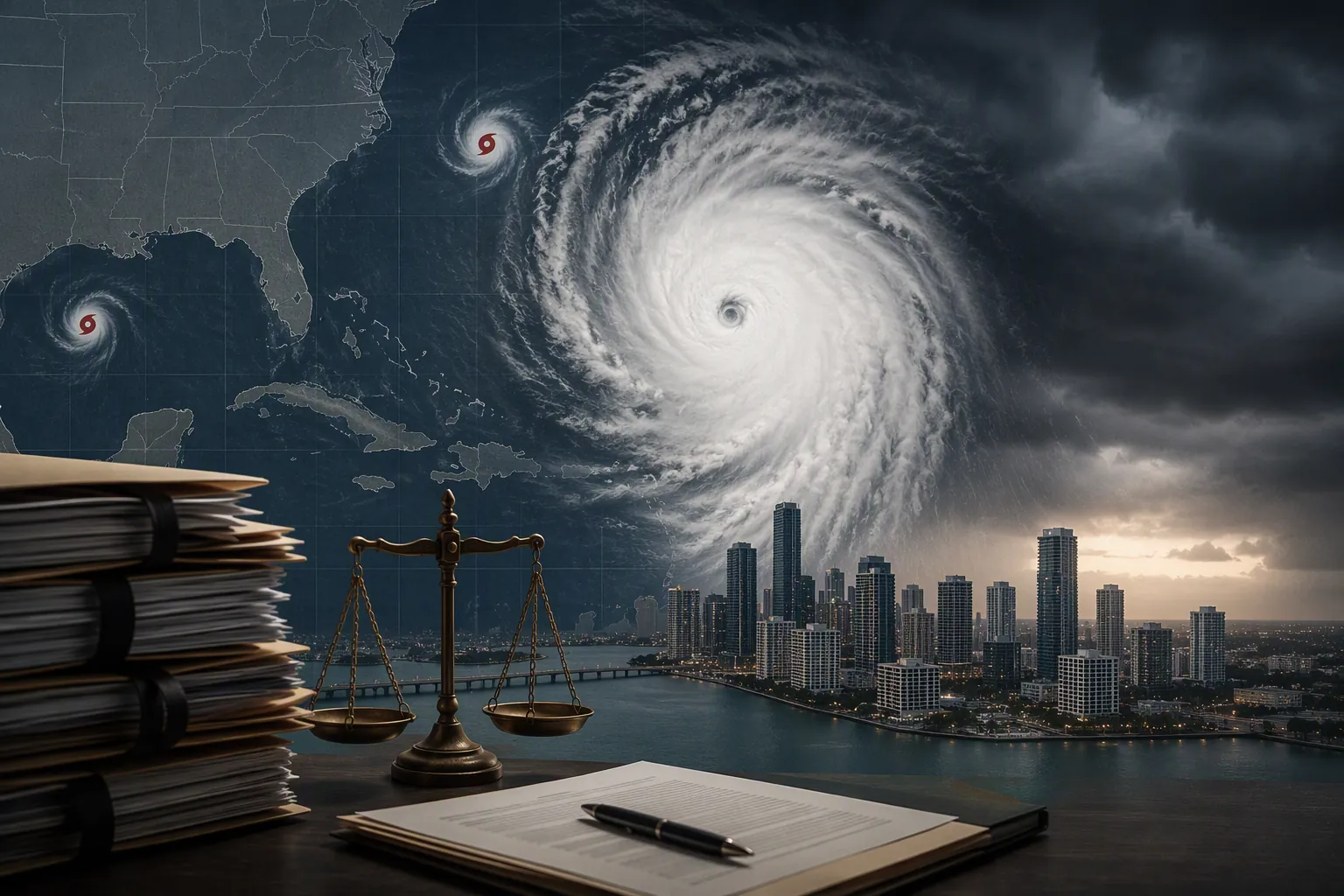
The Storm Count Is the Wrong Legal Metric
Seasonal forecasts help underwriters, emergency managers, and catastrophe modelers frame expected activity. They are much less helpful once a disputed claim file asks whether the roof failed before storm surge entered the first floor, whether ensuing rainwater damage is covered, whether a flood exclusion is triggered, or whether an anti-concurrent-cause clause changes the result. Those disputes turn on sequence, language, jurisdiction, and proof.
The single-landfall scenario is the uncomfortable center of the 2026 risk picture. Karen Clark & Company has estimated that a hurricane landfall in Miami, Tampa, or Houston could exceed $100 billion in insured losses.[4] Hurricane Andrew remains the obvious warning label: one catastrophic landfall can dominate an otherwise unremarkable season. Swiss Re Institute has put Andrew’s loss at about $100 billion in today’s dollars, and the point is not that 2026 is Andrew’s twin. It is that litigation follows where the loss lands, not how many named storms formed before or after it.[5]
That distinction matters more now because the value sitting on the coast has changed. Munich Re data cited in July 2026 reporting show average annual tropical cyclone economic losses rising from $11.4 billion in the 1980s to $109.7 billion per year over the past decade.[6] Reuters also reported that insured losses averaged about $30 billion per season between 2016 and 2024.[4] Those figures do not prove any individual claim will be mishandled, and they do not prove any given storm is climate-caused. They do show why a below-normal season can still produce a legally abnormal volume of contested dollars.
Exposure growth also changes the texture of the dispute. More expensive reconstruction means a larger gap between an initial estimate and a policyholder’s repair demand. Coastal population growth means more claimants, more contractors, more public adjusters, and more local courts asked to process the same storm history. Rapid intensification can make pre-landfall expectations stale quickly, which matters when parties later argue what a reasonable investigation should have anticipated and when mitigation decisions were made.[5]
How a Quieter Season Becomes a Coverage Fight
El Niño is not a cause of action. It will not appear in a complaint as the legal theory that decides coverage. Its relevance is narrower and more practical: it can condition storm activity and steering patterns, and those patterns affect which policy forms, exclusions, state doctrines, and claim-handling systems are likely to be stressed.
NOAA’s Atlantic Oceanographic and Meteorological Laboratory describes El Niño as tending to increase vertical wind shear over the Atlantic, a factor that can suppress hurricane development.[7] But suppression is not elimination. If fewer storms form and one still reaches a high-value coastal market, the claims environment may be more concentrated, not less legally complex.
The first pressure point is causation. Hurricane files often become legal files when the parties stop agreeing on what caused which part of the damage. A carrier may see excluded flood damage driving the loss. A policyholder may see covered wind opening the structure before water entered. An engineer may distinguish roof uplift, window breach, hydrostatic pressure, and preexisting deterioration. A contractor may write a scope that treats the building as one integrated repair. Six months later, coverage counsel has to defend a causation position assembled from all of those descriptions.
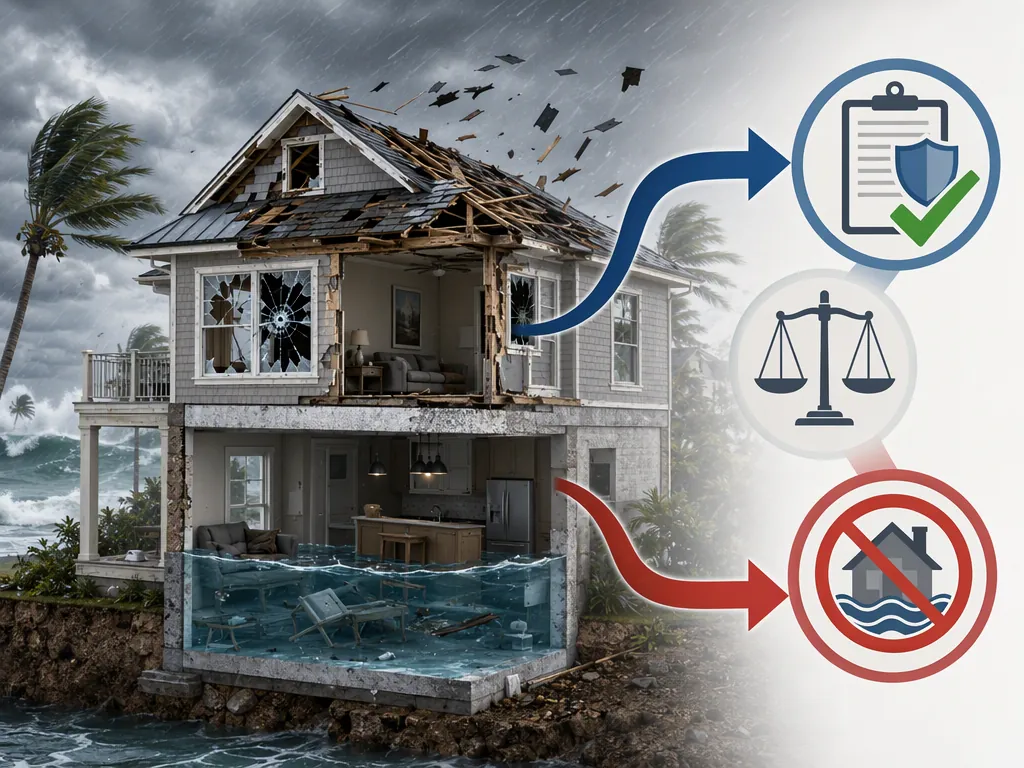
Flood-coverage gaps make that fight sharper. Many homeowners and commercial property policies treat wind and flood differently, and flood may sit in a separate policy or outside the insured’s purchased coverage. When a storm produces both roof damage and storm surge, the file can turn on sequencing and allocation rather than on whether the storm occurred at all. That is where early field notes, photographs, moisture mapping, elevation data, witness statements, and the timing of temporary repairs become litigation evidence rather than claim-administration housekeeping.
The governing law then determines how much that sequencing matters. The 2026 source record does not support a special body of “El Niño insurance law.” It supports the more ordinary, more consequential point that El Niño-conditioned storm tracks may push losses into jurisdictions that already treat concurrent causes differently. Available sources identify Louisiana’s efficient proximate cause doctrine and Florida’s approach to anti-concurrent-cause clauses as examples of state-law differences that can change the coverage analysis when wind and flood combine.[4]
That is also why mid-season forecast updates deserve legal attention without being mistaken for legal conclusions. If El Niño conditions steer the remaining risk toward particular coastal regions, counsel should not merely revise a storm-count expectation. They should ask which policy language predominates in that book, which forums are likely, whether flood exclusions and anti-concurrent-cause wording have already been tested there, and whether local experts can inspect quickly enough to preserve a defensible causation record.
Claims Capacity Is Where the Quiet Season Gets Loud
A below-average season can still overload a claims department if losses are geographically concentrated. That is the moment a coverage dispute begins to look like something more dangerous: a bad faith allegation built from delay, underpayment, inconsistent explanations, or repeated requests for documents the policyholder believes have already been supplied.
Policyholder-side law-firm commentary is not a neutral claims dataset, and it should not be used as if it were one. Still, it is useful as a map of recurring allegation patterns. Hodge Law Firm’s June 2026 hurricane bad faith discussion identifies delay tactics, low offers after large losses, and repeated documentation requests as themes policyholders may raise after hurricane damage.[8] Those allegations do not prove bad faith in any given file. They do identify the conduct that will be recharacterized in pleadings if a high-volume event leaves claimants waiting.
Carrier-side constraints belong in the same frame. After a major landfall, an insurer may be triaging thousands of first notices of loss, assigning independent adjusters, waiting on engineers, reviewing flood information, checking prior claims history, and issuing reservation-of-rights letters while policyholders are trying to reopen businesses or keep a house from deteriorating further. The legal risk is not created by volume alone. It is created when volume makes the claim file fail to show timely, reasoned, and consistent decision-making.
| Claim file pressure point | Why it matters legally |
|---|---|
| Delayed inspection or engineering assignment | Creates a record policyholders may use to argue the insurer let causation evidence degrade. |
| Low initial estimate after a large regional event | Invites allegations that the carrier used a volume-driven settlement posture rather than a property-specific evaluation. |
| Repeated document requests | May be defensible if targeted, but can be pleaded as delay if the file does not explain why each request was necessary. |
| Reservation-of-rights language that stays generic | Leaves later coverage positions vulnerable to arguments that the insurer did not communicate the real dispute clearly. |
| Supplemental claim handling | Turns repair-cost inflation, hidden damage, and missed statutory windows into procedural as well as valuation disputes. |
Supplemental deadlines are a good reminder that hurricane litigation runs on a calendar that outlasts the radar loop. Hodge’s June 2026 discussion identified March 26, 2026 as the Hurricane Helene supplemental claim deadline and April 9, 2026 as the Hurricane Milton supplemental claim deadline.[8] Those dates are not included here because Helene or Milton predicts 2026 outcomes. They are included because they show the post-storm legal clock counsel must track: notice, proof, supplement, appraisal, mediation, administrative review, suit limitation, and statutory prerequisites can all become dispositive before anyone reaches the merits of wind versus flood.
Florida Shows Why Procedure Can Move the Dispute Without Ending It
Florida remains the obvious laboratory for hurricane insurance procedure because its reforms affect where disputes go, how quickly they mature, and what leverage each side has before filing suit. The 2026 materials identify HB 459 as creating an administrative dispute-resolution track that may reshape litigation flow.[9] The same source set notes Florida Office of Insurance Regulation data showing an approximately 30% litigation decline as of December 2025.[9]
That decline should be read carefully. A reduction in filed litigation is not the same as a reduction in underlying conflict. Some disputes may resolve earlier. Some may move into administrative channels. Some may be delayed while parties test new procedural requirements. For coverage counsel, the practical question is not only whether a complaint has been filed. It is whether the dispute is being preserved, documented, and positioned in the forum where it is now most likely to surface.
Florida also illustrates the danger of treating reform as a carrier-side cure-all or a policyholder-side grievance machine. An insurer still needs a claim file that can explain delay, valuation, causation, and coverage reservations. A policyholder still needs timely notice, organized documentation, and a theory of covered damage that survives the policy language. Administrative routing may change the first battleground; it does not make the factual record less important.
What Counsel Should Monitor in Q3 2026
The useful monitoring frame for Q3 2026 is narrower than ordinary hurricane preparedness advice. It starts with forecast updates, but it should not stop there. The August outlook and later advisories may change expected activity or steering risk, and the very strong El Niño probability reported in June was still a forecast, not a fixed condition.[3]
The next question is exposure concentration. A storm threatening a less populated coastline may create serious local losses without producing the same legal volume as a landfall near Miami, Tampa, Houston, or another dense coastal market. In those markets, one event can produce enough claims to stress staffing, engineering capacity, contractor availability, and judicial or administrative dispute systems at once.
Counsel should also watch the likely jurisdiction before landfall, not after suit is filed. If the expected loss corridor includes states with materially different treatment of efficient proximate cause, anti-concurrent-cause wording, appraisal, bad faith prerequisites, or administrative dispute resolution, the legal response should be tailored before first notices of loss arrive. Waiting until the claim file is already inconsistent is how ordinary coverage positions become harder to defend.
Wind-versus-flood proof deserves particular attention in any storm with surge potential. The most useful work happens early: preserving photographs, separating building components by damage mechanism, documenting waterlines, obtaining expert inspections before repairs erase evidence, and making sure coverage letters use the same causation vocabulary that adjusters and engineers are using. Precision at that stage is cheaper than trying to reconcile four inconsistent descriptions in deposition.
Claims capacity is the final indicator that deserves legal, not just operational, monitoring. If adjuster assignments, engineering reports, payment decisions, or supplemental reviews begin to lag after a concentrated landfall, the risk is no longer only indemnity severity. It is the creation of a record that can support delay and unfair-claim-handling allegations, whether or not those allegations ultimately succeed.
A technical metric can be accurate and still be misread for legal purposes. Storm count is one of those metrics. Like wildfire containment percentages in negligence and coverage disputes, it can create a false sense that the headline number measures the risk lawyers will later have to prove or defend. In hurricane insurance, the legally relevant indicators are more specific: where the storm lands, what the policy says, how wind and water interacted, whether the claim file was built coherently, and which procedural path controls the dispute.
El Niño may reduce expected Atlantic hurricane activity in 2026. It does not proportionally reduce insurance legal exposure. Litigation follows landfall concentration, coverage architecture, claims capacity, causation proof, and statutory procedure. For Q3 2026, those are the indicators worth watching after the forecast gives everyone permission to relax.
References
- NOAA predicts below-normal 2026 Atlantic hurricane season — NOAA
- NOAA forecasts 55% chance of below-normal Atlantic hurricane season, as El Nino nears — Artemis.bm
- El Niño is officially here, raising confidence in a quiet 2026 Atlantic hurricane season — Yale Climate Connections, June 2026
- Why El Niño's promise of a quieter hurricane season may not guarantee good news for insurers — Reuters, July 27, 2026
- Below-Average Hurricane Season Forecast for 2026, but Severity Risk Remains Elevated — Risk & Insurance, 2026
- 2026 hurricane season: El Nino dampens Atlantic hurricane risk — AP News
- How does El Niño Impact Atlantic Hurricane Season — NOAA AOML
- Bad Faith Insurance Claims After Hurricane Damage — Hodge Law Firm, June 2026
- Florida's New Insurance Laws for 2026 Explained — Boggs Law Group
Related records
Tool profile
Browse tool evaluations →Governing regulation
Browse the obligations tracker →Preventive workflow
Browse verification workflows →
Report a correction or tip
Spotted an outdated figure, a misstated fact, or a ruling this case record should reflect? Public comments are disabled for this content given the professional cost of a misreported case outcome, penalty amount, or rule text — use the structured correction channel instead.
Report a correction or tip for this record →