
How the End Government Shutdowns Act changes current law
What the End Government Shutdowns Act (H.R. 5542) would do, read from the bill text: a new 31 U.S.C. § 1311 auto-appropriation at 99% of prior-year levels, stepping down one point per 30 days, that would make an Antideficiency Act funding gap legally incapable of producing a shutdown. The real legal debate turns on the Pay Our Military Act precedent, CBO's direct-spending scoring, and the constitutional objections to automatic appropriations.
- Jurisdiction
- US Federal
- Court
- None
- AI tool named
- None
- Ruling date
- Sep 23, 2025
- Source document
- View primary court order ↗
- Last verified
- Aug 5, 2026
Lex Machina Review is an independent risk-tracking and reference resource. Nothing on this site is legal advice, and using it does not create an attorney-client relationship. Every record is reviewed against primary sources but may not reflect the most current status of a matter — always verify directly against the cited court order, rule text, or a licensed attorney before relying on it.
Companion explanation — secondary to the source document above
Record note, last verified August 5, 2026: H.R. 5542 in the 119th Congress is the House bill titled the End Government Shutdowns Act, introduced September 23, 2025, by Rep. Garland “Andy” Barr of Kentucky and referred to the House Committee on Appropriations. The statutory text below is checked against the Congress.gov bill record and the GovTrack text mirror; because legislative text and status can change, counsel should verify the current enrolled or engrossed text before relying on it. This article is legal information, not legal advice. [1][2]
Read from the bill text, the End Government Shutdowns Act would add a new 31 U.S.C. § 1311. That section would automatically appropriate “such sums as may be necessary” when regular appropriations or a continuing resolution has not been enacted. The rate would begin at the lower of three 99 percent baselines: 99 percent of the prior fiscal year’s regular-appropriations rate, 99 percent of the prior fiscal year’s full-year continuing-resolution rate, or 99 percent of the rate under the most recent partial-year continuing resolution. The rate would then fall by one percentage point for every 30-day period in which the automatic funding remains in effect. The reductions would continue past the end of a fiscal year, the authority would roll into the next fiscal year, and it would terminate only when regular appropriations or another continuing resolution is enacted. [2]
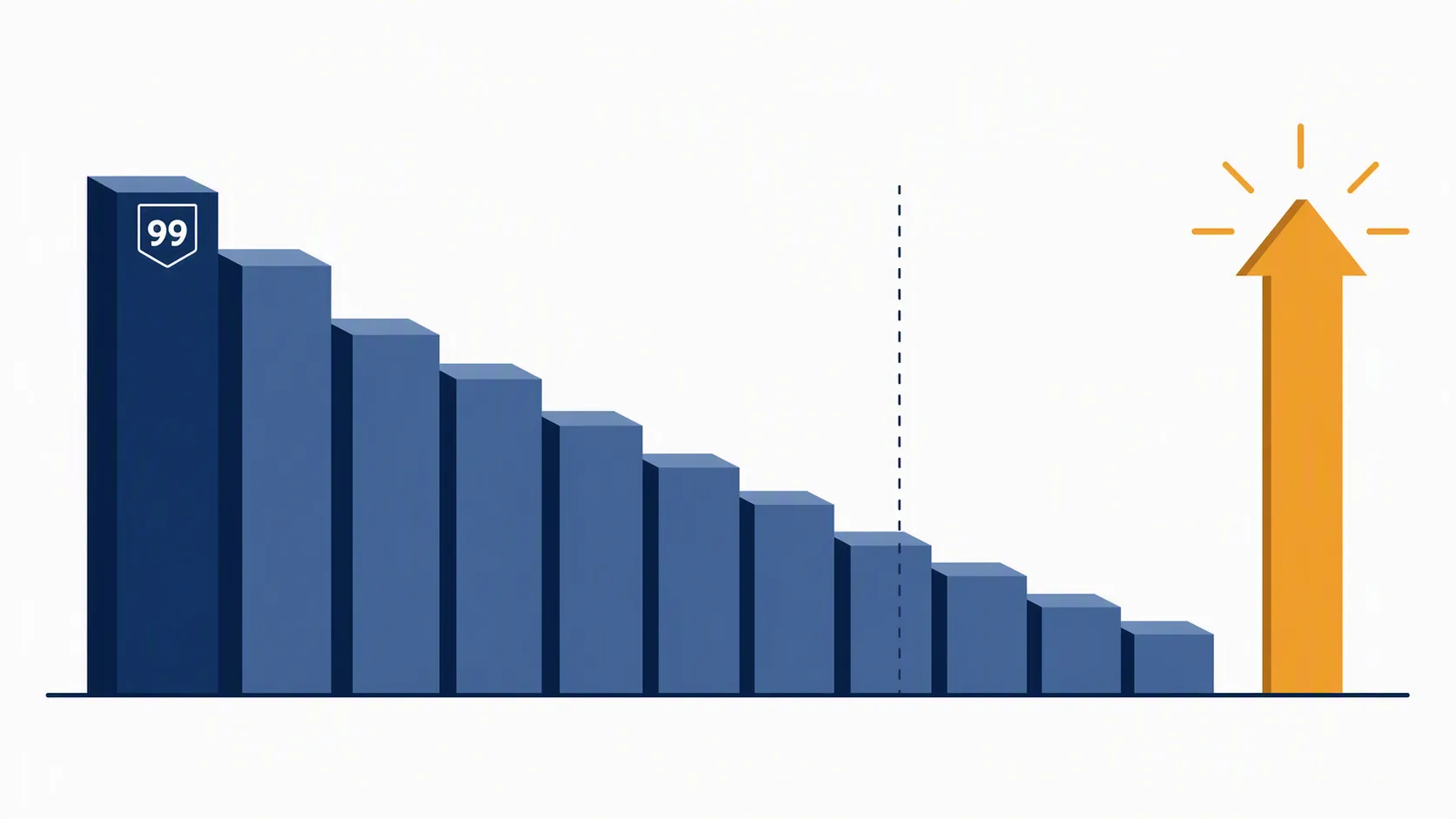
The operative change is budget authority, not shutdown rhetoric
The bill’s legal work is done by the appropriation itself. It does not merely instruct agencies to remain open, ask the Office of Management and Budget to improvise, or create a post-lapse payment promise. It places a standing funding rule in Title 31. If the triggering condition exists — no regular appropriation and no continuing resolution for a covered purpose — the proposed section supplies budget authority at the statutory rate.
That distinction matters because a shutdown is not a free-standing constitutional event. It is the operational consequence of agencies reaching the Antideficiency Act without available appropriations. A federal officer may not obligate or expend funds in advance of or in excess of an appropriation, and agencies may not accept voluntary services except as authorized by law. CRS identifies the relevant Antideficiency Act provisions as 31 U.S.C. §§ 1341-1342 and 1511-1519. [3]
H.R. 5542 is drafted to change that answer at the moment counsel would otherwise say: there is no enacted appropriation for this activity, so the agency must stop non-excepted work. New § 1311 would make the missing appropriation appear by operation of law. The Antideficiency Act would still exist. The officer still could not spend above the available rate or outside the authorized purpose. But the ordinary funding-gap prohibition would no longer point automatically to a shutdown, because the bill would itself provide the budget authority that is missing under current law.
How the automatic rate would be set
The 99 percent figure is only the starting point. The more important phrase is “the lower of.” H.R. 5542 does not select the most favorable prior funding measure. It looks across three possible baselines and begins at 99 percent of whichever one is lowest. That is a substantive constraint, not drafting decoration. It prevents the automatic continuing appropriation from using a higher earlier level when a more recent partial-year continuing resolution was already lower. [2]
| Question | Textual answer in H.R. 5542 |
|---|---|
| When does automatic funding begin? | When appropriations are not otherwise provided by regular appropriations or a continuing resolution. |
| How much is appropriated? | “Such sums as may be necessary,” but at the statutory rate rather than at full current-policy funding. |
| What is the initial rate? | The lower of three 99 percent baselines tied to prior regular appropriations, a prior full-year CR, or the most recent partial-year CR. |
| How does the rate change? | It decreases by one percentage point for each 30-day period the automatic appropriation remains in effect. |
| Does the reduction reset at fiscal year-end? | No. The reductions continue, and funding continues into the next fiscal year until superseded. |
| What ends the authority? | Enactment of regular appropriations or another continuing resolution. |
The fiscal-year carryover language deserves more attention than it usually gets. Many continuing-resolution fights are shaped by September 30, because that is when annual appropriations expire. H.R. 5542 is built for the case in which Congress still has not enacted a replacement after that date. The one-point reductions do not restart simply because the calendar has entered a new fiscal year. A lapse that continues long enough would therefore become progressively tighter even though operations remain legally funded. [2]
A simplified hypothetical shows the consequence. Suppose an agency account is covered by a prior regular appropriation, no new appropriation is enacted, and no continuing resolution is in place. Under current law, the agency’s lawyers would have to sort activities into excepted and non-excepted categories under the Antideficiency Act framework. Under H.R. 5542, the first question changes: the account would have automatic budget authority at the applicable statutory percentage, so the immediate legal problem would become compliance with that rate and purpose, rather than whether ordinary operations lack any appropriation at all.
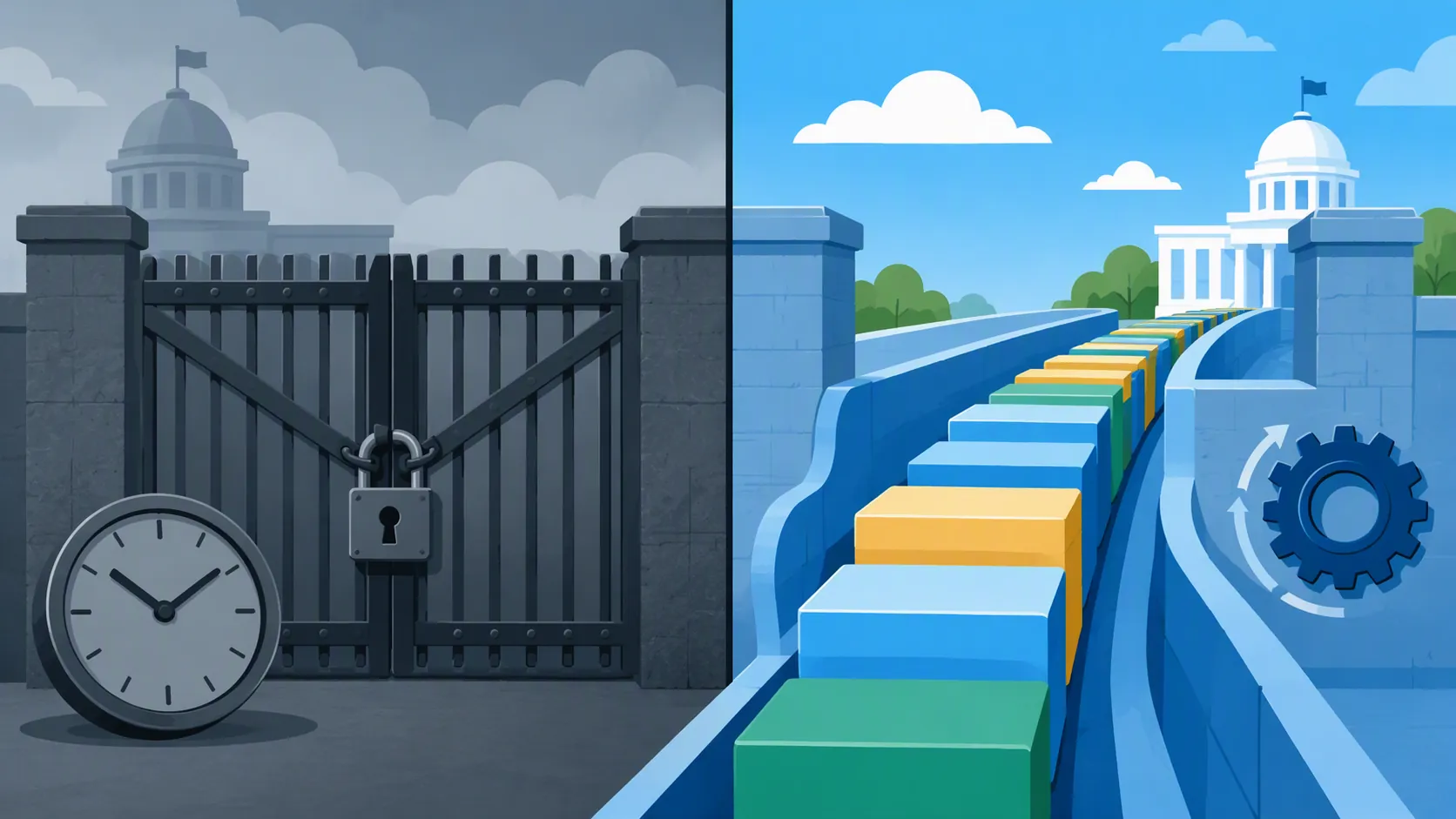
Why current law produces shutdowns when appropriations lapse
The modern shutdown rule is usually traced through the Antideficiency Act and two Attorney General opinions issued by Benjamin Civiletti in 1980 and 1981. CRS describes those opinions as the legal turning point for the modern treatment of funding gaps: absent appropriations, agencies generally may not continue operations except where authorized by law, where necessary to protect life or property, or where otherwise falling within recognized exceptions. [3]
That is the background against which automatic continuing-resolution bills have to be read. Before the Civiletti opinions, funding gaps did not always produce the same operational shutdown consequences. After those opinions, a lapse in appropriations became a legal event that agency counsel had to translate into shutdown plans, furlough instructions, contract limitations, court-operation contingencies, and excepted-function determinations. CRS also notes the practical reason this keeps recurring: full-year appropriations were enacted on time only for FY1977, FY1989, FY1995, and FY1997. [3]
For readers tracking operational exposure rather than legislative theory, that is the hinge. The Antideficiency Act does not ask whether a shutdown is wasteful, politically embarrassing, or avoidable. It asks whether the government has legal authority to obligate funds. For a fuller treatment of how continuing resolutions interact with agency exposure under current law, see this site’s explainer on the legal meaning of continuing resolutions.
The Pay Our Military Act is the useful precedent
The enacted precedent is narrower than H.R. 5542 but more useful than general assertions that automatic appropriations are impossible. CRS identifies the Pay Our Military Act, Public Law 113-39, as a 2013 enactment that provided appropriations for specified military pay and related civilian and contractor support during the FY2014 funding gap. The authority was effective from October 1 through October 17, 2013. [3]
That statute did not create a government-wide automatic continuing resolution. It did, however, demonstrate the appropriations-law move at issue: Congress can enact language that supplies funding during a lapse for a defined class of obligations. H.R. 5542 generalizes the move and codifies it as a standing Title 31 mechanism. The constitutional and budgetary questions do not disappear, but the discussion should start from the fact that Congress has used lapse-targeted appropriations before.
The constitutional objection is about control of the purse
The cleanest constitutional question is not whether an agency may spend without an appropriation. Under H.R. 5542, the asserted spending authority would be the statute itself. The question is whether Congress should create a standing automatic appropriation that keeps funds flowing when Congress has not enacted the ordinary annual measure.
The baseline objection starts with the Appropriations Clause and the older legislative-control theory associated with Federalist No. 58: control over money is a central means by which the legislature controls the executive. The National Constitution Center’s shutdown explainer frames modern shutdowns against that constitutional allocation of spending power. [4]
An automatic continuing appropriation does not hand the President a blank check in the ordinary sense. The rate, the covered accounts, the step-down, and the termination condition would all be statutory. Still, critics have a real separation-of-powers point: once standing funding exists, the President may face less immediate pressure to accept appropriations terms from Congress during a lapse. The leverage created by the threat of shutdown would be reduced because the default condition changes from cessation of non-excepted operations to continued funding at a declining statutory rate.
CBPP made that objection in June 2026 against S. 4632, a sibling automatic-CR design, arguing that an automatic continuing resolution “would greatly strengthen the President’s hand.” That critique should not be quoted as if it were a bill-text reading of H.R. 5542; the S. 4632 drafting includes its own language and design choices. It is best used here as a competing-design critique of automatic CRs as a category. [5]
CBO scoring may matter more than broad constitutional rhetoric
The legislative obstacle that lawyers sometimes underweight is budget scoring. CRS reports that CBO treated automatic continuing-resolution proposals in the 106th Congress, including S. 558 and H.R. 853, as direct spending subject to PAYGO requirements. [3]
That treatment does not decide whether H.R. 5542 is constitutional. It does affect how the bill would move through Congress. If an automatic appropriation is scored as direct spending, the question is not merely whether members like the shutdown-prevention concept. The proposal may need offsets or a procedural path that can survive PAYGO consequences. For legislative viability, that is a harder constraint than the usual good-government language surrounding shutdown bills.
Do not read every automatic-CR bill as H.R. 5542
The bill family is easy to conflate and worth separating. H.R. 5542, as introduced in the 119th Congress, uses a 99 percent starting rate and a one-percentage-point reduction for every 30-day period. The 118th Congress version, S. 2041, introduced by Sen. Mike Braun on June 15, 2023, used a different step-down design: a one percent reduction after 120 days and then one percent for each additional 90-day period, according to the Congress.gov CRS summary. [2][6]
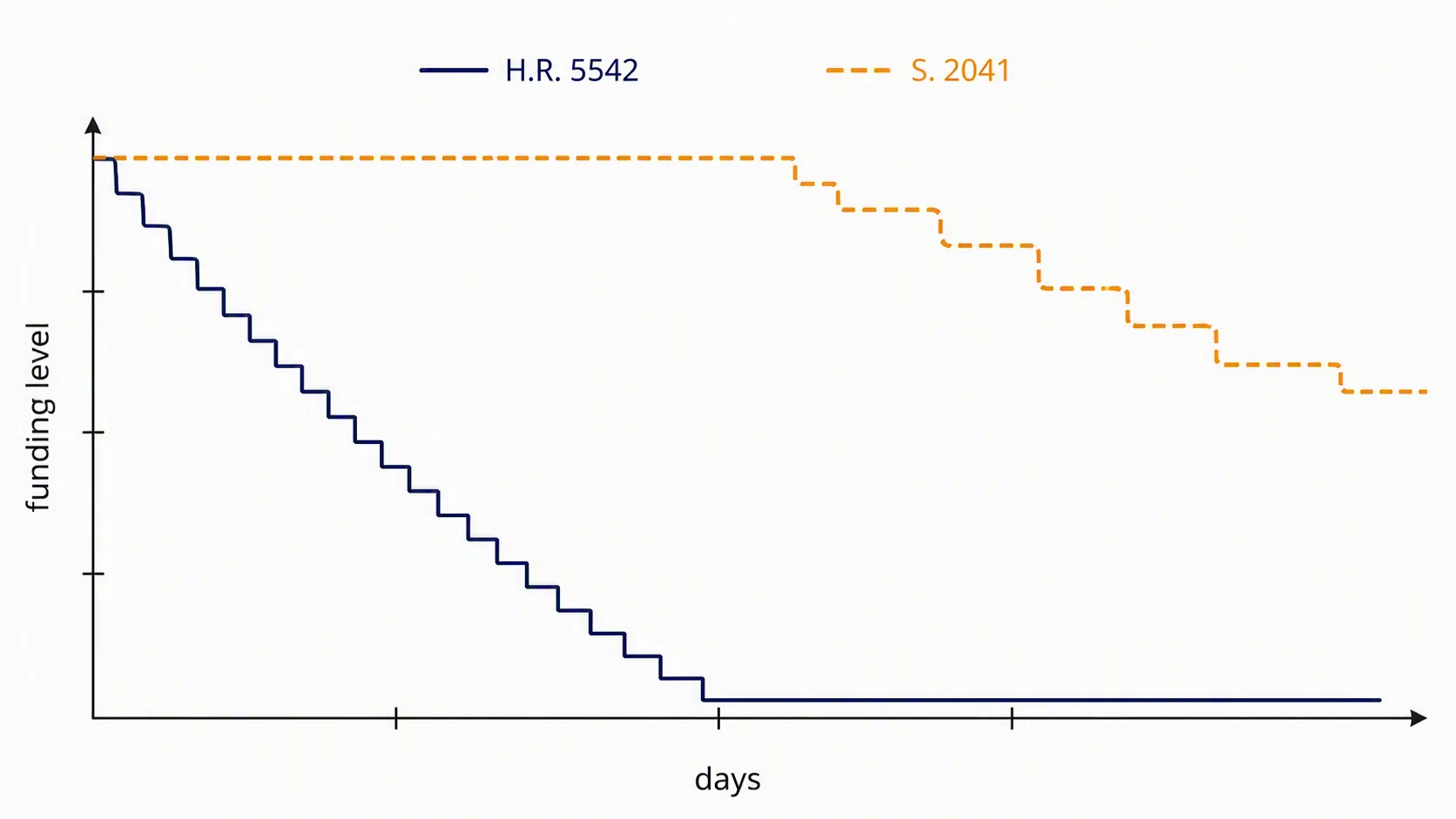
That difference is not cosmetic. A reduction after 30 days creates a different legal and budgetary pressure than a reduction after 120 days followed by 90-day intervals. Both designs try to prevent shutdown procedures from beginning merely because an annual appropriations bill is late. They do not impose the same ratchet.
Other proposals sit nearby but are not the same object. The Prevent Government Shutdowns Act line has used a rolling short-term continuing-resolution model with congressional scheduling penalties and waiver mechanics; Sen. Grassley’s September 2025 Q&A described that approach as a 14-day rolling CR design. [7] CRFB’s January 2026 discussion of automatic-CR proposals also distinguishes shutdown-prevention designs, including proposals with different rate-reduction formulas such as a one-percent-per-90-days approach. [8]
The same caution applies to shutdown counts. CRFB’s January 2026 pro-automatic-CR piece framed the problem as recurring “shutdown drama,” but counts vary depending on whether the source is counting funding gaps, shutdowns with furloughs, or “true” shutdowns. The legal analysis here does not turn on choosing one count. It turns on the Antideficiency Act consequence of a lapse and whether new § 1311 would supply appropriations during that lapse. [8]
What H.R. 5542 would and would not settle
If enacted as described in the GovTrack text mirror, H.R. 5542 would settle the agency-counsel question that matters first during a lapse: whether there is budget authority. The answer would be yes, at the automatic statutory rate, until Congress enacts regular appropriations or another continuing resolution. That would neutralize the ordinary Antideficiency Act shutdown trigger for covered funding because the gap would be filled by operation of law. [2][3]
It would not settle every appropriations question. Agencies would still need to identify the covered account, apply the correct baseline, observe the declining rate, and respect purpose, time, and amount limitations. If a particular activity is barred by another statute, an automatic continuing appropriation would not repeal that separate bar unless the text says so. If Congress later enacts a regular appropriations act or a different continuing resolution, H.R. 5542’s automatic authority would terminate under its own terms.
The legal classification is therefore fairly narrow. The End Government Shutdowns Act is best understood as an automatic appropriations bill. It would not repeal the Antideficiency Act; it would change the fact pattern to which the Act applies by supplying standing budget authority. The unresolved fight is whether Congress should, constitutionally and budgetarily, create that kind of automatic funding authority — especially given the Appropriations Clause objection, the executive-leverage critique, and CBO’s prior direct-spending treatment of comparable proposals.
References
- H.R.5542 - End Government Shutdowns Act, Congress.gov, https://www.congress.gov/bill/119th-congress/house-bill/5542
- H.R. 5542: End Government Shutdowns Act, GovTrack, https://www.govtrack.us/congress/bills/119/hr5542/text
- Automatic Continuing Resolutions: Background and Overview of Recent Proposals, CRS Report R41948, https://www.everycrsreport.com/reports/R41948.html
- The Constitution and federal government shutdowns, National Constitution Center, https://constitutioncenter.org/blog/the-constitution-and-federal-government-shutdowns
- An Automatic Continuing Resolution Is Not a Good Solution for Government Shutdowns, Center on Budget and Policy Priorities, June 18, 2026, https://www.cbpp.org/research/federal-budget/an-automatic-continuing-resolution-is-not-a-good-solution-for-government
- S.2041 - End Government Shutdowns Act, Congress.gov, https://www.congress.gov/bill/118th-congress/senate-bill/2041
- Q&A: Prevent Government Shutdowns Act, Chuck Grassley, September 12, 2025, https://www.grassley.senate.gov/news/news-releases/q-and-a-prevent-government-shutdowns-act
- Congress Could End Government Shutdown Drama Once and For All, Committee for a Responsible Federal Budget, January 29, 2026, https://www.crfb.org/blogs/congress-could-end-government-shutdown-drama-once-and-all
Related records
Tool profile
Browse tool evaluations →Governing regulation
Browse the obligations tracker →Preventive workflow
Browse verification workflows →
Report a correction or tip
Spotted an outdated figure, a misstated fact, or a ruling this case record should reflect? Public comments are disabled for this content given the professional cost of a misreported case outcome, penalty amount, or rule text — use the structured correction channel instead.
Report a correction or tip for this record →