
What the Epstein Files Act Reveals About Statutory Compliance Gaps
The Epstein Files Transparency Act required DOJ to release Epstein-related records within 30 days but lacked any enforcement mechanism. This article examines the legal remedies—or absence thereof—when an executive official fails to meet a statutory disclosure deadline.
- Jurisdiction
- United States
- Ruling date
- Dec 19, 2025
- Source document
- View primary court order ↗
Lex Machina Review is an independent risk-tracking and reference resource. Nothing on this site is legal advice, and using it does not create an attorney-client relationship. Every record is reviewed against primary sources but may not reflect the most current status of a matter — always verify directly against the cited court order, rule text, or a licensed attorney before relying on it.
Companion explanation — secondary to the source document above
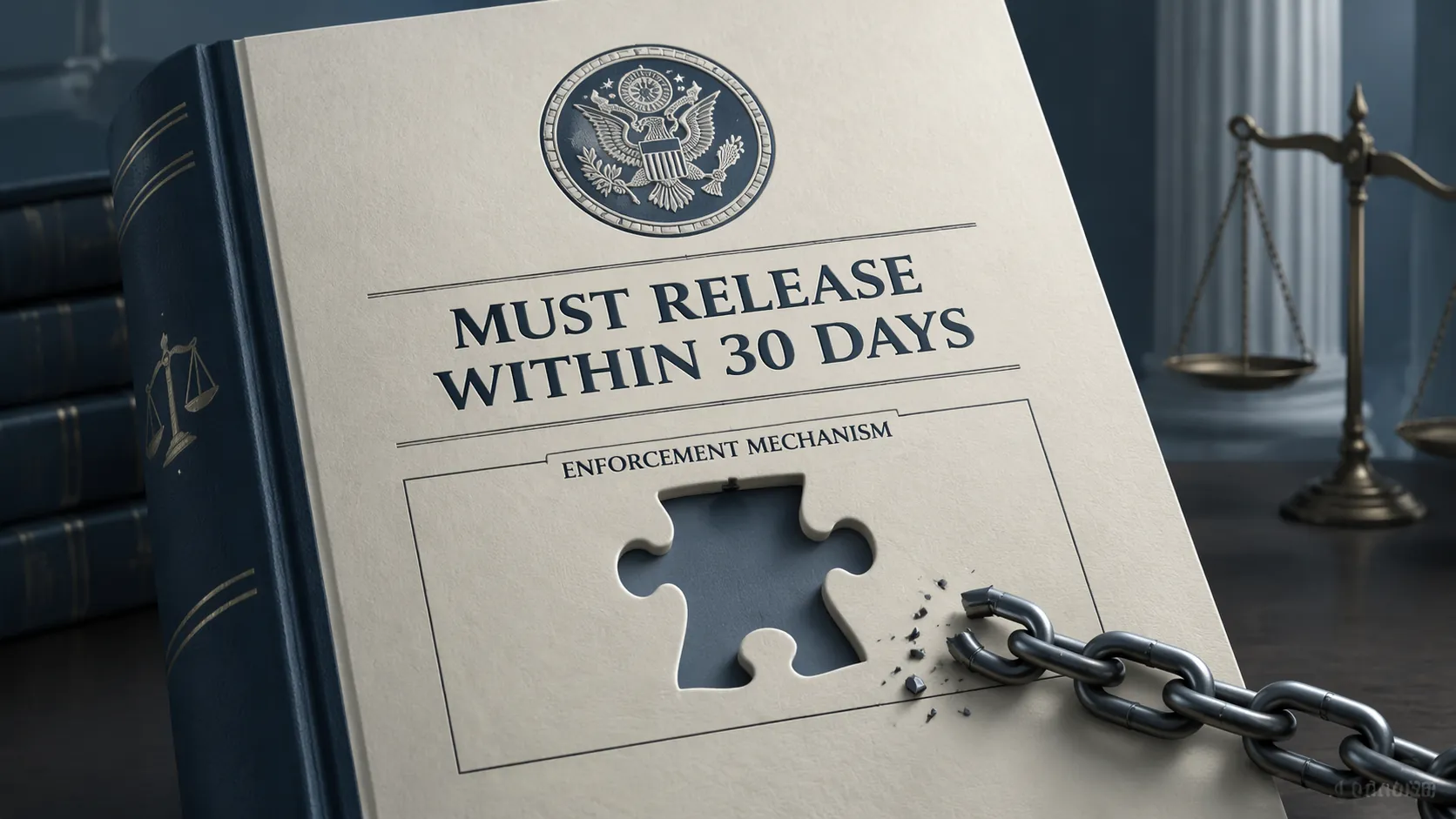
The Epstein Files Transparency Act made a clean promise: the Attorney General “shall make publicly available in a searchable and downloadable format” unclassified Justice Department records relating to Jeffrey Epstein and related investigations within 30 days. The statute was signed on November 19, 2025, so the operative deadline fell on December 19, 2025.[1] For lawyers reading the statute after that date, the harder question was not whether Congress used mandatory language. It plainly did. The harder question was who, outside the executive branch, could force the Attorney General to finish the job.
That is where the legal analysis has to begin: not with the notoriety of the underlying matter, and not with the politics of who demanded disclosure first, but with the mechanics of compliance. A statutory deadline can create a duty without also creating a practical remedy. EFTA is a useful and frustrating example because its post-deadline record produced documents, disputes, redactions, oversight, and personnel consequences, while still leaving the legal enforcement question underbuilt.
The Deadline Passed Into a Compliance Dispute
EFTA did not leave DOJ without instructions. It required release of unclassified Epstein-related records, including materials concerning investigations, prosecutions, detention, death, immunity arrangements, plea agreements, and related communications, subject to exclusions for classified information, child sexual abuse material, victim-identifying material, and other protected categories.[1] The Act’s structure assumed that DOJ could separate what had to be disclosed from what could lawfully be withheld.
After the December 19, 2025 deadline, DOJ released files in phases through March 2026 rather than as a single completed production. DOJ later treated those releases as satisfying the statute and described the production universe as approximately 3.5 million pages. Critics, including Representatives Ro Khanna and Thomas Massie, asserted that more than 6 million responsive pages existed.[2] That discrepancy should not be flattened into a confident conclusion that either number is right. It is the compliance dispute itself: the agency in possession of the files says the mandate has been fulfilled; outside actors say the record universe has not been accounted for.
| Date or period | Event | Compliance significance |
|---|---|---|
| Nov. 19, 2025 | EFTA signed into law | Started the 30-day statutory clock |
| Dec. 19, 2025 | Release deadline | Converted the statutory command into an auditable compliance question |
| Through March 2026 | DOJ phased releases | Created a record of production, but not agreement over completeness |
| Apr. 2, 2026 | Attorney General Pam Bondi fired | Created political consequence without resolving statutory compliance |
| Apr. 23, 2026 | DOJ OIG audit announced | Moved the dispute into institutional oversight |
| July 2026 | EFTA II proposed | Targeted the original Act’s missing enforcement lever |
The redaction record made the dispute sharper. At least 550 pages in the first release were entirely blacked out, and one 119-page grand jury file was released completely redacted.[2] Those facts do not by themselves prove unlawful withholding; grand jury material and victim-identifying material can present real legal constraints. But they do show why the word “release” can become formalistic. A page can be made public while conveying no usable information. A file can be counted in a production total while remaining substantively unavailable to the reader who is trying to verify what Congress ordered.

Mandatory Language Is Not the Same as an Enforceable Remedy
The Act’s operative language matters. “Shall” is not a suggestion. A 30-day release date is not an aspiration. If an agency lawyer were building a compliance calendar, EFTA would not be hard to docket: identify covered records, screen for statutory exclusions, publish the releasable material in the required format, and preserve a defensible explanation for withholdings.
But a statutory obligation answers only the first half of the enforcement problem. The second half is remedial: what happens if the official charged with performance does too little, too late, or too opaquely? EFTA did not create an express private right of action. It did not specify damages, contempt, fee-shifting, a special review procedure, a deadline-enforcement petition, or a statutory role for victims or state attorneys general to sue DOJ for non-compliance.[1] That omission is not a drafting footnote. It determines who can turn non-compliance from an allegation into a case.
FOIA litigators already understand this distinction. FOIA is not merely a disclosure norm; it supplies a judicial path for requesters to challenge withholding. A requester can sue, a court can review exemptions, and the agency must defend its position within an established procedural frame. EFTA, by contrast, imposed a one-time disclosure mandate on DOJ, but did not separately hand outsiders a comparable enforcement instrument.
That matters most when the allegedly non-compliant actor is the Attorney General. Congress can investigate. Inspectors general can audit. The President can remove an official. Committees can hold hearings. Members can issue statements. None of those mechanisms is the same as a statutory cause of action held by the people most affected by the production. They may generate pressure, and pressure may produce documents. They do not necessarily produce a court order requiring completion.
The Page Counts Exposed the Verification Problem
A disclosure statute without a remedy often shifts the fight from “what does the law require?” to “how would anyone know whether the law was satisfied?” EFTA’s page-count dispute illustrates the point. DOJ’s position, as reported in the implementation record, was that approximately 3.5 million pages fulfilled its statutory obligation. Critics said the responsive universe exceeded 6 million pages.[2] The gap is too large to treat as a clerical disagreement, but the public record also does not support treating the critics’ estimate as finally proven.
For an auditor, that kind of dispute calls for a record map. What repositories were searched? Which offices held responsive files? How were duplicate files counted? Were sealed, classified, victim-protective, or grand jury materials included in the denominator before being withheld from the numerator? Did DOJ count fully redacted pages as released pages? Were metadata, indexes, logs, and transmittal records included or excluded? EFTA’s public controversy was not only about disclosure volume; it was about the absence of a shared accounting method.
The 550 fully blacked-out pages and the fully redacted 119-page grand jury file intensified that accounting problem.[2] If a release contains pages that cannot be read at all, the compliance review has to separate at least three questions: whether the page was within the Act, whether a lawful withholding basis applied, and whether the public release format gave enough information to test the withholding. EFTA told DOJ to disclose; it did not itself build a litigation-style process for outsiders to test those answers.
Bondi’s Firing Was a Consequence, Not a Compliance Ruling
Attorney General Pam Bondi was fired on April 2, 2026, with reporting and political accounts largely attributing the termination to her handling of the Epstein files.[2] It would be easy to treat that as the system finding its remedy. That would be too quick.
Removal can punish or respond to perceived failure, but it does not adjudicate whether a statute was complied with. It does not establish the correct universe of responsive records. It does not explain why pages were redacted. It does not create a production order. It does not give victims, state attorneys general, or watchdog groups an enforceable right to inspect the agency’s compliance theory. At most, it shows that the political system can impose personnel consequences when a disclosure controversy becomes intolerable.
That distinction is easy to miss because personnel action feels concrete. Someone loses an office; the controversy appears to have produced a result. But the legal compliance question remains separate. A fired Attorney General can leave behind the same unresolved production dispute that existed the day before removal.
The OIG Audit Supplied Oversight, Not a Private Enforcement Path
On April 23, 2026, DOJ’s Office of Inspector General announced that it would review compliance with the Epstein disclosure law.[3] Institutionally, that was the most serious post-deadline development. An inspector general can examine internal records, test agency representations, review process failures, and produce findings that carry more weight than competing press statements.
An OIG audit, however, is still not the same thing as a claimant-controlled remedy. Victims do not direct its scope. State attorneys general do not plead claims inside it. FOIA litigators cannot convert its existence into discovery. Congressional staff may rely on its eventual findings, but they do not control the timing or conclusions. If the audit identifies deficiencies, it may strengthen oversight and reform; it does not automatically provide an injured party with a judicial order compelling disclosure.
That is why the audit belongs in the compliance timeline but should not be mistaken for the missing clause in the statute. It helps answer what DOJ did. It does not fully answer who can force DOJ to do what remains undone.
Why EFTA II Is the Clearest Evidence of the Original Gap
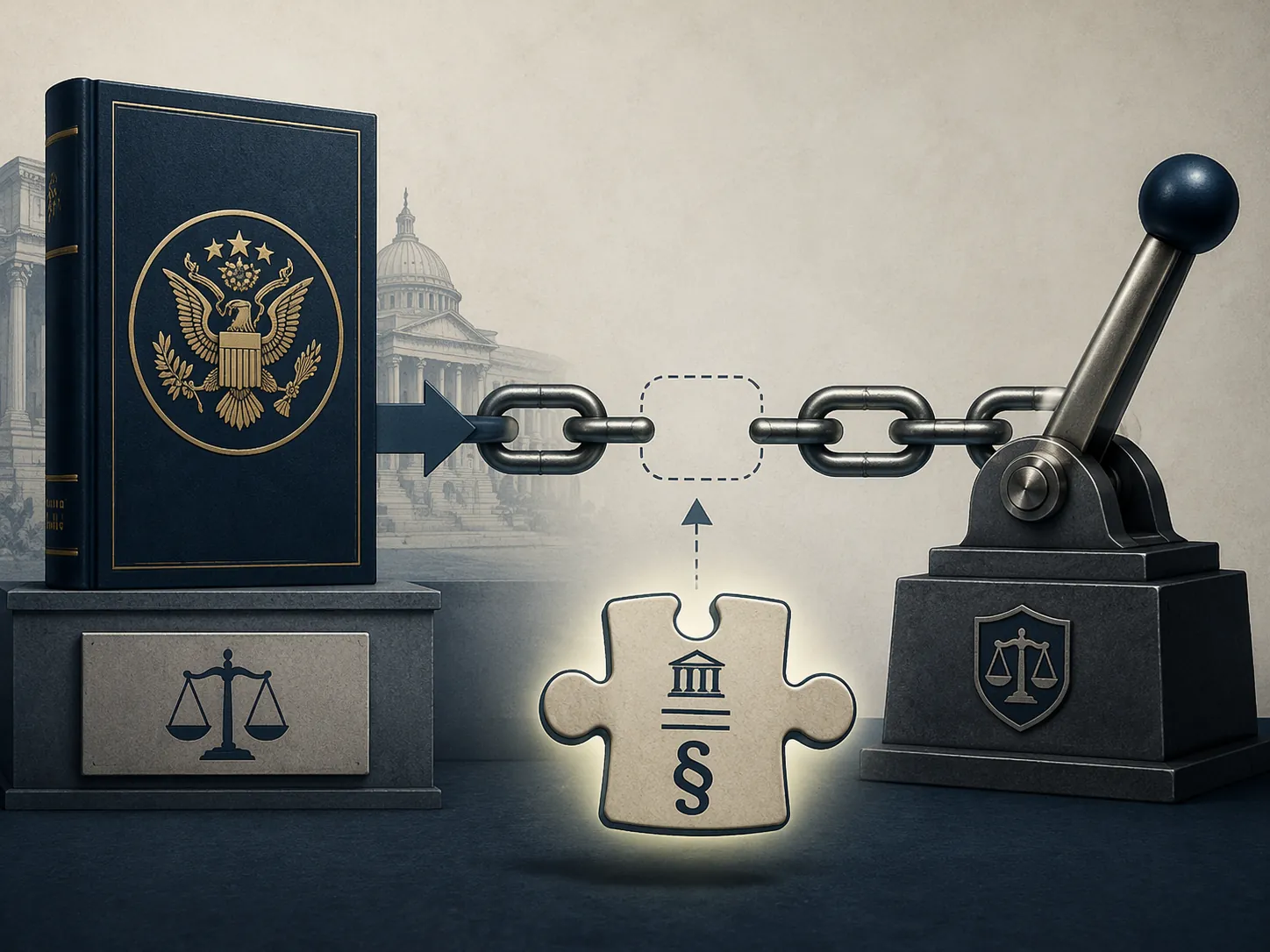
The proposed EFTA II, introduced in July 2026, is legally revealing because of the remedy it would add. The proposal would create a private right of action for victims and state attorneys general to sue DOJ for non-compliance.[4] That choice identifies the weakness in the original design more precisely than any speech about transparency could. If the first Act had already supplied an adequate enforcement path for those actors, a second bill creating one would be unnecessary.
A private right of action would change the posture of the dispute. DOJ’s view of the page universe could be tested in court. Redaction justifications could be placed into a structured adversarial process. Victims or state attorneys general would not have to wait for Congress, the White House, or an inspector general to decide whether the production deserved further scrutiny. The legal significance is not that every challenge would succeed. It is that someone outside the agency would hold the procedural key.
There are reasons Congress might hesitate before creating such a remedy in a sensitive law-enforcement disclosure statute. Grand jury secrecy, victim privacy, classified information, ongoing investigative equities, and third-party reputational harms are not decorative concerns. But those concerns can be addressed through standards of review, sealed submissions, protective orders, categorical exclusions, and in camera procedures. They do not require leaving the enforcement question to pressure alone.
What Legal Teams Should Take From the EFTA Record
For compliance lawyers, the lesson is not that statutory deadlines are meaningless. They are often the reason an agency acts at all. DOJ’s phased releases through March 2026 were not nothing; millions of pages reportedly entered the public record because Congress enacted a disclosure command.[2] But a deadline without a remedy leaves the verification burden in a precarious place. Outsiders can count pages, compare statements, flag redactions, brief members of Congress, and request audits. They may still lack a direct procedural lever.
That distinction matters beyond this statute. A legal team evaluating any mandatory disclosure regime should ask remedial questions before assuming the mandate can be enforced:
- Who has standing to sue if the deadline is missed or the production is incomplete?
- Does the statute create an express cause of action, or must challengers rely on other administrative-law theories?
- Does the statute define the record universe, the search method, and the treatment of redacted or withheld pages?
- Is there a court-review mechanism for exemptions, redactions, or categorical exclusions?
- Are there consequences for non-compliance beyond oversight, public criticism, or personnel action?
EFTA’s record shows what happens when those questions are answered late. Congress issued a command. DOJ produced records in waves. Critics disputed the production universe. Large blocks of released material were unreadable. The Attorney General lost her position. The inspector general opened a review. A follow-on bill proposed the enforcement mechanism the original Act lacked. That sequence generated accountability pressure, but it did not itself supply a clean legal remedy for outsiders trying to compel full compliance.
Disclosure mandates without remedies can produce documents, controversy, oversight, and political fallout, while still leaving compliance legally under-enforced.
References
Related records
Tool profile
Browse tool evaluations →Governing regulation
Browse the obligations tracker →Preventive workflow
Browse verification workflows →
Report a correction or tip
Spotted an outdated figure, a misstated fact, or a ruling this case record should reflect? Public comments are disabled for this content given the professional cost of a misreported case outcome, penalty amount, or rule text — use the structured correction channel instead.
Report a correction or tip for this record →