
Etched's $10.3B Valuation Flags a Hidden Legal AI Risk
Etched's Sohu ASIC, backed by a $10.3 billion valuation, cannot run MoE models like DeepSeek V4. This article explains why law firms should treat inference hardware architectural dependency as a new due diligence dimension for AI tool reliability, and what questions to ask vendors.
- Jurisdiction
- United States
- Court
- General
- AI tool named
- Etched Sohu
- Ruling date
- Jul 23, 2026
- Source document
- View primary court order ↗
- Last verified
- Jul 25, 2026
Lex Machina Review is an independent risk-tracking and reference resource. Nothing on this site is legal advice, and using it does not create an attorney-client relationship. Every record is reviewed against primary sources but may not reflect the most current status of a matter — always verify directly against the cited court order, rule text, or a licensed attorney before relying on it.
Companion explanation — secondary to the source document above
Most legal AI vendor reviews still start in familiar territory: data retention, privilege, model provider, hallucination controls, audit logs, security certifications, and whether lawyers can verify the output before it reaches a client or court. Those questions remain necessary. They are no longer sufficient.
The part usually missing from the diligence call sits several layers below the contract: what inference hardware assumptions does the tool depend on, and what happens if the model architecture the vendor wants to use no longer fits that hardware? That question sounds remote until a legal AI product is slow during a filing rush, changes model behavior after an infrastructure migration, or quietly stops supporting the model family that made it useful last quarter.
Etched has made that hidden layer harder to ignore. On July 23, 2026, the AI chip startup announced a $300 million raise at a $10.3 billion valuation, led by Sequoia, with reporting from TechCrunch and Reuters confirming the size and valuation of the round.[1][2] That figure is not interesting to law firms because it predicts a winner in the chip market. It is interesting because money at that scale pulls vendors, infrastructure partners, and customers toward a particular technical bet.
The Bet Is Not Just Faster Inference
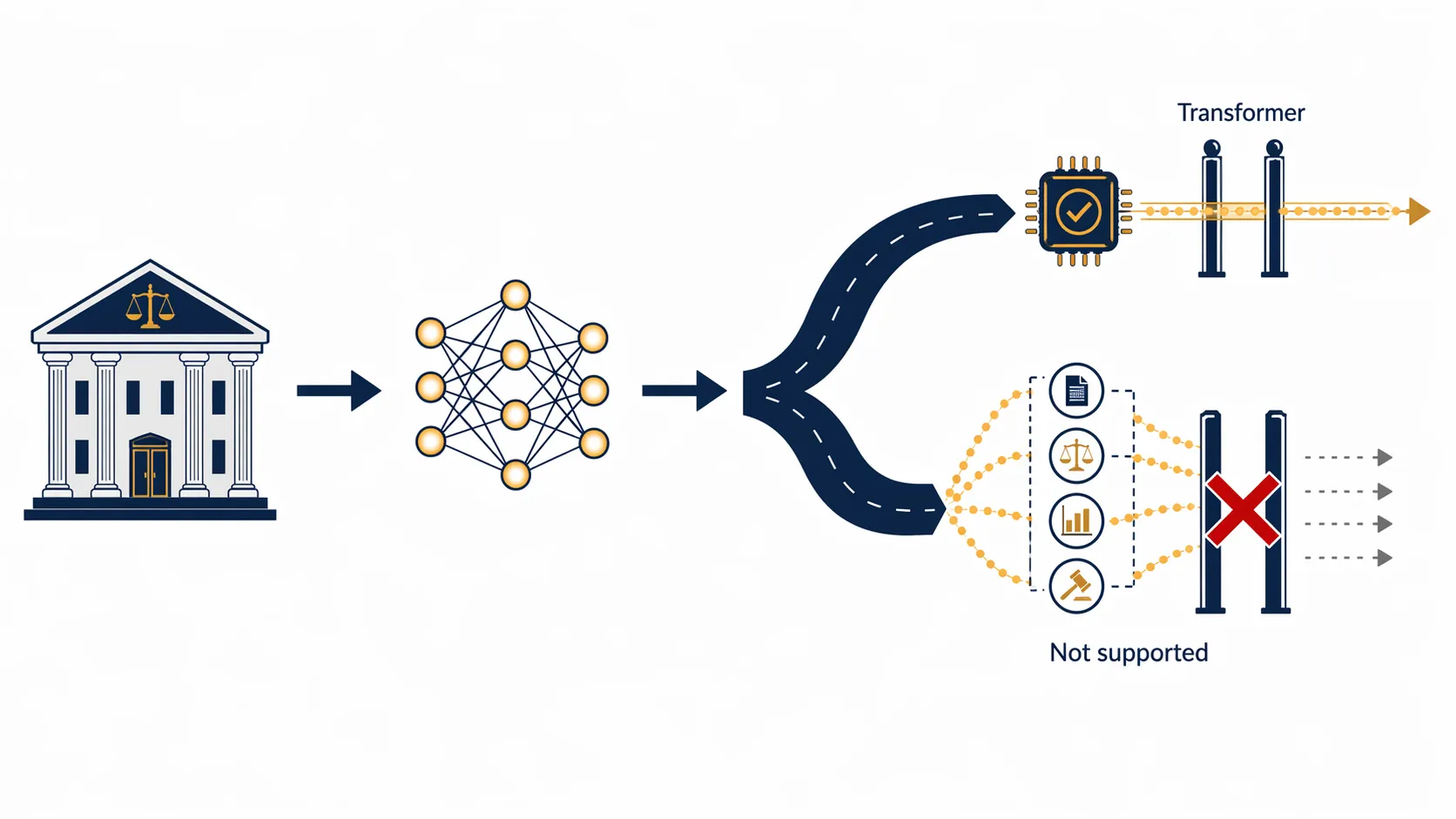
Etched’s Sohu chip is not a general-purpose GPU that happens to be good at AI inference. It is described as a fixed-function transformer ASIC: hardware built around transformer attention rather than a broad compute platform. Spheron Network’s technical analysis says Sohu cannot run mixture-of-experts workloads, SSM/Mamba models, vision encoders, or diffusion models; the same analysis also describes Sohu as lacking a migration path from CUDA, vLLM, SGLang, or TensorRT-LLM into its proprietary compiler path.[3]
Spheron is not a neutral court-appointed expert. It is a GPU cloud vendor, and its broader competitive framing should be read with that commercial interest in mind. But the narrow architectural point is the one that matters for legal AI procurement: Sohu is specialized for transformer workloads, and that specialization excludes several model architectures a legal AI vendor may want to use or support.
That is the procurement issue. A legal AI buyer does not need to decide whether Etched can beat NVIDIA. The buyer does need to know whether a contract-analysis tool, drafting assistant, deposition summarizer, or research product is being designed around infrastructure that gives excellent performance only inside a narrowing architectural lane.
| Diligence Layer | Usual Legal AI Question | Question Now Missing |
|---|---|---|
| Application | Can lawyers verify citations, quotations, and generated work product? | Does performance change when the vendor moves to a different model or inference stack? |
| Model | Which model provider or model family powers the feature? | Is the roadmap tied to transformer-only models, MoE models, or a mix? |
| Runtime | Where is the tool hosted and who can access client data? | Can workloads move across CUDA, vLLM, SGLang, TensorRT-LLM, or another serving environment? |
| Hardware | Rarely asked directly. | Is inference dependent on a specialized ASIC that cannot run unsupported architectures? |
Why Transformer-Only Becomes a Legal Operations Problem
A transformer-only chip can be a rational engineering answer if the workload remains transformer inference. Legal AI tools today are largely built on transformer-based large language models. If a vendor knows its use case, model family, batch patterns, and deployment constraints, a fixed-function accelerator may produce attractive economics.
The risk appears when the model layer moves faster than the hardware assumption. Spheron’s analysis identifies DeepSeek V4 as a 671 billion-parameter mixture-of-experts model, describes it as the most-downloaded Hugging Face model in early 2026, and states that Sohu cannot serve that MoE architecture.[3] That does not prove every legal AI vendor will adopt DeepSeek V4. It does show why “faster inference” and “fewer future options” can be the same sentence.
Mixture-of-experts matters operationally because it changes what the hardware must do. Instead of running one dense path through the full model in the same way for every token, an MoE model routes work among different expert components. A chip that hard-codes the expected transformer attention pattern can be very fast for the workload it was built to serve, while being unable to run the workload a vendor later wants because the routing and execution pattern is different.
For a law firm, that difference does not appear as an architecture diagram. It appears as a vendor saying a new model is unavailable in the firm’s region, a feature will be delayed until the infrastructure team finishes a migration, batch processing prices must change, or the tool will stay on an older model because the optimized serving path does not support the newer one. None of those outcomes is a sanctions headline. All of them are reliability and continuity issues for lawyers who thought they were buying software rather than inheriting an infrastructure bet.
The Dependency Chain Runs All the Way Down
A legal AI product can look stable at the user interface while depending on a chain that is less stable underneath: application workflow, model provider, model architecture, serving framework, compiler, accelerator, memory supply, data-center availability. A change at any lower layer can surface as a product issue that the legal team experiences without being able to diagnose.
This is why inference hardware belongs in due diligence. The question is not whether the lawyer using an AI assistant should understand chip design. The question is whether the vendor selling into legal work can explain its own dependency chain clearly enough that a firm can evaluate continuity risk before a matter team relies on the tool.
Sohu’s published promise sits at the hardware end of that chain. Spheron reports a claimed 500,000 tokens per second on Llama 70B for an eight-chip server, while also noting that the figure lacks independent third-party verification and was measured at batch size 1.[3] TechCrunch likewise reported Etched’s performance claims in connection with the funding announcement.[1] Batch size 1 is not a trivial footnote. A single-stream demonstration does not describe the production shape of a legal AI platform serving many users, multiple documents, long prompts, retrieval calls, and deadline-driven bursts.
Legal work is not one neat prompt in a lab. A litigation team may run document summaries across a production set while associates ask research questions and a partner tests a brief section. An in-house legal operations team may schedule contract extraction jobs while business users submit ad hoc requests. Throughput, latency, and cost under those conditions depend on batching, routing, memory, queue management, and serving software. A precise number measured under a narrow condition can be less useful than a messy benchmark that resembles the work.
What to Ask Before a Vendor’s Hardware Bet Becomes Yours
The diligence conversation should not turn into a seminar on semiconductors. It should force the legal AI vendor to identify dependencies, alternatives, and exit friction. If the vendor cannot answer, that is itself information.
- Which model architectures does the product currently run in production: dense transformer, MoE, SSM/Mamba, multimodal, or a combination?
- Does any production feature depend on Sohu-optimized infrastructure or another fixed-function inference accelerator?
- If the preferred model roadmap shifts toward MoE or hybrid architectures, can the same feature run without material degradation?
- Can workloads move across CUDA, vLLM, SGLang, TensorRT-LLM, or other serving environments without a rewrite that changes product availability?
- Does a proprietary compiler sit in the critical path, and what happens to the firm’s service if that compiler path is delayed, unsupported, or unavailable?
- Are performance claims based on independent production-like benchmarks, or on vendor demonstrations measured at batch size 1?
- What is the fallback plan if the accelerator, cloud capacity, or memory supply behind the product becomes constrained?
Those questions are not requests for trade secrets. A vendor can protect confidential engineering detail while still disclosing whether the firm’s use case depends on one hardware architecture, one compiler path, or one cloud availability assumption. If the answer is “we abstract that away,” the next question is who bears the cost when the abstraction fails.
The response should be specific enough to map operational consequences. “We can migrate” is not the same as “we can migrate this document-review feature within our contractual service levels, without changing output behavior materially, because we already run it on more than one serving stack.” Procurement should hear the difference.
Availability Is Part of the Same Risk
The timing details are brief but important. Data Center Dynamics reported that Etched’s first production racks were expected to ship in summer 2026.[4] As of the July 2026 funding coverage, Sohu hardware was not available for independent testing or cloud rental.[1][2][4] That does not make the chip vaporware. It does mean a legal AI buyer should treat current production-readiness claims differently from independently tested, rentable, operational capacity.
Memory supply also belongs in the continuity file. Spheron’s analysis describes Sohu as using TSMC N4P and HBM3E memory.[3] Jon Peddie Research noted in January 2026 that Etched would be competing with NVIDIA for HBM supply, and that NVIDIA’s Rubin using HBM4 would consume the bulk of available HBM capacity.[5] A law firm does not need to forecast the HBM market. It does need to ask whether the vendor’s service levels assume access to scarce components that the vendor does not control.
Supply exposure is easy to dismiss until it becomes a product queue, a delayed region rollout, or a vendor notice that premium features are being repriced. The right question is not “will there be a shortage?” It is “if capacity tightens, which clients, features, jurisdictions, and workflows move first?”
This Is Not an Incident Record
No documented legal AI failure has been tied to Sohu. There is no record here of a missed filing, corrupted output, privilege breach, or court sanction caused by Etched’s hardware. Treating this as an incident would overstate the evidence.
The evidence supports a narrower conclusion: Etched’s Sohu illustrates an emerging due-diligence category. A fixed-function transformer ASIC may be an elegant and commercially useful answer for the right inference workload. It may also create architectural-concentration risk if a legal AI vendor builds around it and later needs models, serving frameworks, or deployment paths the hardware does not support.
That category now belongs beside the familiar legal AI review topics. Data handling asks where client information goes. Verification asks whether lawyers can trust and check the work product. Infrastructure diligence asks whether the tool can keep serving the work when the model architecture, compiler path, memory supply, or cloud availability changes.
Etched’s $10.3 billion valuation matters because it turns a specialized chip design into a market signal vendors may be tempted to follow. Before that bet becomes a law firm’s operational problem, buyers should ask what sits underneath the AI tool, what it cannot run, and how the vendor gets out if the model roadmap moves somewhere the hardware cannot go.
References
- AI chip startup Etched defies skeptics, hits $10.3B valuation from big-name investors, TechCrunch, July 23, 2026
- AI chip startup Etched raises $300 million at $10.3 billion valuation, Reuters, July 23, 2026
- Etched AI Sohu vs NVIDIA: Transformer ASIC vs General-Purpose GPU for LLM Inference (2026), Spheron Network
- AI chip startup Etched closes $300m funding round, doubles its valuation to $10.3bn, Data Center Dynamics
- Welcome to the club, Etched, Jon Peddie Research, January 2026
Related records
Tool profile
Browse tool evaluations →Governing regulation
Browse the obligations tracker →Preventive workflow
Browse verification workflows →
Report a correction or tip
Spotted an outdated figure, a misstated fact, or a ruling this case record should reflect? Public comments are disabled for this content given the professional cost of a misreported case outcome, penalty amount, or rule text — use the structured correction channel instead.
Report a correction or tip for this record →