
Five Legal Risks That Could Derail Etched's $10.3B Valuation
Business coverage of Etched's rapid valuation growth has overlooked five distinct legal risk vectors—export controls, CFIUS exposure, antitrust exit risk, IP concentration, and securities-disclosure obligations—that could materially alter its trajectory toward a reported $20B target.
- Jurisdiction
- US Federal
- Court
- Various
- AI tool named
- Etched
- Ruling date
- Jul 25, 2026
- Source document
- View primary court order ↗
- Last verified
- Jul 25, 2026
Lex Machina Review is an independent risk-tracking and reference resource. Nothing on this site is legal advice, and using it does not create an attorney-client relationship. Every record is reviewed against primary sources but may not reflect the most current status of a matter — always verify directly against the cited court order, rule text, or a licensed attorney before relying on it.
Companion explanation — secondary to the source document above
Etched’s valuation story has moved faster than the legal record around it. The company has been reported at a $5 billion valuation after a $500 million financing in December 2025, then at $10.3 billion by July 2026, with coverage also pointing toward a much higher target near $20 billion if the next leg of financing lands as hoped.[1][2] That is not just a pricing sequence. For an AI chip startup built around a single architectural bet and a Taiwan manufacturing dependency, it is a stack of assumptions about exportability, import cost, ownership review, exit optionality, patent leverage, and investor disclosure.

The business narrative is easy to see. Etched is not trying to build a general-purpose GPU clone. It is betting on a transformer-specific chip and has publicly claimed performance advantages over incumbent hardware. But the legal diligence question is narrower than whether the technical thesis is elegant. It is whether the legal conditions that support the current mark can remain favorable long enough for the company to manufacture, sell, finance, and eventually exit at the valuation implied by current coverage.
The useful risk map has five parts: export controls and tariffs; CFIUS and ownership review; antitrust exit scrutiny; patent concentration; and securities-disclosure treatment of architecture dependence. None of those proves the valuation is wrong. Each can, however, change the denominator that investors quietly use when they decide whether a $10.3 billion private mark is a bridge or a ceiling.
The first legal condition is physical: can the chip move?
The strongest legal risk around Etched is not a vague geopolitical mood. It is the intersection between a specific manufacturing route and specific trade-law proposals. Etched depends on TSMC’s 4nm N4P process in Taiwan, while 2026 policy materials identify two channels that would bear directly on advanced AI chip movement: the AI OVERWATCH Act and Section 232 tariff exposure.[3]
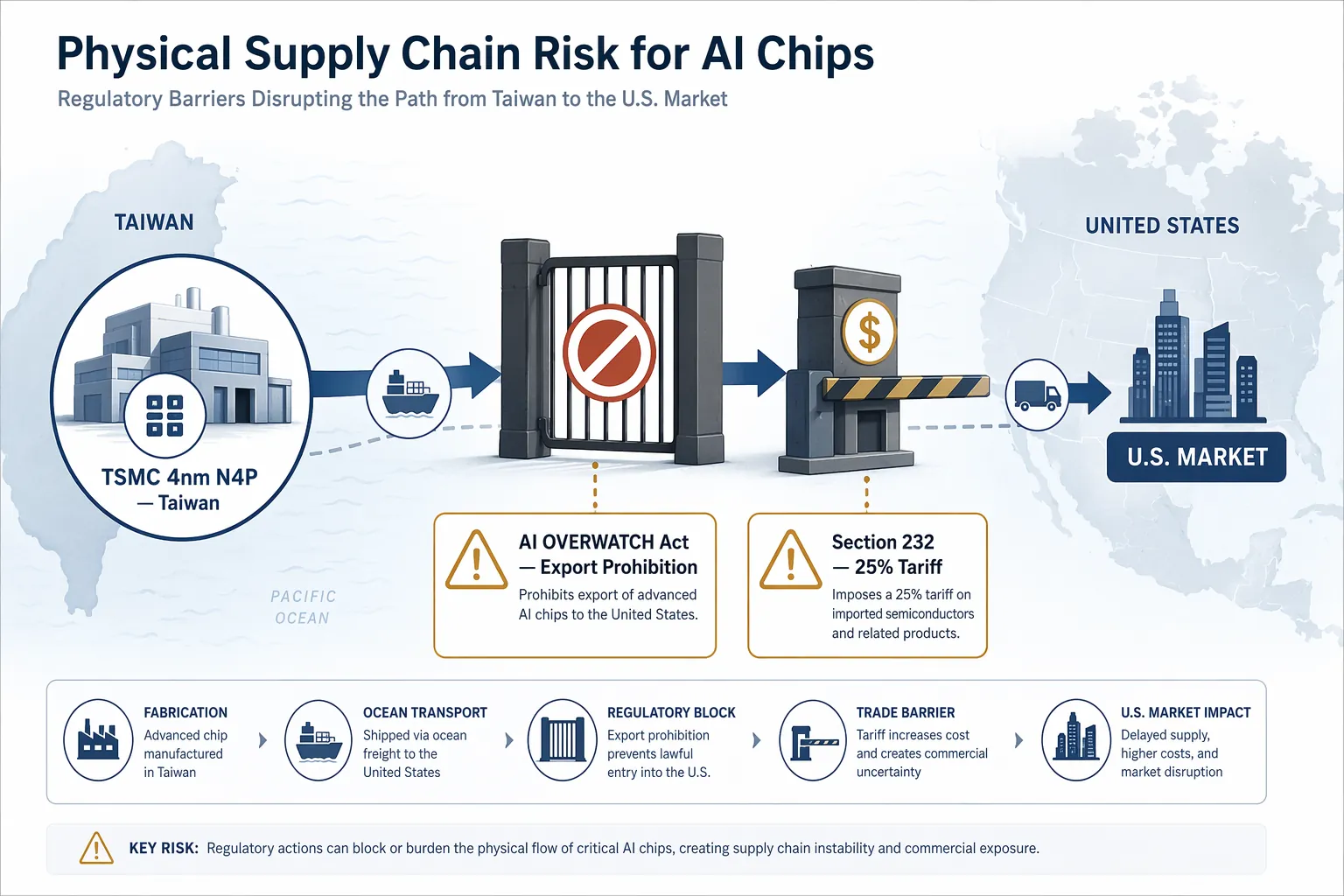
ML Strategies’ 2026 AI policy and semiconductor outlook describes the AI OVERWATCH Act as having advanced through the House Foreign Affairs Committee in January 2026 and as a measure that would prohibit exports of advanced AI chips comparable to frontier systems for two years, treating them in a manner closer to weapons sales than ordinary commercial electronics.[3] The same outlook identifies Section 232 exposure involving a 25% tariff on advanced AI chips imported into the United States.[3]
That matters because a chip startup’s valuation does not rest only on benchmark slides. It rests on the assumption that units can be fabricated, imported, priced, delivered, and supported without a regulatory toll changing the model. A two-year export prohibition would not need to target Etched by name to affect customer availability. A tariff does not need to ban the chip to change gross-margin assumptions, contract pricing, or the attractiveness of domestic deployment at scale.
There is a caveat worth keeping close to the claim: the public materials do not establish that Etched’s chip has been classified under any particular export-control category, nor do they show that the AI OVERWATCH Act has already become operative law against Etched. The point is more procedural. If a financing memo treats manufacturing and customer access as ordinary execution items, it is skipping the part where trade counsel has to test whether the legal route assumed in the revenue case is still open.
| Legal mechanism | Public source | Valuation-sensitive question |
|---|---|---|
| AI OVERWATCH Act | ML Strategies 2026 AI policy outlook | Could advanced AI chip exports face a two-year prohibition or licensing treatment that constrains addressable markets? |
| Section 232 tariff exposure | ML Strategies 2026 AI policy outlook | Does a 25% import tariff alter the cost assumptions behind U.S. deployment? |
| TSMC 4nm N4P dependency | Publicly reported Etched manufacturing profile | Is the model exposed to one offshore manufacturing route rather than multiple legally substitutable routes? |
For private valuation purposes, this is where the mark can compress without a product failure. A delayed shipment, a tariff pass-through dispute, or a licensing ambiguity can force the next investor to haircut projected sales while still believing the chip works. That is the kind of risk that rarely looks dramatic in a launch article and often looks obvious in a post-closing file.
CFIUS risk is not generic when a TSMC-linked investor is named
The second condition is ownership certainty. Bloomberg Law reported that VentureTech Alliance, described as a TSMC-linked venture firm, invested in Etched, alongside other disclosed investors including Jane Street.[2] That single cap-table fact is more useful than a broad sentence about foreign investment scrutiny because it gives counsel something to test: whether Etched’s business and investor rights could bring the company within a CFIUS-sensitive zone.
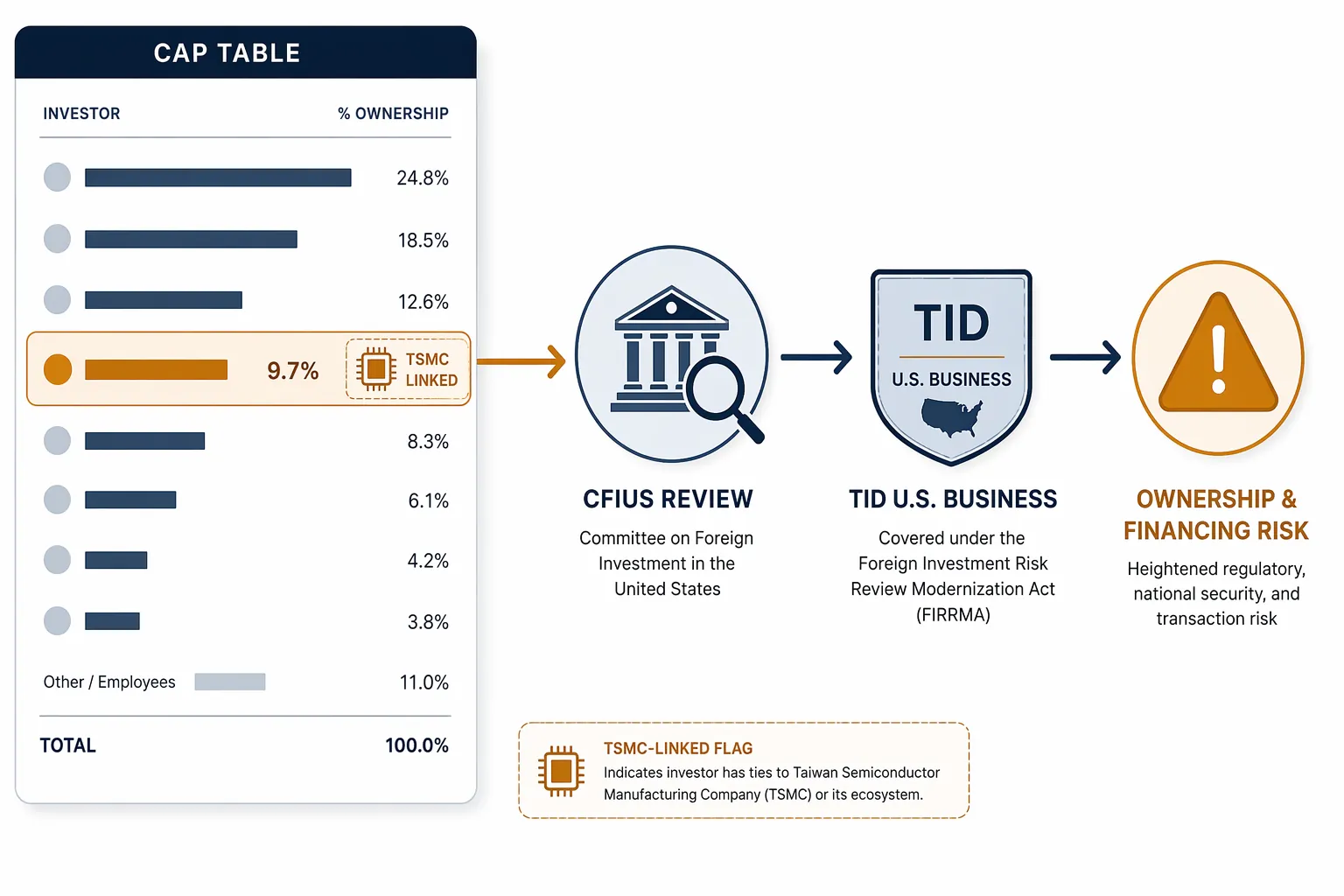
A&O Shearman’s June 2026 analysis of the U.S. national-security investment landscape discusses the CFIUS fast-track pilot program and the continued importance of TID U.S. Business classification for companies dealing in critical technology, critical infrastructure, or sensitive personal data.[4] A transformer-specific AI accelerator fabricated on an advanced semiconductor process is not automatically a CFIUS case from the public facts alone. But it is plainly the kind of company where counsel should ask whether critical-technology status, board or observer rights, information rights, vetoes, or future financing participation could create filing, mitigation, or timing issues.
The CFIUS question is limited by the public record. Etched’s full cap table is not public. Known investor names do not disclose percentage ownership, governance rights, side letters, data access, observer arrangements, or veto rights. Those details matter. A passive minority investment can present a different risk profile from an investment paired with nonpublic technical information rights or governance influence.
Still, financing certainty is part of valuation. If a later round requires additional diligence, mitigation terms, governance restructuring, or a CFIUS filing, the issue may not be whether the company survives. It may be whether the closing calendar, investor syndicate, or price protection changes. In a fast-marking private company, time is not neutral; a review process can move negotiating leverage from the issuer to the next money in.
Outbound-investment rules add a second layer. Covington’s June 2025 review of CFIUS and national-security investment regulation discusses the Office of Investment Security Policy’s outbound-investment rules as part of the widening perimeter around sensitive technology capital flows.[5] That does not mean Etched has an outbound-investment problem on the public facts. It means a serious diligence memo should not stop at “U.S. startup, prestigious investors.” It should map where capital, technical know-how, manufacturing dependency, and information rights actually sit.
Antitrust risk is mostly an exit-pathway issue
Etched’s valuation also depends on what investors think the eventual exit universe looks like. The antitrust point should be kept modest: there is no public indication that Etched is the subject of an antitrust enforcement action. The relevant signal is the regulatory treatment of adjacent AI chip consolidation.
Hashrate Index’s discussion of independent AI chip companies describes scrutiny around the Groq-NVIDIA transaction, including a March 2026 letter from Senators Elizabeth Warren and Richard Blumenthal concerning the proposed $20 billion deal and Federal Trade Commission attention to the transaction.[6] That is a comparable pathway signal, not an Etched-specific legal event. It tells counsel how the market may treat a major incumbent acquisition of an AI chip challenger.
The valuation implication is straightforward. If the cleanest premium exit is an acquisition by a dominant AI hardware platform, antitrust review can reduce certainty, lengthen timing, and change buyer appetite. A strategic buyer may still pay. It may also demand a risk discount, reverse termination protection, conduct covenants, or a longer outside date. Those are legal mechanics, but they are also valuation mechanics.
This is not an argument that Etched cannot go public, remain independent, or sell to a non-incumbent. It is narrower: a private mark that quietly prices in a strategic takeout should be tested against the antitrust climate now visible in the closest public AI-chip acquisition template.
Patent concentration cuts both ways
Etched’s patent story is attractive because it is unusually direct. TechCrunch reported the company’s public claim that it holds patent assets Nvidia would need to license.[1] If that claim proves durable, it could support valuation by giving Etched leverage against an incumbent and by making its design harder to copy without negotiation.
The same concentration can become a litigation surface. A patent position that matters enough to threaten an incumbent’s freedom to operate matters enough to invite validity challenges, design-around efforts, licensing pressure, or counterclaims. That does not require predicting that Nvidia, or any other incumbent, will sue. It only requires recognizing that patent leverage and patent exposure often arrive in the same envelope.
This vector should not be overbuilt from the public record. The available materials do not provide claim charts, prosecution histories, validity analysis, prior-art searches, licensing terms, or litigation pleadings. For valuation diligence, that means the patent claim should be carried as a conditional asset, not booked as an established moat. A buyer or late-stage investor would normally want counsel to separate issued claims from pending applications, blocking claims from marketing claims, and enforceability from bargaining posture.
The disclosure issue is architecture dependence, not hindsight
The most quotable legal fact around Etched is also the simplest. In 2024, CNBC quoted CEO Gavin Uberti saying, “if transformers go away, we’ll die.”[7] That is unusually clear language for a startup risk. It compresses the technical thesis into a securities-law problem: investors are being asked to value a company whose upside depends on a specific model architecture remaining commercially central.
The public record does not show that Etched has violated any disclosure rule. Private startup financings are not public-company 10-K filings, and the SEC has not issued startup-specific guidance for single-architecture AI ASIC companies. The issue is investor reliance. If a company raises capital rapidly at materially higher marks, counsel will want to know whether offering materials, board materials, investor presentations, and diligence responses consistently describe the architecture-concentration risk in a way that matches management’s public candor.
General AI startup legal frameworks from Chip Law Group and Traverse Legal emphasize that AI companies face recurring legal obligations around intellectual property, regulatory compliance, commercial claims, data governance, and investor-facing risk treatment.[8][9] Those sources do not create a special Etched rule. They do support the more basic proposition that AI startups with concentrated technical dependencies should treat legal risk disclosure as part of financing hygiene, not as boilerplate added after valuation is negotiated.
The performance claims deserve the same discipline. Etched has publicly promoted strong benchmark ratios and replacement claims, but the research record here treats those as company-reported benchmarks rather than independently verified production-scale facts.[1] A diligence memo can repeat the claims. It should not quietly convert them into established operating performance unless independent validation, customer deployment data, and production yield evidence support that conversion.
This is where disclosure risk becomes valuation risk without any allegation of misconduct. If later investors discover that the architecture-dependence risk, manufacturing dependency, or benchmark limitations were visible in public sources but thinly addressed in financing materials, the problem is not merely reputational. It can affect negotiation leverage, investor trust, board process, indemnity demands, and future financing credibility.
What the next diligence memo should actually carry
The cleanest way to evaluate Etched is not to ask whether the company is overvalued in the abstract. The better question is which legal assumptions must stay true for the reported $10.3 billion mark to compound rather than stall. Buchalter’s 2026 investment-risk alert frames trade, CFIUS, immigration, and deal-certainty issues as return-shaping factors for AI, semiconductor, biotech, and infrastructure investments; that is the right category of analysis for a company like Etched.[10]
- Export and tariff assumption: the model should identify which markets require chip export, import, licensing, or tariff analysis, and whether the 25% Section 232 exposure changes unit economics.
- Manufacturing assumption: the memo should state whether TSMC’s 4nm N4P dependency is treated as a temporary capacity choice or a structural dependency with no legally equivalent near-term substitute.
- Ownership assumption: the cap table review should test known foreign-linked investors, governance rights, information rights, and future financing rights against CFIUS-sensitive categories.
- Exit assumption: the valuation case should separate IPO, independent operating, non-incumbent acquisition, and dominant-platform acquisition pathways rather than blending them into one premium-exit story.
- Disclosure assumption: investor materials should treat architecture dependence, company-reported benchmarks, patent uncertainty, and manufacturing concentration as valuation-sensitive risks, not background technical color.
Etched remains an unusually interesting hardware bet precisely because its thesis is so concentrated. A transformer-specific chip can be a sharper investment story than a broad AI infrastructure pitch. But concentration is not only an engineering choice; it is a legal fact pattern. The valuation can survive that fact pattern if trade routes, ownership review, exit law, patent position, and disclosure practice remain manageable. Current coverage has treated those conditions as peripheral. They belong in the price analysis.
References
- Nvidia competitor Etched hits $5B valuation, $1B in sales for AI chip, TechCrunch, June 30, 2026
- AI Chip Startup Etched Says Jane Street, TSMC-Linked VC Invested, Bloomberg Law
- 2026 AI Policy and Semiconductor Outlook: How Federal, ML Strategies, February 4, 2026
- Navigating the evolving US national security investment landscape, A&O Shearman, June 2026
- Reflections on CFIUS and U.S. National Security and Foreign Investment Regulation in the First Four Months of the Trump Administration, Covington, June 2025
- Independent AI Chip Companies & AI ASIC Market, Part 3, Hashrate Index
- Etched raises $120 million to build chip to take on Nvidia in AI, CNBC, June 25, 2024
- Navigating the AI Startup Maze: Legal Risks and Regulatory Challenges, Chip Law Group, November 2024
- Legal Checklist for AI Startups, Traverse Legal, 2025
- Investing in AI, Semiconductors, Biotech, and Data Infrastructure in 2026: How Immigration, Trade, and CFIUS Shape Returns and Deal Certainty, Buchalter, January 2026
Related records
Tool profile
Browse tool evaluations →Governing regulation
Browse the obligations tracker →Preventive workflow
Browse verification workflows →
Report a correction or tip
Spotted an outdated figure, a misstated fact, or a ruling this case record should reflect? Public comments are disabled for this content given the professional cost of a misreported case outcome, penalty amount, or rule text — use the structured correction channel instead.
Report a correction or tip for this record →