
What Legal Consequences Exist for False Claims in Political Debates?
This Risk Digest record surveys every legal mechanism that can attach liability to false claims made during or adjacent to political debates, including defamation, state false-campaign-speech laws, and deepfake regulations, and explains the First Amendment barriers that limit enforcement.
- Jurisdiction
- US-State
- Court
- Delaware Superior Court
- AI tool named
- None
- Ruling date
- Apr 18, 2023
- Source document
- View primary court order ↗
- Last verified
- Jul 31, 2026
Lex Machina Review is an independent risk-tracking and reference resource. Nothing on this site is legal advice, and using it does not create an attorney-client relationship. Every record is reviewed against primary sources but may not reflect the most current status of a matter — always verify directly against the cited court order, rule text, or a licensed attorney before relying on it.
Companion explanation — secondary to the source document above
The most important fact about legal consequences for false claims in political debates is the missing case: the materials do not show a documented instance of a candidate being sanctioned simply because a false claim was made during a live debate. That absence does not make debate lies harmless. It does make the legal question narrower than the public argument usually allows.
A statement can be false without being actionable. It can be actionable without producing liability. It can produce liability for a broadcaster, campaign consultant, platform, or outside speaker while leaving the candidate who said something on a debate stage beyond the reach of any practical remedy. The law does not ask only whether the claim was wrong. It asks who was injured, whether the statement concerned a provable fact, whether the defendant had the required state of mind, and whether the remedy survives First Amendment review.
Where A False Debate Claim Can Become A Legal Problem
The live-debate setting is only one part of the legal map. The stronger cases tend to arise nearby: in campaign ads, televised repetition after the debate, fundraising emails, social media clips, robocalls, synthetic-media spots, or claims about election machinery and voting procedures. Once the statement leaves the instantaneous debate exchange and becomes a repeated, documented communication, plaintiffs and regulators have more to work with.
| Mechanism | What It Needs | Why It Usually Fails |
|---|---|---|
| Defamation | An identifiable plaintiff, a false factual statement, injury, and for public figures or public issues, proof of actual malice. | Candidate rhetoric is often generalized, opinion-like, or aimed at public figures who must meet the actual malice standard. |
| False campaign speech statutes | A state law that punishes or fines false statements in campaigns. | Courts repeatedly object to government truth-policing in elections and strike broad laws under the First Amendment. |
| Election-mechanics disinformation rules | A false statement about how, when, where, or whether people may vote. | The survivable zone is narrower than general political falsity and often depends on precise drafting. |
| Deepfake and synthetic-media rules | A manipulated image, audio, or video, often in an ad or election communication. | Disclaimer regimes look safer than broad bans; some aggressive laws have already been struck down. |
The gatekeeper for the most consequential private lawsuits is the actual malice standard. In public-official and public-figure defamation cases, the plaintiff must show that the defendant knew the statement was false or acted with reckless disregard for whether it was false. Protect Democracy describes that standard as one that protects even false statements unless the demanding fault requirement is met; Harte-Hanks v. Connaughton further treats reckless disregard as more than ordinary failure to investigate.[1]
That is why a debate-stage correction, however satisfying on television, is usually not a legal event. A candidate may exaggerate a voting record, misdescribe a policy, or accuse an opponent of something loosely framed enough to resist proof. Even if the statement is provably false, the injured person may be another public figure, meaning the plaintiff must prove knowledge or reckless disregard rather than mere negligence. The practical consequence is severe: most false political claims die as litigation risks before they become lawsuits.
Why The Election-Technology Defamation Cases Matter
The election-technology cases show the exception. Dominion Voting Systems and Smartmatic were not candidates complaining that an opponent had lied about them in the rough language of politics. They were identifiable companies alleging that named defendants spread specific false claims about their role in the 2020 election, causing reputational and business harm. That changes the case architecture.
Fox agreed in 2023 to pay Dominion $787.5 million to settle defamation claims over false election claims, a figure reported by AP as the largest publicly known defamation settlement involving the 2020 election-fraud narrative.[2] The settlement was not legally significant merely because it was large. It mattered because the case had reached the point where internal communications and editorial decision-making could be tested against the actual malice standard.
Newsmax later agreed to pay Dominion $67 million in a defamation case over false 2020 election claims, according to PBS News/AP reporting on the company’s SEC filing.[3] Newsmax also settled with Smartmatic for $40 million in 2024, while Smartmatic’s separate $2.7 billion claim against Fox remained pending as of mid-2026.[3] Pending means pending. A damages demand is not an adjudicated loss, and a settlement is not a judicial finding that every contested statement was actionable.
Those cautions do not drain the cases of force. They show the rare pathway from political falsehood to financial consequence: repeat a verifiably false claim about a specific entity, create a record of what the speaker or publisher knew, and give the plaintiff a business injury that can be pleaded and valued. That pathway is much easier to see when the target is an election-technology company than when the target is a rival candidate on a debate stage.
Candidate-versus-candidate disputes usually lack at least one of those pieces. The statement may be too vague. The injury may be political rather than legally measurable. The plaintiff may be a public figure facing the highest fault standard. The defendant may be able to say the disputed line was interpretation, opinion, or campaign hyperbole. None of those defenses is magic. Together, they make courtroom liability a poor substitute for political accountability.
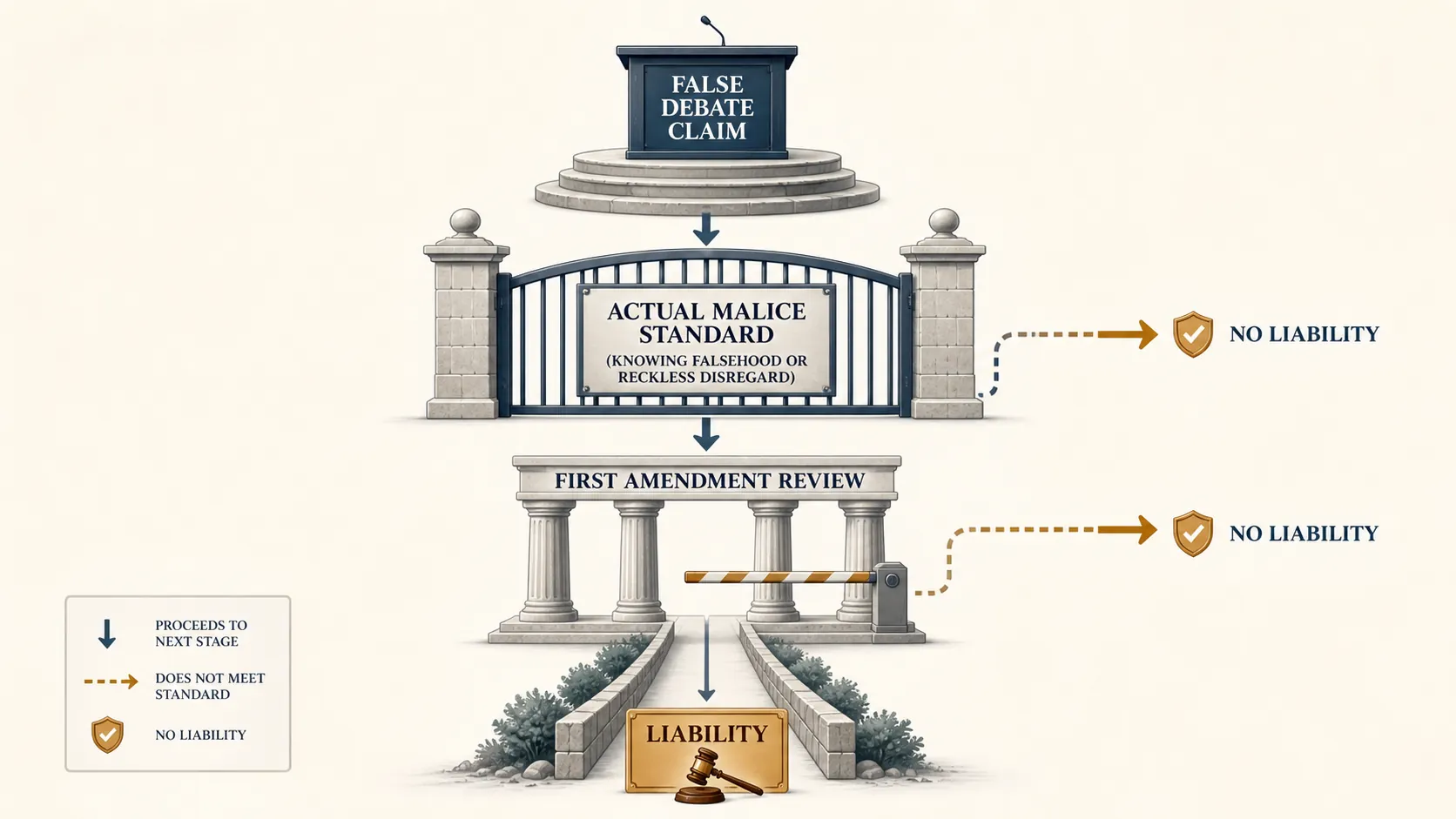
The Actual Malice Gate Is Not A Formality
Actual malice is often described too casually, as though it means bad motive or political nastiness. It does not. The standard asks whether the defendant made the statement with knowledge of falsity or reckless disregard for truth. A speaker can dislike the target, benefit from the claim, and still defeat a defamation case if the plaintiff cannot prove the required mental state.[1]
That evidentiary burden explains why internal messages matter more than public outrage. A fact-check may show that a claim was false. A clip may show that the claim was repeated. Neither automatically proves what the defendant knew at the time. In the election-technology cases, the legal pressure came from allegations and evidence that defendants had reason to know the fraud theories were unsupported while continuing to air them. Without that bridge between falsity and state of mind, a politically satisfying lawsuit can become a constitutional failure.
This is also where the debate format gives defendants room. Live exchanges are messy. Candidates answer under time pressure. Moderators interrupt. Opponents provoke. A plaintiff trying to prove knowing falsity from a single debate line would need more than the clip. Counsel would look for prior briefing materials, warnings from staff, corrections, expert notices, private emails, or repeated post-debate use after debunking. The lie itself is only the beginning of the proof problem.
Why State False-Campaign-Speech Laws Keep Running Into The First Amendment
Legislatures have tried the more direct route: prohibit false campaign statements and let a state body enforce the line. Courts have not been kind to broad versions of that idea. The pattern is repetitive enough to be instructive. Washington’s Supreme Court struck down a state law barring falsehoods in campaign ads in Washington 119 Vote No! Committee, with reporting at the time emphasizing the court’s First Amendment concern over government regulation of campaign truth.[4]
The same resistance appears in later cases. The Sixth Circuit in Susan B. Anthony List v. Driehaus, the Massachusetts Supreme Judicial Court in Commonwealth v. Lucas, and the Eighth Circuit in 281 Care Committee v. Arneson all rejected or sharply limited state efforts to punish false political speech.[5] The details vary, but the constitutional anxiety is stable: election season is exactly when government truth-policing is most dangerous, because enforcement itself can burden speech while voters are deciding.
The objection is not that false political statements are valuable. It is that empowering the state to decide which campaign claims are sufficiently false, sufficiently material, and sufficiently punishable risks suppressing the very debate the First Amendment is designed to protect. A law that seems sensible when aimed at a candidate one dislikes can become less attractive when administered by officials elected from the opposing party.
For debate claims, this matters because the most intuitive remedy is usually the least durable one. A rule saying “candidates may not make false claims in debates” sounds administrable until someone must decide whether a prediction, accusation, selective statistic, characterization of a vote, or contested historical claim is legally false. Courts have repeatedly declined to create a general First Amendment exception for political falsehoods.[6]
The Narrower Zone: Voting Mechanics And Election Administration
There is a more defensible category of election falsehood: statements about voting mechanics. A false claim that polls are closed, that Election Day has moved, that a group of eligible voters may not vote, or that ballots must be delivered to the wrong place is different from a false claim that an opponent “destroyed the economy” or “stole an election.” It targets the process of voting rather than the merits of a candidate.
That distinction does not erase First Amendment scrutiny, but it gives lawmakers a narrower interest to defend. The strongest version of an election-disinformation rule is specific, tied to verifiable voting procedures, and aimed at preventing voters from being misled about how to cast a lawful ballot. The weaker version tries to regulate broad political misinformation and inherits the defects that doomed earlier false-campaign-speech laws.
Michigan Senate Bill 533 illustrates the developing approach. Reporting from Michigan Advance described proposed civil penalties of $1,000 per violation for spreading false election information.[7] The status matters: a proposed penalty is not an enacted enforcement regime, and an enacted regime would still need to survive constitutional challenge. The legal risk is real enough for campaigns and speakers to watch, but not settled enough to treat as a clean answer to debate-stage lying.
Deepfake Laws Add Risk, But Not A General Ban On Lying
Synthetic media has moved faster than the older false-speech statutes. MultiState reported that states enacted 64 new deepfake-related laws in 2025 alone and that more than 30 states had political deepfake laws by early 2026.[8] That is a major compliance change for campaigns, consultants, ad buyers, and platforms. It is not the same thing as a general legal consequence for every false statement in a debate.
The constitutional line appears to be forming around remedy design. Disclosure and disclaimer regimes are less vulnerable because they require the speaker to identify manipulated content rather than banning political expression outright. Broad bans, especially those that sweep in satire, parody, or commentary, invite heavier First Amendment objections. Wiley LLP’s 2026 discussion of political AI restrictions notes that California’s deepfake ban and platform-removal law were struck down, and that a Hawaii law was overturned for lacking a satire or parody exemption.[9]
For debate-adjacent content, the practical lesson is straightforward. A manipulated clip of a candidate supposedly saying something on a debate stage may create a different legal risk than the candidate’s own false statement during the debate. The former can trigger synthetic-media disclosure rules, platform obligations, or campaign-ad restrictions. The latter still runs into the ordinary problems of proof, injury, and constitutional protection.
Threatened Lawsuits And Political Settlements Should Not Be Overread
Political defamation threats generate headlines because they sound like accountability. They are not the same as liability. BBC News reported in November 2025 on Donald Trump’s threatened $1 billion lawsuit against the BBC and the hurdles such a legal argument might face.[10] A threatened suit is not a filed complaint, a filed complaint is not a surviving claim, and a settlement is not always a merits ruling.
This distinction is not pedantry. It is the difference between legal exposure and political theater. A demand letter can be used to pressure a newsroom. A complaint can be used to fundraise. A settlement can reflect litigation cost, business risk, insurance realities, reputational management, or evidentiary weakness. The question for debate falsehoods is narrower: can the plaintiff get through the actual malice gate, prove legally cognizable injury, and obtain a remedy that does not punish protected political speech?
A Practical Risk Judgment
The clearest legal exposure does not come from a candidate being punished for an in-debate lie. It comes from a speaker, campaign, media defendant, or distributor repeating a verifiably false factual claim about an identifiable person or entity, after warnings or internal doubts, in a way that causes measurable harm. Dominion and Smartmatic fit that structure far better than the ordinary debate exchange.
The next clearest risk lies in narrow election-administration falsehoods and synthetic-media communications. A false statement about when or how to vote, or a fabricated video circulated as real, gives lawmakers and plaintiffs more concrete ground than a general accusation that an opponent is corrupt, weak, radical, or dishonest. Even there, drafting and proof decide much of the outcome.
So the answer is bounded. False political claims can produce legal consequences. The enforceable zone is narrow, evidence-heavy, and shaped more by First Amendment doctrine than by public anger. The people left to clean up the damage may be election officials, voting-system companies, lawyers, and judges; the law gives them tools, but not a general license to convert every false debate claim into a sanction.
References
- The “actual malice” standard, explained, Protect Democracy
- Fox, Dominion reach $787M settlement over election claims, AP News
- Newsmax to pay $67M in defamation case over false 2020 election claims, PBS News/AP
- State law barring falsehoods in campaign ads struck down, Reporters Committee for Freedom of the Press
- Constitutional Free Speech Protection of Disinformation in Political Campaigns, American Bar Association, September 2024
- When Are Lies Constitutionally Protected?, Knight First Amendment Institute
- Senate votes forward proposed penalties for spreading false election information, Michigan Advance
- State Deepfake Laws in 2026: What’s Changed and What’s Next, MultiState, February 2026
- AI Restrictions in Political Ads: What to Know About “Deepfake” Disclaimers and Bans, Wiley LLP
- Trump vs the BBC: What hurdles might the president’s legal argument face?, BBC News
Related records
Tool profile
Browse tool evaluations →Governing regulation
Browse the obligations tracker →Preventive workflow
Browse verification workflows →
Report a correction or tip
Spotted an outdated figure, a misstated fact, or a ruling this case record should reflect? Public comments are disabled for this content given the professional cost of a misreported case outcome, penalty amount, or rule text — use the structured correction channel instead.
Report a correction or tip for this record →