
Did Fauci's 2020 Disclosure Violate Conflict of Interest?
An analysis of whether Dr. Anthony Fauci's 2020 financial disclosure created a legally actionable conflict of interest during the COVID-19 pandemic, and the systemic gaps in federal ethics oversight that the episode revealed for senior officials.
- Jurisdiction
- US-Federal
- Court
- U.S. Senate Committee on Health, Education, Labor, and Pensions
- Judge
- None
- AI tool named
- Not applicable
- Ruling date
- Apr 21, 2020
- Source document
- View primary court order ↗
- Last verified
- Jul 30, 2026
Lex Machina Review is an independent risk-tracking and reference resource. Nothing on this site is legal advice, and using it does not create an attorney-client relationship. Every record is reviewed against primary sources but may not reflect the most current status of a matter — always verify directly against the cited court order, rule text, or a licensed attorney before relying on it.
Companion explanation — secondary to the source document above
On the materials currently available, the narrow legal answer is no: Dr. Anthony Fauci’s 2020 financial disclosure does not establish a criminal conflict of interest under 18 U.S.C. § 208. The form was filed on April 21, 2020, signed and certified by an NIH ethics officer on May 18, 2020, and the reported holdings were diversified mutual funds rather than individual pharmaceutical stocks; public reporting also verified that the disclosure form was available to the public, even if not through the easy online route used for many political officials.[1][2]
That answer matters because the current controversy has again moved faster than the record. The July 29, 2026 Senate hearing at which Fauci invoked the Fifth Amendment is a live timing hook, but without a full transcript in the available record, it should not be converted into evidence about a 2020 financial-disclosure violation. The useful question is narrower: what did the actual disclosure system require, what did this form show, and what did the public still have no practical way to verify?
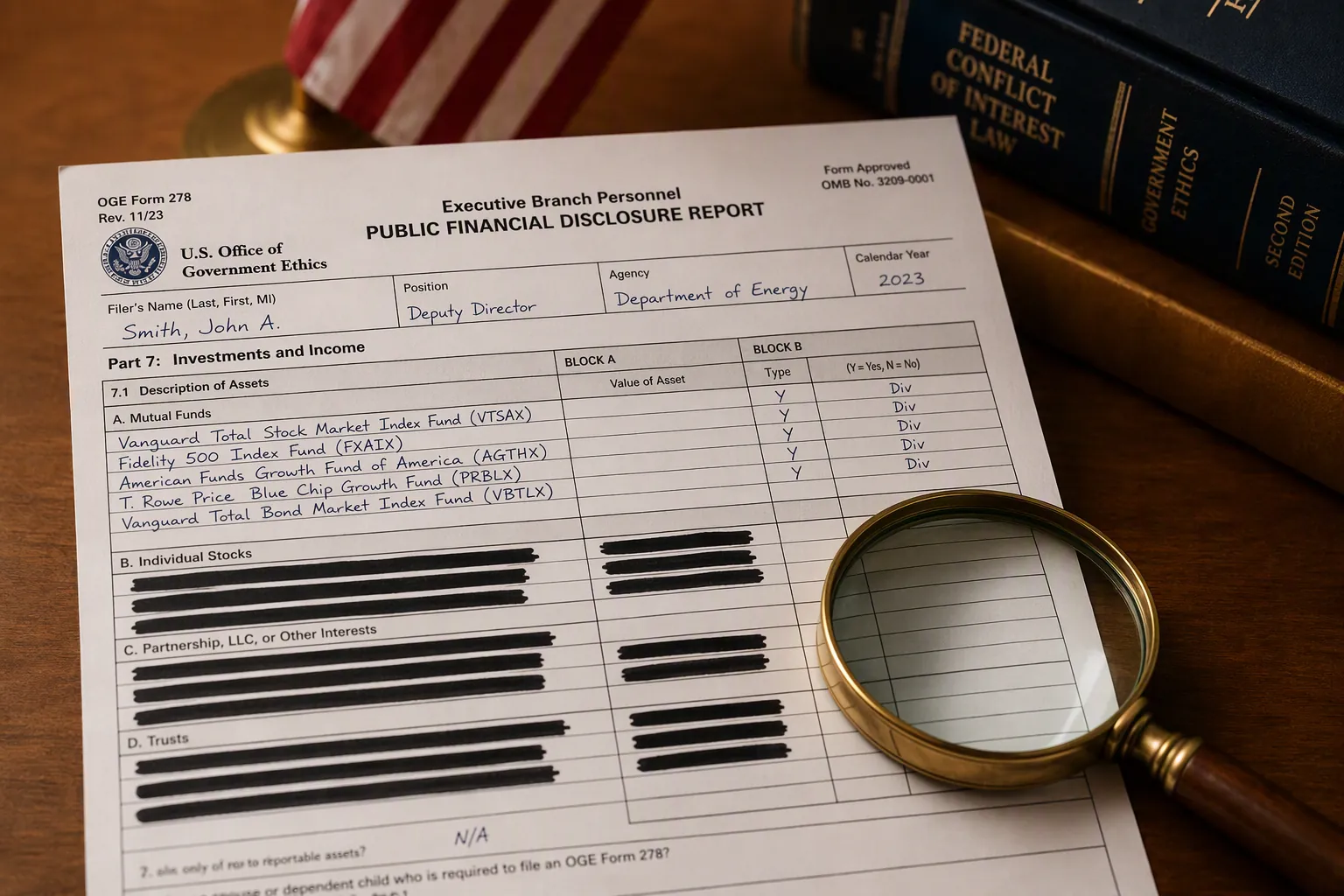
The 2020 form is a disclosure record, not a corruption finding
A federal financial disclosure form is supposed to surface reportable interests. It is not, by itself, a finding that the filer was conflicted in a legally actionable way. That distinction is the first place a conflict-of-interest theory has to survive contact with the record.
For Fauci’s 2020 disclosure, the stabilizing facts are procedural and specific. He filed the form on April 21, 2020. An NIH ethics officer signed and certified it on May 18, 2020. The holdings reflected diversified mutual funds, not individual shares in vaccine manufacturers or other pharmaceutical companies. FactCheck.org later verified that the forms were publicly available, and the Center for Public Integrity described the access route for Fauci and other career officials as obtainable but far less direct than the online posting available for many political appointees.[1][2]
| Question | What the available record supports |
|---|---|
| Was the 2020 form filed and certified? | Yes. It was filed April 21, 2020 and certified by an NIH ethics officer May 18, 2020.[1] |
| Did the disclosure show individual pharmaceutical stocks? | No. The described holdings were diversified mutual funds, not individual pharma-company shares.[1] |
| Was the form public? | Yes, but access was not the same as routine online posting for many political officials.[1][2] |
| Does the disclosure itself prove a § 208 criminal conflict? | No. The available record does not show a finding of a § 208 violation. |
The financial scale explains why the document drew attention. Forbes, using OpenTheBooks data, reported Fauci’s net worth at $10.4 million and income at $1.78 million, including a $100,000 McGraw-Hill editorship and $8,100 in gala tickets.[3] Those figures are legitimate context for public scrutiny. They are not, without more, evidence that a particular COVID-19 policy decision was affected by a prohibited financial interest.
Why the § 208 theory does not fit the known facts
The Ethics in Government Act disclosure regime and 18 U.S.C. § 208 do different work. Disclosure rules require senior officials to report categories of assets, income, positions, gifts, and related interests so ethics officials and, in some cases, the public can assess risk. Section 208 is narrower and more consequential: it is the criminal conflict statute used when a federal employee participates personally and substantially in a particular government matter in which the employee has a financial interest.
That statutory fit problem is not cosmetic. A large net worth is not a § 208 interest. A high federal salary is not a § 208 interest. Outside income that is disclosed and unrelated to a particular government matter is not automatically a § 208 interest. Even an asset class that includes broad exposure to health-care markets is not the same thing as owning stock in a company directly affected by a specific decision.
The mutual-fund point is especially important because it is where many public claims overrun the form. The reported holdings were diversified mutual funds. A diversified fund may contain exposure to pharmaceutical, biotechnology, or health-care companies as part of a broader portfolio, but that is not the same legal fact as owning individual shares in Moderna, Pfizer, Johnson & Johnson, or another company whose product is before the government. If a complaint or investigative theory wants to move from “pandemic official had investments” to “pandemic official had a criminal conflict,” it has to identify the financial interest, the particular government matter, and the official participation that made the interest legally disqualifying. The 2020 disclosure record described in the public materials does not do that.
Certification also matters, though it should not be oversold. The NIH ethics officer’s May 18, 2020 certification means the form went through the ordinary internal ethics review channel.[1] It does not mean the public must accept every agency judgment on trust. It does mean that a legal-risk assessment should not treat the form as if it were an uncertified leak or a hidden personal balance sheet discovered outside the ethics process.
For pleading purposes, that leaves a thin record. A lawyer alleging a criminal conflict from this disclosure would need more than dollar totals and pandemic proximity. The available materials support a defensible conclusion of technical compliance under the disclosure regime and do not support a finding that Fauci violated § 208.
Compliance still left important facts hard to see
The mistake in many defenses of the disclosure system is stopping at the word “public.” A record can be legally public and still functionally difficult to inspect. For senior officials whose decisions affect markets, grants, licensing, and public trust, that distinction is not academic.
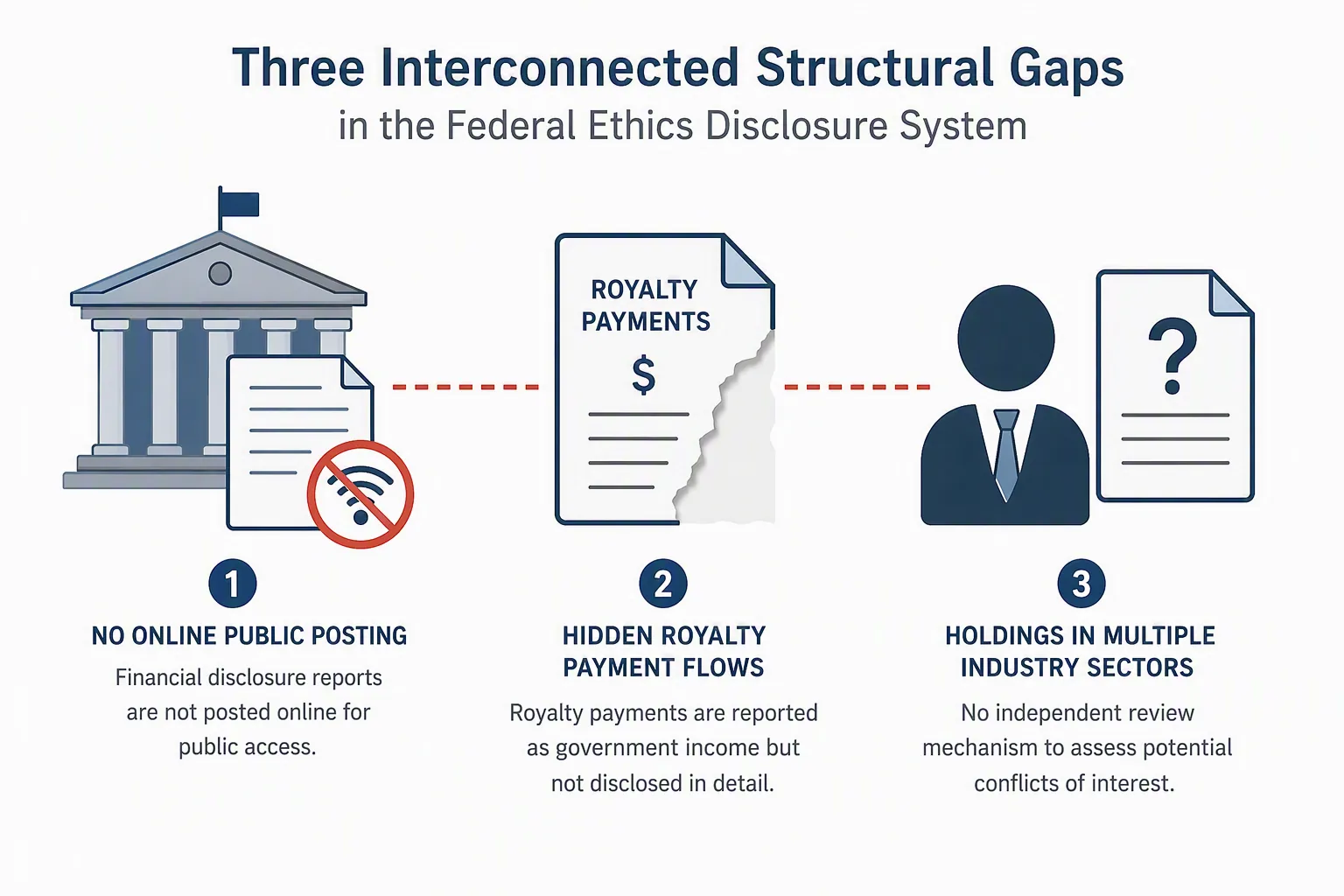
The online-access gap
Career officials’ disclosures were not posted in the same straightforward online manner as many political officials’ disclosures. The Center for Public Integrity reported that obtaining comparable records required a request process, and response times varied from one business day to 2.5 months.[2] That is not secrecy in the strict legal sense. It is access friction, and access friction matters when public claims are spreading faster than the paperwork can be independently checked.
This is where both sides of the public argument tend to become careless. Viral claims often treat the fact that a document required a records request as proof that something improper was hidden. Agencies, in turn, often treat eventual producibility as if it were equivalent to meaningful public access. Neither position is good enough for officials operating in a public-integrity environment where allegations can become litigation theories, congressional questions, or institutional risk events before a requester receives the file.
The royalty-payment gap
The more serious blind spot involves NIH royalty payments. Available public materials indicate that NIH royalty payments from drug-company licensees of government patents are treated as government income and excluded from public financial disclosure forms, even though Fauci was eligible for such payments.[4] That exclusion creates a verification problem the 2020 form cannot solve.
The public record does not disclose Fauci’s actual NIH royalty receipts. That is the key limitation. It is not accurate to say, from the available disclosure form, that royalty payments created a specific financial interest in a specific pharmaceutical product. It is also not reassuring to say the public had everything it needed, because a category of payments capable of creating an appearance problem was outside the public form.
OpenTheBooks and Judicial Watch litigation over NIH royalty records reported more than $350 million in NIH royalty payments during 2009–2019.[4] That system-level number does not prove Fauci had a disqualifying interest in any COVID-19 matter. It does show why an exclusion for royalty income is a poor fit for a public-facing ethics regime when drug-company licensees, government patents, and senior health officials occupy the same institutional space.
The broad-sector appearance gap
The third gap is harder to reduce to a single line on a form. Pandemic policy affected entire sectors: drug development, diagnostics, hospitals, public-health contractors, universities, and research institutions. A senior official may hold only diversified funds and still participate in decisions that move broad market categories. That may not create a § 208 violation, but it can create an appearance problem for which the public disclosure system offers little independent review.
This is not an argument for treating every index fund as a criminal conflict. That would make federal service nearly unworkable and would confuse general market exposure with a direct financial stake. The problem is different: the current structure leaves too much of the appearance-conflict assessment inside the agency’s ethics channel, with too little public visibility into how broad holdings were reviewed when an official’s work affected an entire industry.
For risk officers and counsel, that distinction matters. The legal question is whether there is a prohibited financial interest in a particular matter. The institutional-risk question is whether the agency can demonstrate, without asking the public to rely on personal trust, that senior officials’ holdings were reviewed against the scope of their authority. Fauci’s 2020 form answers the first question more clearly than the second.
What the FAUCI Act would have changed
The proposed FAUCI Act, S.4232 in the 118th Congress, is best read as evidence that lawmakers identified disclosure access as a fixable structural problem, not as proof that Fauci violated existing law.[5] A statute can tighten access rules because the old system was inadequate for public verification; it does not follow that every official who complied with the old system committed a violation.
That distinction is often lost in oversight disputes. Reform proposals are frequently built from episodes that exposed weakness without establishing illegality. Here, the weakness is plain enough: if a senior career official’s disclosure is public only after a request, if royalty income from licensees is excluded from the public-facing form, and if broad-sector holdings receive no visible independent appearance review, then the system has left predictable attack surfaces.
One boundary should also stay intact. The separate “unlawful appointment” theory sometimes associated with Fauci-related litigation belongs to a different legal category. It concerns Appointments Clause and grant-decision issues, not whether the 2020 financial disclosure created a conflict of interest. Merging the theories makes the conflict analysis less precise, not stronger.
The risk conclusion
The 2020 disclosure record supports technical compliance. It does not show individual pharmaceutical stock holdings, it was filed and certified through the NIH ethics process, and the available materials do not establish a criminal conflict under 18 U.S.C. § 208.
It also exposes a system that asks the public to accept too much on institutional trust. The record was public but not easily online for career officials. NIH royalty payments capable of creating appearance concerns were excluded from public forms, and Fauci’s actual royalty receipts remain undisclosed. Broad mutual-fund holdings did not create the same legal risk as direct pharma stocks, but there was no visible independent mechanism for reviewing whether broad sector exposure created appearance problems during policy work that affected entire industries.
That is the disciplined answer: no supported criminal conflict on the 2020 disclosure record, and still a federal ethics architecture that leaves senior officials exposed because key information is hard to access, partly excluded, or never independently reviewed in public-facing terms.
References
- Fauci’s Financial Disclosure Forms Are Publicly Available — FactCheck.org
- Analysis: Fauci’s finances are public, if you know where to look — Center for Public Integrity
- Dr. Anthony Fauci’s Financial Disclosure Shows $10.4M In Investments, $1.78M In Income — Forbes — January 15, 2022
- Lankford/HSGAC letter on NIH royalty payments — U.S. Senator James Lankford
- S.4232 - FAUCI Act — Congress.gov
Related records
Tool profile
Browse tool evaluations →Governing regulation
Browse the obligations tracker →Preventive workflow
Browse verification workflows →
Report a correction or tip
Spotted an outdated figure, a misstated fact, or a ruling this case record should reflect? Public comments are disabled for this content given the professional cost of a misreported case outcome, penalty amount, or rule text — use the structured correction channel instead.
Report a correction or tip for this record →