
Why Fauci Invoked the Fifth After Receiving a Pardon
Why Anthony Fauci's legal team advised him to plead the Fifth despite a prior presidential pardon: the perjury-trap doctrine created new criminal exposure that the pardon could not cover. This analysis explains the legal basis and its relevance for practitioners advising clients facing congressional testimony.
- Jurisdiction
- US Federal
- Court
- U.S. Senate Committee on Health, Education, Labor, and Pensions
- AI tool named
- None
- Ruling date
- Jul 29, 2026
- Source document
- View primary court order ↗
- Last verified
- Jul 30, 2026
Lex Machina Review is an independent risk-tracking and reference resource. Nothing on this site is legal advice, and using it does not create an attorney-client relationship. Every record is reviewed against primary sources but may not reflect the most current status of a matter — always verify directly against the cited court order, rule text, or a licensed attorney before relying on it.
Companion explanation — secondary to the source document above
The practical answer to why Fauci pleaded the Fifth at the Senate hearing is narrower than the political argument around it. Anthony Fauci’s pardon reduced federal criminal exposure for conduct during the covered period, but it did not immunize the sworn testimony he was being asked to give on July 29, 2026. That testimony would have been a new event, under oath, in front of hostile questioners, with a record ready for later use.
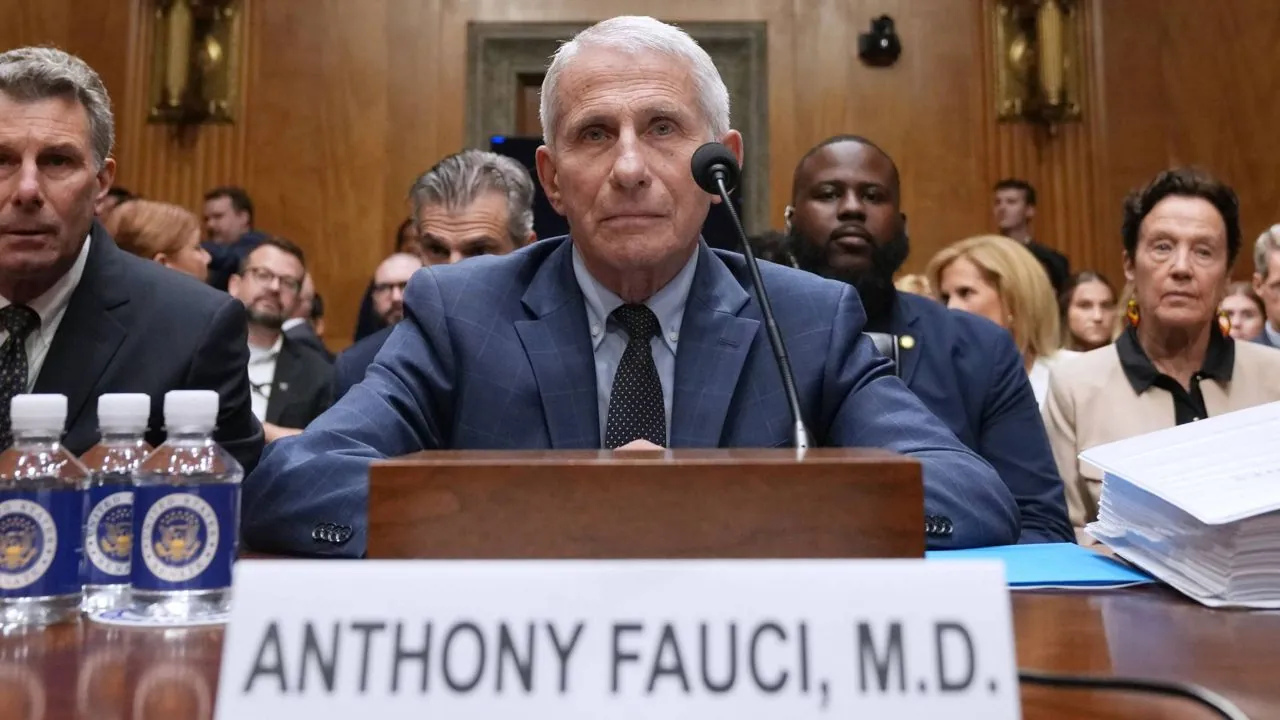
That distinction matters because the numbers and timing do not describe a casual refusal. Fauci invoked the Fifth Amendment 106 times over roughly three hours before a Senate committee on July 29, 2026.[1] The pardon he had received from President Joe Biden on Jan. 19, 2025 covered federal offenses from Jan. 1, 2014 through Jan. 19, 2025; it did not cover state crimes and did not cover new perjury or false-statement exposure created by later testimony.[2] As of July 30, 2026, Sen. Rand Paul’s threatened contempt vote was still pending for Aug. 5, not an accomplished result.[3]
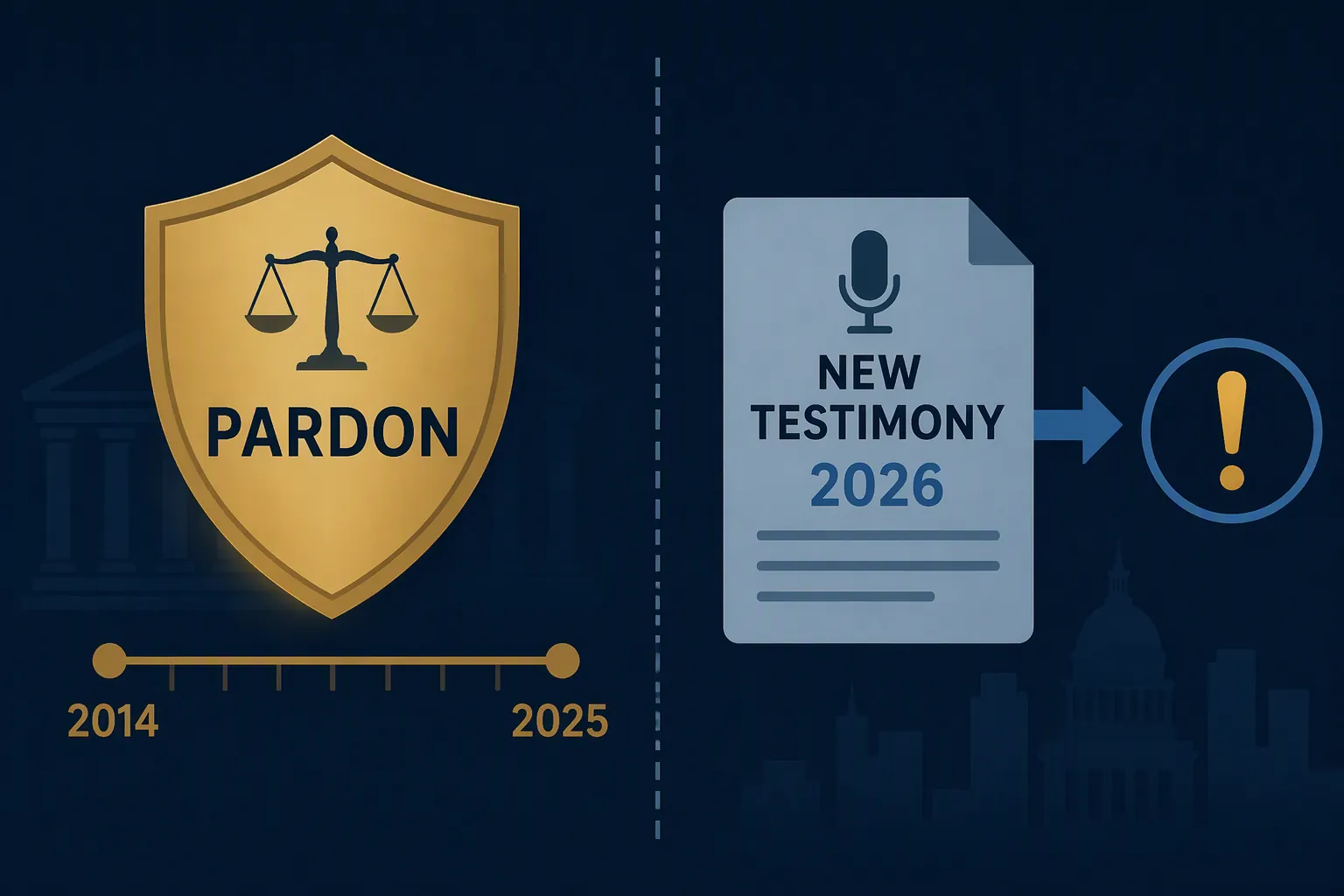
The pardon solved one problem, not the hearing problem
A pardon for past federal conduct is not a license to answer imprecisely in a later congressional hearing. It can remove punishment for the covered federal offenses, but it does not pre-clear every sentence a witness may utter afterward. If a witness answers under oath and prosecutors later characterize an answer as knowingly false, misleading, or obstructive, the alleged crime is not the old conduct. It is the new statement.
That is the counseling point that tends to disappear in television versions of the dispute. The question was not only whether Fauci could be prosecuted federally for pandemic-era conduct covered by the Biden pardon. The harder question was whether answering Paul’s questions would create exposure under federal false-statement, obstruction, or perjury theories, including statutes identified in the record such as 18 U.S.C. §§ 1001, 1505, and 1621.[3]
For a witness with a clean relationship to the committee, that risk might remain abstract. Here it was not abstract. Paul had released 1,141 pages of Fauci diary entries in the days immediately before the hearing and had previously made public demands to see Fauci imprisoned.[4] Those facts do not prove that a prosecutor would bring a false-statement case. They do make it easier for counsel to say the danger was not imaginary.
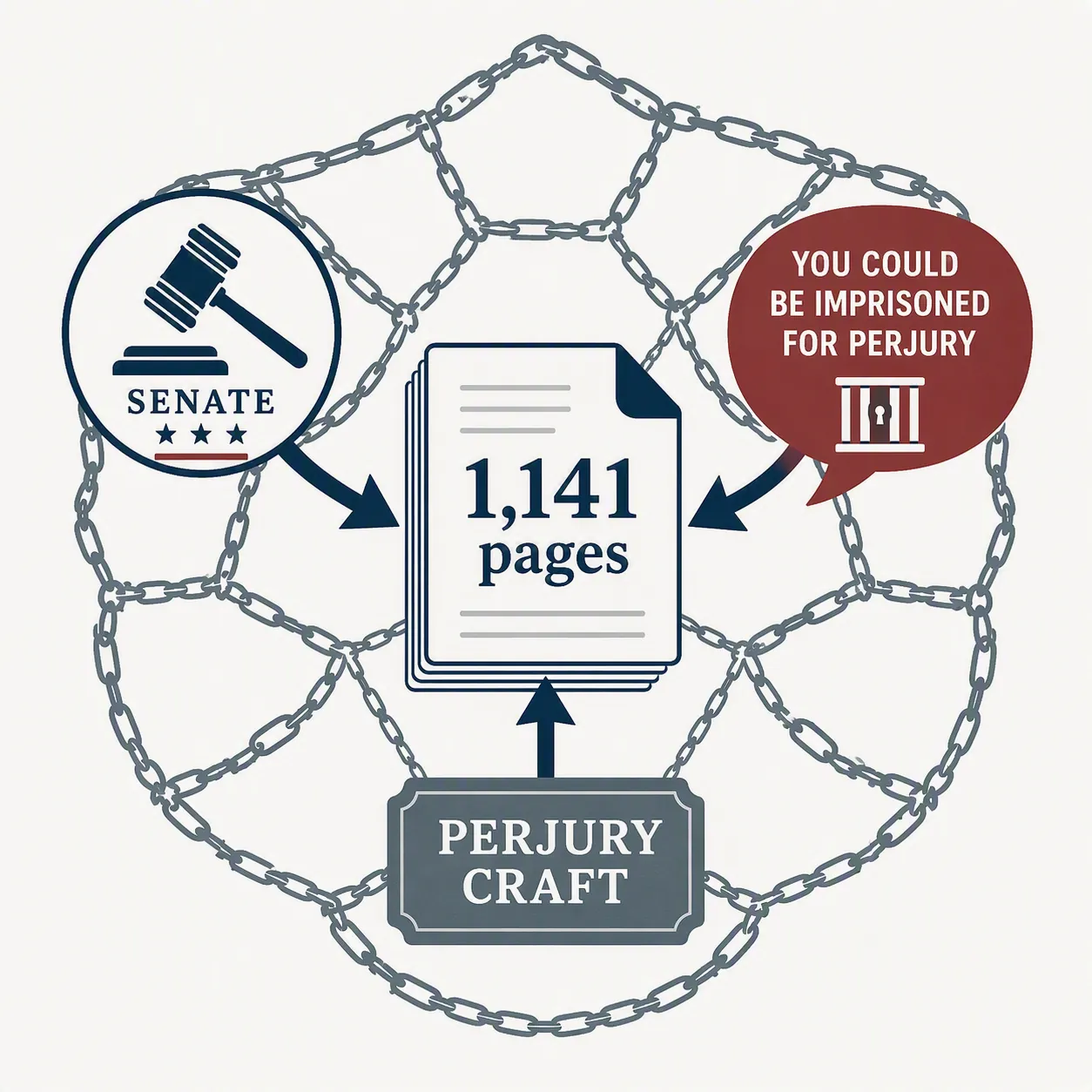
The diary release is especially important because it changes the nature of the examination. A witness is no longer answering only broad policy questions or defending a public record. He is being asked to respond, in real time, to a preselected document set in a hostile forum, while every qualification, lapse of memory, and disagreement over wording is preserved. In that setting, the lawyer’s fear is not that the client will deliberately lie. The fear is that the client will give one answer that can later be framed as inconsistent with a document, an email, a prior interview, or another witness’s recollection.
Sen. Richard Blumenthal gave the defense argument its bluntest label during the hearing, calling the proceeding “a perjury craft for criminal prosecution going forward” and describing Fauci’s invocation of the Fifth as “the more prudent course.”[3] That phrase is loaded, and Paul would contest the premise behind it. But for privilege analysis, the point is not whether the committee chair subjectively intended to manufacture a prosecution. The point is whether the circumstances gave the witness a reasonable basis to fear that compelled answers could be used against him.
How testimony becomes new exposure
The path from “pardoned conduct” to “new exposure” is not complicated, but it is unforgiving. The witness enters with protection for covered federal offenses. The committee asks about the same factual period. The witness answers. The answer is later compared with documents and prior statements. If the government claims the answer was false or obstructive, the prosecution theory is built around the answer, not around the pardoned conduct.
| Question counsel has to answer | Why the pardon does or does not help |
|---|---|
| Can Fauci be prosecuted federally for covered conduct from Jan. 1, 2014 to Jan. 19, 2025? | The Biden pardon was reported to cover federal offenses during that period.[2] |
| Can he be prosecuted federally for a false statement made in the July 29, 2026 hearing? | The pardon did not cover new perjury or false-statement exposure created by later testimony.[2] |
| Can a federal pardon eliminate state-level jeopardy? | No. The reported pardon did not cover state crimes.[2] |
| Has a court already resolved whether this kind of time-limited preemptive pardon eliminates the Fifth Amendment privilege for testimony about the pardoned period? | No federal court ruling on that precise question has been identified, and Paul himself acknowledged the issue probably had never been tested legally.[5] |
That second row is where the legal strategy lives. A client can be safe from prosecution for the old act and still be exposed by the new answer. The pardon may shut one door while the hearing opens another.
This is why the “just tell the truth” response is persuasive in ordinary conversation and still incomplete as legal advice. Of course a truthful answer is not perjury. But compelled testimony risk is not limited to the witness who plans to lie. A truthful answer may identify people, documents, timelines, meetings, or decision points that prosecutors can use as links in a later chain. A careful but mistaken answer may become a false-statement theory. A qualified answer may be attacked as evasive. A failure to remember may be compared with a document and reframed as concealment.
None of that means every congressional hearing is a perjury trap. It means a witness’s lawyer does not analyze the privilege by asking whether the client has something to hide. The lawyer asks what a hostile record-builder can do with the answer after the hearing is over.
The reasonable-apprehension threshold did the real work
The Fifth Amendment question is not whether prosecution is certain. It is whether the witness has a reasonable apprehension of prosecution. Forbes quoted Richard Hughes IV of George Washington University and Randy Zelin of Cornell Law describing that as the relevant threshold for a valid invocation.[3] The quotations are secondhand press accounts, not a court ruling on Fauci’s invocation, but they capture the working standard counsel would have been applying at the table.
The facts pushing counsel toward that conclusion were cumulative: Paul’s prior public demands for imprisonment, the immediate pre-hearing release of 1,141 pages of diary entries, a hearing format built around sworn answers, and an announced path toward contempt if Fauci continued to refuse.[3][4] Any one of those facts could be argued away. Together, they gave the privilege something concrete to attach to.
That is also why the invocation count matters without proving anything by itself. One hundred and six invocations over roughly three hours suggests a strategic position maintained across the examination rather than a one-off refusal to answer a uniquely dangerous question.[1] It also suggests that counsel was not trying to distinguish safe questions from unsafe ones in the moment. In a hostile document-driven hearing, that kind of question-by-question triage can be its own hazard.
Brown, Burdick, and the gap this hearing exposed
The most tempting doctrinal shortcut is to say that a pardon removes the Fifth Amendment privilege because there is no longer any prosecution to fear. Brown v. Walker is the usual starting point for that proposition: where immunity is broad enough to replace the privilege, the witness can be compelled to testify because the danger of prosecution has been removed.[6]
But Brown answers only the clean version of the problem. It helps when the immunity or pardon is coextensive with the exposure created by the testimony. Fauci’s situation was messier. The Biden pardon was time-limited and offense-limited to federal conduct in the covered period. The hearing took place later. The allegedly criminal act that counsel feared would not necessarily be the old conduct; it could be the new sworn answer.
Burdick v. United States supplies another familiar rule, but it did not give Fauci an exit ramp. Burdick held that a witness may refuse a pardon, a point often remembered because accepting a pardon can carry legal consequences.[7] Fauci had accepted Biden’s pardon. Whatever Burdick might mean for a witness deciding whether to accept clemency in the first place, it did not let him treat an accepted pardon as though it had never happened.
The unresolved question is the one Paul himself reportedly acknowledged: whether a time-limited preemptive pardon eliminates the self-incrimination privilege for testimony about the pardoned period has probably never been tested legally.[5] That concession matters. It means neither side had a clean controlling answer. Fauci’s lawyers were not invoking the Fifth in the face of settled law that plainly foreclosed the privilege. They were choosing the safer position inside an unsettled space.
For defense counsel, unsettled law rarely feels like neutral terrain. If the client answers and a later prosecutor builds a false-statement theory, the harm has already been created. If the client invokes and the committee pursues contempt, the fight is at least framed around the validity of the invocation and the committee’s enforcement power. That is not a harmless fight, but it is a different one.
The contempt threat was real, but it was not the same risk
Paul’s counterargument deserves its due because it is the argument many non-lawyers find intuitive. If Fauci had been pardoned, and if truthful answers are not crimes, then refusing to answer can look like obstruction by another name. Paul also threatened a contempt vote, scheduled for Aug. 5, 2026, after Fauci’s repeated invocations.[3]
That threat was not theatrical in the sense that it could be ignored. A contempt process can impose cost, publicity, litigation burden, and uncertainty. It can also become part of a political record that follows the witness long after the hearing transcript cools. Counsel advising Fauci would have had to price that risk seriously.
Still, contempt is a known category of fight. The witness asserts a privilege; the committee disputes it; the dispute proceeds through institutional and legal channels. A false-statement or perjury theory is less bounded. It can be built later, sentence by sentence, from the transcript, the diary entries, prior public statements, emails, and witness interviews. The public may hear both as “legal trouble,” but they are not the same counseling problem.
As of July 30, 2026, the contempt vote had not yet occurred. Any conclusion about whether the committee would vote, whether enforcement would follow, or whether a court would sustain the privilege would go beyond the record available now.
State exposure remained a separate reason for caution
The state-law point is easy to overstate and too important to omit. Biden’s pardon was a federal pardon. It did not cover state crimes.[2] That means a witness could still have a reasonable concern that testimony about underlying facts might provide leads, admissions, or connective tissue for a state-level theory.
The record supplied here does not identify any announced state investigation of Fauci. So the state-exposure argument should not be inflated into a claim that state charges were imminent or even likely. It is more modest than that: because a federal pardon does not bind state authorities, it does not by itself eliminate every possible source of criminal jeopardy.
That matters at the privilege stage. The witness does not need to prove that a state prosecution will happen. He needs a reasonable basis to fear that compelled testimony may furnish evidence usable in a prosecution not extinguished by the pardon. On the facts available, that concern remained legally available even if its practical likelihood was uncertain.
Why the congressional setting sharpened the trap
Congressional testimony has its own procedural imbalance. The witness is not in a criminal trial with the same evidentiary controls, pacing, and judicial supervision. The questioning can be political, repetitive, document-heavy, and designed for video as much as for fact development. A careful answer may be too slow for the format; a fast answer may be too loose for the transcript.
That structural danger has become a broader concern for lawyers advising witnesses in coordinated investigations. A June 2026 Farella Braun + Martel analysis described a “Catch-1001” dynamic in which congressional testimony can become dangerous when committee investigations and aggressive false-statement theories interact.[8] The Fauci hearing fit enough of that pattern to make the comparison useful, even if it does not prove any particular prosecutorial plan.
The record staged before Fauci made the danger more than theoretical. Paul had a document set. He had a long public history of accusing Fauci. He had signaled punitive aims. The hearing was sworn and televised. If Fauci answered, any later discrepancy would not be a private clarification between counsel and committee staff. It would be a permanent clip and a transcript line.
A hypothetical illustrates the problem without needing to invent facts about Fauci. Suppose a pardoned witness is asked whether he ever discussed a particular subject with a particular official. He answers from memory. Later, investigators locate a calendar entry, a text message, or a note that arguably contradicts the answer. The prosecution theory does not need to reopen the pardoned conduct directly. It can focus on whether the hearing answer was knowingly false. That is the sort of exposure a pardon for past conduct does not neutralize.
What the invocation does and does not prove
Fauci’s invocation does not prove guilt. It also does not prove that the pardon was useless. The pardon did meaningful work against federal prosecution for covered past conduct. The Fifth Amendment invocation addressed a different risk: the possibility that testimony in 2026 would create fresh exposure outside the pardon’s protection.
Nor does the invocation conclusively establish that a court would sustain every refusal. The legal question remains unresolved at the level that matters most: no federal court has been identified as having decided whether this type of preemptive, time-limited pardon wipes out the privilege for compelled testimony about the covered period.[5] A court could draw lines differently from defense counsel. A committee could argue that the pardon removed the relevant danger. Paul’s position is not frivolous merely because it is incomplete.
But counseling a witness in that room is not an academic exercise in eventual appellate neatness. It is a live assessment of which mistake is less recoverable. A contempt fight after an invocation is serious. A newly created false-statement record may be worse. Given the pardon’s limits, the document release, the public prosecution rhetoric, and the unresolved doctrine, Fauci’s Fifth Amendment invocation was a narrow defensive response to the risks created by testifying, not a generic refusal to cooperate.
References
- Anthony Fauci invokes 5th Amendment right to refuse to answer questions at Covid hearing, NBC News, July 29, 2026
- Fauci invokes Fifth Amendment in Senate hearing on COVID-19 pandemic, AP News, July 29, 2026
- Fauci invokes Fifth Amendment rights in Senate hearing, accuses Rand Paul of ‘unhinged obsession’ with me, Forbes, July 29, 2026
- Fauci to face Rand Paul’s US Senate committee after diary release, Reuters, July 29, 2026
- Fauci pleads Fifth, criticizes Rand Paul at Senate hearing, STAT News, July 29, 2026
- Do Presidential Pardons Remove the Fifth Amendment Rights of Recipients, Constitution Center
- Burdick v. United States, 236 U.S. 79 (1915), Justia
- Catch-1001: How Coordinated Investigations Have Made Congressional Testimony Dangerous, Farella Braun + Martel, June 2026
Related records
Tool profile
Browse tool evaluations →Governing regulation
Browse the obligations tracker →Preventive workflow
Browse verification workflows →
Report a correction or tip
Spotted an outdated figure, a misstated fact, or a ruling this case record should reflect? Public comments are disabled for this content given the professional cost of a misreported case outcome, penalty amount, or rule text — use the structured correction channel instead.
Report a correction or tip for this record →