
Does a Pardon Negate Fauci's Fifth Amendment Right?
Rand Paul says Biden's January 2025 pardon negates Fauci's Fifth Amendment privilege, citing Brown v. Walker; Fauci's counsel counters that newly sworn testimony and state prosecution risk keep the privilege alive. The legal question is genuinely unsettled, and the committee's pending contempt vote is the likely vehicle for getting it before a court.
- Jurisdiction
- US federal
- Court
- U.S. Senate Homeland Security and Governmental Affairs Committee
- AI tool named
- none
- Ruling date
- Jul 29, 2026
- Source document
- View primary court order ↗
- Last verified
- Aug 2, 2026
Lex Machina Review is an independent risk-tracking and reference resource. Nothing on this site is legal advice, and using it does not create an attorney-client relationship. Every record is reviewed against primary sources but may not reflect the most current status of a matter — always verify directly against the cited court order, rule text, or a licensed attorney before relying on it.
Companion explanation — secondary to the source document above
Legal information only; not legal advice. Legal-background review: Miriam K. Vale, J.D., congressional investigations and white-collar procedure. Last verified: August 2, 2026.
The short version of the July 29, 2026 Fauci-Paul hearing is not that one side made up a constitutional argument and the other hid behind a magic phrase. At the Senate Homeland Security and Governmental Affairs hearing, Dr. Anthony Fauci invoked the Fifth Amendment, while Sen. Rand Paul and Sen. Josh Hawley argued that President Joe Biden’s January 19, 2025 pardon had removed the danger of federal prosecution and therefore stripped the privilege of its foundation. Fauci’s lawyer, David Schertler, answered that the pardon did not cover newly sworn testimony given after the pardon, and did not protect against prosecution outside federal pardon power. The Hill reported that Fauci invoked the Fifth Amendment 111 times; other accounts used broader formulations such as “more than 100,” and Reuters separately counted 15 declined questions from Paul, so those figures should not be collapsed into one statistic.[1]
That is the legal knot. A pardon can matter very much to the Fifth Amendment analysis. But this pardon’s wording matters too. The reported scope was federal offenses “arising from or in any manner related to” Fauci’s government work from 2014 through January 19, 2025.[1] If Congress asks about already-pardoned federal conduct, Paul’s objection has a serious doctrinal foothold. If Congress asks questions that require a witness to create new sworn statements, or questions that could matter to a state prosecutor, the analysis stops being tidy.
What Paul’s Argument Gets Right
Paul’s most important point is not the television-ready version that a pardon “negates” the Fifth Amendment. It is the older and narrower proposition that the privilege against self-incrimination protects against real prosecution risk, not embarrassment, political damage, or reputational ruin. If a valid pardon eliminates the criminal exposure for the offense under inquiry, the witness may no longer have a Fifth Amendment basis to refuse on that ground.
That proposition has a real Supreme Court citation behind it. In Brown v. Walker, decided in 1896, the Court held that a witness who had received immunity equivalent to protection from prosecution could not refuse to testify by invoking the Fifth Amendment; the Court also used pardon language, saying the pardoned offender is treated “as if [the offense] had never been committed.”[2] Paul’s reported “maybe the Fifth Amendment doesn’t attach” formulation is therefore not free-floating rhetoric. It is an argument about whether the prosecution risk that makes the privilege available still exists.[1]
Hawley’s version pressed the same premise more directly: if the pardon forecloses any reasonable chance of future prosecution, the privilege no longer has work to do.[1] That is a colorable congressional position. Committees do not have to accept a witness’s invocation just because the words “Fifth Amendment” are spoken. They may test whether the asserted risk is real, appreciable, and connected to the questions being asked.
The difficulty is that Brown does not answer every question this hearing created. Brown did not involve this exact mix: a preemptive presidential pardon, congressional questioning after the pardon date, disputed exposure from the witness’s new answers, and the possibility that non-federal prosecutors might care about the testimony. Treating Brown as a complete answer skips the very step that usually decides privilege fights: identifying the prosecution risk with precision.
The Pardon’s Scope Is the Pressure Point
The reported Biden pardon did not grant Fauci a general license for all future statements. It covered federal offenses arising from, or related to, his government work during the stated window ending January 19, 2025.[1] That date does a great deal of work. It separates past conduct from future testimony. It also separates federal pardon power from state criminal authority.
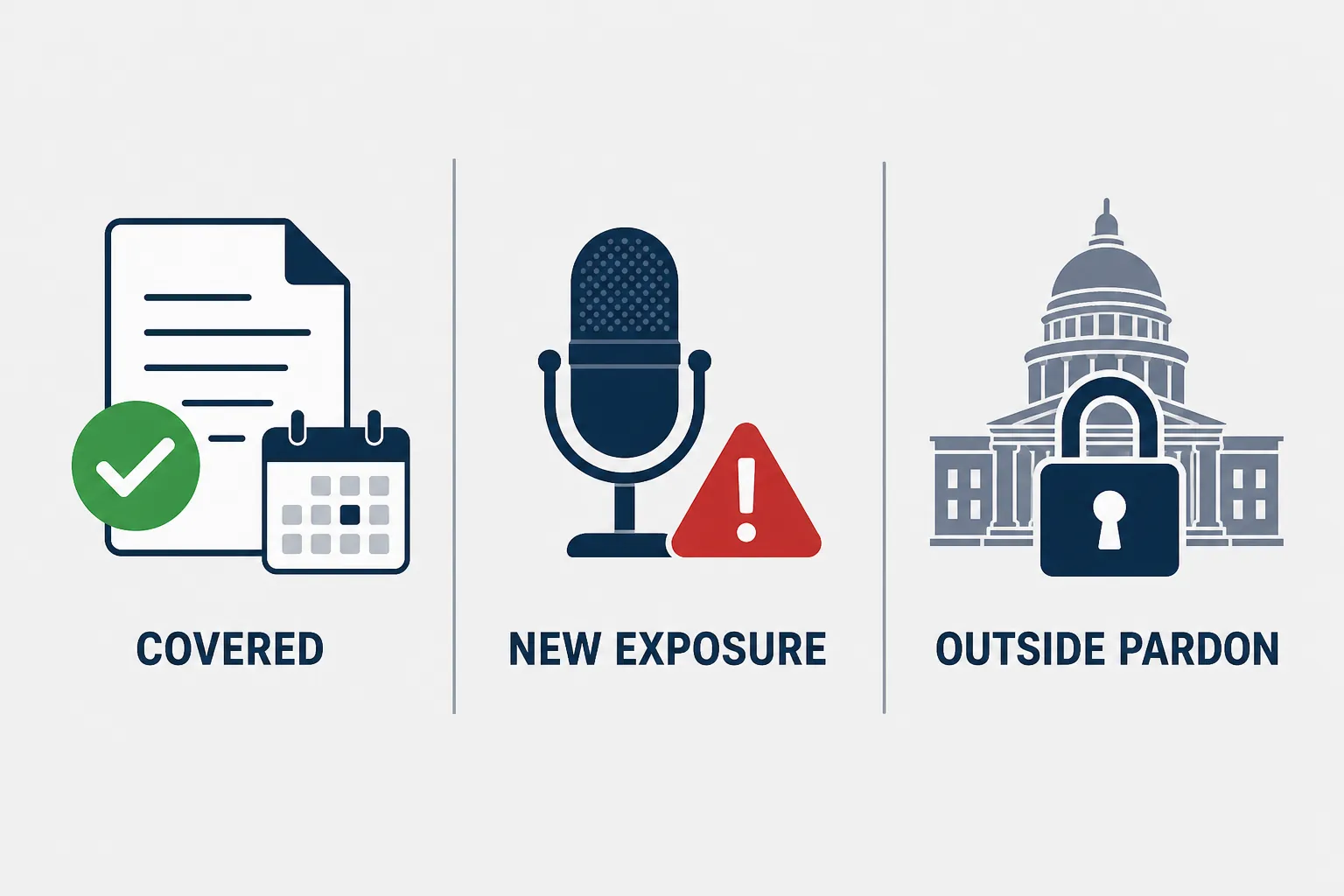
For analysis, the hearing is easier to read if three categories are kept separate:
- Past federal conduct within the pardon: the strongest terrain for Paul’s Brown-based argument.
- New sworn testimony at the hearing: the core of Schertler’s perjury-exposure objection.
- Possible state exposure: a separate limit because a presidential pardon reaches federal offenses, not state crimes.
The second category is not a lawyerly technicality. A witness who answers under oath can commit a new offense by lying, obstructing, or otherwise making false sworn statements, depending on the statute and facts. The pardon may protect the witness from federal prosecution for covered past conduct, but it does not logically pre-pardon every sentence the witness might later utter to Congress. Schertler’s position, as reported by The Hill, was that testimony given that day could create new criminal exposure not covered by the pardon.[1]
That objection does not mean every question automatically triggers a valid Fifth Amendment claim. A court would still need to examine the question, the answer sought, and the realistic chain by which the answer could incriminate the witness. But it does mean the committee cannot resolve the issue merely by pointing to the existence of a pardon. The scope clause and the timing of the sworn testimony have to be read together.
Burdick Complicates the Easy Pardon Story
Burdick v. United States, decided in 1915, is not the same case as Brown, but it is a useful warning against treating pardons as automatic constitutional solvent. In Burdick, the Supreme Court held that a witness could reject a proffered pardon and retain the privilege against self-incrimination.[3] The case is often remembered for the proposition that a pardon carries an “imputation of guilt” and acceptance may involve confession, but its practical relevance here is narrower: the relationship between pardon and privilege has never been as simple as “pardon exists, Fifth disappears.”[3]
Fauci’s situation is different because the pardon had already been issued and the public dispute is not framed as a rejection of it. Still, Burdick matters because it resists the assumption that executive clemency mechanically controls a witness’s privilege position in every later proceeding. Brown supplies the committee’s strongest authority; Burdick supplies caution about overreading it.
The State-Prosecution Caveat Is Not Decorative
The other limit is structural. Presidential pardons operate against federal offenses. They do not pardon state crimes. The National Constitution Center’s discussion of pardons and the Fifth Amendment makes that caveat explicit: a federal pardon may remove federal exposure, but it does not reach state prosecution risk.[4]
That caveat does not prove that Fauci faced a state prosecution risk on any particular question. The record supplied for this article does not establish a specific state investigation, charge theory, or prosecutor. The narrower point is the one that matters procedurally: if the witness can identify a real and appreciable state-law risk, the federal pardon would not eliminate it. A committee cannot answer that problem with Brown alone, because Brown’s logic depends on the relevant prosecution risk actually being removed.
What Happened in the Room Matters Less Than What It Set Up
The hearing produced the kind of conflict congressional hearings are built to produce. CNN reported that Fauci invoked the Fifth Amendment during the Senate appearance, and Reuters reported that he declined to answer 15 questions from Paul.[5][6] NBC News likewise described the proceeding around Fauci’s Fifth Amendment invocation and the COVID-related questioning.[7] C-SPAN’s clip captured Paul removing Schertler from the hearing after Schertler responded to Paul, a moment that will draw attention because it supplies conflict on video.[8]
But the video confrontation is not the legal answer. In privilege disputes, the lawyer’s job is often unlovely: preserve the record, keep the witness from volunteering into new exposure, and force the demanding body to specify the consequence it intends to pursue. That does not make every committee demand abusive. Congress has investigatory authority, and committees are not required to abandon relevant questions the moment counsel objects. It does mean that the next meaningful move is procedural.
Contempt Is the Vehicle, Not the Verdict
The Congressional Research Service describes several mechanisms through which Congress may respond to noncompliance by witnesses, including criminal contempt, civil enforcement, and inherent contempt, each with different institutional steps and consequences.[9] A committee contempt vote is therefore not the same thing as a judicial ruling that the Fifth Amendment claim failed. It is the mechanism by which the dispute may be escalated.
Fox News separately reported that a committee vote on a certifying resolution was scheduled for the following week; as of August 2, 2026, that vote remained pending.[10] The Hill reported that Paul may bypass a full Senate vote and write directly to the Justice Department seeking prosecution, while also describing the open legal question created by the pardon and privilege dispute.[1] That posture matters. If DOJ declines to prosecute, the committee may have a political fight but no immediate judicial test. If the contempt route proceeds in a way that produces litigation, a court would have to decide the narrower questions the hearing exposed rather than the broader cable-news question of whether a pardon always defeats the Fifth Amendment.
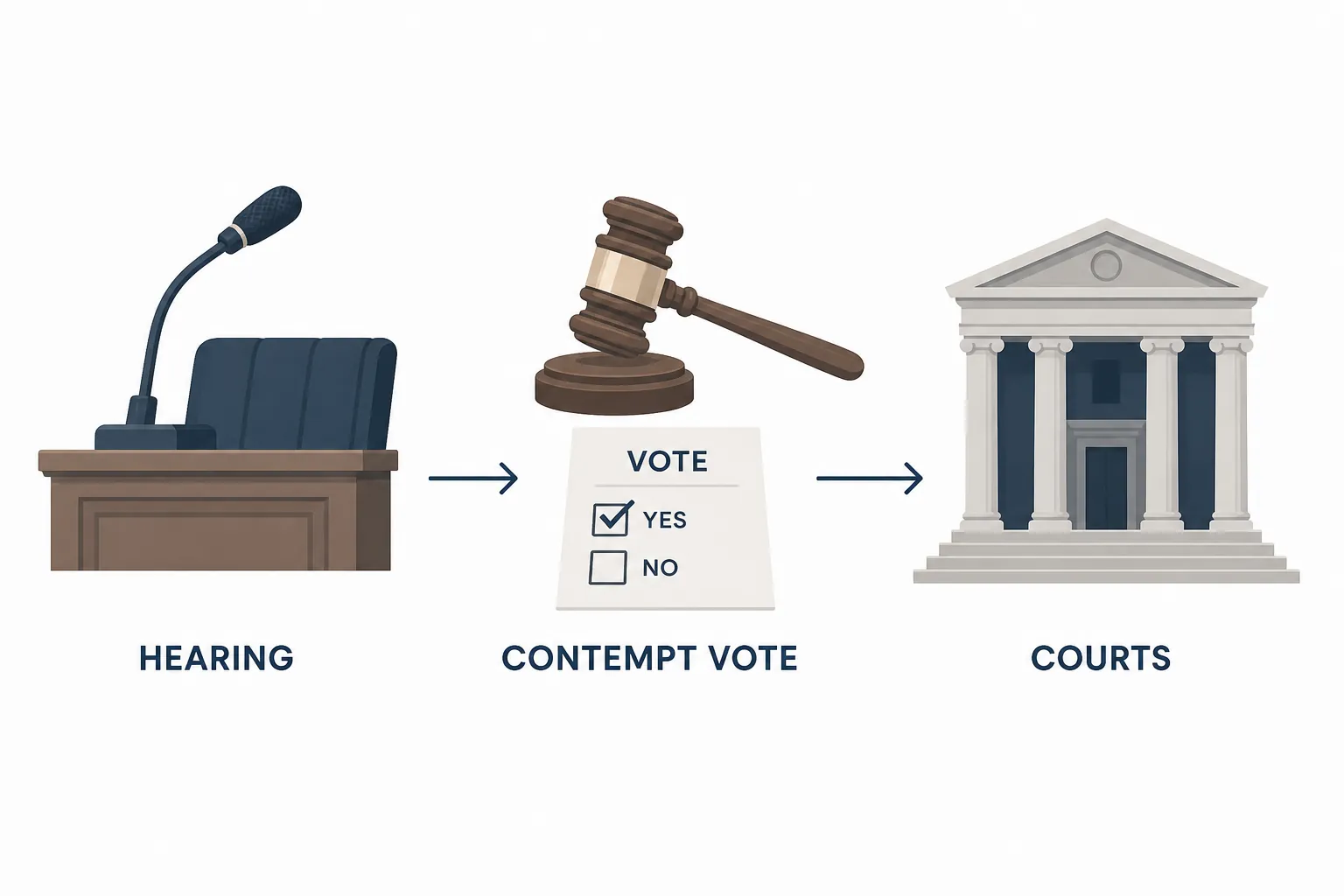
That litigation, if it arrives, would likely start with the actual questions asked. Courts do not usually decide privilege in the abstract. They examine whether a responsive answer could furnish a link in a chain of incrimination. The committee’s strongest position will be where the questions are confined to federal conduct plainly covered by the pardon. Fauci’s strongest position will be where the questions require new sworn factual assertions that could later be alleged to be false, misleading, obstructive, or relevant to non-federal exposure.
| Issue | Why it matters |
|---|---|
| Covered federal past conduct | Brown gives the committee a serious argument that the privilege no longer applies to pardoned conduct. |
| New sworn testimony | A later answer under oath can create fresh exposure that the January 19, 2025 pardon did not necessarily cover. |
| State prosecution risk | A presidential pardon does not reach state offenses, so any real state-law risk must be analyzed separately. |
| Contempt procedure | A committee vote or referral would frame the dispute for possible judicial review; it would not itself settle the constitutional question. |
The Narrow Legal Question
The cleanest question is not “Does a pardon negate the Fifth Amendment?” The cleaner question is: which prosecution risk did this pardon actually remove?
For covered federal offenses arising from Fauci’s government work through January 19, 2025, Paul and Hawley can point to Brown and argue that the privilege has no remaining criminal-risk function. For new testimony at a July 2026 hearing, Schertler can answer that the witness is being asked to create fresh sworn statements after the pardon date. For potential state exposure, the federal pardon is not enough by itself because presidential clemency does not bind state prosecutors.[2][4]
None of that decides whether every one of Fauci’s invocations was valid. It does decide that the pardon is not a universal off switch. The committee’s argument has a real doctrinal anchor, and Brown is the right place to start. The witness’s answer has a serious scope objection, and Brown does not neatly resolve it. If the committee presses contempt, the courts may finally have to decide how far a preemptive presidential pardon reaches when Congress asks a pardoned witness questions that could themselves create new criminal exposure.
References
- Fauci’s legal protection from pardon, Fifth Amendment is an open question, The Hill.
- Brown v. Walker, 161 U.S. 591 (1896), Justia U.S. Supreme Court Center, 1896.
- Burdick v. United States, 236 U.S. 79 (1915), Justia U.S. Supreme Court Center, 1915.
- Do presidential pardons remove the Fifth Amendment rights of recipients?, National Constitution Center.
- Anthony Fauci pleads the Fifth Amendment in Senate testimony, CNN, July 29, 2026.
- Fauci to face Rand Paul’s US Senate committee after diary release, Reuters, July 29, 2026.
- Anthony Fauci takes the 5th Amendment during COVID hearing with Rand Paul, NBC News.
- Chairman Paul Removes Dr. Fauci's Attorney From Hearing After Responding to Paul's Threats, C-SPAN.
- Congress’s Contempt Power and the Enforcement of Congressional Subpoenas: Law, History, Practice, and Procedure, Congressional Research Service.
- Fox News report on scheduled committee vote.
Related records
Tool profile
Browse tool evaluations →Governing regulation
Browse the obligations tracker →Preventive workflow
Browse verification workflows →
Report a correction or tip
Spotted an outdated figure, a misstated fact, or a ruling this case record should reflect? Public comments are disabled for this content given the professional cost of a misreported case outcome, penalty amount, or rule text — use the structured correction channel instead.
Report a correction or tip for this record →