
FBI Captures Elaine Escoe in Jamaica, Fourth Most Wanted Capture in Weeks
The FBI's Most Wanted Fraudsters list has captured its fourth fugitive in five weeks with Elaine Escoe's extradition from Jamaica. This analysis quantifies the enforcement yield—four captured fugitives, ~$1.8B alleged fraud, 3,500+ evasion days—and assesses whether the list signals a durable shift in cross-border fraud enforcement that legal professionals should incorporate into client risk briefings.
- Jurisdiction
- US Federal
- Court
- U.S. District Court
- AI tool named
- None
- Ruling date
- Jul 27, 2026
- Source document
- View primary court order ↗
- Last verified
- Jul 27, 2026
Lex Machina Review is an independent risk-tracking and reference resource. Nothing on this site is legal advice, and using it does not create an attorney-client relationship. Every record is reviewed against primary sources but may not reflect the most current status of a matter — always verify directly against the cited court order, rule text, or a licensed attorney before relying on it.
Companion explanation — secondary to the source document above
| Risk Digest verification frame | Current read |
|---|---|
| Category | Fraud enforcement / cross-border fugitive recovery |
| Last verified | July 27, 2026 UTC |
| Primary signal | Elaine Escoe’s return from Jamaica makes her the fourth captured fugitive from the FBI’s new Most Wanted Fraudsters list in roughly five weeks. |
| Source caveat | Several official DOJ and FBI statements were not directly reviewable from primary pages; this analysis relies on DOJ/FBI statements as reported by Fox News, WPBF, NBC Miami, and the Miami Herald where noted. |
| Legal status caveat | The fraud figures are allegations; capture is not conviction; Escoe’s alleged ringleader role remains to be adjudicated. |
The headline “FBI captures Elaine Escoe, Jamaica fraud suspect” is accurate, but it is too small for the risk question. The more useful read is that Escoe’s return appears to mark the fourth capture in roughly five weeks from a list the FBI and DOJ launched on June 4, 2026, with Escoe among the first eight named fugitives. [1]
On the numbers available now, the early capture set is unusually dense: four captured fugitives, about $1.8 billion in alleged fraud exposure, more than 3,500 combined evasion days, and activity spanning three continents. [1] That is still an early enforcement sample, not a settled trend. But for a partner briefing, board update, or client exposure memo in Q3 2026, it is no longer just launch publicity.
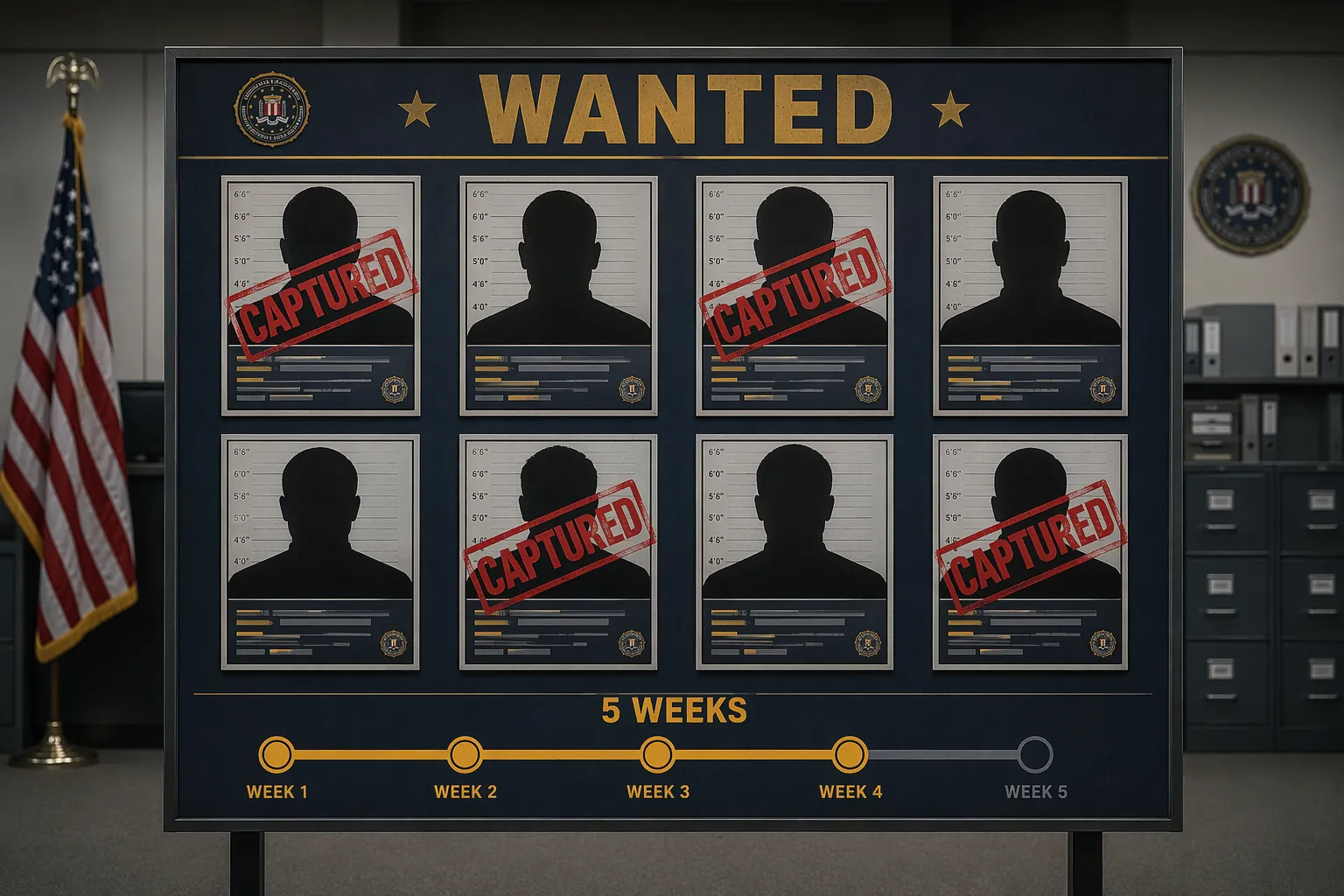
The Escoe case is useful because it changes the list-level count
Escoe was wanted in connection with an alleged COVID-relief fraud scheme. The public figures are not perfectly uniform: DOJ-related reporting has described the case as a $32 million matter, while NBC Miami’s program-by-program breakdown totals approximately $34.1 million, including $29.1 million tied to PPP, $1.2 million tied to the Restaurant Revitalization Fund, and $3.8 million tied to the Shuttered Venue Operators Grant program. [2]
That discrepancy should be handled as a source difference, not rounded away. For the granular case record—scheme mechanics, application counts, and the program-level allegations—the better file is the existing Elaine Escoe COVID-fraud case record. This article is concerned with what her capture does to the enforcement signal.
The distinction matters. A single fugitive return can be a case update. Four returns from a newly launched eight-person list within roughly five weeks is a throughput question. The list has, on the reported figures, moved from publication to verified custody changes quickly enough that legal teams should be asking whether the public list is functioning as an operational filter, not merely as a branding device.
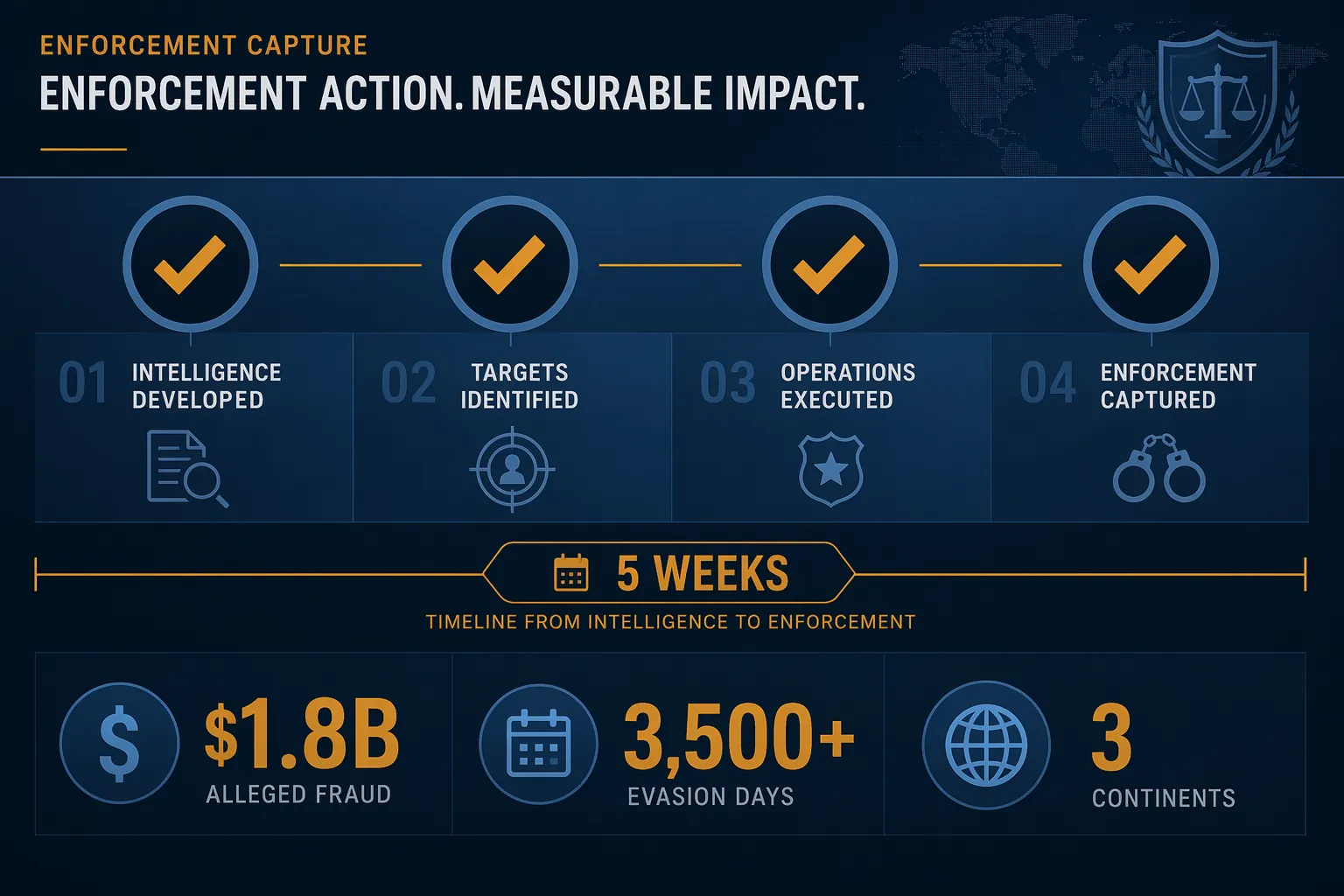
What counts as the capture metric
The relevant metric is not “the FBI issued a list.” It is whether named targets on that list move from fugitive status to captured status within a measurable window. On the current record, the defensible formulation is narrow: the Most Wanted Fraudsters list launched June 4, 2026; Escoe was one of the initial eight named fugitives; she is now reported as the fourth captured fugitive from that list in roughly five weeks. [1]
That count should not be inflated into conviction statistics. It does not show guilt, sentencing exposure, asset recovery, extradition speed across all cases, or a durable year-over-year improvement. It shows something more limited and still material: the list appears to have produced confirmed fugitive recoveries fast enough to change the risk conversation for high-dollar fraud matters with international movement.
| Measure | Current supported read | What it does not prove |
|---|---|---|
| Named-list capture count | Four captured fugitives in roughly five weeks. | It does not prove future capture rates will remain this high. |
| Alleged fraud amount | Approximately $1.8 billion across the four captured fugitives. | It does not establish adjudicated loss or criminal liability. |
| Evasion duration | More than 3,500 combined evasion days. | It does not show why each fugitive evaded capture for that period. |
| Geographic reach | Reported activity across three continents. | It does not prove uniform capability in every jurisdiction. |
| Broader framework | FBI-reported figure of more than 30 additional high-value targets returned to the United States since June 2026. | It is a reported FBI figure through news coverage and should not be treated as independently audited. |
The additional FBI-reported figure—more than 30 high-value targets returned to the United States since June 2026 under the broader framework—widens the frame, but it should not carry the conclusion by itself. [1] The firmer signal is the narrower one: the named Most Wanted Fraudsters list has produced multiple status changes almost immediately after launch.
Why Escoe’s alias matters more than the fugitive color
The reported alias, “Harley Newman,” is not important because it makes the case more cinematic. It matters because a public-tip model depends on a gap between how a fugitive is living and how the public can identify that person. WPBF and the Miami Herald reported that Escoe was living in Jamaica under that alias, and the reporting ties her identification to tip-driven law-enforcement activity. [3][4]
That is the mechanism the list is supposed to activate. A traditional sealed-investigation posture and a public-facing wanted program do different work. The list gives law enforcement a public artifact that can travel through media, tip channels, and cross-border coordination. If the alias reporting is accurate, Escoe’s capture is a clean example of the list model doing what its design implies: converting visibility into a location lead.

The capture was also not a single-agency story. Reporting that quotes DOJ release language identifies the FBI, Homeland Security Investigations, the U.S. Marshals Service, the Diplomatic Security Service, the Jamaican Constabulary Force, and the JCF Fugitive Apprehension Team as participating in the operation. [3][2]
For legal risk purposes, that coordination list is more valuable than the label “most wanted.” It suggests that once a target is prioritized publicly, the enforcement path may combine domestic fraud investigators, fugitive-apprehension capacity, diplomatic channels, and local police resources. A client who assumes distance alone is a meaningful buffer in a high-dollar fraud matter would be relying on a thinner premise after this cluster of captures.
The co-defendant sentences show why alleged role still matters
Escoe’s alleged ringleader status should be kept in the conditional tense, but it is still relevant to how the case will be discussed. NBC Miami reported multiple co-defendant sentences in the case, and the sentencing spread gives useful penalty context without turning this into a sentencing analysis. [2]
| Co-defendant | Reported sentence |
|---|---|
| Alfred Davis | 235 months |
| Cher Davis | 87 months |
| Latoya Clark | 70 months |
| Gino Jourdan | 46 months |
| James McGhow | 42 months |
The table does not predict Escoe’s outcome. It does, however, explain why her capture is not just another fugitive return. If prosecutors continue to treat her as an alleged central organizer, then her case sits at the intersection of two risk categories counsel tend to separate: pandemic-program fraud exposure and cross-border fugitive recovery.
What lawyers can safely say now
The safe briefing language is neither breathless nor dismissive. Counsel can say the FBI’s Most Wanted Fraudsters list is showing early enforcement yield: launched June 4, 2026, with eight initial fugitives, and producing four reported captures in about five weeks, including Elaine Escoe’s return from Jamaica. [1]
Counsel should also preserve the caveats. The fraud amounts are alleged. The $32 million and $34.1 million descriptions should be attributed to their respective reporting frames rather than merged as though they are identical. The DOJ press-release page and FBI wanted-poster materials were not directly accessible for this review, so certain official statements are being carried through news reports rather than directly reviewed primary documents. [1][2][3]
For in-house teams, the practical implication is not that every fraud investigation now becomes an international fugitive case. It is that high-dollar matters with identifiable individuals, public-facing wanted materials, and cross-border location uncertainty deserve a different probability discussion than they did before the list began producing rapid captures.
For litigators, the point is similar. If a client, witness, officer, or counterparty is tied to a major alleged fraud scheme and is outside the United States, the list’s early cadence is now part of the enforcement environment. It may affect advice about voluntary appearance, cooperation timing, privilege-sensitive internal reviews, preservation work, and board-level disclosure of enforcement risk. None of those judgments should rest on the list alone, but ignoring the list would now understate the public recovery signal.
The Q3 2026 risk signal
The early evidence supports a calibrated conclusion: the FBI’s Most Wanted Fraudsters list is already a material Q3 2026 enforcement signal for cross-border fraud exposure. Escoe’s capture in Jamaica matters because it converts the list from a launch announcement into a fourth verified recovery in a short window, with the four captured fugitives tied to roughly $1.8 billion in alleged fraud and more than 3,500 evasion days. [1][3][4]
Durability remains open. The list will need continued verified captures, extraditions, and source-confirmed status changes before anyone can fairly call it a long-term transformation in fraud enforcement. For this quarter, though, the capture cadence is real enough to belong in client risk briefings.
References
- Fox News exclusive reporting quoting DOJ and FBI statements on the June 4, 2026 launch of the FBI Most Wanted Fraudsters list, early capture metrics, and high-value returns. Source link not provided in the research brief.
- NBC Miami reporting on Elaine Escoe’s arrest, alleged COVID-relief fraud breakdown, and co-defendant sentencing. Source link not provided in the research brief.
- WPBF reporting quoting DOJ release language on Elaine Escoe’s capture in Jamaica, agency coordination, and alias details. Source link not provided in the research brief.
- Miami Herald reporting on Elaine Escoe’s alias and Jamaica capture. Source link not provided in the research brief.
Related records
Tool profile
Browse tool evaluations →Governing regulation
Browse the obligations tracker →Preventive workflow
Browse verification workflows →
Report a correction or tip
Spotted an outdated figure, a misstated fact, or a ruling this case record should reflect? Public comments are disabled for this content given the professional cost of a misreported case outcome, penalty amount, or rule text — use the structured correction channel instead.
Report a correction or tip for this record →