
Over 60% of Federal Judges Use AI in Chambers, But Training and Policies Lag Behind
A 2026 random-sample survey of 502 federal judges reveals that more than 60% use at least one AI tool in chambers, yet nearly half received no AI training from court administration and one in four has no official AI policy. This data-driven risk-digest article analyzes the survey findings, the tool preferences of judges, the policy patchwork, and the implications for litigants and attorneys navigating an inconsistent judicial AI landscape.
Lex Machina Review is an independent risk-tracking and reference resource. Nothing on this site is legal advice, and using it does not create an attorney-client relationship. Every record is reviewed against primary sources but may not reflect the most current status of a matter — always verify directly against the cited court order, rule text, or a licensed attorney before relying on it.
Companion explanation — secondary to the source document above
Executive Summary: What the 2026 Judicial AI Survey Reveals
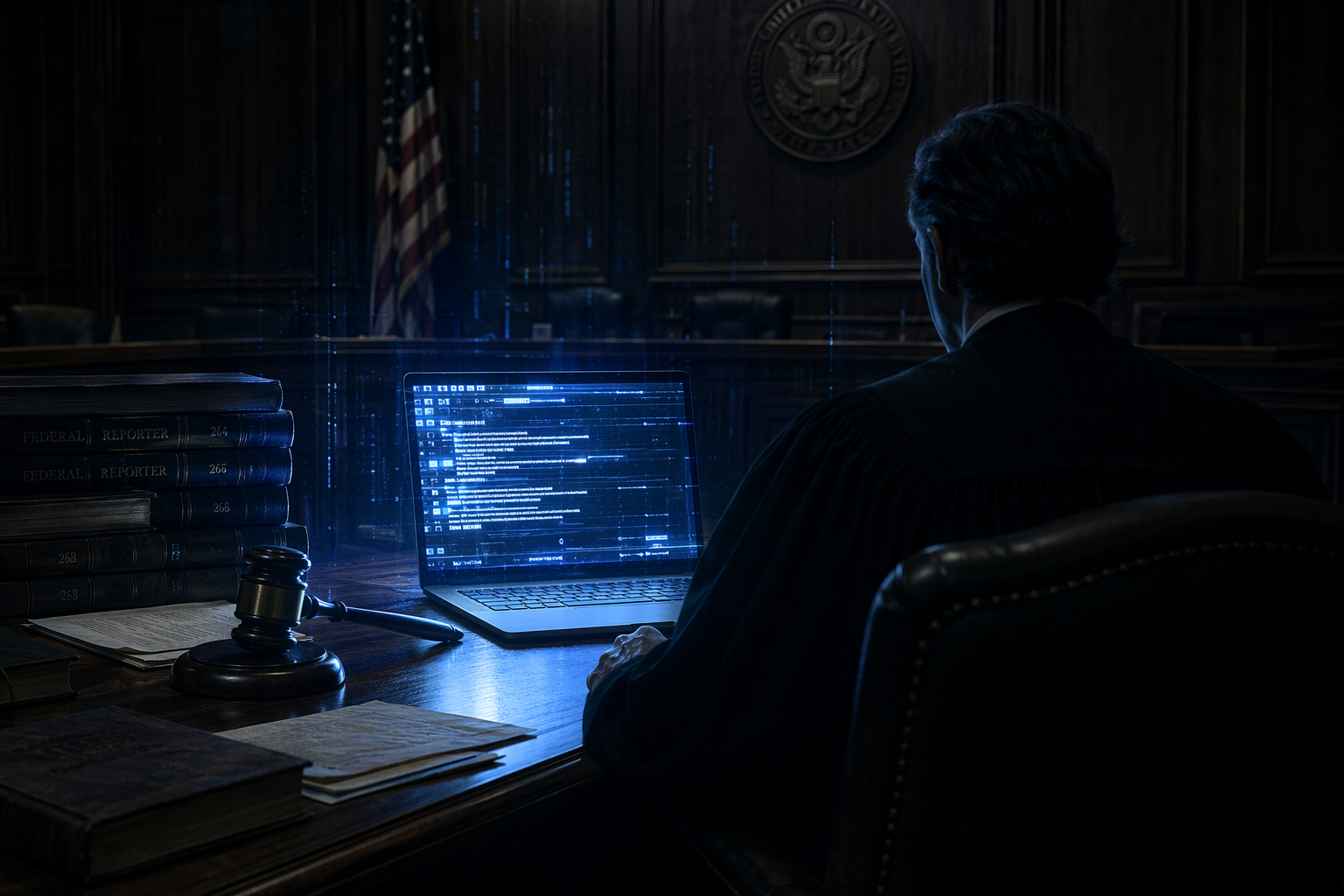
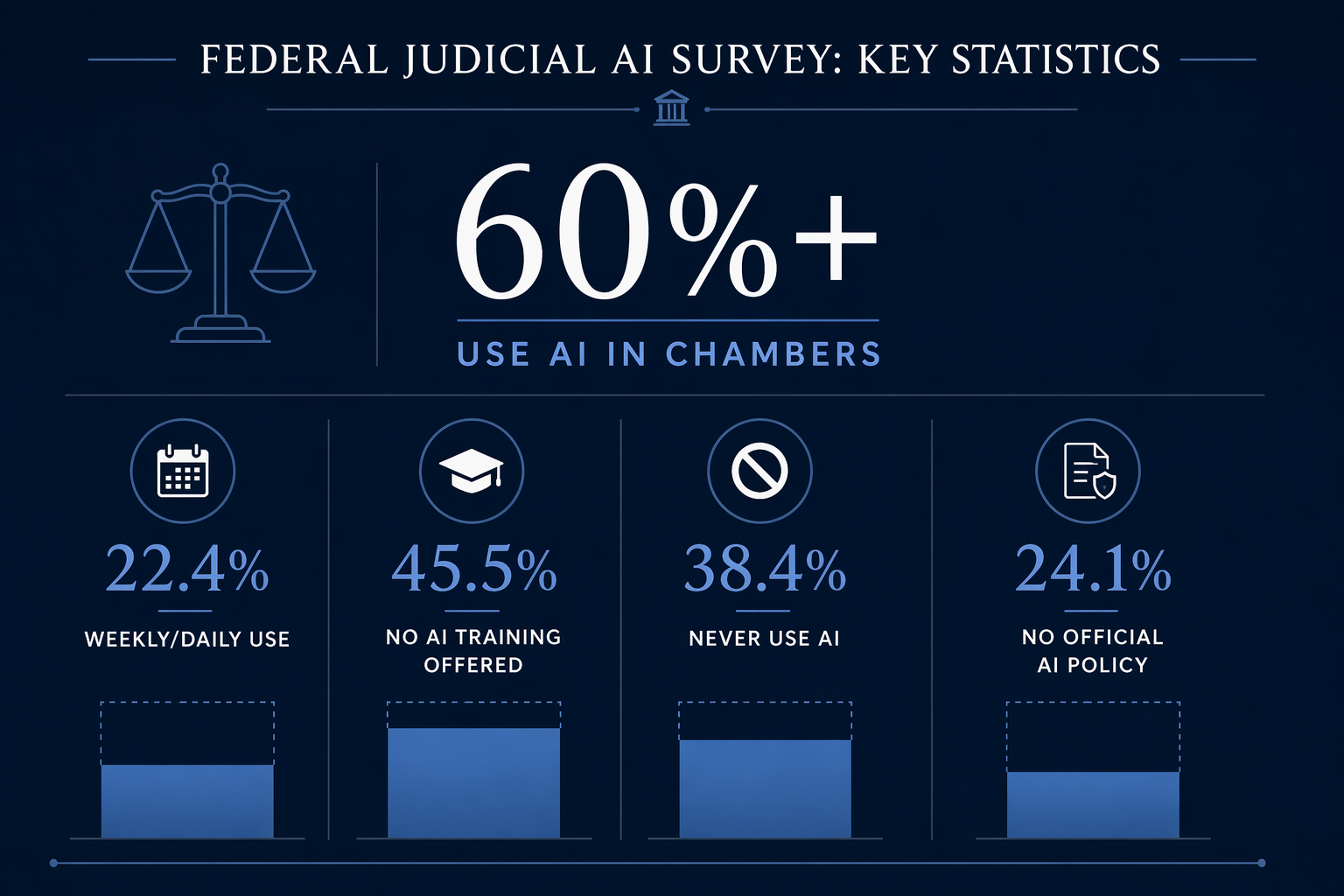
For the first time, we have rigorous, random-sample data on how federal judges are actually using artificial intelligence in chambers — and the picture is one of rapid, unsupervised adoption. The 2026 New York City Bar Association / Sedona Conference survey found that more than 60% of responding federal judges use at least one AI tool in their judicial work. Yet only 22.4% use these tools on a weekly or daily basis, and 38.4% have never used AI at all.
The deeper story lies in what the survey reveals about institutional preparedness. Nearly half of judges — 45.5% — report that court administration has offered no AI training. One in four judges has no official AI use policy in chambers. The result is a fragmented landscape where a litigant cannot predict whether their assigned judge permits AI, prohibits it, or has never considered the question.
Survey Methodology: How the Data Was Collected
The survey, conducted jointly by the New York City Bar Association and the Sedona Conference, represents the first statistically rigorous attempt to measure AI adoption across the federal judiciary. Prior to this study, the conversation around judges and AI relied on anecdotal reports, isolated sanction orders, and informal polling.
The methodology was designed to produce generalizable results:
- A stratified random sample of 502 judges was drawn from the total population of 1,738 current federal judges, including bankruptcy judges, magistrate judges, district court judges, and court of appeals judges.
- The survey achieved a 22.3% response rate, yielding 112 completed responses.
- The sample was stratified to ensure proportional representation across court levels and geographic circuits.
- The survey was conducted in late 2025 and published on March 30, 2026.
Key Findings: Adoption Rates, Frequency, and Tool Preferences
The headline figure — more than 60% of judges using at least one AI tool — masks significant variation in how and how often these tools are deployed. The survey's breakdown by frequency and use case reveals a judiciary that is experimenting with AI but has not yet integrated it into routine practice.
| Metric | Percentage | Interpretation |
|---|---|---|
| Judges using at least one AI tool | 60%+ | Majority have experimented with or adopted AI in chambers |
| Weekly or daily AI use | 22.4% | Only about one in five judges uses AI regularly |
| Never used AI | 38.4% | More than a third of judges have not used AI at all |
| Legal research as primary use | 30.0% | Most common application, consistent with attorney adoption patterns |
| Document review as primary use | 15.5% | Second most common use case |
The data on tool preference is particularly instructive. Judges are significantly more likely to use legal-specific AI tools — such as Westlaw AI-Assisted Research — than general-purpose tools like ChatGPT, Microsoft Copilot, or Google Gemini. This pattern mirrors the broader legal profession's preference for domain-specific AI products that offer citation verification and jurisdiction-aware outputs.
The Policy Patchwork: Permissive, Prohibitive, and Absent
Perhaps the most concerning finding for litigants and practitioners is the inconsistency of chamber-level AI policies. The survey reveals a judiciary that has not reached consensus on whether, when, and how AI should be used in judicial work.
| Policy Stance | Percentage of Judges | Risk for Litigants |
|---|---|---|
| Permit AI use in chambers | ~33% | Low — policy is known and predictable |
| Formally prohibit AI use | 20.4% | Low — prohibition is clear and enforceable |
| Discourage but do not prohibit | 17.6% | Medium — ambiguity creates uncertainty about what is acceptable |
| No official policy | 24.1% | High — litigants cannot predict how AI will be treated |
| Discourage or no policy (combined) | 41.7% | High — nearly half of judges operate without clear guidance |
The 24.1% of judges with no official AI policy represents a significant blind spot. When combined with the 17.6% who discourage but do not prohibit, the total rises to 41.7% — nearly half of the judiciary operating in a policy gray zone. For attorneys, this means that the same AI-assisted filing or AI-generated legal analysis might be treated differently depending on which judge reviews it.
The Training Gap: Nearly Half of Judges Receive No AI Instruction
The survey's finding on training is arguably its most alarming data point. When 45.5% of judges report that court administration has offered no AI training, and another 15.7% are unsure whether training was available, the implication is clear: a substantial portion of the federal judiciary is using — or considering using — AI tools without institutional guidance on their capabilities, limitations, or risks.
This training gap matters for several reasons. First, AI tools, particularly large language models, are known to hallucinate — generating confident-sounding but factually incorrect citations, case summaries, and legal analyses. A judge who has not been trained on this failure mode may not recognize a hallucinated citation in a party's filing or, worse, may incorporate AI-generated errors into a ruling.
Second, the training gap intersects with the policy gap. Judges who have not received training are less likely to have informed views on appropriate AI use, which may explain why so many chambers operate without clear policies. The survey data suggests a causal relationship: where training is absent, policy tends to be absent as well.
Real-World Consequences: The Grassley Investigation and Sanction Cases
The survey data does not exist in a vacuum. In October 2025, Senate Judiciary Committee Chairman Chuck Grassley launched an investigation into two federal judges whose AI-drafted rulings contained serious errors, providing a real-world illustration of what happens when AI adoption outpaces training and policy.
On October 6, 2025, Grassley wrote to U.S. District Judge Henry T. Wingate of the Southern District of Mississippi and U.S. District Judge Julien Xavier Neals of the District of New Jersey regarding their alleged use of generative AI to draft court orders with little to no human verification. The documented errors in these cases are striking:
- Judge Wingate's July 20, 2025 temporary restraining order contained multiple inaccuracies: it named plaintiffs and defendants who were not parties to the case, misquoted state law, made factually incorrect statements, and referenced four individuals who do not appear in the record. Wingate later replaced the order with a backdated "corrected" version and removed the original from the public docket.
- Judge Neals withdrew his July 23, 2025 decision in a biopharma securities case after counsel identified inaccurate quotes, misstated case outcomes, and quotes attributed to decisions that did not contain them. A person familiar with the matter stated that a temporary assistant in Neals' court had used an AI platform in drafting.
These incidents are not isolated. The same month, in Johnson v. Dunn, No. 2:21-cv-1701 (N.D. Ala., July 23, 2025), the court escalated sanctions beyond monetary fines — which it declared "ineffective at deterring AI-generated false statements of law" — and instead disqualified the offending attorneys from representing the client, ordered the opinion published in the Federal Supplement, and directed the clerk to notify bar regulators in each state where the responsible attorneys are licensed.
The Johnson case is particularly instructive because the law firm involved had a proactive AI policy that forbade generative AI use without permission of practice group leaders. The hallucinated citation was inserted by a practice group co-leader — someone who should have known better. The court noted that Rule 11 does not apply to discovery disputes, and ethical candor rules in most jurisdictions require knowing falsity, leaving a gap for negligent AI misuse.
Implications for Litigants and Practitioners
For attorneys practicing in federal court, the survey data translates into a set of concrete operational risks that require proactive management:
- You cannot assume your judge has an AI policy. With 24.1% of judges having no policy and 17.6% discouraging but not prohibiting, the default assumption should be that the policy is unknown until verified.
- You cannot assume your judge has received AI training. With 45.5% of judges receiving no training from court administration, the judge reviewing your AI-assisted filing may not understand the technology's failure modes.
- You cannot assume AI-generated errors will be caught. The Wingate and Neals cases demonstrate that even judges can be misled by AI outputs. If a judge's own AI-drafted rulings contained hallucinations, there is no guarantee that AI-generated content in party filings will be identified.
- Sanctions are escalating. The Johnson case signals that courts are moving beyond monetary sanctions toward disqualification, publication of opinions, and bar referrals. The cost of an AI error is no longer just a fine — it can include career consequences.
The survey also raises a question that has not been adequately addressed: what happens when a judge uses AI to draft a ruling that contains errors harmful to one party? The Wingate case, where the judge backdated a corrected order and removed the original from the docket, suggests that the current mechanisms for identifying and correcting judicial AI errors are ad hoc and opaque.
Recommendations for Attorneys Navigating the AI-in-Courts Landscape
Until the federal judiciary develops uniform policies and training requirements, attorneys must take responsibility for understanding the AI landscape in each courtroom where they practice. The following steps are grounded in the survey data and the documented incidents discussed above:
- Check standing orders and local rules for AI disclosure requirements before filing. Many courts now require parties to disclose whether AI was used in drafting filings. Failure to comply can result in sanctions regardless of whether the AI-generated content is accurate.
- Inquire about chamber policies where unclear. If the local rules are silent on AI, consider whether to raise the issue proactively. Some judges appreciate the candor; others may view the question as presumptuous. Assess based on the judge's known temperament and prior rulings.
- Maintain human verification of all AI-assisted work product. The Johnson case demonstrates that even a firm with a formal AI policy can produce hallucinated citations. Every AI-generated citation, quote, and legal conclusion must be verified against primary sources before filing.
- Document your AI use and verification process. If a question arises about the accuracy of your filing, contemporaneous documentation of your verification steps can demonstrate good faith and mitigate sanctions risk.
- Monitor developments in proposed FRE Rule 707 and state bar ethics opinions. The proposed Federal Rule of Evidence 707, which would require disclosure of AI-generated evidence, is currently in the rulemaking process. State bar associations continue to issue ethics opinions on attorney AI use. These developments will shape the regulatory environment in the coming months.
Related records
Tool profile
Browse tool evaluations →Governing regulation
Browse the obligations tracker →Preventive workflow
Browse verification workflows →
Report a correction or tip
Spotted an outdated figure, a misstated fact, or a ruling this case record should reflect? Public comments are disabled for this content given the professional cost of a misreported case outcome, penalty amount, or rule text — use the structured correction channel instead.
Report a correction or tip for this record →