
West Virginia FEMA Disaster Denials: Legal Process and Appeal Options
Explains the legal process under the Stafford Act for challenging denied or delayed FEMA disaster declarations in West Virginia, including the 30-day governor appeal window, the 60-day individual appeal deadline, and the limited scope of judicial review.
- Jurisdiction
- West Virginia
- Ruling date
- Jul 22, 2025
- Source document
- View primary court order ↗
Lex Machina Review is an independent risk-tracking and reference resource. Nothing on this site is legal advice, and using it does not create an attorney-client relationship. Every record is reviewed against primary sources but may not reflect the most current status of a matter — always verify directly against the cited court order, rule text, or a licensed attorney before relying on it.
Companion explanation — secondary to the source document above
In West Virginia’s recent flood disputes, the phrase “FEMA denial” has covered more than one legal event. In April 2025, FEMA approved individual assistance for some counties after February flooding but denied it for seven others: Boone, Cabell, Greenbrier, Kanawha, Lincoln, Monroe, and Summers. Public assistance was also denied for Cabell and Kanawha, and Gov. Patrick Morrisey said the state would “look at all options” to appeal.[1] Three months later, after deadly June flooding in Ohio County, the fight was not framed as a formal denial at first. The grievance was time: nine people had died, but the major disaster declaration was not issued until July 22, 2025, and the declaration designated Marion and Ohio counties for individual assistance.[2][3]
Those details matter because the legal implications of a West Virginia presidential disaster declaration dispute depend on the decision being challenged. A governor appealing a denied declaration is not in the same posture as a homeowner appealing a FEMA letter denying repair money. A pending request is different again. As of July 23, 2026, Morrisey’s July 21, 2026 request for a major disaster declaration after June 22–23 flooding in southern West Virginia remained unresolved; the request reported 186 damaged homes in Boone and Logan counties, including 12 destroyed homes and 18 with major damage.[4]
The First Question Is Which Decision Exists
The Stafford Act declaration process begins with a governor’s request for federal disaster assistance. FEMA evaluates the request and makes a recommendation, but the major disaster declaration itself is a presidential decision. Federal regulations then supply procedures around that decision, including what happens after a denial and how applicants challenge later eligibility decisions under an approved program.[5]
That structure produces several different legal positions that can look similar in headlines:
- A requested major disaster declaration may still be pending, with no final denial to appeal.
- A declaration may be approved but limited to certain counties, types of assistance, or both.
- A declaration or requested category of assistance may be denied, triggering the governor’s appeal route.
- An individual applicant may be denied assistance after a declaration has already opened the program.
The April 2025 West Virginia decision is useful precisely because it was not a clean statewide yes-or-no. FEMA approved individual assistance for seven counties and denied it for seven others after the same February flooding, while also denying public assistance for Cabell and Kanawha.[1] For residents in an approved county, the legal problem could become an individual application denial. For officials in a county left out, the problem sat higher up the chain: the state had to decide whether to press an appeal over the federal declaration decision itself.
The Governor’s Appeal Is Short, Formal, and County-Specific
When FEMA denies a governor’s request for a major disaster declaration or denies requested supplemental assistance, 44 CFR § 206.48 gives the governor 30 days from the date of the denial letter to appeal. The appeal must include additional information justifying the need for assistance.[5] FEMA’s declaration process guidance describes the appeal as the route for submitting supplemental information after a denial, not as an open-ended political reconsideration period.[6]
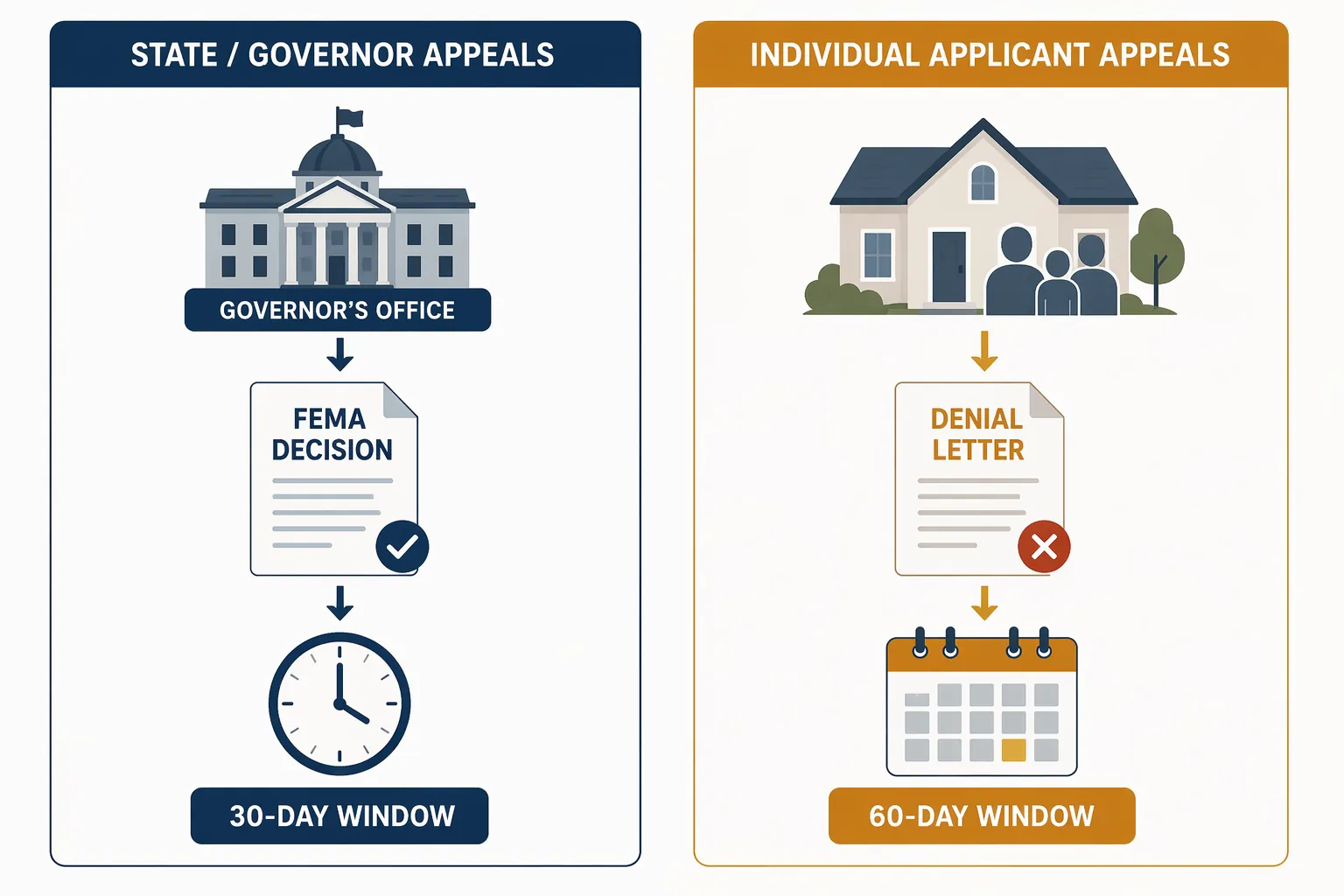
The clock is one of the most important legal facts in this part of the process. It does not begin when a county commission complains, when news coverage peaks, or when residents discover they are outside the designated area. Under the regulation, the governor’s 30-day appeal period runs from the date of the denial letter.[5] That puts pressure on the governor’s office and emergency management officials to collect county-level damage documentation quickly, while local officials are still dealing with roads, debris, shelters, and utility outages.
A partial denial also narrows what the appeal is about. In the February 2025 flooding example, the legal question was not whether West Virginia had experienced a disaster in the ordinary sense. FEMA had already approved individual assistance for some counties. The appeal issue for the excluded counties would have been whether the additional record supported adding those counties or assistance categories under the federal criteria that FEMA and the President apply to the request.[1][5]
For lawyers advising local governments, that distinction changes the work. A county’s strongest contribution is usually not a generalized statement that conditions are bad. It is a record that helps the state supplement the declaration file: verified home damage, uninsured losses where available, local capacity limits, photographs tied to addresses or public facilities, cost estimates, and documentation showing why state and local resources cannot meet the need without federal assistance. The governor files the appeal; counties build much of the record the governor has to use.
A Pending Request Is Not Yet a Denial
The July 21, 2026 request after southern West Virginia flooding sits in a different category. Morrisey’s office said the June 22–23 flooding damaged 186 homes across Boone and Logan counties, with 12 destroyed and 18 suffering major damage.[4] Those numbers belong in the declaration record, but a pending request does not create the same appeal posture as a denial letter.
That does not make delay meaningless. Time affects whether residents can stabilize housing, whether counties can plan debris and infrastructure work, and whether legal aid and emergency managers can give people clear instructions. But legally, it is important not to treat every unanswered request as an unlawful denial. Until the federal government acts, the available pressure is mostly administrative and political: supplying additional documentation, communicating through state and federal channels, and keeping the public record accurate about what has and has not been decided.
Individual Appeals Start After FEMA Denies a Person, Not a County
Once individual assistance is available in a designated county, residents still have to apply. FEMA may then approve assistance, ask for more information, or deny the claim. That denial is not the same legal event as the President declining to declare a county eligible for individual assistance. It is an applicant-level eligibility decision, and it has its own deadline.
Under 44 CFR § 206.115, an applicant may appeal a FEMA assistance determination within 60 days after the date FEMA notifies the applicant of the award or denial. The appeal must explain why the applicant believes the determination is wrong and include supporting documentation.[5] Legal Aid of West Virginia’s public guidance similarly treats the FEMA letter as the starting point: applicants should read the reason for the decision, gather documents, and submit an appeal within the 60-day window.[7]
This is where many residents misunderstand the word “denied.” A denial letter may mean FEMA thinks the applicant has insurance that should pay first, lacks proof of occupancy or ownership, has not shown the damaged home was a primary residence, or needs to supply repair estimates or other records. It does not necessarily mean the disaster declaration failed, the county was excluded, or the person has no remaining administrative option.
| Issue | Governor-level declaration appeal | Individual assistance appeal |
|---|---|---|
| Who files | The governor | The applicant or someone authorized to act for the applicant |
| Decision challenged | Denial of a declaration request or requested assistance category | FEMA’s award, denial, or eligibility determination for that applicant |
| Deadline | 30 days from the denial letter | 60 days from FEMA’s notice to the applicant |
| Core record | Supplemental disaster impact and capacity documentation | Documents showing eligibility, loss, occupancy, ownership, insurance status, or repair need |
| Legal source | 44 CFR § 206.48 | 44 CFR § 206.115 |
For legal aid lawyers, the practical triage begins with the letter. The date controls the deadline. The stated reason controls the evidence. The applicant’s county matters only after confirming that individual assistance was available there for the relevant disaster. In the July 2025 declaration, for example, Marion and Ohio counties were designated for individual assistance.[3] An applicant outside a designated county would face a different threshold problem than an applicant inside one of those counties who received a denial based on missing documents.
Why Timing Becomes Political Before It Becomes Judicial
The Ohio County flash flooding showed how quickly declaration timing turns into a public fight. Local reporting described frustration after the June 2025 flash flood killed nine people and a major disaster declaration had still not arrived weeks later. Lawmakers criticized the wait, and one Democratic lawmaker used the phrase “legislative malpractice” in connection with the congressional delegation’s handling of the delay.[2] The declaration was ultimately issued on July 22, 2025, with Marion and Ohio counties designated for individual assistance.[3]
That kind of criticism can matter without changing the legal standard. Public pressure may accelerate attention, force clearer explanations, or push officials to document the consequences of delay. It does not by itself create an applicant appeal, extend the governor’s 30-day clock after a denial, or convert a pending request into a court-ready claim. The administrative file still has to do the work.
Judicial Review Is the Narrowest Path

By the time a dispute reaches talk of litigation, the process has usually narrowed. The Stafford Act gives the President broad discretion over major disaster declarations, and the regulations provide administrative routes rather than a broad damages remedy for communities disappointed by a declaration decision.[5] That is why judicial review of declaration denials is generally a weak forum, especially when the challenge is to the President’s discretionary judgment rather than to a discrete applicant-level determination or a failure to follow a mandatory procedure.
This does not mean no disaster-related FEMA dispute can ever be litigated. It means lawyers should separate possible claims carefully. An individual applicant contesting how FEMA handled an eligibility determination is not raising the same issue as a state trying to force a presidential disaster declaration. The more a claim asks a court to second-guess the substance of a declaration decision, the more it runs into the discretionary structure of the statute.
For West Virginia officials and advocates, the legal center of gravity remains administrative: preserve the governor’s 30-day appeal option after a denial, protect each household’s 60-day appeal deadline after an applicant letter, and avoid telling residents that a lawsuit is the normal next step when the governing framework points elsewhere.
What the West Virginia Examples Show
The 2025 and 2026 flood examples do not prove one uniform FEMA posture toward West Virginia. They show three different procedural states. In April 2025, the state faced a partial denial, with some counties approved and others excluded from individual assistance.[1] In July 2025, the public dispute centered on the wait for a declaration after a deadly flash flood, followed by a declaration that designated Marion and Ohio counties for individual assistance.[2][3] In July 2026, the governor submitted a new request documenting damage in Boone and Logan counties, but the available record did not yet show a final federal decision.[4]
The legal implications follow that sequence. A denied declaration decision belongs first to the governor’s appeal process under § 206.48. A denied household claim belongs first to the applicant’s appeal process under § 206.115. A pending request may justify scrutiny and pressure, but it should not be described as a denial unless the federal government has made that decision. West Virginia’s recent flood disputes show a process with real deadlines and documentation channels, but not a broad judicial remedy for every contested FEMA declaration decision.
References
- FEMA Denies 7 Counties Individual Aid For Destructive February Flooding, West Virginia Public Broadcasting.
- West Virginia lawmakers weigh in on wait for federal disaster declaration, Weirton Daily Times.
- West Virginia; Major Disaster and Related Determinations, Federal Register, September 8, 2025.
- Governor Morrisey Requests Presidential Disaster Declaration for Southern West Virginia, West Virginia Governor’s Office.
- 44 CFR Part 206, Electronic Code of Federal Regulations.
- A Guide to the Disaster Declaration Process and Federal Disaster Assistance, FEMA.
- Appealing a FEMA Decision, Legal Aid of West Virginia.
Related records
Tool profile
Browse tool evaluations →Governing regulation
Browse the obligations tracker →Preventive workflow
Browse verification workflows →
Report a correction or tip
Spotted an outdated figure, a misstated fact, or a ruling this case record should reflect? Public comments are disabled for this content given the professional cost of a misreported case outcome, penalty amount, or rule text — use the structured correction channel instead.
Report a correction or tip for this record →