
Why Spectrum Fiber Cuts Aren't Charged as Terrorism
Charter's 'domestic terrorism' label for fiber optic cuts doesn't match what prosecutors charge. This record explains the statutory gap and its strategic consequences for litigators and risk managers.
- Jurisdiction
- California
- Court
- State court
- AI tool named
- Not applicable
- Ruling date
- Jun 1, 2025
- Source document
- View primary court order ↗
- Last verified
- Jul 28, 2026
Lex Machina Review is an independent risk-tracking and reference resource. Nothing on this site is legal advice, and using it does not create an attorney-client relationship. Every record is reviewed against primary sources but may not reflect the most current status of a matter — always verify directly against the cited court order, rule text, or a licensed attorney before relying on it.
Companion explanation — secondary to the source document above
Charter’s public description of the Van Nuys Spectrum outage and LAPD’s investigative description do not line up. Charter CEO Chris Winfrey called the incident “domestic terrorism” and demanded federal prosecution; LAPD said it “is not being treated as an act of domestic terrorism” and was being investigated as felony vandalism.[1] That contradiction is the practical starting point for any spectrum fiber optic cut criminal investigation. The question is not whether the conduct was serious. It plainly was. The question is what a prosecutor can charge under the statute in the venue where the line was cut.
The scale explains why Charter reached for the strongest public language available. In the Van Nuys incident, 13 fiber lines were cut, about 50,000 residential customers and about 500 businesses were affected, and some outages lasted up to 30 hours.[1][2] Those facts support a felony-level investigation and a corporate demand for more aggressive enforcement. They do not, by themselves, supply the elements of a terrorism offense.
As of July 28, 2026, this is a public-record charging-risk review, not legal advice. It separates press labels from investigative posture and filed charges; where no charging document is public, it does not infer one.
The “no copper” fact matters, too. Spectrum has said its fiber contains no copper, and local reporting on later Southern California outages repeated that point.[1][3] That takes the easy copper-theft narrative off the table. A line can be cut for sabotage, disruption, coercion, retaliation, or some other reason still unknown to investigators. But eliminating theft as the obvious motive does not automatically create a domestic-terrorism charge. It leaves the charging lawyer with a damaged communications line, an outage record, repair costs, possible business interruption evidence, and whatever proof of intent or motive investigators can actually develop.
Press classification is not charging exposure
There are three different records here, and they should not be merged. Charter’s statement is a corporate and public-safety classification. LAPD’s statement is an investigative posture. A filed complaint, information, or indictment would be the charging record. The public dispute between Charter and LAPD is not a court ruling on what “domestic terrorism” means in a fiber-cut case; it is a visible mismatch between corporate severity language and law-enforcement charge selection.
For counsel, that distinction changes the advice. A client accused of cutting fiber is not advised based on the most alarming label in a press release. The analysis starts with venue, the damaged property, the applicable vandalism or criminal-mischief statute, any communications-line statute, any critical-infrastructure enhancement, proof of loss, and evidence of motive. If the jurisdiction has not enacted a clean infrastructure-specific offense for fiber-only sabotage, the case does not become terrorism because the outage was large.
That is not a soft view of the conduct. Outages of this kind can interrupt homes, businesses, emergency communications dependencies, payment systems, remote work, and local operations. The legal point is narrower: operational harm and terrorism classification are different questions. Prosecutors still have to plead a statute that exists and prove the elements that statute requires.
Why California points toward felony vandalism
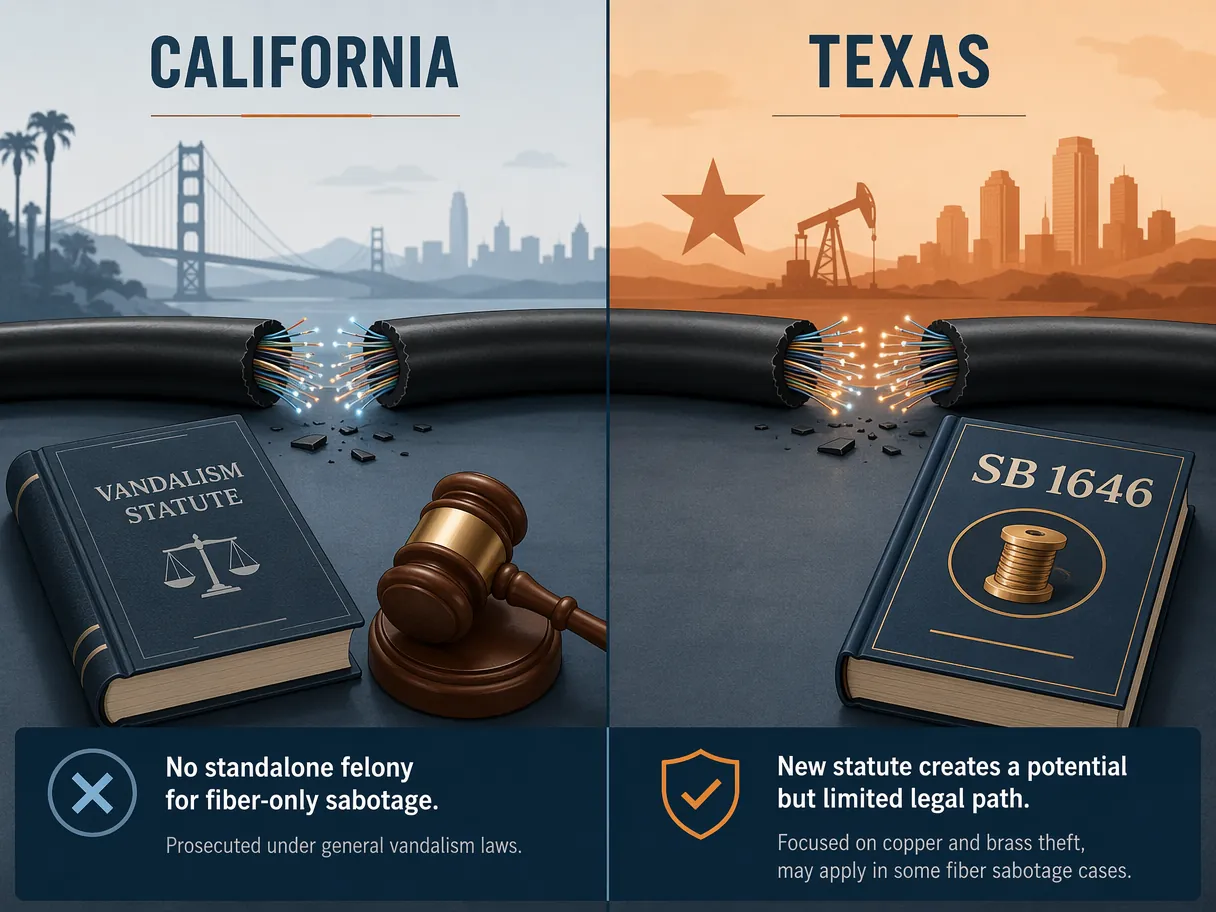
California is the most important jurisdiction in the Van Nuys record because it explains the classification gap. A prosecutorial analysis published by the Texas District & County Attorneys Association, co-authored by Charter’s senior security director and a sitting district attorney, states that California has no standalone felony for fiber-optic-only sabotage. Instead, prosecutors rely on Penal Code § 591, which covers damage to phone or telegraph lines and is described in the source as a misdemeanor-felony wobble, along with general vandalism statutes.[4]
That framework makes LAPD’s “felony vandalism” posture less surprising. It is not an announcement that the outage was minor. It is an announcement that, on the public record, the conduct is being routed through available California property-damage tools rather than a specialized infrastructure-terrorism category. The older communications-line statute may still matter, but the research record does not support treating it as a bespoke felony for modern fiber sabotage in the way Charter’s public label suggests.
The gap becomes sharper because fiber networks are not built like a single fenced facility. Lines run through neighborhoods, utility corridors, poles, conduit, vaults, and rights-of-way. A statute written around older forms of line damage or around protected facilities may be usable in some cases and awkward in others. When the charge must survive first contact with court, awkwardness matters.
Texas shows a different answer, with its own limit
Texas moved closer to an infrastructure-specific model with SB 1646, effective September 1, 2025. The bill created a third-degree felony framework for damaging copper or brass components of critical infrastructure facilities or their communication wires, and it applies “regardless of whether the equipment or communication wires are enclosed by a fence or other barrier.”[5] The fence language is important because communications infrastructure is dispersed. A cut does not need to occur inside a locked substation or a clearly fenced compound to create the same service consequences.
But Texas is not a universal answer to fiber-only sabotage. The same statutory development was tied to copper and brass damage. If the line is truly fiber-only and contains no copper, counsel still has to read the statute against the physical evidence. The presence of “communication wires” language helps. The copper and brass limitation complicates the cleanest application. That is exactly why a multistate incident briefing cannot stop at “critical infrastructure” as a label.
| Charging question | Why it changes the exposure |
|---|---|
| What was physically damaged? | Fiber-only cable, copper component, brass component, cabinet, conduit, pole, vault, or facility equipment can point to different statutory language. |
| Where did the cut occur? | California, Texas, South Carolina, Missouri, and other states do not share one infrastructure-sabotage framework. |
| Was there proof of motive? | No-copper evidence may weaken a theft theory, but sabotage motive still has to be proved through admissible evidence rather than inferred from outage size alone. |
| What charge has actually been filed? | A press label, reward notice, or investigative statement is not the same as a complaint, indictment, or plea record. |
The FBI’s role is meaningful, but narrow on the public record
The FBI’s involvement should not be dismissed. In the Van Nuys reporting, the FBI confirmed awareness and said it was “working with our law enforcement partners to investigate the nature of the attack, to include the motive.”[1] That is an investigative signal. It means federal agents were at least engaged with the local record and the motive question.
It is not the same thing as a federal case. In the cited July 2025 record, no suspect had been publicly identified and no federal charges had been filed in the Van Nuys matter.[1] A federal agency can assist, gather information, assess motive, and coordinate with local law enforcement without producing a federal complaint. For charging-risk purposes, the public record still points to local felony vandalism unless and until a filed federal charge changes that record.
This is where outage size can mislead a non-lawyer briefing. A 30-hour outage across tens of thousands of customers feels federal. It may attract federal attention. It may support a corporate argument that existing laws are inadequate. None of that substitutes for venue, statutory fit, and proof.
The incidents form a patchwork, not a single national charge
The later incident record reinforces the same point. In June 2026, the San Fernando Sun reported another criminal attack affecting local Spectrum customers in Sylmar, again in Southern California and again in a setting where the no-copper distinction mattered.[3] In July 2026, FOX Carolina reported that Spectrum offered a $25,000 reward after a fiber line was intentionally cut in Anderson County, South Carolina, but the public report was brief and did not provide charging documents or a detailed sheriff’s case status.[6]
| Incident or area | Public record value | Charging-risk caution |
|---|---|---|
| Van Nuys, California | 13 lines cut; about 50,000 residential customers and about 500 businesses affected; LAPD treated the case as felony vandalism rather than domestic terrorism.[1][2] | Best record for the Charter/LAPD classification mismatch. |
| Sylmar, California | June 2026 report of a criminal attack affecting local Spectrum customers.[3] | Shows the Southern California pattern, but does not change California’s statutory gap. |
| Anderson County, South Carolina | July 2026 report of an intentionally cut fiber line and a $25,000 Spectrum reward.[6] | Useful as an incident marker; too thin to infer charges without local filings. |
| Kansas City, Waxahachie, and North Austin | Referenced in the broader prosecutorial discussion of critical infrastructure attacks and communications-line damage.[4] | They illustrate state-by-state exposure, not a uniform national terrorism category. |
That table is less dramatic than the outage map, but it is more useful for a lawyer. Each event has to be separated into the public incident report, the available statute, the physical composition of the damaged line, the repair and outage evidence, and any filed charging document. Without that separation, a risk memo can drift into either corporate maximalism or casual minimization. Both are bad advice.
National loss numbers explain urgency, not chargeability
The cable industry’s national numbers are substantial. NCTA reported 18,327 attacks on critical communications infrastructure in 2025 and said 11.8 million customers were affected; it also cited an economic analysis by Dr. Edward Lopez estimating societal costs between $294 million and $1.47 billion.[7] Those figures help explain why providers want stronger laws and why local vandalism classifications look inadequate from an operational-risk perspective.
They should be used with the right caveat. The incident data are member-provided, and the economic analysis was commissioned by NCTA.[7] That does not make the numbers irrelevant. It means they are business-risk and policy-context evidence, not proof that a given defendant in a given county satisfies a terrorism statute. Aggregate harm can support legislative attention. It cannot replace the elements of an offense.
The policy community has identified the same statutory problem. ITIF has argued that Congress and states should close loopholes that allow broadband vandals to avoid infrastructure-specific consequences, and H.R. 2784 has been introduced as a federal bill addressing communications-infrastructure damage.[8][9] That is relevant because it confirms that policymakers see a gap. It also confirms the present-tense problem for charging advice: if a bill is needed to close a loophole, the existing law may not already do the work that public rhetoric assumes.
What a defendant actually faces
On the public Van Nuys record, the clean answer is felony vandalism, with possible reliance on California’s older communications-line statute and general property-damage law depending on how prosecutors plead the case.[1][4] In another state, the answer may be criminal mischief, a utilities offense, a communications-line offense, a critical-infrastructure statute, or some combination of property damage and enhancement theories. In Texas after SB 1646, counsel would have to test the facts against the new third-degree felony framework and its copper, brass, and communication-wire language.[5]
The hard cases are not hard because the damage is trivial. They are hard because modern fiber infrastructure does not always match older criminal-code categories. A statute may punish damage to a line but not treat it as critical-infrastructure sabotage. Another may protect critical infrastructure but be drafted around fenced facilities or metal theft. Another may have been amended for copper theft and only partly capture fiber cuts. The same conduct can therefore produce different exposure depending on the state.
Motive evidence remains the dividing line for any more aggressive theory. No copper narrows the field by making theft less plausible. Repeated cuts, timing, location selection, tools, communications, surveillance footage, admissions, or coordination evidence could matter. But a charging record cannot simply reason backward from a large outage to a terrorism motive. That is the difference between an operational conclusion and proof in court.
The risk record should not overclaim
For in-house counsel, the immediate risk is messaging outrunning the legal record. Calling a fiber cut “domestic terrorism” may serve a public-safety, deterrence, or legislative purpose. It may also be understandable when thousands of customers lose service and businesses are down for hours. But if the company’s own later legal or insurance record must depend on filed charges, police classifications, or recoverable loss evidence, the public label should be kept separate from the charge sheet.
For defense counsel, the mistake runs the other way. “Just vandalism” is not a safe description when the outage record includes 13 cut lines, tens of thousands of customers, hundreds of businesses, and multi-hour disruption.[1][2] Felony vandalism or criminal mischief can still carry serious exposure, restitution pressure, pretrial consequences, and negotiation leverage for the state. The absence of a terrorism charge does not turn the case into a nuisance matter.
The usable conclusion is narrower and more durable: in the available public materials, “domestic terrorism” is a strategic and public label, while actual criminal exposure for cutting Spectrum fiber turns on jurisdiction, statutory elements, infrastructure definitions, motive evidence, loss proof, and filed charging documents.
References
- Charter Calls Cable Sabotage Domestic Terrorism — LAPD Says It's Just Vandalism — Patch, June 2025.
- Spectrum says fiber optic outage in LA area caused by a criminal act of vandalism — CNN, June 2025.
- Criminal Attack on Infrastructure Results in Outage for Local Spectrum Customers — San Fernando Sun, June 2026.
- What prosecutors should know about critical infrastructure attacks (CIAs) — TDCAA Journal.
- Committee Substitute — Texas Legislature, SB 1646.
- Spectrum offering $25K reward for info after fiber line intentionally cut — FOX Carolina, July 2026.
- Attacks on Critical Communications Infrastructure Hit Record Highs in 2025 — NCTA.
- Congress and States Should Close Loopholes to Stop Broadband Vandals — ITIF.
- H.R.2784 — Congress.gov.
Related records
Tool profile
Browse tool evaluations →Governing regulation
Browse the obligations tracker →Preventive workflow
Browse verification workflows →
Report a correction or tip
Spotted an outdated figure, a misstated fact, or a ruling this case record should reflect? Public comments are disabled for this content given the professional cost of a misreported case outcome, penalty amount, or rule text — use the structured correction channel instead.
Report a correction or tip for this record →