
Can a Pardoned Witness Still Plead the Fifth?
A presidential pardon does not automatically extinguish the Fifth Amendment privilege against self-incrimination. Whether the privilege survives depends on state-level exposure, the witness's acceptance of the pardon, and the scope of future or ongoing conduct — factors every attorney must assess when advising a pardoned client.
- Jurisdiction
- US Federal
- Court
- United States Supreme Court
- AI tool named
- None
- Ruling date
- Jul 29, 2026
- Source document
- View primary court order ↗
- Last verified
- Jul 30, 2026
Lex Machina Review is an independent risk-tracking and reference resource. Nothing on this site is legal advice, and using it does not create an attorney-client relationship. Every record is reviewed against primary sources but may not reflect the most current status of a matter — always verify directly against the cited court order, rule text, or a licensed attorney before relying on it.
Companion explanation — secondary to the source document above
A pardoned witness can lose the Fifth Amendment privilege, but not because the word “pardon” has been spoken. The privilege disappears only to the extent the pardon has removed every realistic criminal risk the answer would create. Eugene Volokh’s modern formulation is the cleanest working rule: “The privilege disappears only when there is no realistic prospect of prosecution by any American government, federal or state.”[1]
That answer matters at the table where it is usually asked. A witness has been subpoenaed. A committee lawyer or prosecutor says the witness has already been pardoned. The witness’s lawyer has minutes, not months, to decide whether one more answer could still supply evidence for a charge. The right question is not whether the pardon was dramatic, broad, or politically controversial. It is whether the proposed testimony can still incriminate the witness in a case someone with charging authority could realistically bring.
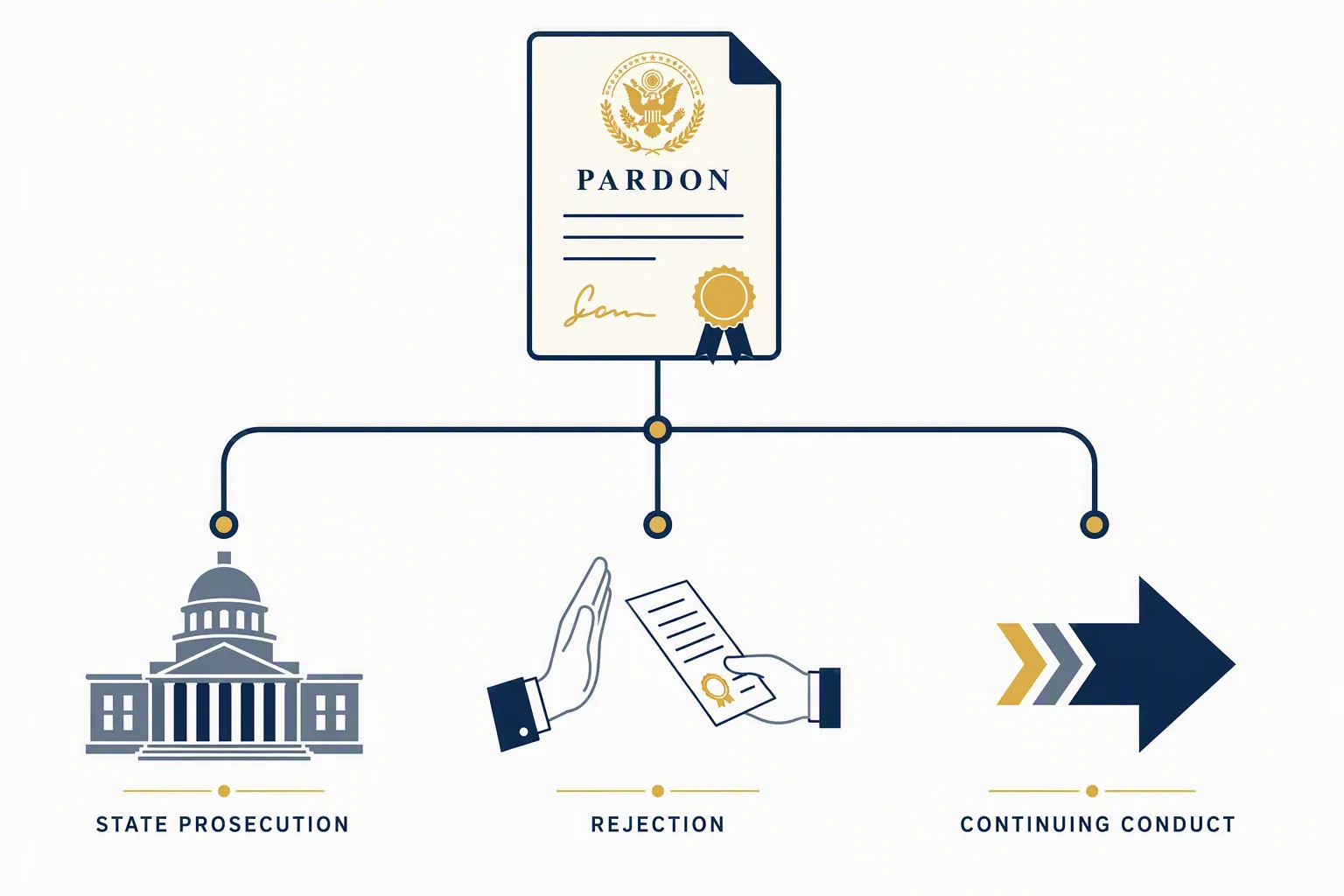
Three routes usually decide the analysis. First, a presidential pardon reaches federal offenses, not state crimes. If truthful testimony could expose the witness to a state prosecution, the privilege may survive. Second, under Burdick v. United States, a pardon may be refused; if the witness has not accepted it, the federal jeopardy may not have been eliminated. Third, the pardon protects only covered past conduct. It does not license future perjury, obstruction, contempt, false statements, or a continuing course of conduct that extends beyond the pardon’s temporal and substantive terms.
| Question counsel must answer | Why it matters |
|---|---|
| What conduct and dates does the pardon cover? | The Fifth is lost only for exposure actually eliminated by the pardon. |
| Has the witness accepted the pardon? | If the pardon can still be refused or has not been accepted, Burdick keeps the federal-risk question alive. |
| Could the same testimony support state charges? | A federal pardon does not itself extinguish state criminal exposure. |
| Does the question reach conduct after the pardon or conduct that continued beyond it? | Post-pardon or continuing offenses remain chargeable. |
| Is the remaining risk realistic rather than merely imaginable? | The privilege is not preserved by speculative prosecution theories. |
The baseline: if prosecution is gone, so is the privilege
The Fifth Amendment protects against compelled testimonial self-incrimination. If an answer cannot incriminate the witness because prosecution for the relevant offense is legally impossible, the constitutional reason for silence disappears. That is the point of Brown v. Walker: when the law has supplied protection coextensive with the privilege, the witness can be compelled to testify. In pardon terms, the same idea is often stated this way: a valid pardon for a federal offense removes federal criminal jeopardy for that offense, so the witness cannot invoke the Fifth merely to avoid admitting the pardoned federal conduct.[2]
That baseline is why sweeping commentary contains a grain of truth. If the pardon is valid, accepted, and broad enough to cover the federal crime under discussion, and if no state or post-pardon exposure is realistically in play, the witness may have to answer. The Fifth Amendment is not a reputational privilege. It does not protect a pardoned person from embarrassment, civil consequences, professional discipline, political damage, or public contradiction.
Pillsbury Co. v. Conboy supplies useful functional support for that approach. Justice Marshall’s concurrence treated pardon protection as comparable to transactional immunity for Fifth Amendment purposes: if the government has eliminated the criminal consequences of the transaction, compelled testimony about that transaction no longer creates self-incrimination in the constitutional sense.[2]
The hard work starts where that sentence ends. Pardon protection is rarely identical to the universe of possible exposure. The lawyer still has to ask which sovereign can prosecute, whether the pardon has been accepted, and whether the question is limited to completed conduct inside the pardon’s scope.
State exposure is the exception that cannot be waved away
A presidential pardon reaches “Offenses against the United States.” It does not pardon state crimes. That limitation is not a technicality; it is often the most important survival route for the privilege. If an answer about federally pardoned conduct would also furnish a link in a state prosecution, the witness still has a plausible Fifth Amendment objection.
The doctrinal anchor is dual sovereignty. Gamble v. United States reaffirmed that federal and state governments may prosecute the same conduct under their own laws without violating double jeopardy, because they are separate sovereigns. The same structure matters after a pardon. A federal pardon may remove the federal case, but it does not create a double-jeopardy bar against a state prosecutor who can charge a state offense arising from the same facts.[1]
This point should be framed carefully. There is no need to pretend that the Supreme Court has handed down a square, modern holding saying: whenever state exposure remains after a federal pardon, the Fifth Amendment privilege automatically survives. The more precise view is that Brown’s immunity logic, read together with dual sovereignty and modern expert commentary, points strongly in that direction. If the federal pardon has not eliminated all realistic American prosecution risk, the testimonial hazard has not been fully removed.
The word “realistic” does work here. A lawyer should not preserve a Fifth Amendment objection by reciting a state statute that no prosecutor could plausibly use, in a jurisdiction with no venue, after an expired limitations period, for conduct that does not satisfy the elements. But neither should counsel surrender the privilege because the federal pardon is broad. The state analysis has to be done offense by offense and jurisdiction by jurisdiction.
The practical inquiry is concrete. Did the conduct occur in a state with a potentially applicable analogue? Does the testimony supply an element the state would otherwise struggle to prove? Are there conspiracy, fraud, tax, records, false-statement, election, procurement, health, or licensing statutes that could attach under state law? Has the limitations period run, and if so, is there a tolling theory? A witness does not need to show that indictment is likely. But the privilege is strongest when counsel can identify a real sovereign, a real statute, and a nonfanciful path from the answer to criminal exposure.
This is also why committee-room assertions that a pardon “strips” the Fifth are dangerous when made categorically. They may be right as to a covered federal offense. They may be wrong as to state exposure. The distinction is not academic for the witness who answers under compulsion and later finds that the transcript has become a roadmap for a state grand jury.
Burdick makes acceptance a real question, especially for unsolicited pardons
Burdick v. United States is the case that prevents pardon analysis from becoming automatic. The Court treated a pardon as something that may be rejected, and famously described acceptance as carrying an imputation of guilt. If the witness refuses the pardon, the pardon has not removed the witness’s federal jeopardy; if federal jeopardy remains, the Fifth may remain as well.[1]
In the simple case, the sequence is easy enough. The executive offers clemency. The recipient accepts. The covered federal exposure is gone. A later effort to invoke the Fifth about those same covered federal offenses is vulnerable to challenge. But preemptive and unsolicited pardons are not always simple. They may arrive before indictment, before a charging decision, or before the recipient has taken any clear step that looks like acceptance.
For counsel, the acceptance question should not be handled with assumptions. Has the client signed anything? Filed anything? Relied on the pardon in court? Publicly embraced it? Asked the Department of Justice or a court to treat it as effective? Conversely, has the client expressly rejected it or avoided any act that could be characterized as acceptance? Those facts may decide whether the pardon has actually done the work that a questioner says it has done.
There is a trap on both sides. A witness who has accepted a pardon may not be able to invoke the Fifth for the covered federal conduct merely because the testimony is humiliating or politically costly. But a witness who refuses a pardon to preserve the privilege may also preserve the underlying federal criminal risk. Burdick is not a painless escape hatch. It is a choice about legal exposure.
The harder scenario is the unsolicited preemptive pardon, because no one should be too confident about what counts as acceptance in every procedural setting. A court may eventually have to decide whether silence, later reliance, or some other conduct is enough. Until that happens, a lawyer advising a subpoenaed witness should separate two questions that commentators often merge: whether the pardon is available, and whether this witness has accepted it in a way that extinguishes the privilege as to covered federal crimes.
Past covered conduct is different from future or continuing conduct
A pardon does not protect tomorrow’s crime. It also does not necessarily protect a continuing offense that straddles the pardon’s cutoff date. That is the third major survival route for the Fifth Amendment privilege: the answer may expose conduct outside the pardon’s temporal or substantive scope.
This point is easiest with perjury. A witness cannot invoke the Fifth because truthful testimony would deprive the witness of the option to lie without being prosecuted. Perjury in the new proceeding would be a new offense, and the Constitution does not protect a right to commit it. But that does not end the matter. A question may ask about post-pardon false statements, obstruction, witness tampering, document destruction, concealment, conspiracy activity, or other conduct that occurred after the pardon date. Those answers may incriminate the witness for offenses not covered by the pardon.
The same problem appears when the alleged conduct began inside the pardon period and continued outside it. A question framed as “what did you do in 2024?” may be safe if the pardon covers that conduct and no state exposure remains. A question that asks “what did you continue doing after the pardon?” is different. So is a question that uses pardoned conduct as the opening link in proving an unpardoned later offense.
Counsel should therefore resist global labels. “The transaction was pardoned” is not enough. The operative work is to draw a line between completed federal conduct covered by the pardon and later acts, later agreements, later concealment, or later testimony that could be charged on their own.
Hunter Biden as an application, not a shortcut
The Hunter Biden pardon is useful because it shows how quickly the analysis becomes narrower than the public argument. The December 2024 pardon was described as covering federal offenses over a 2014–2024 period.[1] If a later question asked only about federal crimes within that covered period, and if the pardon had been accepted, the Fifth Amendment argument would be weak as to those federal offenses.
That does not mean every possible question becomes compulsory. Counsel would still ask whether the answer could expose state-law analogues, whether the question reaches conduct outside the covered period, and whether the answer supplies evidence of a later obstruction, false-statement, tax, records, or other offense not covered by the pardon. Volokh’s point about any American government is the operational safeguard: the privilege is gone only when the remaining prosecution risk is gone in a realistic sense, not merely when the federal pardon is broad.[1]
The pardon may also aid investigators in a narrow but important way. Once federal jeopardy for covered conduct has been eliminated, a witness may be compelled to answer about that conduct, subject to the remaining exceptions. That is the pardon paradox: clemency can make a recipient less able to refuse testimony that prosecutors or congressional investigators want from them.[2]
The Fauci hearing shows why the acceptance and scope questions are still live
The July 2026 dispute over Dr. Anthony Fauci’s Fifth Amendment invocation should be treated as a live controversy, not as a settled precedent. The reported setting was a Senate hearing before Sen. Rand Paul’s committee, following President Biden’s Jan. 19, 2025 preemptive pardon of Fauci for official conduct from 2014 through 2025.[3]
On those reported facts, several questions would matter before anyone could responsibly say the privilege was gone. Did Fauci accept the pardon, and if so, how? Were the committee’s questions confined to federal offenses within the 2014–2025 official-conduct scope? Could the answers create state-law exposure? Did any question concern post-pardon statements, post-pardon obstruction, or continuing conduct? Could contempt pressure attach if the committee rejected the invocation, and would a court later agree?
If a question concerned only accepted, federally pardoned conduct with no realistic state analogue and no post-pardon exposure, the privilege claim would be vulnerable. If a question reached state exposure, nonaccepted clemency, or conduct outside the pardon’s scope, the witness would have a much stronger ground to stand on. As of July 29–30, 2026, the hearing illustrates the dispute; it does not resolve the doctrine.[3]
Conditional pardons sit at the edge of the problem
One further issue belongs near the edge, not the center, of this analysis: whether a president could condition a pardon on waiver of Fifth Amendment rights. Scholarly treatment of the conditional-pardon power has identified the question, but there is no directly on-point Supreme Court holding resolving it.[4]
That uncertainty should not distract from the more common path. Most lawyers advising a pardoned witness will not be litigating an express Fifth Amendment waiver condition. They will be reading the pardon, checking acceptance, mapping federal and state exposure, and deciding whether the question stays inside the zone where criminal jeopardy has actually been removed.
The witness-room analysis
The defensible answer to “Can a pardoned witness still plead the Fifth?” is conditional. Yes, if answering would still create a realistic risk of prosecution by a state, if the pardon has not been accepted, or if the question reaches post-pardon or continuing conduct. No, if the witness has accepted a valid federal pardon that fully covers the conduct at issue and no realistic state or later-offense exposure remains.
Before advising the client to answer or refuse, counsel should do the unglamorous work: identify the pardon’s scope, confirm acceptance, map federal and state exposure, separate past covered conduct from future or continuing conduct, and then decide whether the Fifth Amendment remains available.
References
- Can the Just-Pardoned Hunter Biden Claim Privilege Against Self-Incrimination if Questioned About His Crimes? — Reason / The Volokh Conspiracy — Dec. 2, 2024
- The President’s Pardons Paradox: Granting Them Could Aid the Prosecution — American Constitution Society
- Fauci Senate Hearing — Reuters, NBC News, PBS, Politico — July 29–30, 2026
- The President’s Conditional Pardon Power — Harvard Law Review — Vol. 134
Related records
Tool profile
Browse tool evaluations →Governing regulation
Browse the obligations tracker →Preventive workflow
Browse verification workflows →
Report a correction or tip
Spotted an outdated figure, a misstated fact, or a ruling this case record should reflect? Public comments are disabled for this content given the professional cost of a misreported case outcome, penalty amount, or rule text — use the structured correction channel instead.
Report a correction or tip for this record →