
A Thrown Toddler Exposes Fitness-Club Daycare Liability Gaps
The Kittle v. Bay Club lawsuit — filed July 2026 — crystallizes three liability vectors for fitness clubs operating unlicensed daycare: direct negligence, post-incident fraud exposure, and a disputed licensing exemption under California Health and Safety Code §1596.792(k).
- Jurisdiction
- California
- Court
- Los Angeles County Superior Court
- AI tool named
- None
- Ruling date
- Jul 2, 2026
- Source document
- View primary court order ↗
- Last verified
- Jul 25, 2026
Lex Machina Review is an independent risk-tracking and reference resource. Nothing on this site is legal advice, and using it does not create an attorney-client relationship. Every record is reviewed against primary sources but may not reflect the most current status of a matter — always verify directly against the cited court order, rule text, or a licensed attorney before relying on it.
Companion explanation — secondary to the source document above
The legal problem in Kittle v. Bay Club begins with a short piece of video and a much shorter explanation allegedly given afterward. The lawsuit, filed July 2, 2026, in Los Angeles County Superior Court, alleges that a Bay Club El Segundo Clubhouse employee threw a 23-month-old child about 6 feet into the air, failed to catch him, and caused him to fall on his head while in the club’s childcare program.[1][2]
The child’s alleged injuries are not framed in the complaint as a momentary scare. News reports reviewing the surveillance video describe allegations of concussion, traumatic brain injury, facial abrasion, and continuing hearing loss, with evaluation at UCLA Concussion Clinic after the April 2025 incident.[1][2] The parents also allege that the family was first told a different version: that the child had fallen about 1.5 feet from a squatting position.[3]
That gap between the footage and the reported account is why the case is not just an injury file. It is also a record-integrity file, a licensing file, and potentially a multi-location operating-model file. As of July 25, 2026, the case remains newly filed: no answer, discovery record, ruling on the licensing theory, or adjudication of the allegations is available in the materials reviewed.
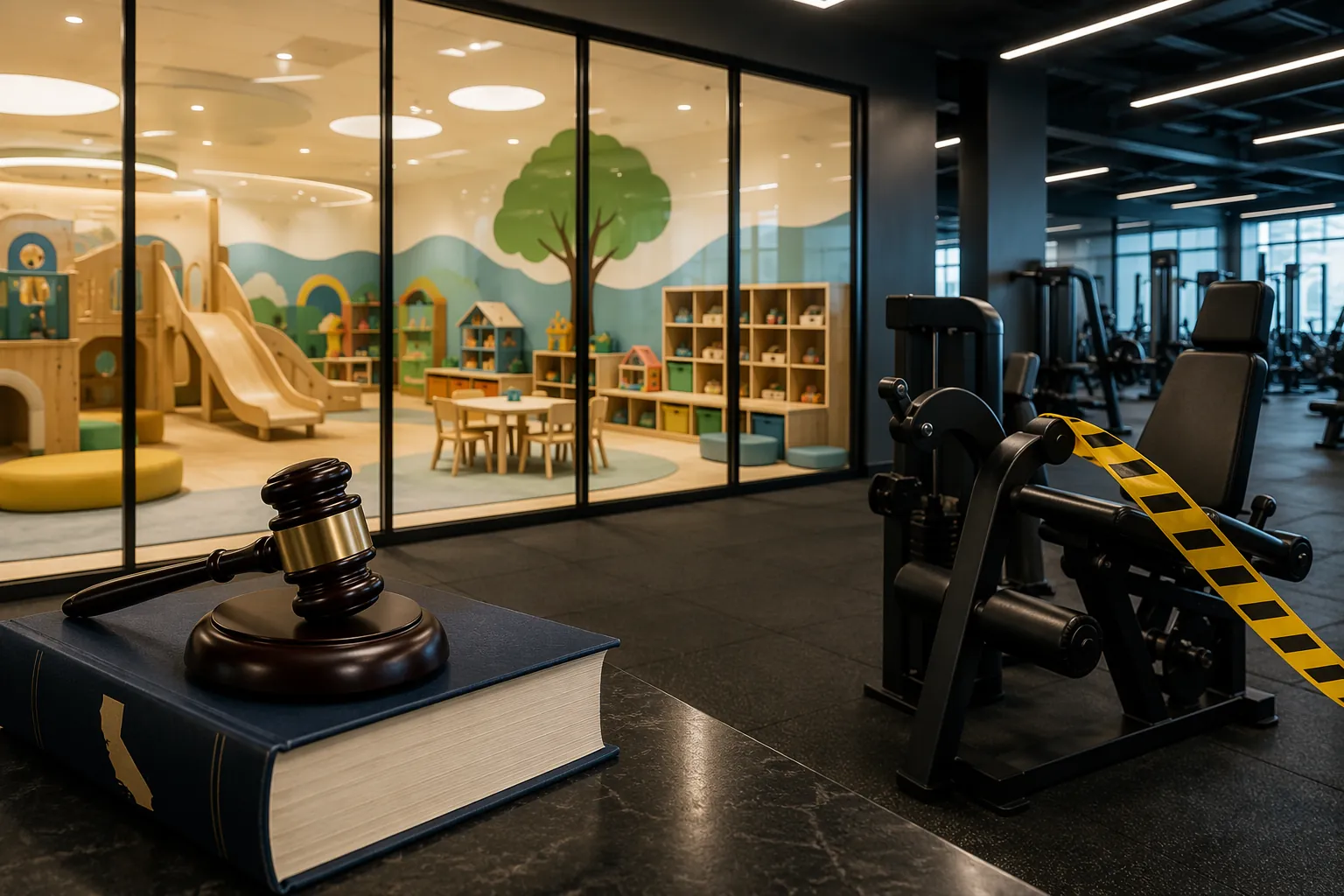
What Is Documented, What Is Alleged, And What Is Still Untested
Several facts sit on firmer public footing than others. Multiple news outlets reviewed the surveillance video and described the employee throwing the toddler upward before the fall.[1][2] CBS Los Angeles reported that the California Department of Social Services said it had no childcare license, no pending application, and no unlicensed-facility record on file for Bay Club El Segundo Clubhouse.[3] The seven pleaded causes of action come from complaint reporting, not from a court ruling on their sufficiency.[4]
That distinction matters because the lawsuit’s strongest risk signal does not require treating every allegation as proven. The public record already puts four items in the same frame: surveillance footage, an allegedly minimized post-incident account, a reported lack of childcare licensing records, and a large dedicated childcare setting inside a fitness-club business.
The Licensing Question Is Bigger Than The Fall
California Health and Safety Code §1596.792 lists facilities and arrangements that are not subject to the Child Day Care Facilities Act. Subdivision (k) exempts “temporary childcare services” when parents or guardians remain “on the same premises” as the facility providing those services.[5] The words are narrow. They do not say that any club may operate an unlicensed childcare center so long as the parent is somewhere within the brand’s broader campus, membership network, or affiliated amenities.
The Bay Club record presses directly on that wording. The Los Angeles Times described the Clubhouse as a 14,000-square-foot dedicated childcare facility.[2] CBS Los Angeles reported the CDSS no-license confirmation for the El Segundo Clubhouse.[3] The plaintiffs also allege that parents could leave the childcare site for a nearby country club, a practice that, if proven and if outside the statutory meaning of “same premises,” would make the exemption theory much harder to sustain.
The statute does not turn on square footage alone. A large childcare space is not automatically unlawful because it is large, and an exemption does not vanish merely because the room looks professional. But physical scale changes the risk question. A 14,000-square-foot dedicated childcare operation looks less like a parent staying nearby while a child is briefly supervised and more like a facility whose legal status depends on exactly how parents move, where they are allowed to go, and what the operator tells regulators, staff, and members about that model.
| Record Item | Why It Matters |
|---|---|
| Surveillance video reportedly showing a 6-foot toss and drop | Supports the direct-injury theory and undercuts any account that materially minimizes the mechanism of injury. |
| Alleged 1.5-foot fall explanation | Moves the case from ordinary negligence into alleged concealment or misrepresentation. |
| CDSS report of no license, pending application, or unlicensed-facility record | Frames the childcare program around exemption reliance rather than licensed operation. |
| Reported 14,000-square-foot dedicated childcare facility | Makes the statutory fit of “temporary childcare services” and “same premises” harder to treat as a casual detail. |
| Allegation that parents could leave for a nearby country club | Targets the statutory condition that parents remain on the same premises. |
Three Liability Vectors Now Travel Together
The complaint reportedly pleads negligence, negligence per se, negligent hiring, supervision, and retention, negligent infliction of emotional distress, fraud by intentional concealment, intentional infliction of emotional distress, and battery.[4] Those labels matter less as a list than as three separate routes through the same record.
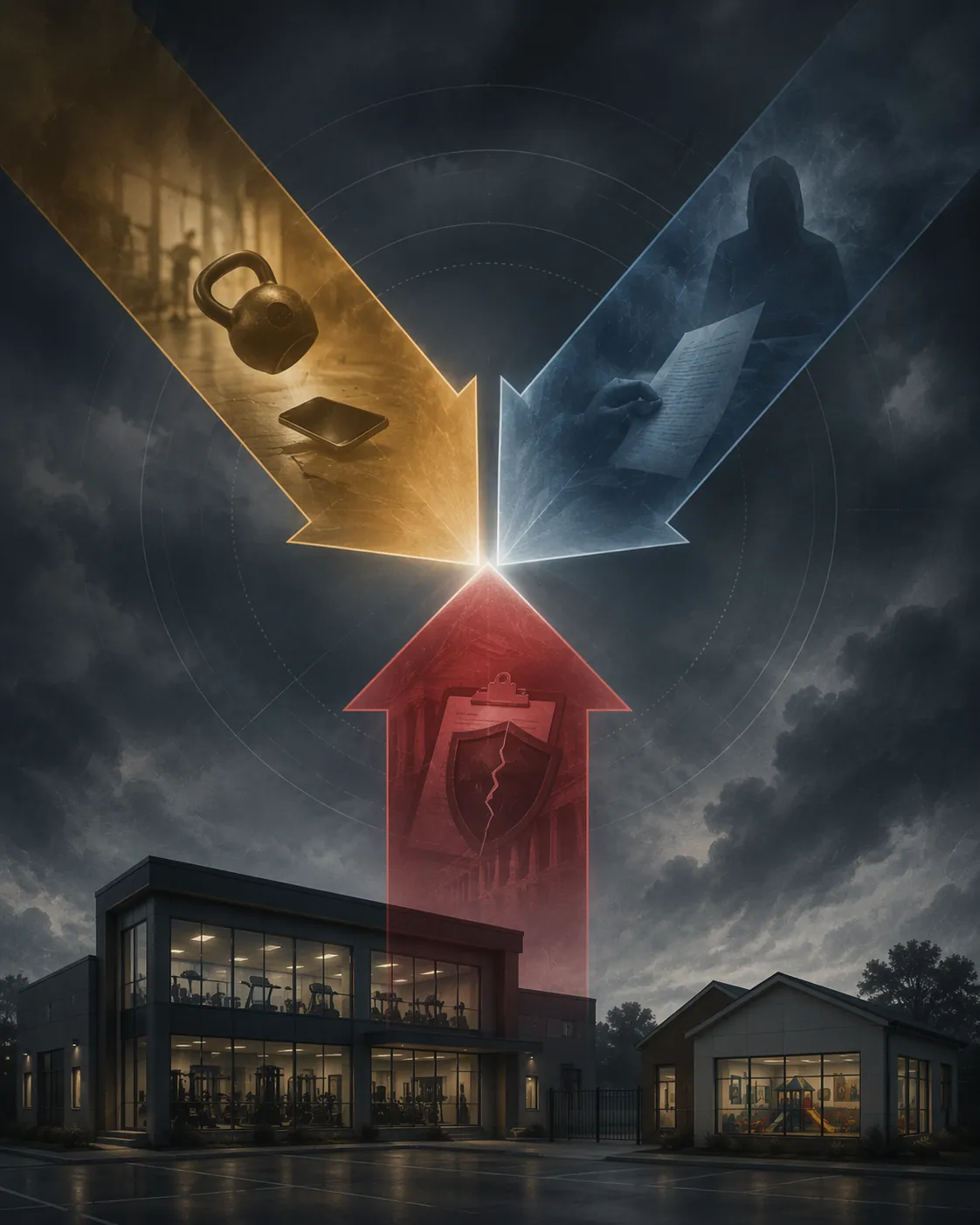
Direct Negligence From The Physical Act
The first route is the most familiar: an employee allegedly handled a toddler in a way that created a foreseeable risk of head injury. If the video is as described in public reporting, the claim does not depend on a subtle supervision standard. Throwing a 23-month-old about 6 feet into the air and failing to catch him supplies the plaintiffs with a concrete act, a concrete fall, and a concrete injury sequence.[1][2]
The negligent hiring, supervision, and retention theory widens the inquiry. It asks who trained the employee, what rules governed physical play with toddlers, how childcare workers were screened, whether prior concerns existed, and whether the facility’s staffing practices matched the vulnerability of the children in its care. Those questions remain untested in court, but they are predictable discovery targets in a childcare injury case.
Fraud Or Concealment From The Post-Incident Account
The second route depends on what happened after the fall. The plaintiffs allege they were told the child fell about 1.5 feet from a squatting position, while surveillance video allegedly showed a much higher toss and drop.[3] If a court later finds the account was knowingly false or materially incomplete, the exposure is not limited to whether staff made a careless mistake. It becomes a question of whether the facility interfered with the parents’ ability to understand the mechanism of injury, obtain appropriate care, and preserve the record.
That is a different evidentiary posture than a defendant saying, “We did not know yet.” The record described in public reports gives plaintiffs a comparison point: the video on one side, the alleged short-fall narrative on the other. The legal significance will depend on who knew what, when they knew it, and what exactly was communicated to the parents.
Negligence Per Se And The Exemption Fight
The third route is the one other fitness clubs should read most carefully. Negligence per se turns a statutory or regulatory violation into a duty-and-breach argument when the statute was designed to protect the kind of person injured from the kind of harm suffered. The complaint’s licensing theory reportedly points to §1596.792(k), arguing that Bay Club’s operation did not satisfy the exemption for temporary childcare services because parents were not required to remain on the same premises.[4][5]
No court has ruled that Bay Club needed a license, that the exemption fails, or that any licensing violation caused the child’s injuries. But the pleaded theory is not decorative. If an operator builds a substantial childcare program around a licensing exemption, the exemption becomes part of the liability architecture. The question is no longer only whether the employee dropped the child. It is whether the operator had structured the childcare service in a way California law allowed in the first place.
The “Same Premises” Language Does The Hard Work
The phrase “same premises” is doing more work than a casual reader might notice. It is the statutory boundary between a temporary childcare amenity and a regulated childcare facility. A parent exercising in the same building while a child is supervised for a short period presents one operating model. A parent leaving for a nearby country club while the child remains in a dedicated childcare facility may present another.
The public materials do not resolve how Bay Club defined the relevant premises, how far the nearby country club was from the childcare facility, whether parents actually left during the relevant time, or how consistently the practice operated. Those facts matter. A statute built around the parent remaining on the same premises cannot be evaluated without a precise map of the childcare room, the club, any nearby affiliated facilities, member check-in rules, and staff instructions.
That is why the CDSS point matters even though it is not, by itself, a liability finding. CBS Los Angeles reported that CDSS had no license, pending application, or unlicensed-facility record for the Bay Club El Segundo Clubhouse.[3] If the operator’s position is that no license was required, the exemption must carry the weight. If the exemption turns on facts that differ from daily practice, the licensing posture becomes vulnerable.
This Is A Known Industry Structure, Not A Bay Club-Only Question
Fitness clubs have not hidden the fact that some childcare offerings are treated as license-exempt. In-Shape Fitness publicly states that its childcare is exempt from licensing under §1596.792(k).[6] That disclosure does not imply In-Shape shares Bay Club’s alleged facts, and it should not be read that way. It does show that the exemption is part of a broader industry operating structure.
AB 772, introduced in the 2023-2024 California legislative session, addressed drop-in daycare by adding a parent-health-assessment requirement, but the materials do not show that it closed the broader gap created when a fitness club offers childcare while relying on the parent’s continued presence nearby.[7] The Kittle case therefore lands in a space lawmakers and operators already know exists: short-term childcare connected to adult recreational facilities, with licensing status often turning on details members may never read.
Waivers Are A Thin Shield In California Childcare
The available record does not establish what waiver, release, membership agreement, or childcare acknowledgment Bay Club may invoke. Still, California childcare operators should be cautious about assuming a pre-injury release ends the case. In Gavin W. v. YMCA of Metropolitan Los Angeles, the California Court of Appeal held that pre-injury releases for childcare satisfied all six Tunkl public-interest factors and were unenforceable as against public policy.[8]
Gavin W. does not decide the Kittle case. It does, however, limit the comfort a club should take from member paperwork when the underlying service is childcare. A fitness-club daycare may be marketed as an amenity, but once staff assume custody of young children, California courts have reason to treat the service differently from an adult member’s voluntary workout risk.
What The Pending Case Actually Signals
The narrow reading is the safer one: Kittle is a pending complaint supported by public reporting, not a judgment. The defendants have not yet answered in the materials reviewed, and the court has not decided whether the employee committed battery, whether any representation was fraudulent, whether §1596.792(k) applies, or whether any statutory violation can support negligence per se.
The risk signal is still substantial. A childcare program can look operationally mature enough to reassure members while legally depending on a narrow exemption written for temporary childcare services. If the parent-location practice does not match the exemption, the operator may have a licensing problem before anyone reaches the injury facts. If the post-incident account does not match the video, the operator may have a credibility problem before anyone reaches damages.
The Kittle lawsuit matters because it places surveillance evidence, no-license reporting, a large dedicated childcare facility, and a disputed “same premises” exemption in the same record. That combination is enough to make fitness-club daycare look less like a low-friction member amenity and more like a litigation and licensing exposure whose legal status depends on actual practice, not branding.
References
- Parents sue fitness club daycare after video appears to show toddler thrown by worker — ABC News
- Toddler suffers brain injury after day-care worker tosses him into the air, lawsuit alleges — Los Angeles Times
- Toddler severely injured after LA-area daycare employee allegedly throws him into air — CBS Los Angeles
- Parents Sue Bay Club Over Toddler's Alleged Brain Injury — Law Commentary
- California Health and Safety Code §1596.792 — California Legislative Information
- Child Care — In-Shape Fitness
- AB 772: Child day care facilities — Digital Democracy/CalMatters, 2023-2024
- Gavin W. v. YMCA of Metropolitan Los Angeles (2003) — FindLaw, 2003
Related records
Tool profile
Browse tool evaluations →Governing regulation
Browse the obligations tracker →Preventive workflow
Browse verification workflows →
Report a correction or tip
Spotted an outdated figure, a misstated fact, or a ruling this case record should reflect? Public comments are disabled for this content given the professional cost of a misreported case outcome, penalty amount, or rule text — use the structured correction channel instead.
Report a correction or tip for this record →