
Are Flock's Autonomous Drones Legal in Public Spaces?
This Risk Digest entry maps the current Fourth Amendment risk for Flock Safety's autonomous Alpha drones, showing that no appellate court has yet ruled on warrantless aerial ALPR surveillance, creating a litigation uncertainty zone for practitioners.
- Jurisdiction
- US Federal
- Court
- U.S. District Court for the Eastern District of Virginia
- AI tool named
- Flock Safety Alpha drone
- Ruling date
- Feb 11, 2026
- Source document
- View primary court order ↗
- Last verified
- Jul 27, 2026
Lex Machina Review is an independent risk-tracking and reference resource. Nothing on this site is legal advice, and using it does not create an attorney-client relationship. Every record is reviewed against primary sources but may not reflect the most current status of a matter — always verify directly against the cited court order, rule text, or a licensed attorney before relying on it.
Companion explanation — secondary to the source document above
Current risk posture
For anyone asking whether Flock Safety autonomous drones are legal in public spaces, the defensible answer is narrower than either a sales deck or a privacy broadside usually allows: no appellate court has squarely blessed warrantless autonomous aerial ALPR surveillance in public spaces. That does not make every Alpha deployment unconstitutional. It does mean prosecutors, city attorneys, and procurement teams should not treat constitutionality as settled.
| Question | Current risk posture |
|---|---|
| System at issue | Flock’s Alpha drone as described by Flock: autonomous Drone as First Responder capability, plate-reading from the air, operation at speed, and coverage claims that make it more than a single officer looking from a lawful vantage point. [1] |
| Fourth Amendment status | Unsettled for autonomous aerial ALPRs. Existing doctrine points in different directions depending on whether a court analogizes the system to public aerial observation, ground ALPR networks, or persistent aerial surveillance. |
| Most important suppression-risk hinge | Persistence and capability density: how often the aircraft flies, how much territory it covers, whether it logs every vehicle, how long data is retained, and who can search or share the records. |
| What this is not | Not legal advice, not a state-law survey, and not a conclusion that FAA operational permission answers Fourth Amendment admissibility. |
| Source verification | As of July 27, 2026, primary opinions and filings should be checked before citing any individual case, especially where the available material comes through secondary reporting. |
The hard part is not the word “drone.” Courts have been dealing with aircraft, cameras, public roads, and license plates for years. The hard part is the combined architecture: an autonomous aircraft that can be launched without a human pilot in the aircraft, cover public space quickly, read plates from above, and create searchable movement records without any officer ever standing next to the person being logged.
What Alpha adds to the old public-road premise
Flock’s own Alpha announcement is the right starting point because the constitutional problem follows from the capability claims. Flock describes Alpha as a Drone as First Responder system with autonomous beyond-visual-line-of-sight launch, the ability to travel up to 60 mph, license-plate reading from up to 2,000 feet, and coverage of up to 50 square miles. [1]
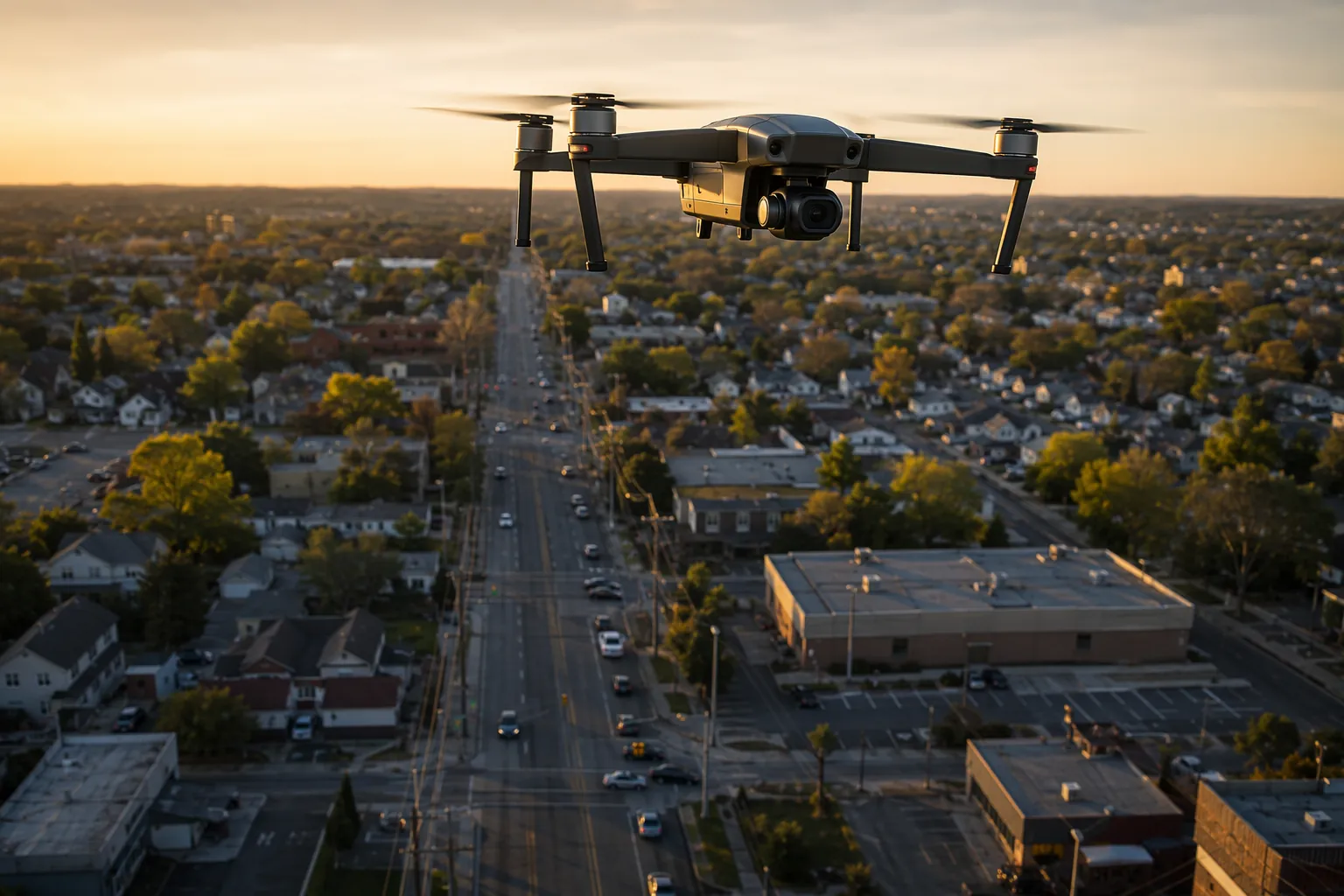
Each capability has a litigation consequence. Speed affects how quickly the system can move from a call location to surrounding roads. Altitude affects whether the observation feels like ordinary public exposure or remote extraction. Coverage affects whether the government is watching an incident corridor or maintaining a regional movement net. Automation affects whether the surveillance is limited by officer attention or scaled by software.
That distinction matters at the evidence stage. A patrol officer who sees a plate on a public road is one thing. A fixed camera that captures a plate at a known intersection is another. A drone system that can fly, identify, and log vehicles over a broad area starts to look less like a single observation and more like infrastructure for reconstructing movement. Courts may still permit it in some settings. But the old sentence “cars on public roads are visible” does not carry the whole load.
The three analogies pull in different directions

A court facing Alpha evidence would probably not start from a blank page. It would reach for analogies. The problem for counsel is that the available analogies are not interchangeable.
Public aerial observation helps the government
The government’s first argument is predictable: public airspace, public roads, visible license plates. Traditional aerial-observation doctrine has often been favorable to law enforcement when officers observe from lawful airspace what could be seen from above. Brookings’ Fourth Amendment analysis frames that older aircraft line as one of the reasons drone surveillance can appear, at first glance, to fit within familiar doctrine. [3]
That argument is strongest when the drone use is short, event-driven, and visually similar to a manned aircraft or helicopter observation. A drone launched to assess an active emergency, locate a fleeing suspect, or give officers a view of a dangerous scene is easier to defend than a program designed to build routine, searchable records of every vehicle moving through a coverage area.
The weakness is that Alpha is not merely an aircraft. It is also an automated recognition and logging system. A manned aircraft precedent may answer whether an officer could look down from lawful airspace. It does not necessarily answer whether the government may automate aerial plate collection at scale, keep the resulting movement data, and search it later.
Ground ALPR cases help, but they do not finish the analysis
Ground-based ALPR decisions are the second obvious analogy. They are especially tempting for agencies already using Flock’s fixed camera network. If a court has upheld a city’s use of stationary plate readers, a procurement memo may want to extend that reasoning to an aerial version.
The Norfolk litigation shows why that extension should be written carefully. WHRO reported that a federal judge ruled Norfolk’s Flock surveillance cameras did not invade people’s privacy yet, while warning that the analysis could change as the capacity of the surveillance system increases. [2] That is not a holding against Alpha. It is also not a safe harbor for Alpha. It is a judicial signpost that scale and technical capability can matter.
A fixed ground camera usually captures vehicles at particular points. A drone can move. A fixed ALPR network can certainly become dense, but its geography is still tied to installed hardware. An autonomous aerial ALPR adds flexibility: it can be dispatched, repositioned, and potentially layered over existing cameras. If the resulting record allows the government to infer where a vehicle traveled, where it paused, and which locations it repeatedly visited, a court may ask a different question than it asks about a single plate hit at a single intersection.
Persistent aerial surveillance is the challenger’s strongest route
The most serious suppression-risk analogy is persistent aerial surveillance. Brookings identifies the Fourth Circuit’s decision in Beautiful Struggle v. Baltimore Police Department as a central Fourth Amendment marker for drones and aerial surveillance; the case involved persistent warrantless aerial surveillance and found a constitutional problem with the program. [3]
Beautiful Struggle is not an Alpha case. It does not decide whether an autonomous drone can read a plate during an emergency response. But it gives challengers a path that is more precise than a generic privacy objection: if the government uses aerial technology to collect movement information persistently enough to reveal patterns, the Fourth Amendment analysis can shift from isolated public exposure to aggregated surveillance.
That is where the suppression fight would likely become fact-heavy. How many flights occurred? Were they tied to specific calls? Did the system log every plate it saw or only plates linked to a hotlist or incident? How long were the records retained? Could investigators later query the data for unrelated investigations? Was the defendant’s movement reconstructed from a single observation or from a database built over time?
The capability-density problem
The Norfolk warning deserves more attention than a passing footnote because it captures the doctrinal hinge. A court may tolerate today what it would not tolerate after deployment becomes denser, faster, more automated, and more searchable. WHRO’s account of the Norfolk ruling describes precisely that caution: the judge found no privacy invasion on the record before the court, but indicated the result could change as surveillance capacity increases. [2]
For Alpha, “capacity” is not a vague policy concern. It is the operational question. A program that launches a drone to a reported shooting and captures a plate near the scene presents one set of facts. A program that flies repeatedly across a 50-square-mile area, reads plates from the air, stores every observation, and allows later searches across unrelated investigations presents another. The Fourth Amendment argument changes as the system moves from response tool to movement database.
This is why “public space” is an incomplete answer. The constitutional issue is not only whether a car was visible on a public road. It is whether the government used automated aerial infrastructure to create a record that ordinary members of the public could not practically create, and that officers historically could not maintain without substantial human effort.
A prosecutor defending Alpha-derived evidence will want the record to look narrow: specific call, limited flight, limited collection, minimal retention, no broad historical query. A defense lawyer will try to make the record look architectural: autonomous launch, broad coverage, recurring flights, plate recognition, database retention, and search access beyond the incident that justified the flight. Both sides will be fighting over the same facts because the appellate rule has not yet been written for this exact system.
FAA permission is not a warrant substitute
Drone First Responder programs are expanding nationally. EFF reported that more than 1,000 FAA waivers had been issued by February 2026, and warned that hundreds of Drone First Responder programs could soon be launched across the country. [4] That matters for scale. It does not decide admissibility.
FAA authorization addresses aviation safety and operational permission. A Fourth Amendment suppression motion asks a different question: whether the government search or seizure was reasonable, and whether the evidence should be excluded. A city can be authorized to fly and still mishandle constitutional risk. Conversely, a Fourth Amendment argument is not proved merely by pointing to the fact that a drone flew.
State drone-warrant statutes add another layer, but they should not be blended into the federal analysis. If a state requires a warrant for certain drone uses, that may create an independent statutory problem even where federal doctrine remains uncertain. The state-law answer should be checked against the current code and session laws for the relevant jurisdiction, not borrowed from a national roundup or vendor memo.
Why the issue is live in 2026
The legal uncertainty would matter even if every deployment were cautious. It matters more because ALPR and drone programs are now being challenged not only as search tools, but as governance systems: who approves them, who audits them, who can query the data, and whether the public was told the truth before the contract was signed.
404 Media has reported on a lawsuit arguing that warrantless use of Flock surveillance cameras is unconstitutional. [5] The reporting concerns ground-based Flock cameras, not Alpha drones, so it should not be cited as an aerial-drone holding. Its practical relevance is narrower and still important: plaintiffs are already testing whether automated plate-reader networks can exceed constitutional limits.
Procurement scrutiny is also growing. The ACLU reported that Flock made misrepresentations to at least five city councils, police departments, or members of the public, creating credibility and due-diligence concerns for municipalities considering or defending surveillance contracts. [6] Those allegations do not decide the Fourth Amendment issue. They do affect how a city attorney should read vendor assurances, public-use policies, and contract language.
Data-sharing concerns are part of the same risk environment. EFF’s investigations reported concerns involving Flock data sharing with ICE and CBP, and patterns connected to protest or abortion-related surveillance. [7] Again, those are not Alpha-specific appellate holdings. They are reasons judges, city councils, and litigants may look harder at retention, access controls, sharing permissions, and whether the stated public-safety rationale matches actual use.
| Risk factor | Why it matters in a Fourth Amendment or procurement memo |
|---|---|
| Persistent flights | Makes the program look less like incident response and more like movement tracking. |
| Large coverage area | Supports an argument that the government is creating a regional surveillance layer rather than observing a single scene. |
| Automated plate logging | Moves the issue from visual observation to searchable data collection. |
| Long retention | Increases the chance that later unrelated investigations will depend on historical movement records. |
| Broad sharing | Creates policy, statutory, and credibility issues, especially where data moves beyond the original public-safety justification. |
| Vendor overstatements | Can undermine procurement records and make later litigation harder to defend. |
How to state the risk without overstating the law
The cleanest memo language is careful because the law is still underbuilt. It should not say that Alpha is unconstitutional simply because it is autonomous, aerial, or sold by Flock. It should also not say that Alpha is constitutional because license plates are exposed on public roads or because the FAA allowed the aircraft to operate.
- Say what the system actually did in the case: emergency response, patrol, search for a suspect, routine area monitoring, or historical database query.
- Separate flight legality from search legality. FAA compliance belongs in the aviation column, not the warrant column.
- Do not convert ground ALPR authority into aerial ALPR authority without explaining the added automation, mobility, altitude, and coverage.
- Treat Beautiful Struggle as a serious analogy when the record shows persistent aerial collection, but do not describe it as an Alpha holding.
- Verify the Norfolk ruling, any Chatrie-related citation, and any state drone-warrant requirement against primary sources before using them as controlling authority.
- Ask for the retention schedule, audit logs, sharing rules, hotlist policy, query permissions, and public approval record before making a procurement or admissibility recommendation.
The present risk map is narrow but important. Warrantless Alpha evidence is not clearly unconstitutional under existing appellate law. It is also not safely constitutional under existing appellate law. Risk rises as the deployment becomes more persistent, more area-covering, more automated, more searchable, and more disconnected from an immediate emergency response.
That is the line worth preserving in litigation files and procurement records: no appellate court has yet done the work for autonomous aerial ALPRs. Until one does, the defensible posture is verification first, analogy second, confidence last.
References
- Flock Safety Unveils Alpha Drone as First Responder System, Flock Safety
- A federal judge ruled Norfolk's Flock surveillance cameras don't invade people's privacy — yet, WHRO, 2026-02-11
- Will drones outflank the Fourth Amendment?, Brookings
- Hundreds of Drone First Responder Programs Could Soon Be Launched Across the Country, Electronic Frontier Foundation, 2026-07
- Lawsuit Argues Warrantless Use of Flock Surveillance Cameras Is Unconstitutional, 404 Media
- Flock Safety Credibility Lost as It Repeatedly Lies to City Councils, Police Departments, and Public Across the Country, ACLU
- EFF's Investigations Expose Flock Safety's Surveillance Abuses: 2025 in Review, Electronic Frontier Foundation, 2025-12
Related records
Tool profile
Browse tool evaluations →Governing regulation
Browse the obligations tracker →Preventive workflow
Browse verification workflows →
Report a correction or tip
Spotted an outdated figure, a misstated fact, or a ruling this case record should reflect? Public comments are disabled for this content given the professional cost of a misreported case outcome, penalty amount, or rule text — use the structured correction channel instead.
Report a correction or tip for this record →