
Seven Flock False Plate Flag Settlements Map a Liability Spectrum
At least seven civil settlements from Flock Safety false-plate-flag incidents have established a liability spectrum from $35,000 to $1.9 million, with single-character ALPR misreads as the dominant error pattern and §1983 unreasonable seizure as the strongest legal theory.
- Jurisdiction
- United States
- Court
- Multiple U.S. federal and state courts
- AI tool named
- Flock Safety ALPR
- Ruling date
- Jan 1, 2025
- Source document
- View primary court order ↗
- Last verified
- Jul 27, 2026
Lex Machina Review is an independent risk-tracking and reference resource. Nothing on this site is legal advice, and using it does not create an attorney-client relationship. Every record is reviewed against primary sources but may not reflect the most current status of a matter — always verify directly against the cited court order, rule text, or a licensed attorney before relying on it.
Companion explanation — secondary to the source document above
The settlement spectrum is already usable, with caveats
In a false-plate-flag challenge involving a Flock camera, the first question is not whether the technology can be imperfect. It is what the stop became after the alert: a quick roadside correction, a gunpoint felony stop, handcuffs, children detained, a police dog, or an injury. The documented settlement record now gives counsel something more concrete than anecdotes. Business Insider and EFF reporting identify at least seven civil settlements arising from Flock false-plate-flag incidents, with a known settlement range from $35,000 to $1.9 million and an approximate median of $47,250 across the known settled cases. Those figures are useful for demand valuation, but they are not merits rulings, and some resolutions included standard denials of wrongdoing. [1][2]
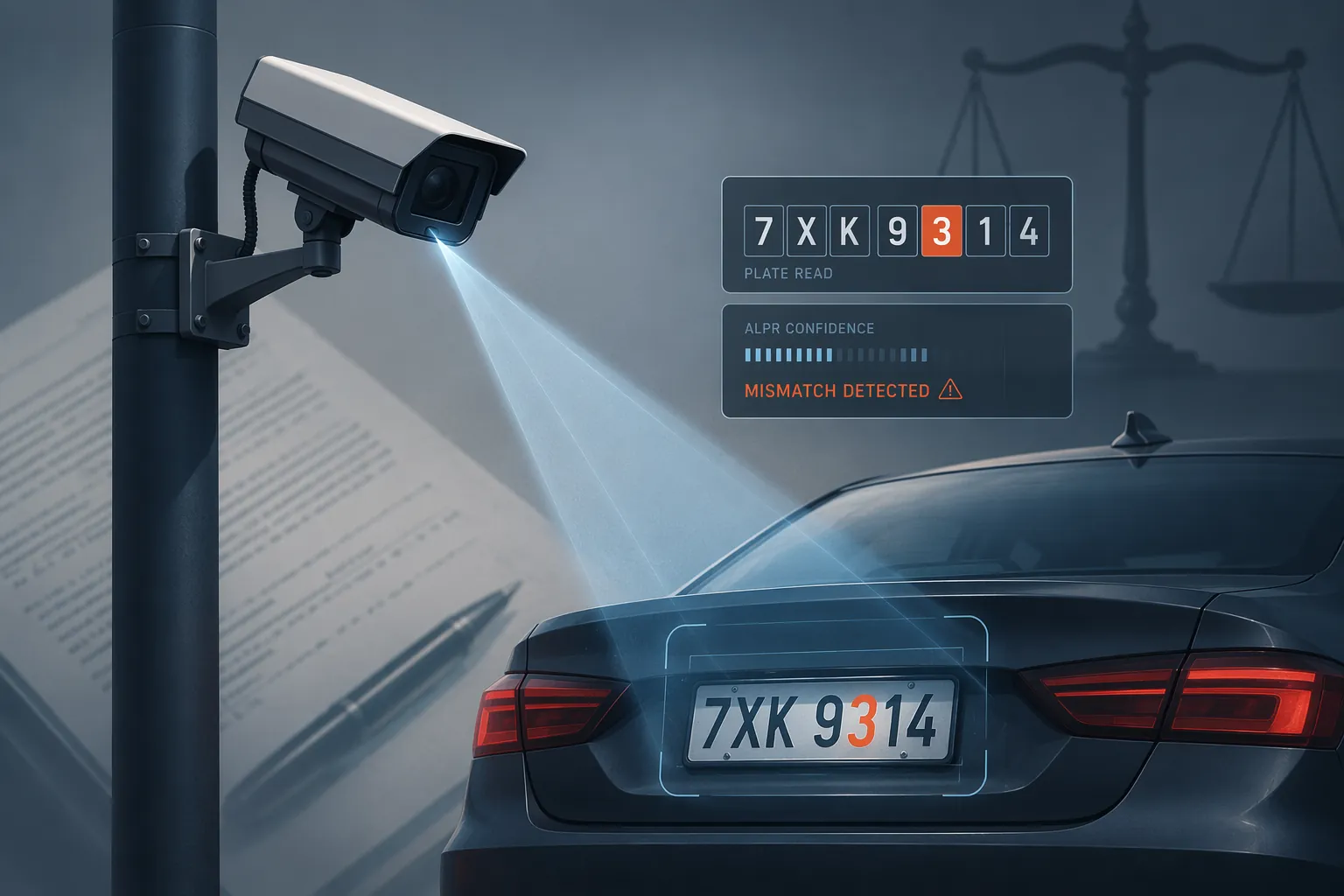
The most important comparators are not all equal. Gilliam anchors the high end because the vehicle mismatch was glaring in ordinary human terms: a motorcycle plate associated with a stolen vehicle led officers to stop an SUV carrying a family, including children, at gunpoint. Green sits in the serious mid-to-high range. Burkleo, Hofer, Upchurch, and Gonzales are lower-to-middle benchmarks, but their value is in the fact pattern: the character read, the database failure, the escalation of force, and whether anyone checked the plate before treating the alert as enough.
| Matter | Jurisdiction | Reported settlement value | False-flag mechanism or key fact | Benchmark use |
|---|---|---|---|---|
| Brittney Gilliam | Aurora | $1.9 million | SUV stopped after a plate associated with a motorcycle was treated as a stolen-vehicle hit; family, including children, handcuffed at gunpoint. [1] | High-end comparator where obvious vehicle mismatch and child/family detention sharply increase exposure. |
| Denise Green | San Francisco | $495,000 | Reported single-character misread involving “3” and “7.” [1] | Serious mid-to-high marker for a misread that traveled into a wrongful stop claim. |
| Brian Hofer | Contra Costa | $49,500 | Unrecovered-vehicle database failure rather than the cleanest single-character OCR misread. [1] | Useful for database and stale-record theories, especially when the officer or agency had a chance to verify. |
| Jason Burkleo | Atherton | $45,000 | Reported “H”/“M” character misread leading to a gunpoint stop. [1] | A compact example of the liability chain: plate read error, insufficient verification, constitutional seizure. |
| Brandon Upchurch | Toledo | $35,000 | False flag followed by police dog mauling. [1][2] | Do not read the low number as a low-severity rule; settlement value may reflect local posture, defendants, proof, caps, or other case-specific constraints. |
| Jaclynn Gonzales | Espanola | Settled; amount not specified in the materials reviewed here | Reported “2”/“7” misread; settled in 2025. [1] | Useful for identifying the recurring single-character pattern even when the dollar figure is not available. |
| Additional reported settled false-plate-flag matter | Not sufficiently detailed in the materials reviewed here | Included in the reported known-settlement set, but not usable here as a matter-level comparator | The reporting supports an at-least-seven-settlement universe and the approximate median, but the present record does not supply enough facts to benchmark this item independently. [1] | Use only for count and range context, not for fact-pattern matching. |
That table should be read the way settlement data is normally read inside a legal department: as exposure intelligence, not as a verdict sheet. It shows what defendants have paid to resolve false-flag events. It does not prove that every similar plaintiff will defeat qualified immunity, establish municipal liability, or recover comparable damages.
The recurring error is small on the plate and large in the stop
The recurring pattern is not “AI made a mistake” in the abstract. The useful allegation is narrower: a license-plate reader misread one character, then officers treated the resulting alert as a basis for a high-risk seizure without independently confirming that the observed vehicle and plate actually matched the wanted record. The reported examples include “7” for “2,” “H” for “M,” and “3” for “7.” [1]
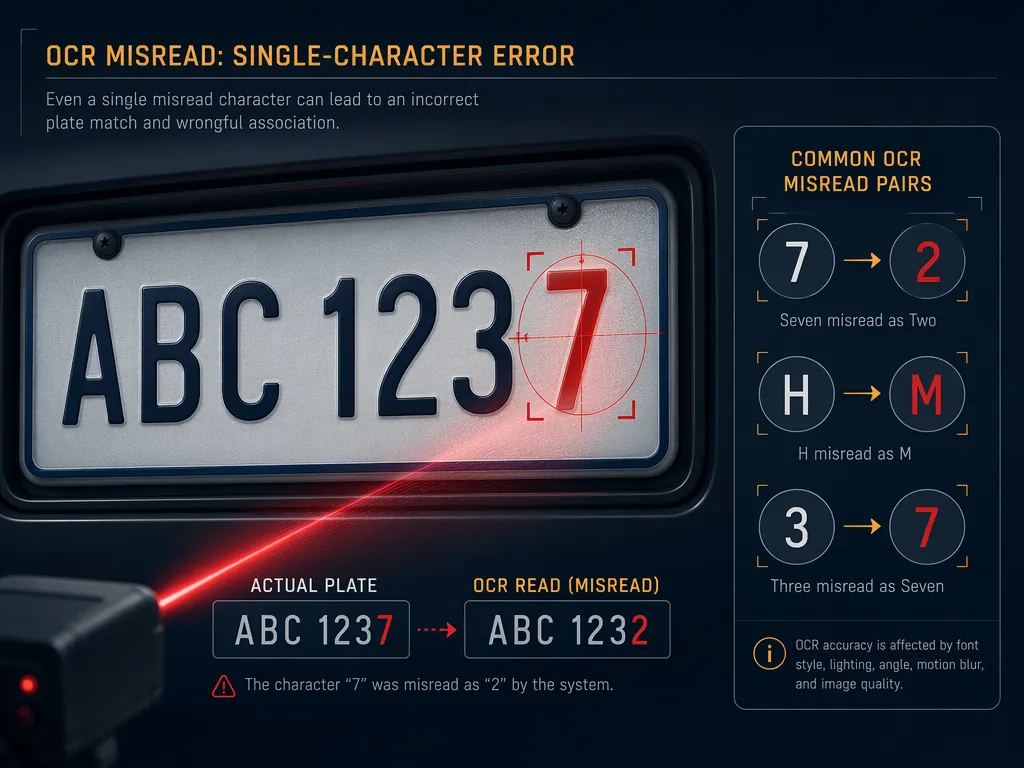
That distinction matters for pleadings and for demand letters. A generalized complaint that an ALPR system is unreliable is harder to value. A complaint that identifies the exact character mismatch, the make-or-type mismatch, the database entry, the officer’s failure to compare the physical plate, and the escalation that followed gives both sides a cleaner damages conversation.
Flock’s own public-facing reliability posture does not give counsel a single global number to plug into a risk model. The company has not published one universal accuracy figure and has stated that “performance can vary depending on plate design, lighting conditions, and environmental factors.” [1] That may be true of optical character recognition systems generally, but it leaves a city attorney or procurement officer with an evidentiary gap: the jurisdiction must assess how alerts are verified locally, not merely whether the vendor says the system performs well under some conditions.
The jurisdiction-specific reliability materials belong mostly elsewhere. The separate Flock ALPR False Positives Tool Evaluation addresses the July 2026 LAPD inspector general audit reporting a 32.3% false-positive rate in that jurisdiction. That figure is useful context for systemic review, but it should not be lifted out of Los Angeles and described as a universal Flock error rate.
What moves a false-plate-flag case up or down
The settlement range is wide because the wrongful alert is only the first event. The valuation question turns on what government actors did with it. A one-character mismatch that is corrected before a stop may be a systems issue. The same mismatch, if used to justify a felony stop, becomes a seizure problem. Add handcuffs, drawn weapons, children, physical injury, or a dog bite, and the settlement conversation changes.
Gilliam is the obvious top-end marker because several exposure factors stacked together. The alleged mismatch was not merely a hard-to-see plate character; the stop involved an SUV when the underlying stolen-vehicle record concerned a motorcycle plate. The family context and the presence of children made the force of the error harder to minimize. The reported $1.9 million settlement does not establish that every family stop will settle near that figure, but it does show the exposure ceiling when a bad ALPR hit is paired with an obvious mismatch and high-force detention. [1]
Green’s reported $495,000 settlement is the better warning for cases that are serious but not Gilliam. A “3”/“7” misread is the kind of error a city might be tempted to characterize as ordinary machine imperfection. That framing does not answer the civil-claims problem. The issue is whether the stop continued, or escalated, after officers could have compared the physical plate and vehicle against the alert. [1]
The lower-dollar settlements are useful precisely because they are closer to routine demand-letter territory. Burkleo’s $45,000 Atherton settlement involved an “H”/“M” misread and a gunpoint stop. Hofer’s $49,500 Contra Costa settlement points to a different pathway: an unrecovered-vehicle database failure rather than a simple OCR character substitution. Upchurch’s $35,000 Toledo settlement is the caution against over-reading the number alone, because the reported facts include a police dog mauling after a false flag. [1][2]
For case screening, the more useful valuation factors are:
- Obvious vehicle mismatch: a motorcycle record leading to an SUV stop is materially different from a same-make, same-color sedan with a one-character plate issue.
- Escalation level: drawn guns, prone positioning, handcuffs, multiple officers, or a felony-stop protocol make the seizure more serious.
- Children or vulnerable passengers: the damages narrative changes when minors are ordered out, handcuffed, or made to witness a high-risk detention.
- Physical injury: a dog bite, fall, prolonged restraint injury, or panic-related medical issue can move a case out of nuisance-settlement territory.
- Verification failure: the strongest plaintiff facts usually include a missed opportunity to compare the actual plate, vehicle type, or database record before initiating or continuing the stop.
- Source of the error: OCR misread, stale database entry, unrecovered-vehicle record, or human dispatch error may lead to different defendants and defenses.
- Duration and correction: a stop that ends as soon as the mismatch is noticed is different from a detention that continues after the alert has been undermined.
The city-side exposure review should not stop at “the camera got it wrong.” It should reconstruct the human decision path: who received the alert, what the alert said, whether the officer saw the actual plate before the stop, whether dispatch confirmed the wanted record, when the mismatch became apparent, and whether the officer de-escalated at that point. The difference between a $35,000 settlement and something closer to Aurora often lives in that sequence.
The legal theories with the clearest settlement track record
The strongest federal theory in the reported false-plate-flag cases is a 42 U.S.C. § 1983 unreasonable-seizure claim. The state-law companions are false imprisonment and negligence. That is a settlement track record, not a declaration that courts have adopted a final rule on Flock alerts. Most of these matters resolved before merits rulings, and the distinction matters when advising a client who wants to know whether a new case is “winnable” rather than merely expensive. [1][2]
§1983 unreasonable seizure
The §1983 theory travels well because the injury is usually not the misread itself. The injury is the government seizure that follows: the traffic stop, the felony-stop posture, the command to exit, the handcuffs, the dog deployment, or the continued detention after the mismatch should have been apparent. A plaintiff does not need to make the camera a constitutional actor. The more direct allegation is that officers lacked reasonable suspicion or probable cause once the actual plate, vehicle type, or database record failed to match.
The theory becomes stronger where the officer had an easy verification step available. If the alert says stolen motorcycle and the officer is looking at an SUV, the plaintiff’s lawyer does not need a technical tutorial to explain why continued high-risk detention looks unreasonable. If the alert contains a plate image showing a different character than the officer’s target vehicle, the verification failure becomes even cleaner.
Qualified immunity still has to be accounted for. A settlement does not mean a court would have held that every officer violated clearly established law by relying on an ALPR alert. But from a risk standpoint, the cases that settle are not being priced only on abstract doctrine. They are priced on deposition risk, body-camera visuals, policy gaps, training materials, and the common-sense problem of explaining why no one checked the plate before pointing guns at the wrong person.
False imprisonment and negligence
State-law false imprisonment claims supply a straightforward route where the detention is unsupported by the facts available to officers. The claim does not require the plaintiff to prove that the vendor intentionally caused the wrong hit. It asks whether the plaintiff was restrained without lawful justification. In a false-plate-flag case, the critical documents are often the alert, the actual plate image, the dispatch record, and the point at which the mismatch could have been seen.
Negligence claims do different work. They can reach maintenance of hot lists, failure to clear unrecovered vehicles, inadequate procedures for confirming alerts, or training gaps around ALPR verification. Hofer is the useful benchmark here because the reported issue was an unrecovered-vehicle database failure rather than a simple “H”/“M” or “2”/“7” read. [1]
The vendor-liability question is more fact-dependent. The settlement record discussed here is most immediately useful for claims against government actors and municipalities after a seizure. Claims against a technology provider require a different review of contract terms, representations, data flow, indemnity language, and causation. That broader landscape is covered in the Flock Safety’s Three Lawsuit Tracks Risk Digest entry.
Using the numbers without overstating them
The approximate $47,250 median is a starting point, not a tariff. It is useful when a plaintiff’s lawyer is deciding whether a demand in the low six figures is defensible, or when a city attorney is deciding whether a $40,000 demand should be treated as a nuisance request or a rational early-resolution number. It is less useful when the case includes children detained at gunpoint, serious physical injury, or a mismatch so obvious that the body camera will carry the argument by itself. [1]
For a plaintiff-side demand, the benchmark package should include the settlement comparators and the verification timeline. The strongest demand letters will not simply attach articles about ALPR errors. They will show the exact character mismatch, the actual plate, the hot-list entry, the vehicle description, the officer’s opportunity to check, and the escalation that followed. If the client was handcuffed, ordered down at gunpoint, bitten by a dog, or accompanied by children, those facts should be organized before the number is chosen.
For a municipal exposure review, the same facts should be sorted slightly differently. The risk manager needs to know whether the department had an ALPR verification policy, whether the officer followed it, whether dispatch confirmed the record, whether the alert screen displayed enough information to catch the mismatch, and whether prior false alerts had been reported. A single bad alert is one problem. A known verification gap is another.
Procurement staff should treat the settlement spectrum as an operational-risk input rather than a referendum on whether ALPR networks should exist. Contract review should ask what accuracy claims are actually made, what audit data the agency receives, how hot lists are maintained, whether alerts preserve images and metadata for later review, and what the vendor agreement says about indemnity and support after a false stop. The lack of a single published Flock accuracy figure makes those local controls more important, not less. [1]
The disciplined conclusion is narrow. These seven reported settlements do not prove adjudicated liability. They do create a usable liability spectrum for evaluating new false-plate-flag incidents. At the low-to-middle end, counsel should look for single-character misreads, database failures, brief detentions, and early correction. At the high end, the exposure drivers are force, children, physical injury, obvious mismatch, and failure to independently verify before or during the seizure. That is enough to price the next demand more carefully than “the camera was wrong.”
References
- Flock Safety ALPR cameras misreads, Business Insider, March 2026.
- The Human Toll of ALPR Errors, Electronic Frontier Foundation, November 2024.
Related records
Tool profile
Browse tool evaluations →Governing regulation
Browse the obligations tracker →Preventive workflow
Browse verification workflows →
Report a correction or tip
Spotted an outdated figure, a misstated fact, or a ruling this case record should reflect? Public comments are disabled for this content given the professional cost of a misreported case outcome, penalty amount, or rule text — use the structured correction channel instead.
Report a correction or tip for this record →