
How Florida's Execution-Warrant Law Enabled a Double Execution
This article explains the specific statutory mechanism under Fla. Stat. § 922.06 that allowed Florida to carry out two executions on the same day in July 2026—a first since 1964—and how that sole-plenary-authority model, combined with the Timely Justice Act, compresses the warrant timeline and reduces transparency. Practitioners assessing procedural risk in Florida capital cases will understand why the state's execution process is structurally distinct and faster than almost any other.
- Jurisdiction
- US-Florida
- Court
- Florida Supreme Court
- AI tool named
- None
- Ruling date
- Jul 28, 2026
- Source document
- View primary court order ↗
- Last verified
- Jul 30, 2026
Lex Machina Review is an independent risk-tracking and reference resource. Nothing on this site is legal advice, and using it does not create an attorney-client relationship. Every record is reviewed against primary sources but may not reflect the most current status of a matter — always verify directly against the cited court order, rule text, or a licensed attorney before relying on it.
Companion explanation — secondary to the source document above
Florida’s July 28, 2026 same-day executions of James Duckett and Dominick Occhicone were publicly notable because Florida had not carried out a double execution on one day since 1964.[1] For lawyers tracking Florida’s same-day execution process, though, the more important point is narrower: the decisive scheduling act was not a same-day judicial order. It was the governor’s use of Florida’s execution-warrant statute.
Under Fla. Stat. § 922.06, Florida gives the governor sole plenary authority to issue death warrants and set the execution date; the warden then carries out the execution within the warrant’s 180-day period.[2] That allocation of power is unusual. In most death-penalty states, courts or corrections officials perform some date-setting function. Florida and Pennsylvania share the sole-plenary-authority model, but Pennsylvania operates under a moratorium, leaving Florida as the active jurisdiction where this feature matters most in practice.[2]

The Warrant Sequence, Not the Court Docket, Created the Same-Day Event
Duckett did not arrive on the July 28 calendar because a court paired his case with Occhicone’s. His earlier warrant, signed for a March 31 execution, expired after litigation interrupted the process. On July 8, 2026, the Florida Supreme Court lifted the stay in Duckett’s case, allowing the death-warrant case to proceed.[3] Six days later, on July 14, Governor Ron DeSantis signed a new warrant for Duckett and placed his execution on July 28, the date already set for Occhicone.[4]
That sequence matters because each institution did something different. The Florida Supreme Court removed a barrier in Duckett’s case. The governor selected the date. The U.S. Supreme Court later declined to stop the executions. None of those acts is interchangeable if counsel is trying to identify where timing risk actually enters the case.
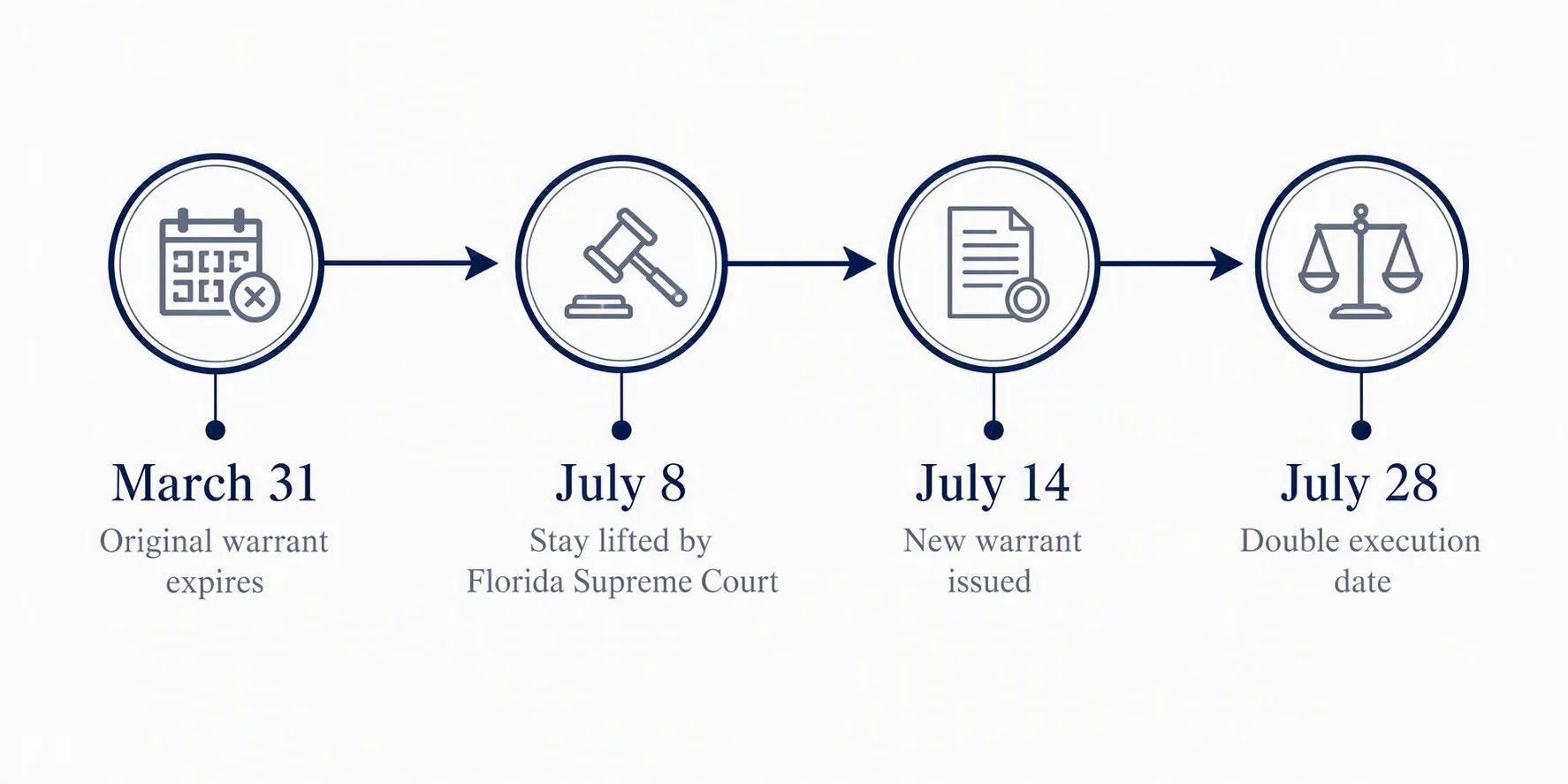
| Date | Procedural event | What changed |
|---|---|---|
| March 31, 2026 | Duckett’s original warrant date passed and the warrant expired | A new warrant would be needed before an execution could proceed |
| July 8, 2026 | Florida Supreme Court lifted Duckett’s stay | A state-court barrier to proceeding was removed |
| July 14, 2026 | Governor signed a new Duckett warrant | Duckett was placed on Occhicone’s existing July 28 execution date |
| July 28, 2026 | Both executions proceeded after last-minute stay denials | The same-day executions occurred |
Why Florida’s Statute Carries So Much Scheduling Force
Section 922.06 is not merely an administrative provision. It is the point at which Florida’s capital process shifts from completed appellate litigation into an executive-controlled execution calendar. The statute’s design leaves no ordinary judicial scheduling step between warrant eligibility and the governor’s selection of an execution period.[2]
That is the procedural lever that made the July 28 pairing possible. Once Duckett’s stay was lifted, the governor did not need a court to choose a new date. He could issue a separate warrant and select a date that already carried another pending execution. Occhicone’s July 28 setting did not mechanically pull Duckett into the same day; the new Duckett warrant did.
For lawyers tracking capital litigation risk, that distinction is not semantic. If a jurisdiction depends on court scheduling, the operative calendar may be visible through motions, orders, and docket practice. If the governor holds the date-setting authority, the risk analysis has to watch the executive branch, clemency posture, statutory triggers, and warrant practice with the same attention normally reserved for appellate deadlines.
The 180-Day Window Is a Ceiling, Not a Practical Runway
The 180-day warrant period can mislead if read as a usable defense horizon. It identifies the outer period within which the warden must execute under the warrant, not the amount of time counsel will necessarily have after a new warrant is signed.[2] In Duckett’s July sequence, the new warrant was signed on July 14 for a July 28 execution date.[4] The period between operative warrant and execution was therefore measured in weeks, not months.
The research record also identifies a broader compression risk: under Florida’s current framework, the warrant-and-execution timeline can collapse to as few as 34 days rather than approach the 180-day statutory maximum.[2] That figure should be read as a procedural-risk measure, not as a prediction that every case will move that fast. Its significance is that the statute permits the calendar to become short enough to change litigation triage.
The Timely Justice Act Narrows the Pre-Warrant Space
The Timely Justice Act adds another timing pressure point. The 2023 law requires the governor to issue a death warrant within 30 days after clemency concludes.[2] That provision does not itself pick the execution date, and it does not prove that any particular execution will occur within 30 days. It does, however, reduce the slack between the end of clemency review and executive warrant action.
That matters because capital counsel often need time for remedial litigation after a warrant issues: competency claims, method-of-execution litigation, public-records disputes, newly discovered evidence claims, or federal stay applications. A short warrant interval changes which claims can realistically be developed, supported, and presented before execution. The legal theories may remain available in the abstract while the practical record-building period contracts.
The constitutionality of the 2023 acceleration has not been squarely tested on the record described in the research materials. Any future Eighth Amendment or due-process challenge would need to confront not just the statute’s text, but how quickly it operates after clemency and how much meaningful review remains before the execution date.
What the U.S. Supreme Court Did—and Did Not Do—on July 28
The U.S. Supreme Court’s role on July 28 was important, but it was not the source of the same-day setting. Both Duckett and Occhicone filed last-minute stay applications, and the Court denied both. Duckett’s execution, originally scheduled for noon, was delayed until 1:19 p.m. while rulings were pending.[5]
Those denials allowed the executions to proceed that day. They did not create the double-execution calendar. The operative date selection had already occurred through the governor’s warrants, including the July 14 Duckett warrant that joined Occhicone’s existing July 28 date.[4][5]
The denials also continued the reported 2025 pattern in which the Court denied 100% of stay requests in this context.[2] For practitioners, that pattern belongs in the risk assessment, but it should not obscure the earlier state-law control point. By the time emergency papers reach Washington, much of the usable calendar may already have been spent.
Limited Disclosure Makes the Operational Record Thin
Florida’s public-records rules further limit what counsel and observers can reconstruct about execution logistics. Fla. Stat. § 945.10 exempts the identity of executioners and information that would identify entities involved in supplying execution drugs from disclosure.[6] The Death Penalty Information Center’s Florida profile likewise identifies confidentiality protections around the state’s execution process.[7]
That secrecy overlay does not prove anything improper about the July 28 logistics. It does mean that the public record is structurally incomplete. When two executions are set for the same day, the most obvious operational questions—staffing, drug handling, timing, contingencies, and internal review—are precisely the kinds of questions for which public documentation may be unavailable or redacted.
That has litigation consequences. Method-of-execution challenges and public-records litigation often depend on detail. If statutory exemptions remove key operational facts from view, counsel may be forced to litigate under both time pressure and information scarcity. The July 28 sequence combined both conditions.
The Human Claims Remain Serious, but They Do Not Explain the Mechanism
The Death Penalty Information Center raised innocence concerns in Duckett’s case and noted Occhicone’s age and health conditions; Occhicone was 80.[1] Those claims are not minor background facts. They are part of why the same-day setting drew attention and why compressed review matters.
They are also not the mechanism that produced the double execution. This procedural account does not resolve Duckett’s innocence claims or assess Occhicone’s medical arguments. It identifies the institutional path that allowed Florida to move both cases onto the same day: stay lifted, warrant signed, date selected by the governor, emergency stays denied.
How Rare Was July 28?
The rarity is real, but it should be used carefully. Florida’s last same-day double execution was in 1964. In the modern death-penalty era after 1976, Arkansas in 2017 and Texas in 2020 are the national calibration points for same-day double executions.[1] Those comparisons show that the event is uncommon; they do not supply Florida’s legal explanation.
Florida’s explanation sits in state law. The governor’s warrant authority under § 922.06 made it possible to select Duckett’s new date without a judicial scheduling process, and the Timely Justice Act supplies additional pressure toward prompt warrant issuance after clemency.[2] The comparison to Arkansas or Texas is useful only after that state-law mechanism is understood.
The Practitioner’s Risk Point
For Florida capital cases, the execution date should not be treated as a court-managed endpoint with a long visible runway. The governor’s warrant is the scheduling instrument that matters. A court may remove a stay, deny relief, or decline to intervene, but the date itself can arrive through executive action on a sharply compressed schedule.
- Watch clemency posture as a timing trigger, not merely as a separate mercy process.
- Treat the warrant date as a litigation triage event, because the remaining window may be measured in days or weeks.
- Separate barrier-removal rulings from date-setting acts when briefing partners, clients, or courts.
- Account for public-record exemptions before assuming execution-logistics facts can be obtained in time.
- Do not rely on the 180-day warrant period as a practical estimate of available litigation time.
The July 28 double execution was enabled by a Florida-specific allocation of authority. Under § 922.06 and the Timely Justice Act, the decisive scheduling power sits with the governor, and the usable litigation window can become exceptionally short while public disclosure remains limited.
References
- Florida Sets Two Executions for the Same Day, Ignoring Serious Concerns About the Innocence of One Man and Elderly Status of the Second Man, Death Penalty Information Center
- DPI Analysis: Death Warrants Under a Spotlight, Death Penalty Information Center
- Florida Supreme Court allows two death warrant cases to proceed, WUSF, July 10, 2026
- 2 executions scheduled for same day in Florida for the first time in more than 60 years, U.S. News & World Report, July 16, 2026
- Florida execution: Dominick Occhicone, James Duckett same-day live, Tallahassee Democrat, July 28, 2026
- Florida Statutes 2024, Section 945.10, Florida Senate
- Florida, Death Penalty Information Center
Related records
Tool profile
Browse tool evaluations →Governing regulation
Browse the obligations tracker →Preventive workflow
Browse verification workflows →
Report a correction or tip
Spotted an outdated figure, a misstated fact, or a ruling this case record should reflect? Public comments are disabled for this content given the professional cost of a misreported case outcome, penalty amount, or rule text — use the structured correction channel instead.
Report a correction or tip for this record →