
Richmond Flying Squirrels Fireworks Malfunction Legal Risks
Although no lawsuit has been filed yet, the July 23 fireworks near-miss at Richmond's CarMax Park exposes venue operators and the vendor to significant tort liability under Virginia law. This risk brief analyzes the incident against three comparable fireworks-into-crowd litigations and identifies four liability drivers counsel should address now.
- Jurisdiction
- Virginia
- Court
- Virginia Circuit Court
- AI tool named
- None
- Ruling date
- Jul 23, 2026
- Source document
- View primary court order ↗
- Last verified
- Jul 25, 2026
Lex Machina Review is an independent risk-tracking and reference resource. Nothing on this site is legal advice, and using it does not create an attorney-client relationship. Every record is reviewed against primary sources but may not reflect the most current status of a matter — always verify directly against the cited court order, rule text, or a licensed attorney before relying on it.
Companion explanation — secondary to the source document above
As of July 25, 2026, the phrase “richmond flying squirrels fireworks malfunction lawsuit” describes a risk file, not an active case. No complaint has been reported from the July 23 post-game fireworks malfunction at CarMax Park. Local video and news accounts, however, describe the kind of record that can mature quickly if even one spectator later alleges injury: a mortar box tilted, fireworks shot toward packed left-field bleachers, and no serious injuries were reported in the immediate aftermath.[1][2]
The early legal significance is not that a lawsuit is inevitable. It is that the event already has the features counsel normally tries to collect before memories, text messages, vendor notes, and site diagrams scatter. The Flying Squirrels’ show had been promoted as “In-Your-Face Fireworks,” prior displays had used a position behind the outfield wall, new seating eliminated that location, and the July 23 display used a first-time center-field configuration, according to The Richmonder. The team then announced that future shows would move to The Diamond.[3]
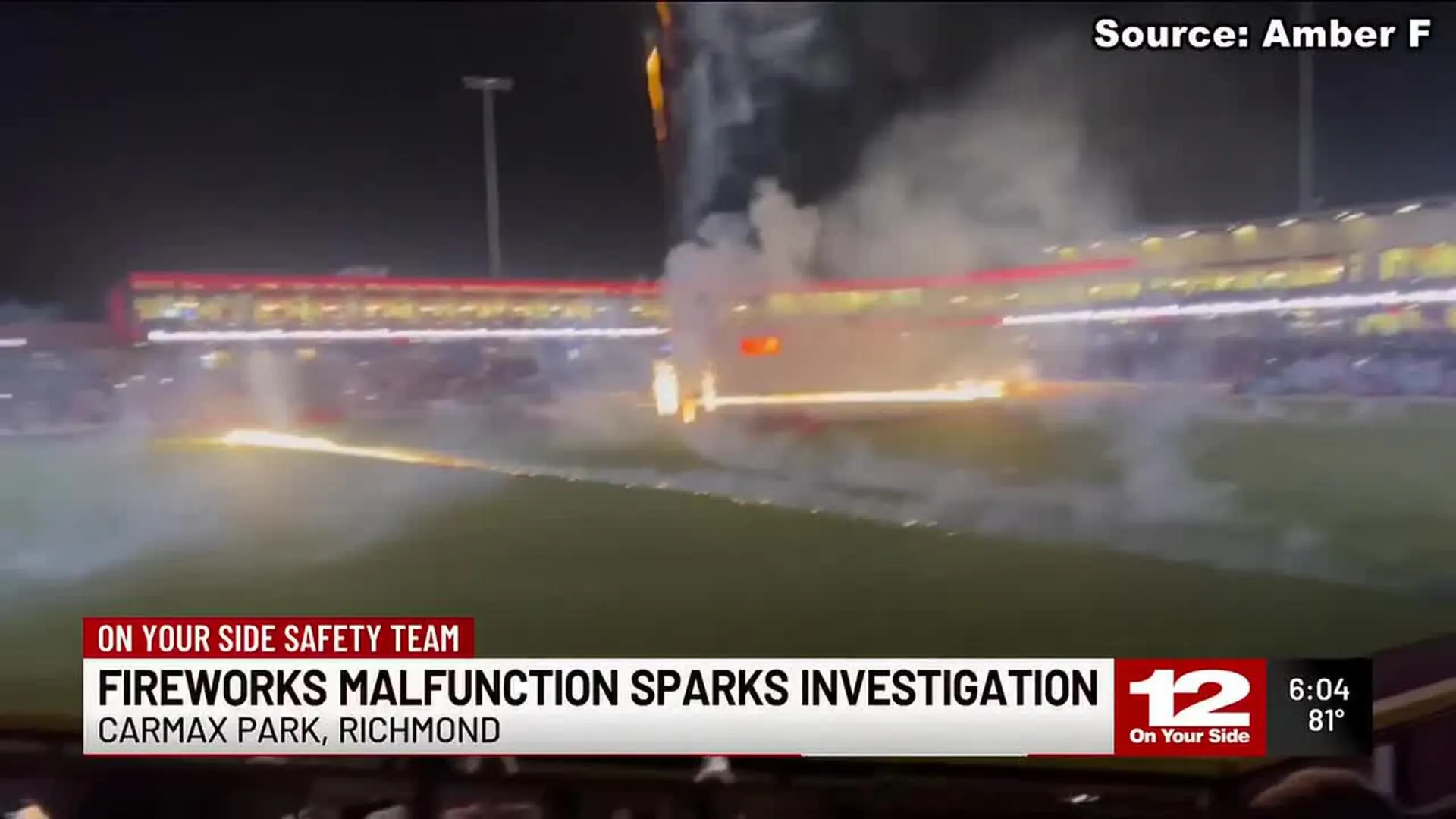
Those details matter because they point to the questions a future negligence or product-liability complaint would most likely ask first: who approved the new firing position, who inspected or secured the mortar assembly, what product records exist for the device that tipped, whether any comparable malfunction warnings were available, and whether the display footprint complied with the safety distances promised in the permit and vendor file. The absence of reported serious injury lowers the visible damages exposure. It does not erase the duty-of-care inquiry.
The Virginia Comparison For The File
The closest warning sign is not a generic fireworks accident. It is a Fairfax County verdict from Virginia. In Hollis v. Schaefer Pyrotechnics, a finale box of linked mortars tipped over and fired into a crowd; a jury awarded $4.75 million to the injured plaintiff in 2010.[4][5]
The mechanical overlap is uncomfortable for any defense file built around the phrase “malfunction.” Hollis involved a box that did not merely fail to launch upward; it redirected toward spectators. The CarMax Park accounts likewise describe a mortar box tilting and fireworks shooting toward the left-field bleachers.[1][3] A future Richmond plaintiff would not need to prove Hollis controls the case. The plaintiff would use it to show that a Virginia jury has already seen a linked-mortar or mortar-box redirection event as more than an unavoidable mishap.
Hollis also limits a common defense instinct. Schaefer Pyrotechnics blamed a Chinese manufacturer, but the jury still found the fireworks company liable.[4][5] That does not mean a product supplier cannot be responsible in another case. It means the operator and display vendor should not assume that pointing upstream ends the inquiry. Jurors can still ask what the vendor knew, what it inspected, what it chose to use, and whether the show went forward despite information that should have changed that decision.
The notice facts in Hollis are the part that belongs on a preservation hold. Reports described evidence that Schaefer had received accounts of 30 similar finale-box failures at other shows on the same evening and did not refrain from using the boxes.[4][5] That is not proof that Pyro Shows or any CarMax Park entity had comparable notice. It is a map of where the factual pressure will fall if a claim is filed: lot numbers, supplier communications, prior incident reports, same-device complaints, internal safety bulletins, and any decision to continue using a product or configuration after an irregularity appeared.
The Four Liability Drivers Now In Play
For CarMax Park, the most plausible litigation theories are ordinary negligence, premises-related negligence against entities responsible for the venue and event, negligent hiring or retention of the fireworks vendor, and product-liability theories if a component defect or warning failure is later identified. Strict liability should be handled carefully. Secondary commentary notes that state treatment of fireworks as ultra-hazardous varies, and the available research does not identify a Virginia appellate decision squarely imposing strict liability on professional fireworks displays as a settled rule.[6]
| Driver | Why It Matters At CarMax Park | Records To Preserve Or Review |
|---|---|---|
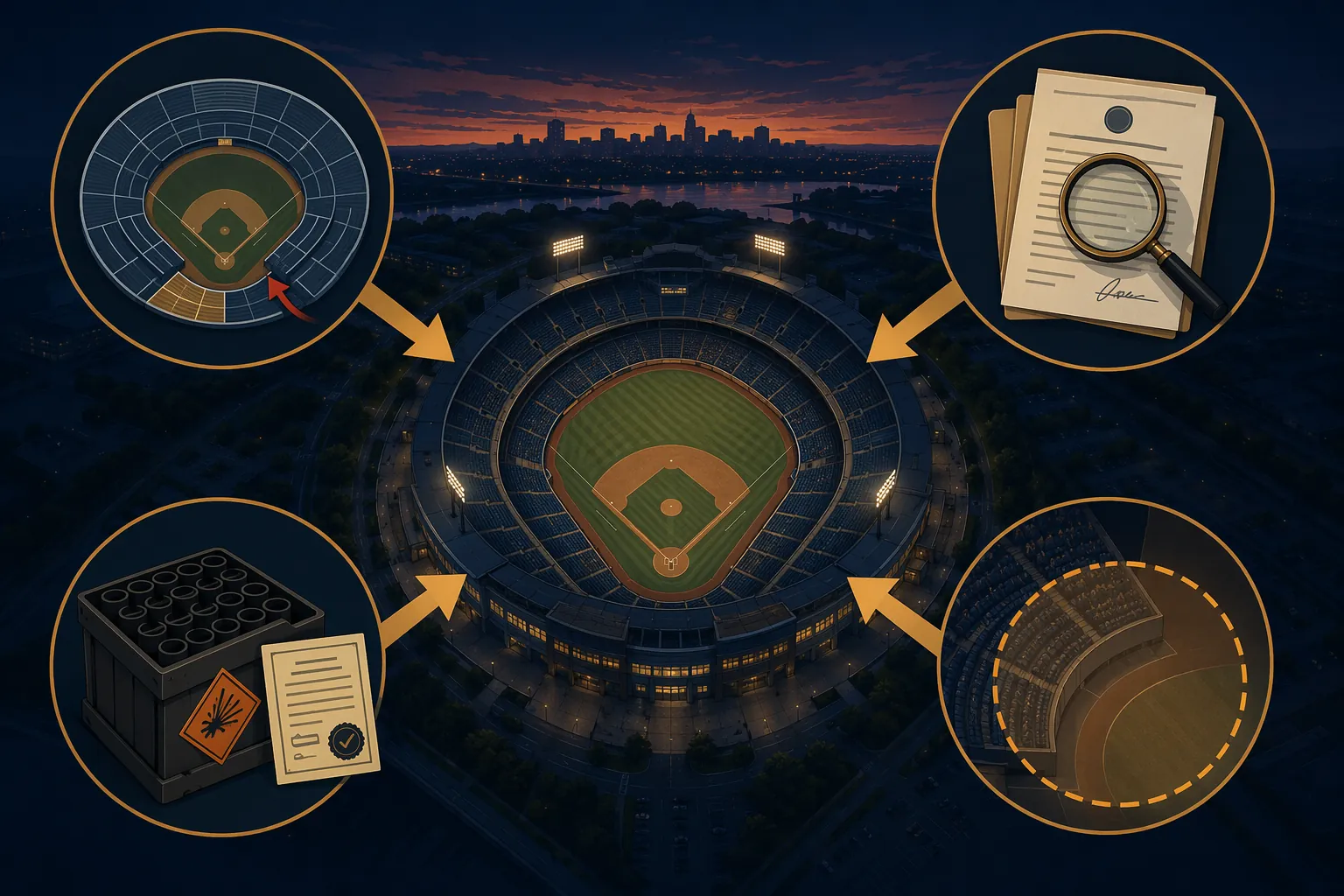
| Site configuration | The firing position reportedly moved because new seating eliminated the prior behind-the-wall location. | Site plans, seating-change drawings, firing-location approvals, field measurements, safety-zone diagrams. |
| Vendor vetting | A professional display shifts attention to contract selection, insurance, licensing, and role allocation. | Vendor contract, certificates of insurance, permits, licensed-pyrotechnician documentation, scope-of-work emails. |
| Product provenance | A tipping mortar-box account makes lot history and prior malfunction notice central. | Device labels, purchase records, batch or lot data, supplier communications, prior incident logs. |
| Safety-radius compliance | A lateral discharge toward bleachers raises the practical question whether the selected footprint allowed a safe failure envelope. | NFPA 1123-style calculations, local fire review materials, as-built setup photos, day-of-show inspection notes. |
Site Configuration
The site-configuration question is unusually concrete. The Richmonder reported that earlier shows used a position behind the outfield wall, that new seating removed that option, and that the July 23 show used a center-field firing position for the first time.[3] That sequence gives a future claimant a simple theory to plead: the venue changed the physical relationship between fireworks and spectators, then approved a display whose failure path reached the stands.
That theory still needs proof. A new location is not negligent merely because it is new. The relevant records are the measurements and approvals behind the change: who selected center field, whether alternatives were considered, what safety radius was calculated, whether left-field seating was within any planned fallout or misfire zone, and whether the operator or vendor treated the changed seating bowl as a materially different risk from prior seasons.
Vendor Vetting And The Permit File
Virginia’s fireworks framework makes the permit file more than housekeeping. The Virginia Department of Fire Programs describes permitting and professional involvement requirements for fireworks, pyrotechnics, and flame effects displays.[7] The available research also identifies a minimum $1 million bond or insurance certificate requirement for aerial fireworks displays, though counsel should confirm the exact certificate, issuer, insured parties, and endorsement language in the event file rather than rely on a public description.
- Was the display permit issued for the actual July 23 firing location, not merely for a prior or generic stadium layout?
- Was a licensed pyrotechnician on site, and what role did that person have in approving the center-field configuration?
- Did the vendor contract allocate responsibility for site selection, crowd separation, product inspection, and shutdown authority?
- Did the insurance certificate name the correct stadium, team, municipal, or operating entities as insureds or additional insureds?
- Were any pre-show objections, weather concerns, setup deviations, or inspection exceptions documented?
Pyro Shows’ public materials describe the company as having more than 50 years in the fireworks business and identify safety as a cornerstone of its operations.[8] That kind of vendor representation is not a concession of fault. It does, however, become part of the procurement record if a plaintiff later argues the venue relied on vendor expertise and should have verified how that expertise was applied to the changed CarMax Park layout.
Product Provenance And Prior Notice
A mortar-box tipping event naturally splits the file between setup and product. If the box tipped because it was placed or secured improperly, the theory sounds like operational negligence. If a component failed despite proper placement, the focus turns to design, manufacturing, warnings, and traceability. In practice, both paths can remain open until the physical device, setup photos, labels, and supplier records are reviewed.
Hollis is again the useful caution. The defense effort to shift blame to the manufacturer did not prevent a plaintiff verdict, and the reported prior-failure evidence made notice a central fact rather than an abstract industry concern.[4][5] For CarMax Park, the question is narrower: whether the involved product, product family, supplier, or configuration had any known prior malfunction history before July 23. Nothing in the available public reporting establishes that such notice existed.
Safety Radius And Failure Direction
The most important safety-radius issue is not whether the shell went high enough or looked normal until it did not. It is whether the selected location allowed enough separation if a device discharged laterally. NFPA 1123-style analysis matters because professional fireworks planning is supposed to account for separation between discharge points and spectators. The paywalled NFPA standard itself has not been reviewed for this article, so any future claim should be grounded in the actual permit materials, applicable adopted code, fire-marshal review, and expert testimony rather than a generalized citation to “industry standards.”
That restraint does not make the issue minor. The public videos and reports describe sparks and smoke trails traveling toward occupied seats.[1][2] If the July 23 firing position was approved on the assumption that devices would launch vertically, counsel will want to know whether anyone considered the foreseeable consequences of a rack, mortar box, or linked assembly tipping toward the closest spectators.
Comparable Lawsuits Show Why Injury Count Is Not The Only Trigger
The Houston Astros case shows how little mass scale is needed for meaningful exposure. In March 2026, a fan filed a $1 million lawsuit alleging that a post-game firework struck her in the eye during a July 25, 2025 game; news accounts identify both the Astros and the fireworks vendor as defendants.[9][10] The full complaint has not been reviewed here, so the case should be used only for the limited proposition the public reporting supports: one spectator injury at a post-game professional sports display can become a seven-figure pleaded claim against both the venue-side entity and the vendor.
The Stadium of Fire litigation supplies the opposite benchmark: a single device malfunction that produced grouped claims. Two suits filed in July 2026 alleged that a 36-shot “howling tails” device malfunctioned and injured 27 spectators, with each plaintiff seeking about $300,000.[11] Utah law and the facts of that show are not Virginia law and not CarMax Park facts. The point is procedural and practical: once one device sends effects into a crowd, plaintiffs’ counsel may organize claims around the shared device, shared setup, shared vendor, and shared event approvals.
CarMax Park, on the present public record, sits below both benchmarks on known injury severity. That is favorable on damages. It is less comforting on breach. The same records that would defend a serious-injury claim are the records needed to explain a near-miss: site drawings, calculations, permits, contracts, pyrotechnician notes, photographs, product records, and post-incident communications.
The Promotional And Post-Incident Record
The “In-Your-Face Fireworks” branding should not be treated as proof of negligence. Promotions are usually written to sell atmosphere, not to define a legal duty. Still, in a future complaint, the phrase is easy to imagine as an exhibit alongside the seating change and center-field firing position. It could color an argument that the event voluntarily emphasized proximity while the physical setup reduced the margin for error.[3]
The relocation of future shows to The Diamond is similarly sensitive. Immediate relocation can be responsible risk mitigation; it can also invite a plaintiff to ask why that location was not used before July 23. Rules limiting the use of subsequent remedial measures may shape admissibility in later litigation, but admissibility is not the same as discoverability or risk analysis. Counsel still needs the internal reason for the move, who approved it, and whether any written statement connects the decision to the malfunction, the new seating, or the safety radius.
Preservation Priorities Before A Complaint Exists
The first 72 hours after a near-miss are often cleaner than the pleadings that come months later. The people involved still know where they stood, which radio channel was used, who called the show, and whether the device was moved, photographed, discarded, or returned to the vendor. If no preservation instruction goes out until a demand letter arrives, the file may already have lost the materials that decide whether this was a defensible malfunction or a preventable setup failure.
- Physical evidence: preserve the involved mortar box, linked assembly, spent components, labels, packaging, stakes, racks, and securing materials.
- Visual evidence: collect stadium video, fan-submitted video, broadcast clips, surveillance footage, field photographs, and any setup or teardown images.
- Approval evidence: retain the permit, site plan, fire-marshal materials, safety-radius calculations, seating-change drawings, and day-of-show inspection notes.
- Contract evidence: secure vendor agreements, indemnity provisions, insurance certificates, additional-insured endorsements, and licensing documentation.
- Communications: preserve texts, emails, radio logs, incident reports, public statements, relocation discussions, and any communications with Pyro Shows or public officials.
None of that requires treating CarMax Park as active litigation. It treats the event as a fireworks-into-crowd near-miss with a changed stadium configuration, a professional vendor, public video, and an immediate operational response. The defensibility of the Flying Squirrels, venue operators, and Pyro Shows will depend less on whether the event was publicly described as fortunate and more on whether the paper and physical record shows a reasonable display plan for the stadium that actually existed on July 23.
That is the practical classification as of July 25, 2026: no filed Richmond Flying Squirrels fireworks malfunction lawsuit, but already a preservation-and-review event. The reported lack of serious injuries reduces the likely damages profile. It does not resolve site selection, vendor vetting, product provenance, or safety-radius scrutiny.
References
- Fireworks malfunction at CarMax Park sends sparks toward stands — 12 On Your Side
- Video shows fireworks malfunction sending sparks into stands at Richmond Flying Squirrels game — WTVR/CBS 6
- 'In-Your-Face' Fireworks malfunction at Squirrels game; no serious injuries reported — The Richmonder
- Fireworks company to pay $4.75 million to explosion victim — Washington Post, Nov. 13, 2010
- Fireworks verdict is $4.75 million — Virginia Lawyers Weekly, Nov. 14, 2010
- When Fireworks Go from Ooh's and Aah's to 'Oh My God' — CLM Magazine
- Fireworks, Pyrotechnics and Flame Effects — Virginia Department of Fire Programs
- Pyro Shows — About Us — Pyro Shows
- $1M lawsuit filed after Astros firework allegedly strikes fan in eye — Houston Chronicle
- Houston Astros Sued By Fan Over Postgame Firework Injury — Law360
- Stadium of Fire faces two lawsuits from fireworks malfunction — Salt Lake Tribune, July 3, 2026
Related records
Tool profile
Browse tool evaluations →Governing regulation
Browse the obligations tracker →Preventive workflow
Browse verification workflows →
Report a correction or tip
Spotted an outdated figure, a misstated fact, or a ruling this case record should reflect? Public comments are disabled for this content given the professional cost of a misreported case outcome, penalty amount, or rule text — use the structured correction channel instead.
Report a correction or tip for this record →