
Bronco Wiring Recall Creates New Litigation Exposure for Ford
Analyzes the legal risk framework for the July 2026 Ford Bronco wiring harness recall, covering prudential-mootness defenses, inadequate-remedy exceptions, and state lemon-law claims under Song-Beverly.
- Jurisdiction
- US Federal
- Court
- United States District Court for the Eastern District of Michigan
- AI tool named
- None
- Ruling date
- Jul 24, 2026
- Source document
- View primary court order ↗
- Last verified
- Jul 25, 2026
Lex Machina Review is an independent risk-tracking and reference resource. Nothing on this site is legal advice, and using it does not create an attorney-client relationship. Every record is reviewed against primary sources but may not reflect the most current status of a matter — always verify directly against the cited court order, rule text, or a licensed attorney before relying on it.
Companion explanation — secondary to the source document above
The Ford Bronco recall over wiring-harness abrasion is not legally important because the number is large, although the number is large. It is important because Ford now has a federally supervised remedy in the record before any Bronco-specific class complaint has, at least as of July 25, 2026, set the litigation frame. That timing changes the first defense motion.
NHTSA recall 26V-468, Ford campaign 26S55, covers 565,691 Ford Bronco and Bronco Raptor vehicles from model years 2021 through 2026. The reported defect theory is abrasion in an engine-compartment wiring harness caused by insufficient abrasion protection; the stated consequence is a potential engine-compartment fire. Ford reported 15 fire incidents, and the remedy is installation of convolute sheathing with abrasion tape, without a do-not-drive advisory reported in the available coverage.[1][2]
Those details point directly to the legal fight. A recall can be a damaging admission in the practical sense that it identifies a defect population, a safety consequence, and a repair protocol. But in economic-loss class litigation, it can also become Ford’s best argument that the court should not supervise a parallel remedial program. The question is not whether owners should take the fire-risk language seriously. They should. The litigation question is whether a pleaded damages theory survives once the manufacturer is already repairing the asserted defect under NHTSA oversight.
The Recall Record Gives Ford a Ready Prudential-Mootness Argument
Ford’s first move in a putative nationwide economic-loss class action would likely be prudential mootness. The doctrine matters most where plaintiffs seek repairs, reimbursement, diminished-value damages, or an injunction tied to the same defect that a recall is already designed to address.
The leading defense-side citation is Winzler v. Toyota Motor Sales, U.S.A., Inc., a 2012 Tenth Circuit decision by then-Judge Neil Gorsuch. As summarized in later legal commentary, the court treated a NHTSA-supervised recall as a reason not to continue an economic-loss class action seeking essentially duplicative relief. The recall did not erase Article III jurisdiction in the strictest sense; rather, the court declined to proceed because the requested relief was already being administered through the federal safety process.[3][4]
That distinction is not academic. A Bronco owner alleging that the harness was defective at sale may still say the defect existed. Ford’s answer would be that the relevant prospective relief is already available: bring the vehicle to a dealer and receive the specified protective sheathing and abrasion tape. If the complaint is framed around the cost of obtaining a repair, the existence of a free recall remedy narrows the damages theory before discovery even begins.
A recall also complicates injunctive claims. Courts are generally wary of ordering a defendant to do what the regulator is already supervising. That gives Ford a clean separation between regulatory compliance and civil exposure: NHTSA oversees the remedy; the district court need not build a second recall administration regime for the same harness condition.
| Recall fact | Litigation relevance |
|---|---|
| 565,691 affected Bronco and Bronco Raptor vehicles | Supports class-size allegations, but also defines the recall population Ford can point to as already covered |
| 15 reported fire incidents | Gives plaintiffs a safety narrative, while leaving causation and remedy adequacy to be pleaded with care |
| Wiring-harness abrasion from insufficient protection | Identifies the alleged defect mechanism more concretely than a generic electrical-risk theory |
| Convolute sheathing with abrasion tape | Creates the central defense question: whether the supervised fix addresses the pleaded defect |
| No reported do-not-drive advisory | Weakens any argument that Ford or NHTSA treated continued use as categorically unsafe before repair |
That is why the precise remedy matters. If the fix were only a software notice, a future inspection, or an undefined interim measure, plaintiffs would have more room to argue that the recall is not equivalent to the relief they seek. Here, the stated repair is physical protection at the abrasion point. On the pleadings, that gives Ford a concrete answer to a concrete defect theory.
Where the Defense Breaks: Pacheco and the Inadequate-Remedy Route
The strongest plaintiff response is not to insist that recalls never moot class claims. That loses the fight on unfavorable terrain. The better route is to plead that this recall remedy does not actually resolve the safety defect.
Pacheco v. Ford Motor Co. is the case plaintiffs will study. The action was initially dismissed in March 2023 after a Ford recall was treated as a basis for ending the safety-defect suit.[5] But in January 2024, the court reopened the case after plaintiffs came forward with allegations of post-recall engine fires that the fix allegedly had not prevented.[4]
Pacheco does not say that every Ford recall is suspect. It says something narrower and more useful: a recall is a powerful defense when it appears to supply the remedy plaintiffs seek, but that defense weakens when plaintiffs plausibly allege that the remedy leaves the same safety risk in place. The litigation turns from “there is a recall” to “what did the recall actually fix, and what happened afterward?”
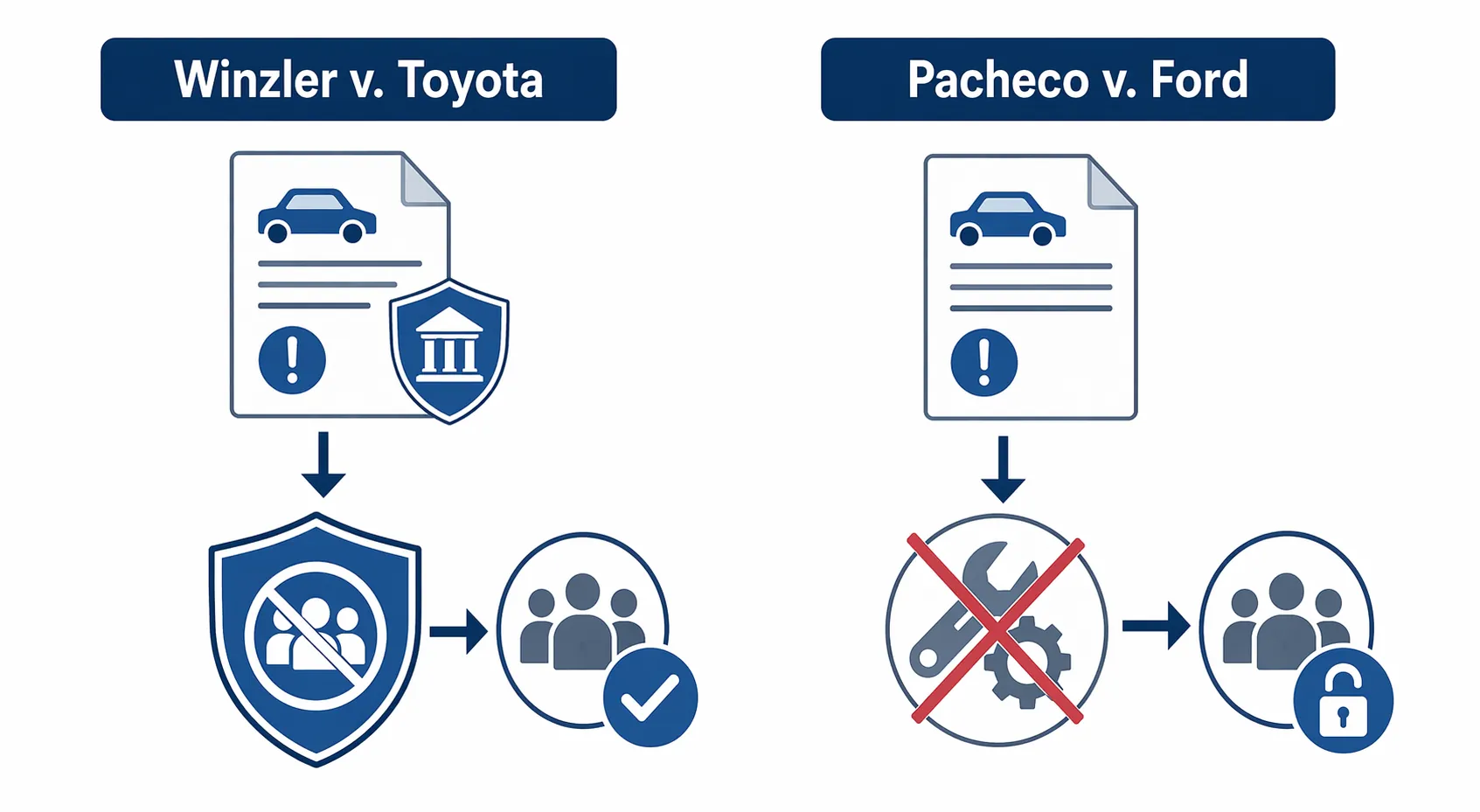
For the Bronco harness recall, that means a complaint filed after repair data develops would be stronger if it can allege post-remedy fires, repeated electrical failures after installation of the sheathing and tape, dealer inability to perform the repair as specified, or technical evidence that the protected area does not match the actual abrasion mechanism. A complaint that merely quotes the recall and demands a repair will walk into Winzler. A complaint that identifies failures after the recall repair has a different posture.
The timing of owner notification and repair availability will also matter, but only if tied to damages. Delay by itself is not enough for a durable class theory unless owners can connect it to out-of-pocket loss, loss of use, a paid repair, or continued exposure after Ford knew the remedy was not reaching affected vehicles. The absence of a do-not-drive advisory in the available reporting makes a generalized loss-of-use theory harder to plead, because Ford has not told owners that the vehicles must be parked pending repair.[2]
This is the practical line between Winzler and Pacheco. Winzler favors dismissal when the regulator-supervised recall is congruent with the requested civil remedy. Pacheco gives plaintiffs a route back when new facts show a mismatch between the defect and the fix. The Bronco recall’s legal exposure will depend less on the headline population and more on whether the sheathing-and-tape remedy performs as a true abrasion cure once installed across real vehicles.
The Consent Order Is Context, Not Causation
Ford’s broader recall posture cannot prove the Bronco harness defect, but it will affect how plaintiffs write the complaint and how regulators, courts, and settlement teams read the record.
In November 2024, Ford entered into a NHTSA consent order involving a $165 million civil penalty for delayed rearview-camera recalls, with three years of independent oversight and quarterly compliance meetings.[6] That order is not evidence that the Bronco wiring recall was delayed, inadequately investigated, or mishandled. Treating it that way would overclaim the record.
It does, however, create a compliance atmosphere. Plaintiffs will have a ready narrative that Ford’s recall governance is already under federal scrutiny. Defense counsel will have to separate the rearview-camera consent order from the harness recall at the pleadings stage, then again in discovery disputes over recall decision-making, escalation records, field reports, and communications with NHTSA.
Recall volume adds the same kind of pressure, with less doctrinal significance. Secondary reporting citing NHTSA data describes 153 Ford recalls in 2025, nearly double the prior record, and more than 50 campaigns covering 11.2 million vehicles from January through June 2026.[6][7] Those figures may matter to investor relations, media attention, and settlement temperature. They do not establish that the Bronco harness remedy is inadequate.
That distinction is worth preserving because plaintiffs do not need the recall-volume argument if they later obtain remedy-failure facts. Conversely, Ford should not assume that a strong prudential-mootness motion ends the broader institutional story. A court may dismiss duplicative class claims and still allow discovery in an individual warranty case, or regulators may continue asking whether the campaign is being completed effectively.
Individual Warranty Files Are the Harder Problem
The owner with the strongest near-term civil claim may not be the owner who learns about the recall from the notice letter. It is the owner who already brought the Bronco to a dealer for electrical symptoms before the recall existed, especially if the vehicle returned with unresolved problems.
That file does not depend on defeating prudential mootness in a nationwide class action. It can sound in warranty, repair history, and state lemon-law remedies. In California, commentary on the Bronco recall points to the Song-Beverly Consumer Warranty Act and its presumption after two repair attempts for a safety defect, with buyback exposure for qualifying owners whose vehicles were not repaired within a reasonable opportunity.[8]
The difference is remedial. A class complaint may ask a federal court to order or value a repair that Ford says NHTSA is already supervising. A Song-Beverly-style claim asks whether this owner’s vehicle conformed to warranty after reasonable repair opportunities. The recall can be relevant evidence in that dispute, but it is not automatically a complete defense to a history of failed repair attempts.
- A pre-recall visit for battery drain, warning lights, no-start conditions, smoke, burning odor, or other electrical symptoms gives the owner a vehicle-specific record.
- A dealer invoice that fails to diagnose the harness issue may support an argument that Ford had a reasonable opportunity to repair but did not correct the condition.
- A post-recall repair followed by recurring symptoms moves the file closer to the inadequate-remedy theory that matters in class litigation.
- A clean recall completion with no prior symptoms and no later failure is a materially weaker damages file, even if the vehicle was within the recall population.
That is where the Bronco recall creates Ford’s most concrete exposure. The company can argue, with real force, that a free NHTSA-supervised repair moots or sharply narrows economic-loss claims seeking duplicative relief. It has a weaker shield if plaintiffs can plead post-repair failures or technical inadequacy in the sheathing-and-tape remedy. And it has no complete recall-based answer to owners whose service histories already support state-law warranty or buyback claims.
References
- “Ford to recall more than 565,000 US vehicles over engine compartment fire risk,” Reuters, July 24, 2026.
- “Ford Recalls Bronco, Bronco Raptor over Potential Engine Fires,” Car and Driver.
- “Voluntary Recalls as a Class Action Defense,” Dentons, April 2023.
- “Shouldn’t Fixing the Problem Be Enough? Post-Recall Civil Litigation and the Prudential Mootness Doctrine,” Baker Donelson.
- “Ford Recall Leads to Dismissal of Lawsuit Over Safety Defect,” Bloomberg Law.
- “Ford Recall Statistics [2025–2026],” Woodard Injury Law.
- “Ford Recalls 2026: 11.2 Million Cars,” Motor1.com.
- “565K Ford Broncos Recalled: Engine Fire Risk & CA Lemon Law,” Lion Lemon Law.
Related records
Tool profile
Browse tool evaluations →Governing regulation
Browse the obligations tracker →Preventive workflow
Browse verification workflows →
Report a correction or tip
Spotted an outdated figure, a misstated fact, or a ruling this case record should reflect? Public comments are disabled for this content given the professional cost of a misreported case outcome, penalty amount, or rule text — use the structured correction channel instead.
Report a correction or tip for this record →