
France's FSD Blockade Tests the Article 39 Exemption Pathway
France's July 2026 opposition to Tesla Full Self-Driving approval tests the legal foundation of the Article 39 type-exemption pathway, revealing the vulnerability of provisional national approvals for manufacturers operating in the EU.
- Jurisdiction
- EU (France)
- Court
- European Commission
- AI tool named
- Tesla Full Self-Driving (FSD)
- Ruling date
- Jul 23, 2026
- Source document
- View primary court order ↗
- Last verified
- Jul 25, 2026
Lex Machina Review is an independent risk-tracking and reference resource. Nothing on this site is legal advice, and using it does not create an attorney-client relationship. Every record is reviewed against primary sources but may not reflect the most current status of a matter — always verify directly against the cited court order, rule text, or a licensed attorney before relying on it.
Companion explanation — secondary to the source document above
France’s July 2026 opposition to Tesla Full Self-Driving approval matters less as a national refusal than as a stress test of the instrument Tesla has been using to enter Europe. The immediate legal problem is that the Dutch RDW’s Article 39 provisional certificate is the root for five existing national approvals. If the Commission later rejects the system through the EU committee process, that provisional Dutch approval can lapse after six months, taking the dependent national approvals with it.[1]
This Risk Digest record is limited to the France-EU approval posture as of July 25, 2026. It does not assess whether Tesla’s supervised driving system is safe enough to use, and it is not legal advice. The narrower question is the one counsel actually has to brief: how much reliance can a manufacturer place on provisional national approval when EU-level harmonization has not yet absorbed objections from large member states?
The approval starts in the Netherlands, not in Brussels
The legal architecture begins with RDW, the Dutch vehicle authority. RDW used Article 39 of Regulation (EU) 2018/858 and UN Regulation 171 on Driver Control Assistance Systems to grant Tesla a provisional type approval after what Reuters described as 18 months and more than 250,000 km of testing.[2] That is a materially different proposition from saying the system has received ordinary, settled EU-wide approval.
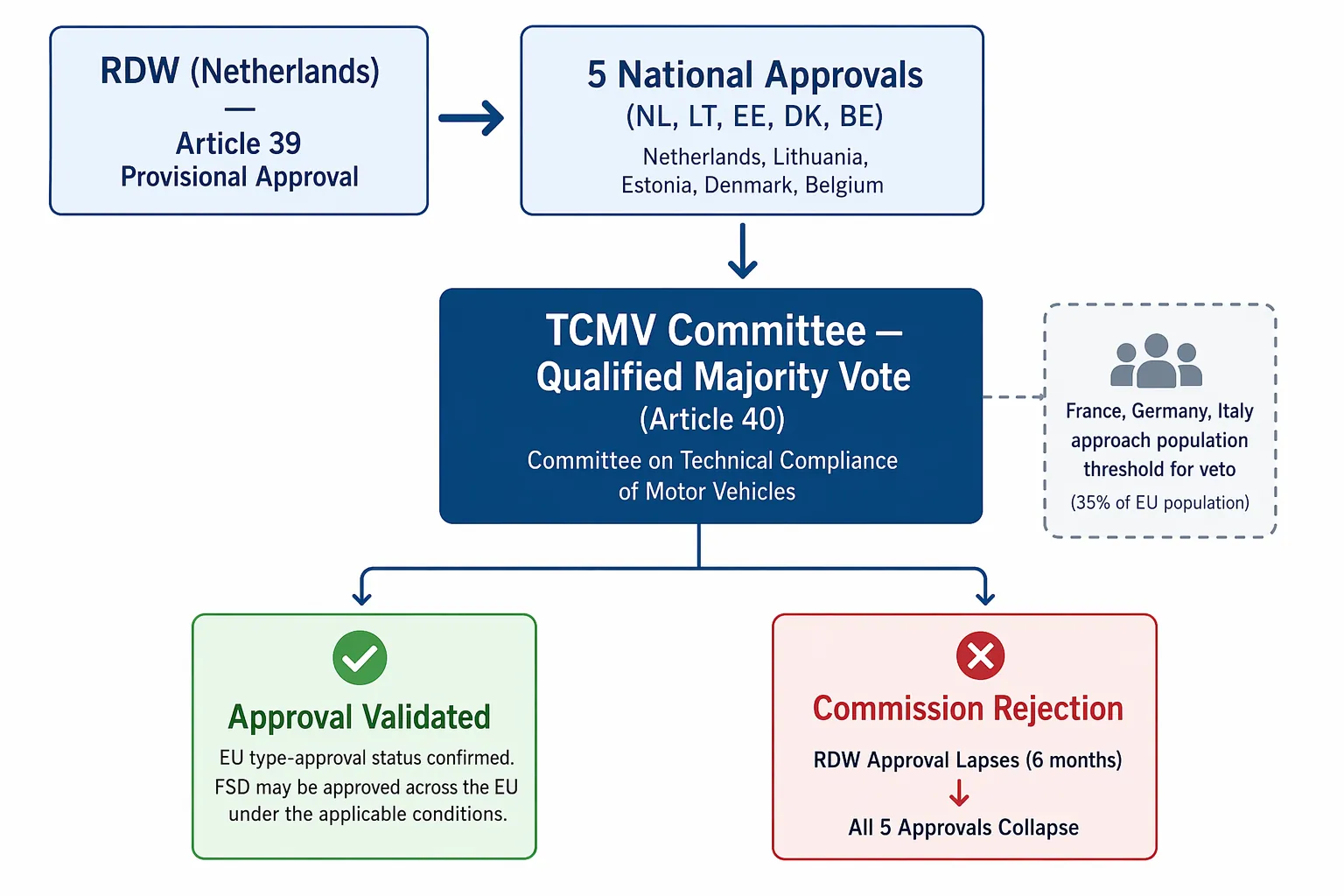
Article 39 is useful precisely because it lets a member state approve new technologies or concepts that do not yet fit fully harmonized EU rules. That usefulness is also the risk. A provisional national certificate can create market momentum before the bloc has resolved whether the same technology should be accepted under common protocols. For a manufacturer, it may look like a bridge. For a board asked to sign off on deployment risk, it is still a bridge with a committee vote at the far end.
The Dutch certificate then travels through national recognition. Reuters reported that the RDW certificate is the legal root for five national approvals: the Netherlands, Lithuania, Estonia, Denmark, and Belgium.[2] Those approvals are therefore not five independent validations of Tesla’s system. They are five downstream positions built from the same originating act.
That distinction is not pedantic. If the root certificate remains valid, the downstream approvals have a path to operate. If the root certificate lapses, the downstream approvals are exposed. Denmark’s traffic authority, as reported by Reuters, said that if the Commission rejects FSD, RDW’s provisional approval lapses after six months and the five national approvals become invalid.[2]
Where France can turn a safety objection into a bloc-level approval problem
France’s position entered through safety, but its force is procedural. Transport Minister Philippe Tabarot said France would not approve FSD until the EU establishes common testing protocols.[1] Electrek’s account of the statement identified two concrete objections: an unresolved speeding-offset issue and urban driver-attention concerns that France says may conflict with UN R-171 requirements.[3]
Those are not generalized objections to software in cars. A speeding-offset concern goes to whether the assistance system permits or encourages operation outside applicable limits. An urban attention concern goes to the driver-supervision premise on which a supervised system depends. If the regulatory category assumes the driver remains responsible and attentive, a credible objection about attention in dense urban environments is not peripheral to the approval; it attacks one of the conditions that lets the system remain in the driver-assistance lane.
The place where that objection can matter is the Technical Committee on Motor Vehicles, or TCMV. Under the Article 40 process described by Reuters, qualified-majority voting requires 15 of 27 member states representing 65% of the EU population.[2] The next realistic vote window has been reported as October 2026, but that timing remains an estimate rather than an official Commission date.[2]
Population matters because the opposition of large member states can change the practical posture even before a final vote. France, Germany, and Italy together approach the population threshold relevant to de facto blocking power.[2] The legal point is not that those states have already defeated the approval. It is that the Article 39 pathway ceases to be a clean launch mechanism once objections by major states move into the Article 40 voting structure.

The missing testing record makes the legal risk harder to cabin
Technical testing would carry more weight if the public record allowed outside parties to see what was tested, under what assumptions, and against which failure modes. RDW’s approval followed a substantial testing period, but RDW has not published the underlying testing data, citing commercial sensitivity.[2] That leaves counsel with an uncomfortable evidentiary posture: the approval exists, but the basis for assessing its durability is partly unavailable.
The European Transport Safety Council has tied that opacity to a broader institutional concern. ETSC says the TCMV process has no formal civil-society input and warned that RDW’s non-public testing record leaves a safety-critical decision moving through an opaque committee channel.[4] That critique does not prove France’s technical objections are correct. It does make the approval pathway more vulnerable to legal and political challenge, because the deliberative record available to outsiders is thin.
Tesla’s own safety statistics do not solve that problem. Reuters reported Tesla’s European figures as three collisions over 7 million km in urban driving and none over 16.6 million km on highways, but those are Tesla-published figures using a non-standard five-second collision window.[5] They should not be treated as directly comparable to police-registered crash data or as an independent benchmark for the Article 39 decision.
For litigation and risk-management purposes, that distinction is central. A manufacturer can cite a regulator’s certificate. It can cite its own operational data. It can cite field experience. But when the bloc-level committee has not yet resolved objections and the testing file is not public, those materials do not have the same defensive value as a settled harmonized approval supported by transparent protocols.
France is also using consumer law, but that is a different front
The July 2026 type-approval dispute sits alongside, rather than inside, France’s earlier consumer-protection action. In June 2025, French investigators ordered Tesla to stop allegedly deceptive business practices, including claims around “fully autonomous driving,” with potential fines of €50,000 per day under the French Consumer Code.[6] Politico likewise reported the French government’s accusation that Tesla used deceptive marketing around autonomy claims.[7]
The two fronts should not be collapsed. The 2025 order concerns how the product is represented to consumers and what penalties attach to continued marketing conduct. The 2026 opposition concerns whether the system should move through the EU vehicle type-approval structure under Regulation (EU) 2018/858 and UN R-171. They have different evidentiary standards, different remedies, and different reversal paths.
Together, however, they show the regulatory template now forming around FSD in France. A product can be attacked as oversold under consumer law and insufficiently settled under vehicle-safety law at the same time. Success on one front does not necessarily dispose of the other. A narrowed marketing claim would not answer an Article 40 objection, and a provisional type approval would not immunize consumer-facing autonomy claims.
Foreign proceedings are context, not proof
Other jurisdictions add pressure to the file, but they should be used carefully. Reuters reported in May 2026 that the U.S. National Highway Traffic Safety Administration had two active FSD investigations, that a California DMV administrative law judge recommended a 30-day license suspension in December 2025, and that Germany’s competition authority issued an adverse finding in 2020 that Tesla appealed.[5]
Those matters are not evidence that France is right about UN R-171 or that the TCMV must reject the Dutch certificate. They do, however, affect how a legal department should describe the risk environment. The same product family is being scrutinized through safety investigation, licensing, advertising, competition, consumer-protection, and type-approval channels. Each proceeding has its own record. The overlap is reputational and strategic, not automatically doctrinal.
What counsel should take from the Article 39 dispute
The practical legal implication is that Article 39 approvals should be treated as contingent assets until the Article 40 process is resolved. They may support limited national deployment. They may be commercially valuable. They may even reflect serious technical review by a competent national authority. But they are not the same thing as an unassailable bloc-wide authorization.
A board briefing should separate at least four questions that are often blurred in public descriptions of “approval in Europe”:
- Which authority issued the root approval, and under which provision?
- Which later national approvals depend on that root certificate rather than on independent review?
- What committee process can validate, modify, or defeat the provisional structure?
- What happens to deployed vehicles, customer communications, insurance assumptions, and contractual launch milestones if the root certificate lapses?
That last question is where regulatory procedure becomes operational exposure. A six-month lapse period after Commission rejection may sound orderly in the abstract. In practice, it can compress decisions about software availability, fleet communications, dealer and customer representations, pending deliveries, subscription terms, and whether continued operation would create consumer-law or product-liability complications in specific member states.
France has not merely objected to Tesla’s safety case. It has exposed the fragility of a launch strategy built on provisional national approvals before the EU has settled common testing protocols and committee-level acceptance. Until that process is resolved, the legally careful description is not that FSD is approved in Europe. It is that a Dutch Article 39 approval has generated a set of national approvals that remain vulnerable to the Article 40 outcome.
References
- France opposes EU approval of Tesla's FSD driver assistance software for now, Reuters, July 23, 2026
- Tesla's road to Full Self Driving approval in Europe, Reuters, June 30, 2026
- France opposes Tesla FSD approval, Tabarot cites speeding issue, Electrek, July 22, 2026
- Tesla approval pushes Europe towards a road safety cliff edge, European Transport Safety Council
- Tesla faces EU skepticism over automated driving tech, records show, Reuters, May 5, 2026
- French investigators order Tesla to stop deceptive business practices, Reuters, June 24, 2025
- Tesla accused of deceptive marketing by French government, Politico
Related records
Tool profile
Browse tool evaluations →Governing regulation
Browse the obligations tracker →Preventive workflow
Browse verification workflows →
Report a correction or tip
Spotted an outdated figure, a misstated fact, or a ruling this case record should reflect? Public comments are disabled for this content given the professional cost of a misreported case outcome, penalty amount, or rule text — use the structured correction channel instead.
Report a correction or tip for this record →