
GEO Group's $80M Hertford County ICE Contract Poses Major Legal Risks
A concise Risk Digest record assessing four independently documented legal risk dimensions in GEO Group's new $80M/year ICE contract to reopen the Rivers Correctional Facility in Hertford County, NC: facility violence history, active forced-labor class actions, regulatory exposure under the NC Border Protection Act, and the elimination of federal oversight mechanisms.
- Jurisdiction
- US-Federal
- Court
- United States Court of Appeals for the Ninth Circuit
- AI tool named
- None
- Ruling date
- Aug 13, 2025
- Source document
- View primary court order ↗
- Last verified
- Jul 31, 2026
Lex Machina Review is an independent risk-tracking and reference resource. Nothing on this site is legal advice, and using it does not create an attorney-client relationship. Every record is reviewed against primary sources but may not reflect the most current status of a matter — always verify directly against the cited court order, rule text, or a licensed attorney before relying on it.
Companion explanation — secondary to the source document above
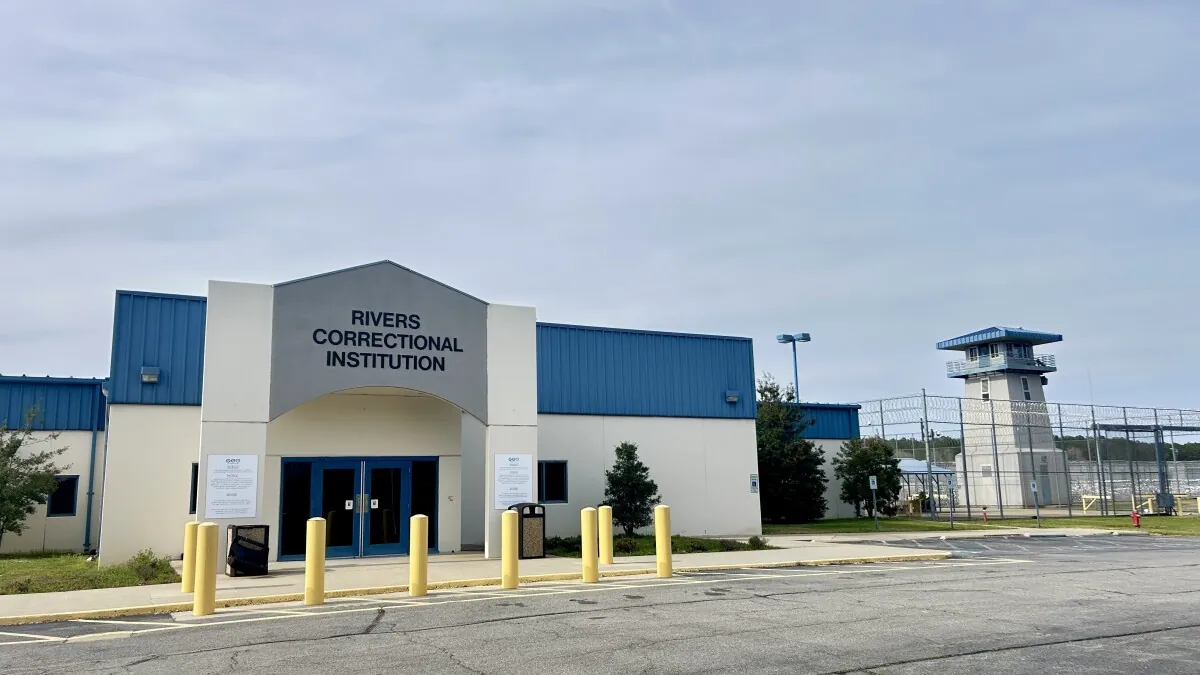
GEO Group’s new private prison ICE contract in Hertford County is not just another detention-expansion headline. The deal record fixes the scale: GEO announced on July 29, 2026, that ICE had awarded a five-year contract for the company-owned Rivers Correctional Facility in Winton, North Carolina, with 1,320 beds and an expected annualized revenue of roughly $80 million under a guaranteed minimum arrangement.[1]
That combination matters because it ties federal detention capacity, private ownership, and a specific reopened site into one future evidence file. If conditions deteriorate, the questions will not be abstract: who controlled the building, who staffed it, who inspected it, what was known before reopening, and which remedial channels were available when complaints started moving.
The Rivers record is facility-specific, not generic industry criticism
The load-bearing fact in this contract is the Rivers Correctional Facility’s own documented history. NC Newsline’s coverage of a Department of Justice Office of Inspector General review reported that Rivers had the highest rates of inmate-on-inmate violence, staff assaults, contraband finds, and positive drug tests among the federal private prisons evaluated; the outlet characterized the facility as a “lawless place.”[2]
That does not prove that the reopened ICE facility will violate detention standards. A 2016 review is not a prediction machine, and counsel should resist turning old misconduct data into a shortcut for present liability. But it does show that the site enters the new contract with documented warning signals attached to the same physical institution, not merely to the private-prison model in general.
The practical distinction is important. A complaint about conditions at a reopened Rivers facility would not need to begin from public opposition to private detention. It could begin from a prior federal oversight record, the decision to return the facility to custodial use, and the systems GEO and ICE put in place after a known history of violence, contraband, and misconduct indicators.
For lawyers reviewing the Hertford County deal, that history should sit in its own folder. It is different from shareholder risk, different from labor litigation, and different from state-law uncertainty. It goes to notice, monitoring, staffing, grievance response, medical and mental-health access, classification decisions, and the adequacy of remedial measures at a facility that already had a documented institutional record before ICE detainees were scheduled to arrive.
Forced-labor litigation gives the contract a second, separate exposure track
The Rivers contract also lands while GEO Group is litigating forced-labor claims on multiple fronts. These cases do not turn on the Hertford County facility’s old violence record. They ask a different set of questions: whether detainee work programs crossed legal lines, whether immigration detention contractors can invoke government-linked defenses, and whether damages can scale across large detainee classes.
The Colorado litigation, Menocal, became harder to dismiss as a peripheral risk after the Supreme Court unanimously rejected GEO Group’s effort to take an immediate appeal based on derivative sovereign immunity in February 2026, clearing the forced-labor class claims for trial rather than resolving the merits in GEO’s favor.[3][4]
That procedural posture matters. The Supreme Court ruling did not decide that GEO committed forced labor. It did remove, at that stage, a defense route that would have let the company avoid trial before factual development on the class claims. In contract-risk terms, the lesson is narrower but serious: GEO’s immigration-detention labor practices remain subject to live adjudication, not just advocacy pressure.
Washington adds a second track. In Nwauzor v. The GEO Group, Inc., litigation over detainee labor at the Northwest ICE Processing Center produced a $23 million verdict tied to $1-per-day wages, and the Ninth Circuit addressed the case in an August 13, 2025 opinion.[5]
California adds a third. Novoa is not the same case, and it should not be treated as interchangeable with Menocal or Nwauzor. Its importance here is that it reinforces a pattern of active litigation over detainee labor practices across jurisdictions, each with its own pleadings, class issues, defenses, and remedial posture.
| Litigation track | Why it matters to the Hertford County risk review |
|---|---|
| Colorado: Menocal | Supreme Court procedural ruling left forced-labor class claims moving toward trial rather than ending them through immediate derivative-sovereign-immunity review. |
| Washington: Nwauzor | A jury verdict and Ninth Circuit proceedings keep detainee labor compensation and contractor liability in active appellate and enforcement focus. |
| California: Novoa | Adds another jurisdictional track to GEO’s forced-labor litigation environment, though its posture must be evaluated separately from Colorado and Washington. |
None of those cases establishes what will happen inside Rivers. They do, however, shape the due-diligence file for any new GEO-operated ICE detention site. Counsel evaluating the Hertford County contract should ask what work programs, sanitation assignments, commissary arrangements, disciplinary rules, grievance procedures, and wage policies will apply at Rivers, and whether they have been revised in light of the litigation already pending elsewhere.
Death-in-custody data belongs in context, not as proof of this contract’s illegality
The detention-expansion context is grim enough without overstating what the data proves. Human Rights Watch and Physicians for Human Rights reported in June 2026 that 52 people died in ICE custody over a 500-day period from January 2025 through June 2026, with a mortality rate of 8.4 deaths per 10,000 people—nearly four times the Biden-era rate described in the report.[6]
Attorney Andrew Free’s data collection, as summarized in the research record, identified 10 immigrant deaths in GEO Group facilities in 2025. That figure is a risk signal, not a facility-specific finding about Rivers. It should prompt questions about medical intake, chronic-care continuity, suicide prevention, emergency response, outside-hospital transfer, and document preservation, especially because reopened facilities often have to rebuild staffing routines while detainee populations are arriving.
For families and counsel facing a fatality after detention, the relevant legal path is highly fact-dependent: custody records, medical chronology, notice to staff, grievance history, contractor obligations, and federal-claim barriers all matter. A separate guide on legal options after a death in ICE custody addresses that narrower post-incident question.
North Carolina’s 2026 state-law environment is still developing
The NC Border Protection Act adds a state-law layer to the Hertford County deal because it expands state-local cooperation with ICE in 2026, but the liability theories are still developing. The available record supports treating it as a regulatory risk area, not as a settled conclusion that the Rivers contract itself violates state or federal law.[7][8]
The risk is less about one provision in isolation than about operational overlap. A county jail transfer, a state-local communication requirement, an ICE detainer, a transportation decision, and a private facility intake can all become separate factual steps in later litigation. If a detainee challenges custody, access to counsel, medical interruption, or transfer timing, the state-local cooperation record may become part of the proof even when GEO is not the public actor that made the first custody decision.
That is why comparison to other state-level detention mandates is useful only up to a point. The legal questions raised by South Carolina’s ICE detention mandate help frame the federalism and local-cooperation issues, but North Carolina’s 2026 statute, any implementation guidance, and any emerging challenges have to be evaluated on their own terms.
The oversight cuts change the reliability of early warning systems
Federal oversight is not a decorative compliance layer in detention litigation. It is often where early complaints, inspection failures, disability-access issues, retaliation claims, and medical-care warnings first become administratively visible. That is why the reported weakening of DHS oversight mechanisms belongs near the center of the Rivers risk assessment.
The Washington Post reported in June 2026 that ICE removed detainee protections after private outreach from GEO Group, while the DHS Office for Civil Rights and Civil Liberties was reduced from 135 staff positions to 4 and the Office of the Immigration Detention Ombudsman’s budget was zeroed out.[9]
Again, the careful conclusion is not that reduced oversight causes illegality at Rivers. The narrower and better-supported conclusion is that fewer independent federal review channels can make it harder to detect, correct, and document problems early. In later litigation, that affects the factual record: who complained, who received the complaint, who had authority to intervene, and whether the absence of intervention reflects no problem or no functioning route for escalation.
For compliance staff, the practical consequence is uncomfortable. If CRCL and OIDO capacity is sharply reduced, private and local documentation becomes more important, not less. Medical request logs, disciplinary records, grievance files, incident reports, segregation decisions, staffing rosters, use-of-force packets, and outside-provider referrals may carry more evidentiary weight because fewer federal administrative records may exist to reconstruct what happened.
Profit and expansion figures show commitment, not liability by themselves
GEO’s financial position helps explain why this contract is institutionally significant, but it should not be made to do more than it can. Prison Legal News reported that GEO Group posted a record $254 million profit in 2025, about a 700% increase over 2024.[10] Just Security and OpenSecrets analyses described roughly $520 million in new or expanded ICE contracts in 2025.[11]
Those figures do not prove deficient conditions, forced labor, or unlawful detention. They do show that the Hertford County contract is part of a larger expansion cycle in which private detention capacity, federal immigration enforcement, and contractor revenue are moving together. In litigation-risk terms, scale matters because it affects staffing pace, oversight burden, public scrutiny, insurance questions, indemnity negotiations, and the volume of records that may later be demanded.
Risk digest: four separate evidence folders
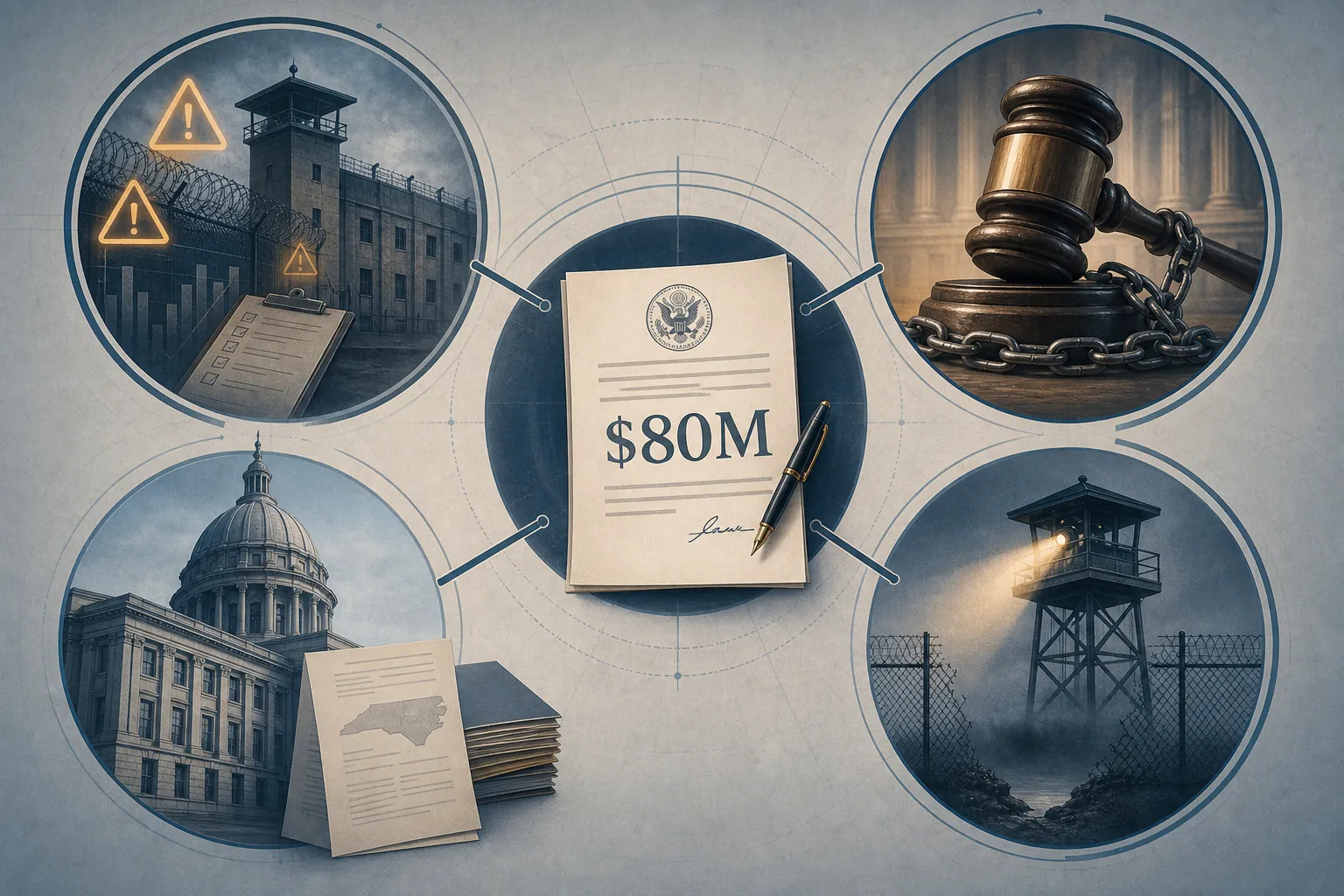
The legal risk in GEO Group’s Hertford County ICE deal is concentrated because several independently documented issues converge at the same reopened facility. They should not be collapsed into one broad private-prison controversy.
- Rivers conditions history: the facility has a documented DOJ OIG-linked record of violence, misconduct, contraband, and drug-test concerns that goes directly to notice and remedial planning.
- Forced-labor litigation: GEO faces active detainee-labor exposure across Colorado, Washington, and California, with Menocal and Nwauzor providing particularly concrete litigation markers.
- North Carolina regulatory exposure: the 2026 NC Border Protection Act expands state-local ICE cooperation, but specific liability theories remain developing and should be assessed cautiously.
- Federal oversight gaps: reported CRCL staffing reductions and OIDO defunding weaken confidence that administrative review will catch detention-condition problems early.
That is the disciplined assessment the current record supports. The Rivers contract is not legally unusual because any one allegation guarantees a future case outcome. It is unusual because the deal combines a facility-specific warning record, live contractor litigation, a changing state-law environment, and diminished federal oversight at the moment ICE is buying a guaranteed block of detention capacity in Hertford County.
References
- The GEO Group Announces Contract for Company-Owned 1,320-Bed Rivers Facility in North Carolina — GEO Group investor relations, July 29, 2026.
- Department of Justice: Rivers Correctional Institution in Hertford County is a 'lawless place' — NC Newsline.
- Court rejects ICE contractor's right to immediate appeal — SCOTUSblog, February 2026.
- Geo Group, Inc. v. Menocal, 607 U.S. ___ (2026) — Justia / Supreme Court, 2026.
- Nwauzor v. The GEO Group, Inc. — Ninth Circuit opinion, August 13, 2025.
- Dying in Detention: Rising Deaths in an Expanding US Immigration Detention System — HRW, June 25, 2026.
- ICE Plans to Open Detention Center in NC by End of 2026 — ACLU of North Carolina, July 2026.
- ICE expected to open mass detention facility in NC, sparking anger, pushback — NC Newsline, July 24, 2026.
- ICE removed detainee protections after private outreach from top contractor — Washington Post, June 16, 2026.
- Private Prison Firm GEO Group Reports Record $254 Million Profit — Prison Legal News, March 1, 2026.
- Private Prison Companies' Enormous Windfall: Who Stands to Gain as ICE Expands — Just Security.
Related records
Tool profile
Browse tool evaluations →Governing regulation
Browse the obligations tracker →Preventive workflow
Browse verification workflows →
Report a correction or tip
Spotted an outdated figure, a misstated fact, or a ruling this case record should reflect? Public comments are disabled for this content given the professional cost of a misreported case outcome, penalty amount, or rule text — use the structured correction channel instead.
Report a correction or tip for this record →