
Which Google Gemini Plan Is Safe for Legal Work?
This article maps each Google Gemini subscription tier — from Free to Enterprise — to its legal exposure risks, covering data retention, privilege waiver under Heppner, HIPAA eligibility, and citation accuracy. Readers can identify which plan meets ABA Model Rule 1.6 confidentiality duties and which consumer-tier plans carry uninsurable privilege risks.
- Jurisdiction
- US-Federal
- Court
- Southern District of New York
- AI tool named
- Google Gemini
- Ruling date
- Jan 1, 2026
- Source document
- View primary court order ↗
- Last verified
- Jul 26, 2026
Lex Machina Review is an independent risk-tracking and reference resource. Nothing on this site is legal advice, and using it does not create an attorney-client relationship. Every record is reviewed against primary sources but may not reflect the most current status of a matter — always verify directly against the cited court order, rule text, or a licensed attorney before relying on it.
Companion explanation — secondary to the source document above
The practical Gemini procurement question for a law firm is not whether the model can draft, summarize, or brainstorm. It is whether the subscription tier gives the firm a defensible answer when a client, court, insurer, or conflicts counsel asks where confidential material went. Google’s post-I/O 2026 subscription ladder makes that question sharper because the consumer tiers sit close in price to the first business tier that can be governed like a legal system rather than a personal productivity account.[1]
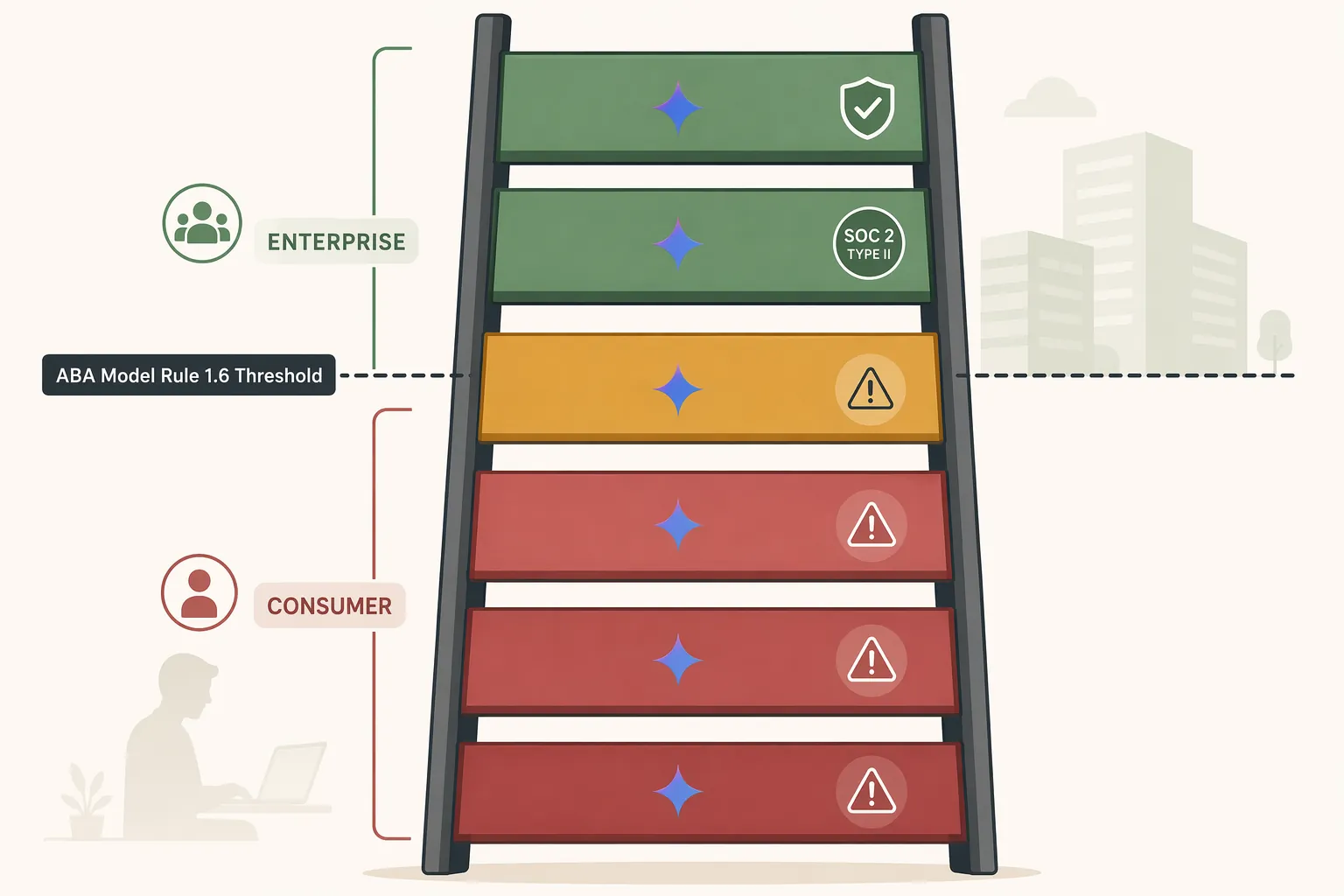
For client work, the cutoff should be drawn above Free, AI Plus, AI Pro, and, absent fuller Spark terms, AI Ultra. Workspace Business Plus with Gemini and Enterprise are the plans that belong in the approval conversation, because they can be tied to contractual controls, administrative governance, data isolation, and, where needed, a Business Associate Agreement. That does not make every Workspace deployment automatically safe. It means the firm is finally buying a plan capable of being configured and defended.
The Gemini Plan Map for Legal Use
| Gemini tier | 2026 pricing signal | Legal-use status | Primary exposure |
|---|---|---|---|
| Gemini Free | Free consumer access | Prohibit for client or confidential legal work | Consumer data handling, retained prompts, possible review, no firm-level contractual controls |
| Google AI Plus | $4.99-$7.99 consumer tier | Use only for public, non-client experimentation | Same legal category as other consumer plans unless Google supplies enterprise-grade controls |
| Google AI Pro | $19.99 consumer tier | Not approved for client work | Looks professionally usable, but lacks the compliance layer needed for privileged material |
| Google AI Ultra | About $100-$200/month; U.S.-only Spark access | Do not approve for client work without documented Spark terms and enterprise controls | Persistent-agent and aggregation risk beyond ordinary chatbot prompting |
| Workspace Business Plus with Gemini | $26.40/user/month minimum safe-looking business tier | Potentially approvable for client work with correct configuration | Requires policy, supervision, retention controls, and contractual review |
| Gemini Enterprise | Enterprise pricing and controls | Preferred tier for regulated or higher-risk legal work | Still requires matter-level limits, verification discipline, and administrative monitoring |
That table is intentionally blunt. A lawyer can do harmless work inside a consumer AI account: asking for a plain-language explanation of a public statute, testing a prompt on a fictional fact pattern, or comparing tone on marketing copy that contains no client information. The line moves when the input becomes client-identifying, privileged, confidential, regulated, or strategically sensitive. At that point, convenience is no longer the relevant procurement category.
A firm that wants a broader market comparison can read Legal AI Pricing in 2026: What You Actually Pay vs. What You Get. For this decision, however, the relevant comparison is narrower: the difference between a consumer subscription that a partner can buy on a card and a Workspace or Enterprise deployment that the firm can govern.
Why Consumer Gemini Tiers Fail the Client-Work Test
ABA Model Rule 1.6 requires a lawyer to avoid revealing information relating to the representation of a client unless an exception applies. The rule is broader than privilege. It reaches client information that may never appear in a pleading, deposition, or advice memo but still belongs outside a consumer AI account.[2]
ABA Formal Opinion 512 then brings generative AI into the everyday supervision problem. Lawyers using generative AI must understand relevant risks, protect confidentiality, supervise outputs, and communicate with clients when the use of the tool is material to the representation or otherwise required.[3] That is a difficult opinion to satisfy with a personal account whose controls are selected by individual users, whose settings may change, and whose records are not administered as part of the firm’s information-governance system.
Workspace and Enterprise offerings matter because they move the discussion from user preference to institutional control. Google’s Workspace security and compliance materials describe enterprise controls including administrative management, client-side encryption, data-region and compliance capabilities, and BAA availability for eligible services.[4] Those are not decorative features. They are the difference between a policy that can be audited and a warning email that hopes every timekeeper remembers which Gemini account is open.
The privilege concern is not theoretical just because the best-known 2026 warning came from a different model. In Heppner, a Southern District of New York privilege dispute involved Claude, not Gemini. The reported concern was that prompts containing confidential material could be retained and potentially reviewed, which supported an argument that the user had disclosed privileged material to a third party.[5] No court has held that Gemini produces the same result. The analogy is narrower: if a consumer AI plan retains prompt data for an extended period and permits review outside the lawyer-client relationship, a risk committee should not wait for the first Gemini-specific sanctions order to notice the problem.
The site’s separate workflow on Gemini privacy settings and client data tracks that consumer-retention issue in more detail. The point for plan approval is simpler: a setting that an individual lawyer must remember is not equivalent to a contractual, administered, and monitored enterprise control.
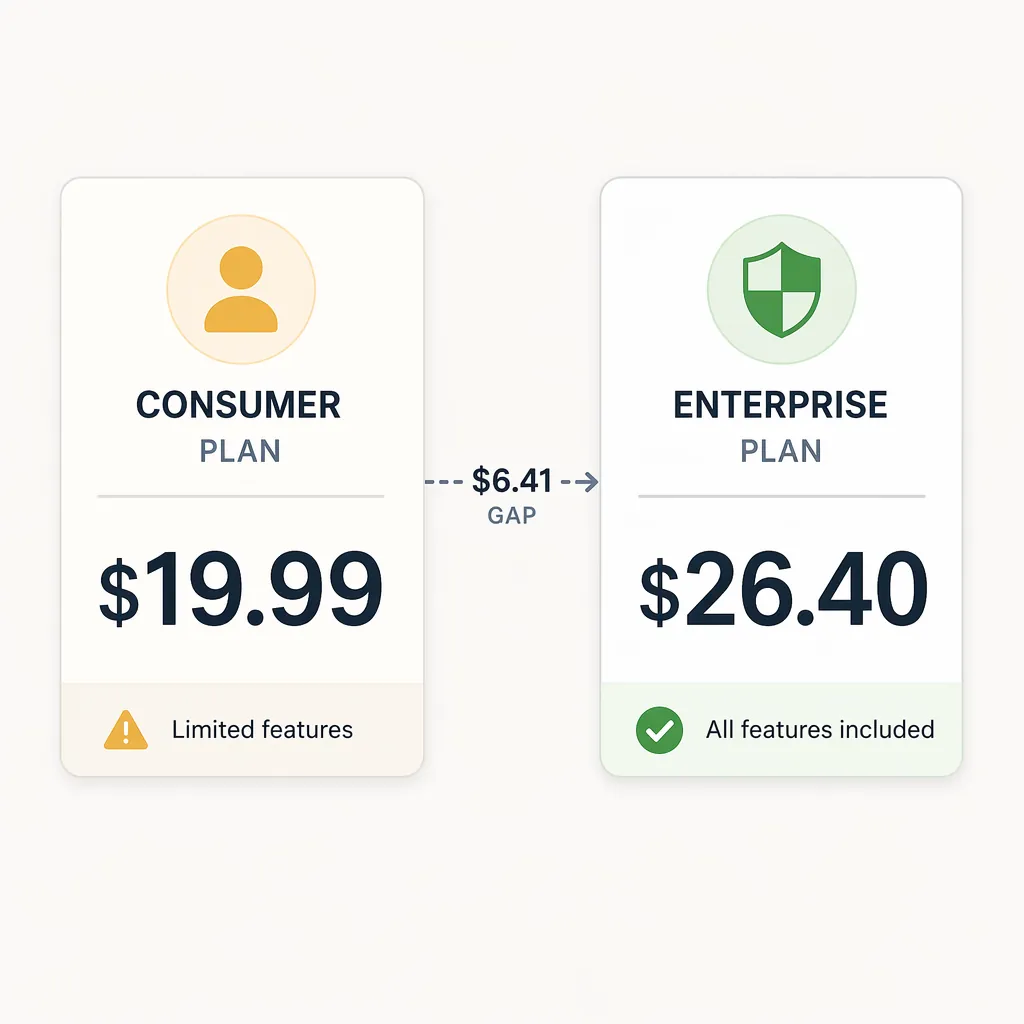
This is where the pricing comparison stops being a budgeting footnote. Google AI Pro is listed at $19.99, while Workspace Business Plus with Gemini is identified at $26.40 per user per month, a $6.41 monthly difference.[1] Once confidential legal work is in scope, that small gap makes the cheaper choice harder to defend. The firm is not saving money by buying less governance; it is moving the cost to privilege review, incident response, client disclosure analysis, and malpractice-risk explanation.
Free, AI Plus, and AI Pro Belong in One Consumer Bucket
Free, AI Plus, and AI Pro differ in access, capacity, and features, but those differences do not solve the legal problem. The issue is not whether AI Pro feels more professional than a free account. The issue is whether the plan gives the firm enterprise contracting, administrative control, data isolation, and documented compliance commitments for client material.
- Approved use: public-law research prompts, fictional training examples, non-client marketing drafts, and internal AI literacy exercises.
- Prohibited use: client facts, privileged strategy, deposition summaries, discovery material, settlement positions, health information, trade secrets, or anything a client would reasonably expect the firm to protect.
- Policy treatment: consumer Gemini accounts should be blocked or expressly limited, not quietly tolerated because lawyers already know how to log in.
The same analysis applies when a lawyer says the prompt is “just a draft.” Drafting can be the disclosure. A prompt asking Gemini to rewrite a litigation email may expose party names, negotiation posture, adverse facts, and the lawyer’s mental impressions before the output ever becomes a document.
AI Ultra and Spark Need a Separate Caution
AI Ultra is not just a more expensive AI Pro for legal-risk purposes. Its relevance in 2026 is Spark: an Ultra-exclusive, U.S.-only feature described as a persistent agentic layer, with pricing signals around $100 to $200 per month.[1] A persistent agent raises a different question from a one-off chatbot prompt. It may connect tasks, remember context, assemble information across sources, and operate through workflows that are harder for a supervising lawyer to reconstruct after the fact.
As of July 2026, Spark’s full data-handling terms remain underdocumented in the available Google privacy materials. That uncertainty should not be treated as permission. It is the reason a firm should keep Spark outside client work unless and until the deployment sits inside an enterprise-governed environment with clear terms, logging, access boundaries, and matter-level supervision.
The firm-level question is not whether an agent can save time. It is whether anyone can later show what the agent saw, what it retained, what systems it touched, what sources it used, and who approved those connections. The separate Spark workflow analysis in Gemini Spark’s Agentic Features Test Legal AI Safeguards is the better place to work through those operational safeguards. For plan approval, the answer is shorter: Ultra does not become safe for client work merely because it is expensive.
HIPAA and BAA Eligibility Are Not Optional for Health-Law Work
If a legal workflow may involve protected health information, the plan analysis becomes even less forgiving. Google’s Workspace compliance materials describe BAA availability for eligible services, but that does not mean every Gemini-branded product, feature, or consumer plan is covered.[4] A firm handling health-care litigation, benefits advice, medical-record discovery, hospital employment matters, or regulatory counseling should confirm the exact covered services before PHI enters a prompt.
- Do not treat a Google account as HIPAA-ready because another Google service has a BAA.
- Confirm that Gemini usage is within the covered Workspace or Enterprise service scope.
- Document administrative controls, access limits, retention settings, and user training before PHI workflows begin.
- Keep consumer Gemini plans out of PHI workflows altogether.
The same habit should carry into other regulated or high-sensitivity matters. A BAA is not the only contract term that matters, but it is a useful reminder that legal AI approval turns on service scope, not brand familiarity.
Accuracy Risk Still Requires a Verification Layer
Confidentiality is the gating issue, but it is not the only one. Secondary legal-tech commentary has cited hallucination rates in the 10% to 20% range for legal AI outputs, though that figure should be treated as a secondary-source estimate rather than a peer-reviewed benchmark.[6] The safer way to use that number is not to argue over the exact percentage. It is to recognize that citation verification must be a required workflow, not an optional courtesy.
That is especially true for general-purpose models. Gemini may produce useful summaries, issue lists, first drafts, and research leads, but legal use requires source checking by someone accountable to the matter. The site’s broader comparison of general-purpose and legal-native AI tools explains why model capability and legal workflow suitability are different questions.
Enterprise configuration can reduce avoidable risk, but it does not eliminate the lawyer’s duty to check the work. Firms building approved internal Gemini workflows should pair access controls with source-grounding rules, citation review, matter-type restrictions, and prompt templates. For teams using custom configurations, Build Custom Gemini Gems for Legal Work That Reduce Sanction Exposure is the more practical next layer.
Do Not Let Old Gemini Names Cloud the Approval Rule
Some secondary materials still use pre-I/O naming such as “Gemini Advanced” where Google’s 2026 ladder now points readers toward Google AI Plus, Google AI Pro, AI Ultra, Workspace Business tiers, and Enterprise.[1] That naming lag can create procurement confusion. A lawyer may think a feature has moved into a safer category because the name sounds more professional, or because a comparison chart uses an older label.
The cure is to approve by control set, not by product nickname. The policy should ask whether the account is consumer or enterprise-governed, whether client data is contractually protected, whether the relevant service is covered by the BAA when PHI is involved, whether admins can manage access and retention, and whether outputs must be independently verified. If those answers are missing, the plan is not approved for client work.
A Defensible Gemini Approval Rule
A defensible firm rule can be short: consumer Gemini may be used only for public, non-client, non-confidential experimentation. Client work requires Workspace Business Plus with Gemini or Enterprise, configured with the correct contractual commitments, data isolation, administrative controls, retention policy, supervision, and citation-verification workflow.
That rule will feel conservative to lawyers who see AI Pro as a cheap productivity tool. It should. The price gap between AI Pro and the minimum safe-looking Workspace option is $6.41 per user per month.[1] Once privilege, confidentiality, HIPAA eligibility, and supervision enter the room, that is not a meaningful savings case. It is a documentation problem waiting for the first bad prompt.
References
- Google AI subscription updates from Google I/O 2026, Google Blog, 2026.
- Rule 1.6: Confidentiality of Information, American Bar Association.
- Formal Opinion 512, American Bar Association.
- Google Workspace security and compliance, Google Workspace.
- Heppner privilege analysis involving Claude prompts, Varghese Summersett, 2026.
- Legal AI hallucination-rate discussion, Spellbook.
Related records
Tool profile
Browse tool evaluations →Governing regulation
Browse the obligations tracker →Preventive workflow
Browse verification workflows →
Report a correction or tip
Spotted an outdated figure, a misstated fact, or a ruling this case record should reflect? Public comments are disabled for this content given the professional cost of a misreported case outcome, penalty amount, or rule text — use the structured correction channel instead.
Report a correction or tip for this record →