
Gorsuch’s Firing Line Rebuttal of the White Christian Founding Myth
Justice Neil Gorsuch used originalist reasoning on PBS’s Firing Line to reject the claim that America was founded as a white Christian nation, citing the First Amendment and founding-era pluralism. This analysis examines how his public statements signal a fracture within the Supreme Court’s originalist bloc and what that means for litigants preparing Establishment Clause and religious-liberty briefing.
- Jurisdiction
- US-Federal
- Court
- Supreme Court of the United States
- Judge
- Neil Gorsuch
- AI tool named
- None
- Ruling date
- Jul 24, 2026
- Source document
- View primary court order ↗
- Last verified
- Jul 30, 2026
Lex Machina Review is an independent risk-tracking and reference resource. Nothing on this site is legal advice, and using it does not create an attorney-client relationship. Every record is reviewed against primary sources but may not reflect the most current status of a matter — always verify directly against the cited court order, rule text, or a licensed attorney before relying on it.
Companion explanation — secondary to the source document above
The useful record in this legal debate begins with a public exchange, not a merits opinion. On the July 24, 2026 episode of PBS’s Firing Line, Margaret Hoover pressed Justice Gorsuch on the claim that the United States was founded as a white Christian nation. Gorsuch’s answer did not merely sound pluralist in a civic-religion register. He moved through the kind of materials that lawyers recognize: the First Amendment’s no-establishment language, Charles Carroll’s Catholicism, and the presence of Amish and Quaker communities in the founding-era landscape. He then stated the point in broader terms: “We were never supposed to be about one race or one religion.” [1]
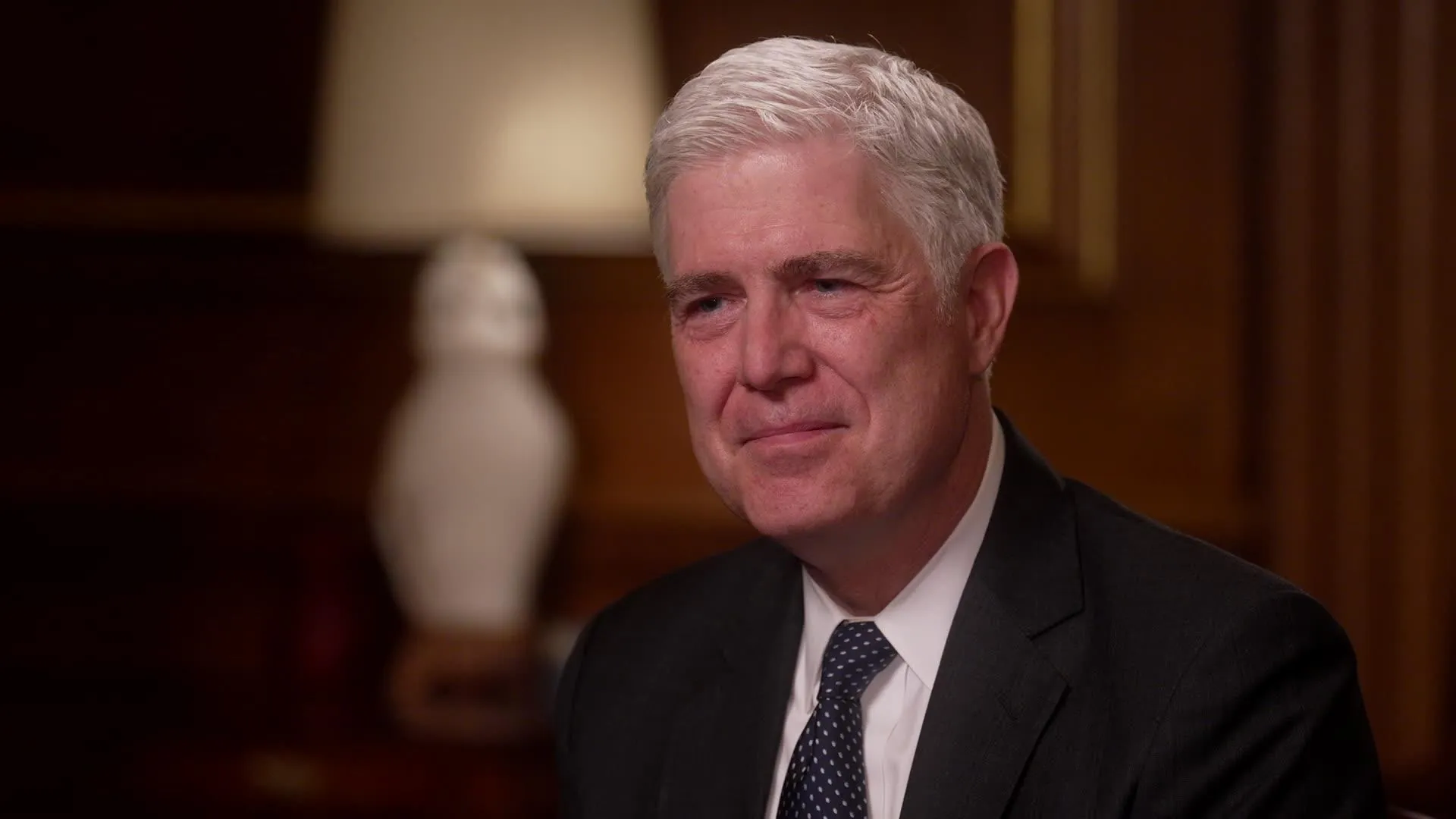
That answer is not law. It does not bind lower courts, it does not tell counsel how Gorsuch will vote in the next Establishment Clause case, and it should not be treated as a prediction engine for religious-liberty litigation. But it is a documented public statement by a sitting justice using originalist and textual vocabulary to reject a claim that political actors, amici, and some litigants have tried to make legally useful. For lawyers who work in the space between doctrine and argument supply, that is enough to make the exchange worth preserving.
The most important feature of the Firing Line answer is its form. Gorsuch did not say only that a white Christian founding story is morally unattractive or socially divisive. He answered as if the claim failed on the materials originalists often ask courts to consult. If the Constitution’s text forbids Congress from making a law “respecting an establishment of religion,” then the founding is hard to redescribe as a single national establishment in waiting. If Charles Carroll, the only Catholic signer of the Declaration of Independence, belongs in the founding story, then “Christian” cannot be collapsed into a narrow Protestant national identity. If Amish and Quaker settlement belongs in the relevant historical frame, then founding-era religion is not monolithic even before the Fourteenth Amendment, incorporation, or modern equality doctrine enters the conversation. [1]
What Gorsuch actually put on the record
The distinction between an inclusive sentiment and a transferable legal argument matters. An advocate cannot cite a television interview as controlling authority. An advocate can, however, notice when a justice frames a public constitutional claim in terms that resemble an argument section: constitutional text first, founding-era evidence second, structural conclusion third.
The constitutional-text move is doing the most work. The answer locates the rebuttal inside the First Amendment rather than in a freestanding appeal to twenty-first-century diversity. That does not settle the modern Establishment Clause test. It does not choose among coercion, history-and-tradition, endorsement, neutrality, or any other doctrinal vocabulary that has moved through the Court’s religion cases. But it does resist a common rhetorical shortcut: the assertion that originalism, because it looks backward, must naturally ratify a Christian-nationalist account of the founding.
The historical examples then give the text a usable environment. Carroll, Amish communities, and Quakers are not decorative examples if they are offered to show that the founding public was religiously varied in ways that mattered to constitutional design. Gorsuch’s answer treats pluralism as something visible in the founding record itself, not as a later correction supplied only by modern doctrine. That is why the line “one race or one religion” is less legally interesting standing alone than it is when read alongside the evidentiary route he used to get there. [1]
The racial component should also be handled with care. Gorsuch’s rejection of a founding defined by “one race” does not turn the founding into a fully egalitarian moment; it does not erase slavery, dispossession, exclusion, or the constitutional compromises that protected them. His formulation instead identifies a constitutional aspiration or design principle that he reads as inconsistent with a racial-religious national identity. That is a narrower claim than a celebratory founding myth, and it is the narrower claim that has litigation value.
The answer fits his public account of originalism
The Firing Line exchange is easier to overread if it is treated as a one-off remark. It is better read alongside Gorsuch’s other public descriptions of the American project. In a May 4, 2026 interview with Reason, he described the United States as a nation grounded in ideas rather than shared religion, culture, or heritage: “Our nation is not founded on a religion. It’s not based on a common culture even, or heritage. It’s based on those ideas.” In the same interview, he said that “we’ve been in a civil rights movement since 1776.” [2]
Those sentences are not Establishment Clause doctrine either. They do, however, show continuity between the PBS exchange and a broader “creedal nation” account that Gorsuch has been willing to state outside opinions. The creed, as he describes it, is not sectarian identity; it is a set of constitutional commitments that can be invoked against inherited exclusions as well as against present-day government overreach.
His 2019 TIME essay on originalism supplies the methodological frame. There, Gorsuch defended originalism as an approach that asks judges to attend to the Constitution’s original public meaning rather than to update legal commands according to personal preference. [3] That matters because the PBS answer used the idiom of originalism against a claim often marketed as originalist. He was not abandoning original meaning in favor of modern pluralism; he was saying, in substance, that the founding materials themselves do not bear the white Christian nation thesis.
His pre-Court First Amendment record also counsels against flattening the point into a simple ideological label. SCOTUSblog’s 2017 review of Gorsuch’s First Amendment jurisprudence described a judge with a substantial record in speech and religion cases before his elevation to the Supreme Court. [4] That record is part of why litigants should avoid the lazy inference that rejecting Christian nationalism means voting narrowly against religious claimants. A justice can reject a national-establishment story and still read free exercise, compelled-speech, or religious-accommodation claims broadly in particular procedural settings.
The same caution applies to the public-facing founding narrative around Gorsuch’s 2026 children’s book, Heroes of 1776. Coverage of the book is useful mainly because it shows that he has been telling a founding story beyond the U.S. Reports, not because it turns him into a cultural commentator whose every public theme should be imported into doctrine. [5]
How the language could travel into briefs
The immediate litigation significance is not that counsel now have a new binding rule. They do not. The significance is that Gorsuch has offered a public originalist vocabulary for resisting the claim that history-and-tradition analysis must point in a Christian-nationalist direction. In Establishment Clause litigation, that vocabulary can help separate founding-era religious pluralism from a theory of national religious identity. In free-exercise litigation, it can help religious-liberty advocates argue for protection of religious practice without conceding that the Constitution privileges a dominant Christian political identity.
| Possible use in briefing | What the Firing Line record supports | What it does not support |
|---|---|---|
| Establishment Clause argument against national religious identity | The First Amendment’s no-establishment language and founding-era pluralism can be framed as originalist evidence against a one-religion founding account. | It does not establish a new doctrinal test or displace existing Supreme Court precedent. |
| Free-exercise argument that protects minority faiths without adopting Christian nationalism | Gorsuch’s examples of Catholics, Amish, and Quakers support an account of religious liberty built for plural communities from the beginning. | It does not show that he will reject broad exemptions, accommodations, or religious-liberty claims in future cases. |
| Response to amici invoking a Christian founding | Counsel can show that at least one prominent originalist justice has publicly rejected the premise using originalist materials. | It should not be represented as a vote count or as the view of the Court. |
A careful brief would not quote the PBS line as if it were a holding. The better use is more disciplined: cite binding doctrine where doctrine is needed, use founding-era sources where historical argument is needed, and treat Gorsuch’s statement as a signal that the proposed historical frame is not alien to an originalist jurist. That is adversarially useful in cases where the opposing side tries to make “originalism” and “Christian founding” sound interchangeable.
There is also a defensive use. Litigants representing non-Christian religious claimants, secular plaintiffs, or institutions concerned about government religious favoritism often face a strategic dilemma: if they engage founding-era history too heavily, they may appear to accept a battlefield chosen by Christian-nationalist amici. Gorsuch’s formulation makes a different route available. The brief can say that founding-era history is not being avoided because it is hostile; it is being read more accurately, with the First Amendment’s no-establishment text and actual religious variety doing the work.
That move still requires evidence. Carroll cannot bear the full weight of a national theory. Amish and Quaker settlement cannot by themselves answer every Establishment Clause question. The point is not to replace one myth with a thinner pluralist myth. The point is to prevent a monolithic religious-nationalist account from passing as the only originalist account available.

The conservative-originalist objection is part of the signal
The fracture is not visible only because progressive commentators liked the answer or because political media treated it as a rebuke. It is visible because conservative originalist critics have objected to the same public account. Modern Age’s June 2026 “Counterfeit Creed” critique attacked Gorsuch’s creedal framing from within the conservative intellectual tradition, arguing against the idea that the American founding can be adequately described through an abstract civic creed detached from a thicker inherited culture. [6]
That criticism should not be brushed aside as partisan noise. It identifies the real contest: whether originalism points toward a constitutional order defined primarily by textually protected liberty across a religiously varied people, or toward a founding tradition that gives Christianity a privileged cultural and political status even if formal establishment is disallowed. Those are not the same argument. They may sometimes produce the same result in a particular case, especially where a religious claimant seeks relief from government burden. But they justify that result differently, and the difference becomes important when the government itself invokes religious heritage to defend official action.
Opposing counsel can be expected to use the intra-originalist critique. They may argue that Gorsuch’s creedal account is too abstract, that it reads later egalitarian aspirations backward into the founding, or that it underweights the Protestant assumptions embedded in founding-era political culture. They may also distinguish between an anti-establishment rule and a broader claim about the nation’s religious character. Those are serious lines of attack, and they are why any brief relying on founding-era pluralism has to do more than quote Gorsuch’s PBS answer.
Still, the objection confirms the point that matters for litigation planning: there is no single uncontested conservative-originalist lane on the white Christian founding claim. If Gorsuch’s formulation were merely anodyne civic language, it would not require a “counterfeit creed” response. The dispute is over what the founding means and what kinds of constitutional arguments can properly be made in its name.
The pressure field around the Court
The political setting explains why a television exchange became legally interesting, but it should not swallow the analysis. The Hill reported Gorsuch’s comments on July 30, 2026, in the context of backlash to Trump-aligned Christian-nationalist rhetoric, including remarks associated with Vice President JD Vance at AmericaFest in December 2025 and Heritage Foundation president Kevin Roberts. [7] That context matters because litigants do not brief religion cases in a vacuum. Claims about national religious identity circulate through speeches, amicus briefs, agency rhetoric, school-board disputes, and public reactions to court decisions.
But the political contrast should be kept in its lane. A justice disagreeing with a political slogan on PBS does not produce a doctrinal realignment. Nor does it make Gorsuch an opponent of religious-liberty claims associated with conservative Christian litigants. The legally relevant contrast is narrower: when a political argument says the founding was white and Christian in a way that should shape constitutional meaning, Gorsuch publicly answered that the founding Constitution’s text and religious variety point elsewhere.
Empirical work on public perceptions of the Court adds another reason to pay attention without pretending it predicts votes. A 2025 American Journal of Political Science study by Armaly and coauthors found that perceptions linking the Court with Christian nationalism increased acceptance of religious reasoning in judicial decisions. [8] That is legitimacy context, not merits authority. It suggests that the public meaning of religious reasoning around the Court can affect acceptance of judicial outcomes. It does not show how Gorsuch, or any other justice, will decide a future Establishment Clause or free-exercise case.
What litigants should and should not take from it
The safest professional takeaway is also the most useful one. Litigants should not assume that originalism is a single pro-Christian-nationalist channel. Gorsuch has now supplied a public example of originalist reasoning that rejects the white Christian founding claim through text, founding-era pluralism, and constitutional structure. That gives advocates a signal and a vocabulary when responding to arguments that try to convert “history and tradition” into a national religious identity.
They should also avoid the opposite overclaim. The PBS exchange is not precedent. It is not a commitment to revive a separationist Establishment Clause regime. It is not evidence that Gorsuch will vote against religious accommodations, exemptions, compelled-speech objections, or free-exercise claims. In many cases, his broader jurisprudence may continue to favor robust protection for religious claimants while rejecting the premise that the Constitution belongs to one religious people.
For briefing purposes, that distinction is an asset. A party can argue that religious liberty is strongest when detached from religious nationalism: the Constitution protects religious exercise because it refuses national establishment, not because it constitutionalizes a dominant faith. Gorsuch’s interview does not make that argument win. It makes it harder for an opponent to say the argument is foreign to originalism.
The live legal debate, then, is not whether a PBS answer changes the law. It does not. The debate is whether lawyers, judges, and amici will continue to treat “Christian founding” as the inevitable historical premise of originalist religion-clause argument. Gorsuch has publicly refused that premise in originalist terms. That is not a holding, but it is law-shaped material.
References
- Firing Line with Margaret Hoover: Justice Neil Gorsuch, PBS, July 24, 2026.
- Neil Gorsuch: Our Nation Is Founded on Ideas, Reason, May 4, 2026.
- Why Originalism Is the Best Approach, TIME, 2019.
- Neil Gorsuch on the First Amendment, SCOTUSblog, 2017.
- Supreme Court Justice Neil Gorsuch has written a children's book. Here's why, USA Today, May 9, 2026.
- Counterfeit Creed, Modern Age, June 2026.
- Gorsuch rebuts claim that America was founded as a white Christian nation, The Hill, July 30, 2026.
- Christian Nationalism and Americans’ Views toward the Supreme Court, American Journal of Political Science, 2025.
Related records
Tool profile
Browse tool evaluations →Governing regulation
Browse the obligations tracker →Preventive workflow
Browse verification workflows →
Report a correction or tip
Spotted an outdated figure, a misstated fact, or a ruling this case record should reflect? Public comments are disabled for this content given the professional cost of a misreported case outcome, penalty amount, or rule text — use the structured correction channel instead.
Report a correction or tip for this record →