
Habita's re-entry admission shifts Kumamoto blast liability
Habita's admission that two employees were ordered back inside the Aeon Kumamoto mall before the July 28 blast undercuts a force-majeure explanation for their deaths. As of August 3, 2026, no charges or civil claims tied to that order have been confirmed; this record lays out what criminal and civil exposure the admission could support and what still must be proven.
- Jurisdiction
- Japan
- Court
- No court proceeding filed as of 2026-08-03
- AI tool named
- None
- Ruling date
- Aug 3, 2026
- Source document
- View primary court order ↗
- Last verified
- Aug 3, 2026
Lex Machina Review is an independent risk-tracking and reference resource. Nothing on this site is legal advice, and using it does not create an attorney-client relationship. Every record is reviewed against primary sources but may not reflect the most current status of a matter — always verify directly against the cited court order, rule text, or a licensed attorney before relying on it.
Companion explanation — secondary to the source document above
Habita Inc.’s admission is the legal fulcrum in the Aeon Mall Kumamoto blast record. On Aug. 2–3, 2026, Habita executives admitted that two employees who later died had been instructed to return inside the building to put sales proceeds in a safe; the company apologized at Kurumi Otake’s wake and handed her family a written account of events. A Habita sales manager was quoted as saying, “Looking back now, it was not worth a life.” [1][2]
That does not mean criminal liability has been established. It does not mean a civil court has found causation. It does not even mean, on the cited public record, that an arrest, indictment, or civil complaint tied to the re-entry instruction has been confirmed as of Aug. 3, 2026. This is a live legal-risk record, not legal advice; AI tool implicated: none.
The legal question is now narrower than the first wave of disaster coverage suggested. Gas mechanics, earthquake damage, evacuation performance, and mall-operator conduct still matter. But for the two Habita employees, the sharpest question is whether an employer’s instruction placed workers back inside a known or knowable danger zone.
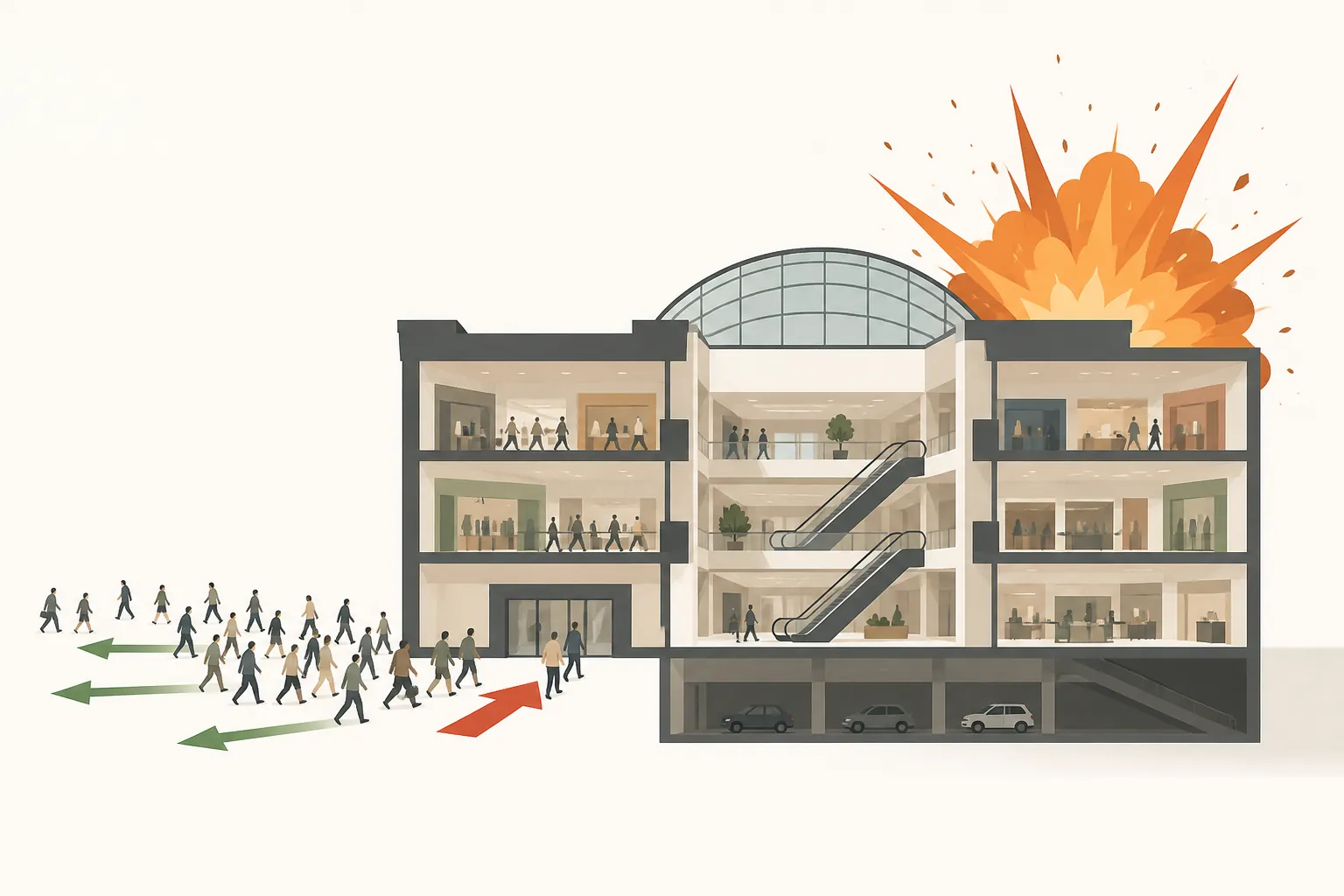
Reuters reported that roughly 3,000 shoppers were evacuated within half an hour after the July 28 earthquake and that the mall company believed employees had also evacuated; the same report placed the mall’s tenant count at about 200 stores and quoted mall executives addressing the suspected gas cause while deferring technical findings to fire authorities. [3] Jiji, carried by Nippon.com, separately reported Aeon’s statement that the dead were employees of specialty stores rather than Aeon Mall employees. [4] That distinction is not a footnote. It separates the mall operator’s safety system from the tenant employer’s command over its own staff.
Why the re-entry admission changes the liability map
Before the admission, the public record could be read largely as a catastrophe sequence: earthquake, possible gas leak, blast, deaths. That kind of record tends to spread attention across building systems, inspection history, emergency response, and the unforeseeability arguments that follow a major seismic event. Habita’s admission adds a different kind of fact: a human instruction.
An instruction to return for sales proceeds gives claimants a concrete factual hook. It can be tested against who had authority over the workers, what risk information was available, whether workers had already reached safety, and whether the return materially exposed them to the blast. That is a different record from a claim that everyone was simply caught by an infrastructure failure.
For criminal exposure, the obvious issue is professional negligence resulting in death: whether a person with workplace authority breached a duty of care by directing employees back inside under circumstances where danger was foreseeable. For civil exposure, the admission would be examined under tort and employer-responsibility theories, including the Civil Code employer-liability frame commonly associated with Article 715 and ordinary tort liability associated with Article 709. Those labels do not decide the case. They identify the proof problems.
The moral gravity of a return-for-money instruction is obvious. The legal gravity is more demanding. A court or prosecutor would still need evidence of the exact order, the person who gave it, the person’s role, the timing, the workers’ location when they received it, and whether the explosion risk was reasonably foreseeable then. The admission weakens a pure force-majeure account for these two deaths; it does not, by itself, supply every element of liability.
The proof questions now matter more than the rescue chronology
The record should now be organized around proof, not around repeating the disaster timeline. The key questions are not dramatic. They are the questions that determine whether a reported admission becomes a prosecutable or compensable claim.
| Issue | Why it matters | Current public-record status as of Aug. 3, 2026 |
|---|---|---|
| Who gave the instruction | Criminal and employer-liability analysis depends on whether the speaker had supervisory authority or apparent authority over the workers. | Habita admitted the workers were instructed to return, but the cited public record does not establish a complete command chain. |
| Exact words and timing | A request, a directive, and an emergency instruction may carry different legal consequences; timing affects foreseeability. | The public record identifies the purpose as placing sales proceeds in a safe, but does not provide a full verbatim instruction. |
| Worker location before re-entry | If the workers had already evacuated, the instruction can be framed as a renewed exposure to danger rather than mere failure to evacuate. | The admission concerns a return inside; the precise location and sequence for each worker still require proof. |
| Causation | Claimants would need to connect the instruction to the deaths, not merely to show that an instruction was unsafe in hindsight. | Deaths and the instruction are reported together, but causation has not been adjudicated or publicly confirmed through a legal finding. |
| Foreseeability of explosion or gas risk | Force-majeure arguments remain stronger if the blast risk was not reasonably knowable when re-entry was ordered. | The LPG investigation provides context, but the record does not yet establish what Habita personnel knew at the moment of re-entry. |
A clean liability theory would show that the employees had moved to safety, that a person with authority sent them back for property or cash-handling reasons, that the danger was sufficiently apparent, and that the re-entry caused the fatal exposure. A weaker theory would have gaps on authority, timing, or foreseeability and would leave more room for the defense to argue that the deaths were caused by an unforeseeable gas-system failure after an earthquake.
Aeon’s role is separate from Habita’s order
Aeon is not irrelevant. The mall operator controlled the premises, coordinated evacuation, and faced questions about building systems and emergency procedures. Reuters reported that AEON MALL President Keiji Ohno said the fire department was investigating the cause, while another executive, Akio Yoshida, said the possibility that gas caused the blast was “very high.” [3] Those statements belong to the operator-side record.
But the Habita admission creates an employer-side record. If the deceased were tenant-store employees, as Aeon stated in the Jiji/Nippon.com report, the immediate workplace command question sits with the tenant employer unless further facts show mall-operator involvement in the re-entry decision. [4] That is why the tenant-employee distinction matters more here than the total number of stores or the evolving casualty count.
A confirmed no-re-entry rule by the mall operator would be important as a safety-norm comparator. It would help show that, after evacuation, returning inside was contrary to the emergency posture that a reasonable operator or employer should have followed. But unless the public record ties Aeon personnel to the specific instruction given to Habita’s employees, the no-re-entry norm should not blur the basic allocation: operator duties on one side, tenant-employer instructions on the other.
The LPG investigation mainly bears on foreseeability
The gas-system record should not be ignored, but it should not swallow the re-entry question. The Straits Times, citing The Japan News/Yomiuri, reported expert discussion of broken gas pipes, an LPG seismic shut-off requirement triggered at intensity 5-plus, a roughly 9.3-tonne tank, statutory inspection on June 10, 2026, and voluntary inspection on March 12, 2026. [5] Those facts may matter to whether the explosion risk was foreseeable to mall operators, contractors, regulators, or tenants.
For Habita’s potential liability, the narrower question is what risk was or should have been apparent to the person who told employees to go back inside. If the evidence later shows visible gas danger, emergency warnings, instructions from mall staff not to re-enter, or other signs that re-entry was unsafe, foreseeability becomes harder for the employer to contest. If the evidence shows no such warning reached Habita personnel and no obvious hazard was present, the defense has more room to argue that the blast remained an unforeseeable intervening event.
The same distinction matters for force majeure. An earthquake may explain why a gas system failed. It does not automatically explain why employees were sent back inside for sales proceeds after an evacuation. The more the case turns on that instruction, the less persuasive a generalized earthquake narrative becomes for these two deaths.
Workers’ compensation is part of the landscape, not the endpoint
Because the deaths involved employees at work, workers’ accident compensation may become part of the practical response for the families. That administrative path, however, would not answer every accountability question raised by the admission. Compensation eligibility and employer fault are not identical inquiries, and the public record cited here does not establish how any workers’ compensation claim has been handled.
For counsel, the admission should therefore be treated as a preservation trigger. Communications about cash-handling, evacuation orders, store-manager instructions, tenant-mall coordination, security announcements, and post-quake re-entry controls are all likely to matter. So are drafts of the written account Habita gave Otake’s family, internal incident reports, and any contemporaneous messages between store staff and managers.
That is also where live-case discipline matters. The better practice is to separate confirmed filings from reported admissions, and to track source hierarchy as the record changes. This site uses the same confirmed-versus-reported approach in other live accountability records and primary-source checks, including its verification workflow.
Current legal posture
As of Aug. 3, 2026, the strongest public fact is Habita’s reported admission that two employees who died were told to return inside to secure sales proceeds, followed by an apology and written account to Otake’s family. That fact materially weakens a pure force-majeure framing for those two deaths.
The public record still does not supply the elements needed to convert exposure into confirmed criminal or civil liability. The missing pieces are familiar but decisive: who gave the order, what exactly was said, when it was said, what the speaker knew or should have known, whether the workers relied on the instruction, and whether that re-entry caused the fatal exposure.
References
- 2 women who died in Aeon mall blast were told to return inside by employer, Kyodo News, Aug. 3, 2026.
- Company Ordered Staff Back Inside Before Aeon Mall Kumamoto Explosion, News On Japan, Aug. 2, 2026.
- After the quake came the blast: Inside Japan's shopping mall disaster, Reuters, Jul. 29, 2026.
- Aeon Apologizes for Deaths in Kumamoto Mall Blast after Quake, Nippon.com / Jiji Press, Jul. 29, 2026.
- Kumamoto quake: Broken gas pipes likely behind deadly mall blast, say experts, The Straits Times / The Japan News, Jul. 31, 2026.
Related records
Tool profile
Browse tool evaluations →Governing regulation
Browse the obligations tracker →Preventive workflow
Browse verification workflows →
Report a correction or tip
Spotted an outdated figure, a misstated fact, or a ruling this case record should reflect? Public comments are disabled for this content given the professional cost of a misreported case outcome, penalty amount, or rule text — use the structured correction channel instead.
Report a correction or tip for this record →