
Haitian TPS Expiration Leaves Families at Risk of Separation
The termination of Haitian TPS creates a large-scale family separation risk for roughly 50,000 US-citizen children. This article assesses ICE's untested non-separation policy, state guardianship options, and the critical gaps parents and advocates face.
- Jurisdiction
- US-Federal
- Court
- U.S. Supreme Court
- AI tool named
- None
- Ruling date
- Jun 25, 2026
- Source document
- View primary court order ↗
- Last verified
- Jul 28, 2026
Lex Machina Review is an independent risk-tracking and reference resource. Nothing on this site is legal advice, and using it does not create an attorney-client relationship. Every record is reviewed against primary sources but may not reflect the most current status of a matter — always verify directly against the cited court order, rule text, or a licensed attorney before relying on it.
Companion explanation — secondary to the source document above
Last-verified posture: July 28, 2026
Haitian TPS is no longer a future deadline problem. As of this risk record, the designation has been terminated, work authorization lapsed on July 24, 2026, and an implementation order was expected today and should be checked against the current docket before any family is advised on timing. The child-welfare exposure is already visible: roughly 50,000 U.S.-citizen children have at least one Haitian TPS parent, an estimate reported by NPR and attributed to FWD.us and Princeton research rather than to a government census. [1]
That number matters because the Haitian TPS expiration is not only an immigration-status event. It is a custody, school-release, medical-consent, housing, and sibling-placement event. ICE says parents are asked whether they want their children removed with them or placed with a designee. Many parents, however, cannot accept taking a U.S.-citizen child to Haiti under current violence conditions, and the alternative depends on state-law paperwork that may not have a clear counterpart, may not be recognized in the moment, or may not be ready when detention happens. Human Rights Watch reported that 85% of Haitian TPS households are mixed-status, which means the separation problem is built into the structure of the affected families rather than confined to unusual cases. [2]

The Federal Register notice terminating Haiti’s TPS designation is the hard administrative frame; the same-day uncertainty is about implementation mechanics, not whether the designation has been terminated. [3] For lawyers and advocates fielding calls from Haitian TPS parents, the practical question is narrower than the political dispute: if a parent is detained or removed, who has lawful authority to pick up the child, keep the child with siblings, consent to care, and communicate with the school or clinic?
ICE’s stated choice is not the same as an operating plan
The most important federal statement so far is also one of the thinnest. NPR reported on July 23 that an unnamed DHS spokesperson said ICE “does not separate families” and asks parents whether they want children removed with them or placed with a designee. [1] On paper, that sounds like a binary decision administered at the point of enforcement. In a clinic hallway or a school office, it immediately becomes a list of unresolved instructions: who is the designee, where is the child, does the designee have documents, will the school release the child, can the designee authorize medical treatment, and what happens if the parent cannot reach that person from custody?
The statement should not be ignored. If ICE officers are in fact asking the question and documenting the parent’s answer, that matters. But it is an unattributed press statement, reported through a single outlet, not a published regulation, field manual, settlement agreement, court order, or state child-welfare protocol. It has not been tested at scale against a population that includes tens of thousands of U.S.-citizen children. [1]
The harder problem is that both choices can be unacceptable. A parent who takes a U.S.-citizen child to Haiti may be sending that child into the same country conditions that led advocates and human-rights groups to warn of return to violence. [2] A parent who leaves the child in the United States may preserve the child’s citizenship-based future but lose daily custody, income, housing stability, and the ability to supervise the child’s care. The policy language treats the decision as a parent selection. The actual burden falls on the parent, the named caregiver, the school clerk, the pediatric office, the legal-aid lawyer, and eventually a state-court judge or child-welfare worker if the plan fails.
The expected flow of deportations adds pressure to that gap. Haiti’s top migration official expected about 1,000 deportees per month from the United States, according to reporting cited by NPR. [1] Even if only a portion of those removals involve parents of minor U.S.-citizen children, the question is no longer whether one family can improvise a plan. It is whether local systems have a repeatable way to recognize the plan before the parent is gone.
Mullin v. Doe narrowed the runway
The Supreme Court’s June 25 ruling in Mullin v. Doe matters here because it sharply reduced the chance that litigation would keep Haitian TPS in place long enough for families to plan slowly. In a 6-3 ruling, the Court held that INA § 244(b)(5)(B) bars judicial review of TPS termination decisions. Justice Alito’s majority opinion also said the equal-protection claim was likely to fail; Justice Kagan, joined by Justices Sotomayor and Jackson, dissented and wrote that the record evidence of race-based motivation “fairly shouts.” [4]
For removal-defense planning, the doctrinal fight now has an immediate administrative consequence: the termination can move forward while family contingency plans remain uneven. Litigation may continue in some form, and individual defenses may exist for particular people, but advocates cannot responsibly treat a court pause as the family-safety plan.
Massachusetts shows what preparation can look like
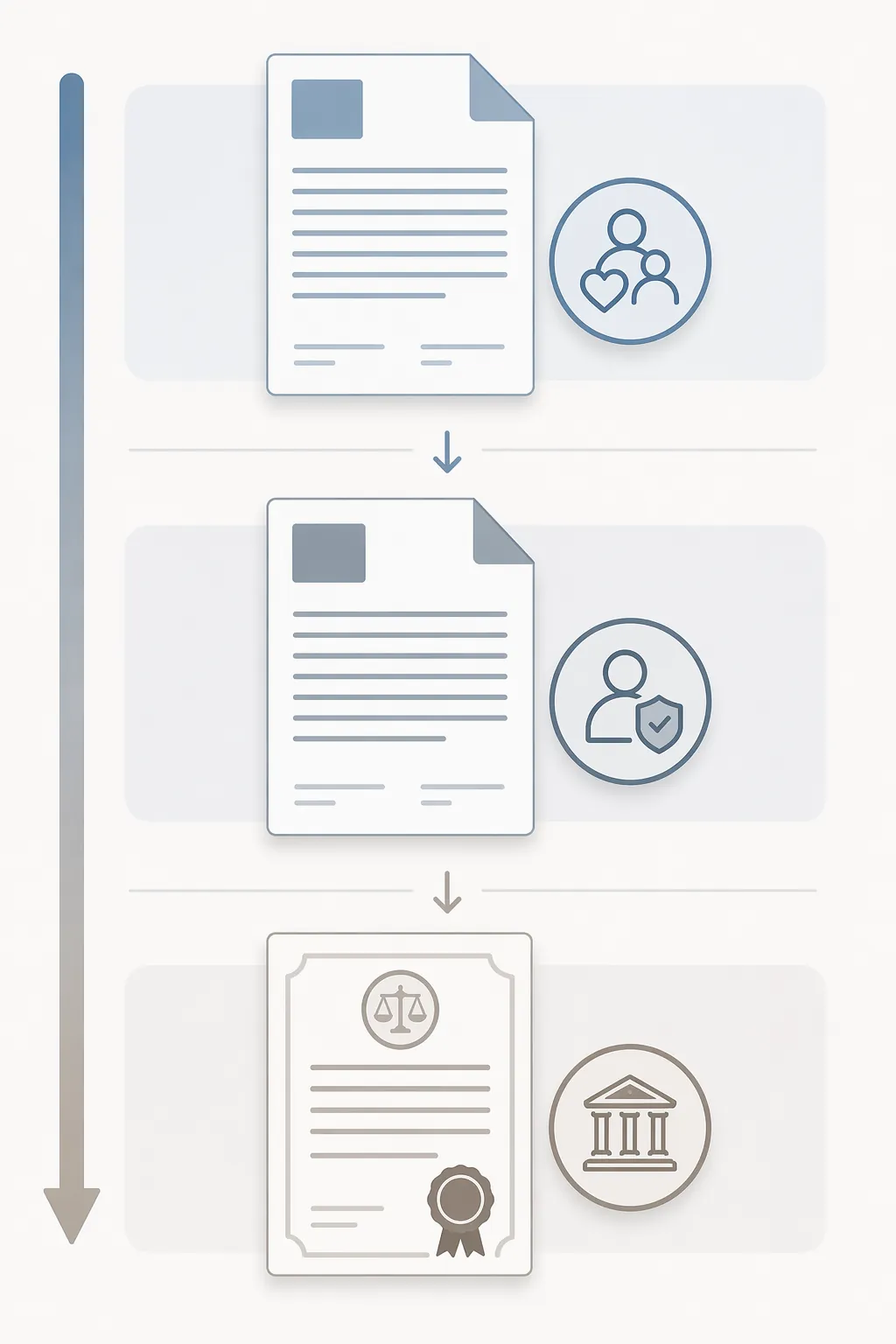
The most concrete published state-level model in the available research comes from Massachusetts. WBUR reported on Attorney General Andrea Campbell’s emergency-planning materials for Haitian TPS holders with American-born children, and the Massachusetts guide identifies three legal tools for parents with uncertain immigration status: caregiver authorization, temporary agent authorization, and full guardianship. [5][6]
| Massachusetts tool | What it is trying to solve | Boundary that still matters |
|---|---|---|
| Caregiver authorization | A parent identifies a caregiver who can step into specified child-care functions when the parent is unavailable. | It depends on institutions recognizing the document when the caregiver needs to act. |
| Temporary agent authorization | A parent designates another adult to act for the child on a temporary basis. | It is still a delegation from the parent, not a cure for the parent’s immigration status or removal risk. |
| Full guardianship | A court-recognized arrangement gives another adult broader legal authority over the child. | It is more formal and may be necessary in harder cases, but it does not answer whether the parent should take the child to Haiti or leave the child behind. |
The distinction among the three tools is important because not every family needs, wants, or can obtain the same level of legal authority. A caregiver authorization may be enough for a trusted relative to manage ordinary school and health-care friction in a short disruption. A temporary agent authorization may fit a parent who wants a clearer delegation while preserving the expectation that the parent remains the decision-maker. Full guardianship is a heavier step, usually more intrusive and more formal, and may be considered when the caregiver needs authority that a school, hospital, landlord, or benefits office will not accept from a lighter document.
That is useful work, not a complete answer. Guardianship and authorization documents do not stop an arrest, restore work authorization, reopen TPS, or create a lawful status for the parent. They also do not guarantee that siblings will stay together if different relatives are named, if one caregiver becomes unavailable, or if a child-welfare agency later questions the arrangement. The documents reduce the number of decisions that must be improvised after enforcement begins; they do not remove the underlying separation risk.
The Massachusetts example also exposes the national gap. In the available research, Massachusetts is the state with a detailed, public emergency-planning guide tied to this moment. WBUR described advocates using that guide to explain options to Haitian TPS parents, but the research does not identify equivalent statewide guides across most other states. [5] A parent in Massachusetts may at least be handed a menu. A parent in another state may be told to “name someone” without being told which document the school, clinic, or local court will actually recognize.
What the paperwork has to cover before detention
The emergency packet should be built around the person who will have to use it, not around the parent’s wish that enforcement will not happen. The named caregiver needs copies of the child’s birth certificate, school information, medical and insurance information, medication instructions, emergency contacts, and any state-specific authorization or guardianship document. If siblings are supposed to remain together, that should be written into the plan and discussed with the caregiver before a crisis.
The parent also needs to decide who will receive calls from detention, who can speak to immigration counsel, and who can retrieve documents from the home. Those are not elegant legal questions, but they are the questions that decide whether a child waits at school, whether a caregiver is turned away at a clinic, and whether an advocate has enough information to find the parent in custody.
- Confirm the current TPS implementation posture before advising on timing; same-day orders can change the risk window.
- Identify one primary caregiver and at least one backup who already knows the plan.
- Use the state-specific document that local schools, medical providers, and courts are most likely to recognize.
- Keep children’s identity, school, medical, and contact records in a place the caregiver can access.
- Do not describe guardianship paperwork as immigration relief; it is a child-care authority tool.
- Screen each parent for individualized immigration options with qualified counsel rather than relying on TPS-wide summaries.
Immigration options remain individualized and delayed
Family contingency planning should run alongside immigration screening, not replace it. Some Haitian TPS holders may have individual paths based on family petitions, asylum-related claims, prior entries, parole, employer sponsorship, or other facts. Others may have no viable near-term route. A TPS label alone does not answer the question.
Delay itself is now a risk factor. PBS News reported an immigration-court backlog of 3.2 million cases, a figure that helps explain why even people with claims or defenses may face months-to-years uncertainty. [7] For a parent with a child-safety plan, a delayed hearing is not simply a scheduling inconvenience; it is a prolonged period in which work authorization, housing, caregiving, and custody arrangements can unravel.
Adjustment of status also should not be oversold. A 2026 practitioner guide from Vega & Associates describes USCIS Policy Memo PM-602-0199 as adding discretionary denial authority for adjustment applications, which could complicate some I-485 strategies. [8] That memo should be verified against USCIS’s official policy source before it is treated as controlling guidance in a client advisory. The safer point for this risk record is narrower: possible green-card pathways require case-by-case screening, and none should be assumed to protect a child from immediate caregiving disruption unless counsel has confirmed both eligibility and timing.
The unresolved separation risk
The current safety net has two visible strands. The first is ICE’s reported assurance that parents will be asked whether children should go with them or remain with a designee. The second is state-law preparation, illustrated most clearly by the Massachusetts guide. Both are better than silence. Neither has been shown to function at the scale suggested by the 50,000-child estimate. [1][6]
The most responsible advice now is also the least satisfying: prepare documents, name caregivers, keep siblings and medical needs visible in the plan, verify state law, and seek individualized immigration counsel immediately. But neither an informal federal assurance nor a stack of state guardianship forms answers the central risk at scale: many Haitian TPS parents are being asked to choose between bringing U.S.-citizen children into danger and leaving those children in the United States without them.
References
- Families brace for separation as Haitians set to lose protected status next week, NPR, July 23, 2026.
- US: Haitians Set to Lose Protections, Risk Return to Violence, Human Rights Watch, July 2, 2026.
- Termination of the Designation of Haiti for Temporary Protected Status, Federal Register, November 28, 2025.
- Mullin v. Doe, Supreme Court of the United States, June 25, 2026.
- What Haitian TPS holders with American-born children can do to protect their kids, WBUR, July 14, 2026.
- Emergency Planning Guide for Parents with Uncertain Immigration Status, Massachusetts Office of the Attorney General.
- What's next for immigrants with TPS after Supreme Court ruling?, PBS News, 2026.
- Can TPS Holders Get a Green Card? Complete 2026 Guide, Vega & Associates.
Related records
Tool profile
Browse tool evaluations →Governing regulation
Browse the obligations tracker →Preventive workflow
Browse verification workflows →
Report a correction or tip
Spotted an outdated figure, a misstated fact, or a ruling this case record should reflect? Public comments are disabled for this content given the professional cost of a misreported case outcome, penalty amount, or rule text — use the structured correction channel instead.
Report a correction or tip for this record →