
How FBI Most Wanted Fraudster Status Escalates Criminal Exposure
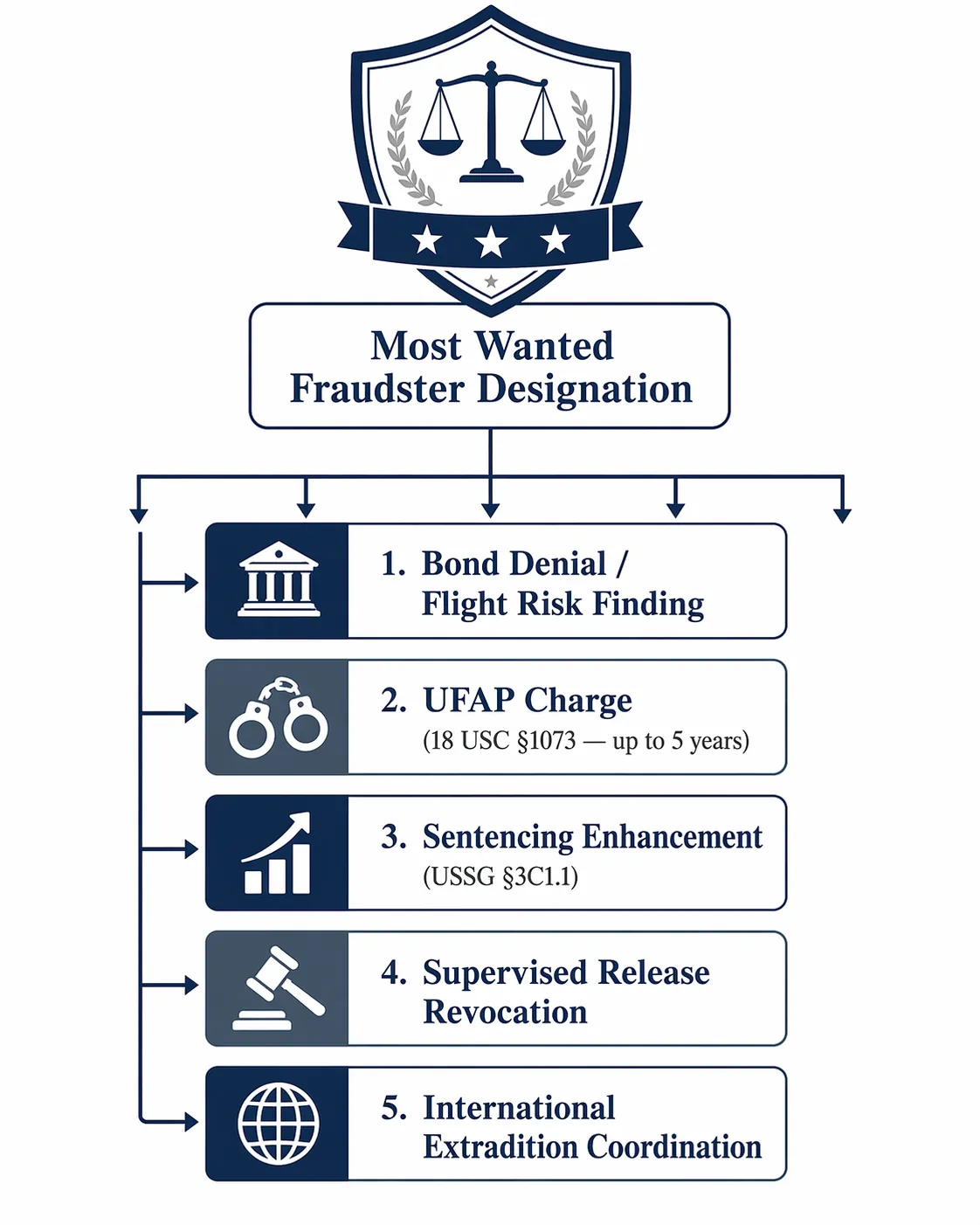
Placement on the FBI's Most Wanted Fraudsters list triggers automatic flight-risk findings, potential UFAP charges, sentencing enhancements, and coordinated international extradition—a cascade of consequences that the Elaine Escoe case illustrates for counsel assessing fraud enforcement exposure.
- Jurisdiction
- US Federal
- Court
- U.S. District Court
- AI tool named
- None
- Ruling date
- Jul 25, 2026
- Source document
- View primary court order ↗
- Last verified
- Jul 27, 2026
Lex Machina Review is an independent risk-tracking and reference resource. Nothing on this site is legal advice, and using it does not create an attorney-client relationship. Every record is reviewed against primary sources but may not reflect the most current status of a matter — always verify directly against the cited court order, rule text, or a licensed attorney before relying on it.
Companion explanation — secondary to the source document above
“Most Wanted Fraudster” is not a count in an indictment. It does not, by itself, add a statutory maximum or create a sentencing enhancement. But in the Elaine Escoe matter, the designation changed the way the existing facts could be packaged: missed appearance, fugitive status, international capture, alias use, and a prior supervision posture all became easier for the government to present as one continuous flight-risk record.
The FBI wanted page for Elaine Angene Escoe identifies the underlying federal charges as conspiracy to commit wire fraud, conspiracy to commit money laundering, wire fraud, concealment money laundering, and transactional money laundering, with a reward of up to $150,000 for information leading to her arrest and conviction.[1] The FBI’s Most Wanted Fraudsters list launched on June 4, 2026, and Escoe was reported as one of the initial eight designees placed on the new list.[2] She was later captured in Jamaica on July 25, 2026, reportedly under the alias “Harley Newman.”[3]
For the full factual record on the alleged COVID-relief fraud scheme, see the Risk Digest case record. This analysis is narrower: what the Most Wanted Fraudster designation does to the defense problem once a fraud defendant is already charged, already missing, or already exposed on supervision. The available public record here relies on the FBI wanted page and local reporting for some return-and-capture details; the DOJ return announcement itself was not available as readable primary text for this piece.
The Escoe timeline is the legal signal
The designation matters because of the sequence around it. In a clean docket, prosecutors argue the charged fraud conduct. After a missed appearance and an international capture, they argue the charged conduct plus the defendant’s conduct after the court already had authority over her.
| Event | Why it matters legally |
|---|---|
| 2024 wire-fraud conviction reported in a separate falsified-bank-statements matter[4] | Creates a supervision backdrop if the defendant was still serving a federal term of supervised release when later conduct occurred. |
| Last reportedly seen in Palm Beach County on June 3, 2025[2] | Helps establish the factual lead-in to flight, but does not by itself prove a separate federal offense. |
| Missed court date on June 5, 2025[2] | Turns absence into a courtroom fact prosecutors can use in bond, warrant, and obstruction arguments. |
| Fugitive designation on July 9, 2025[2] | Places the defense in a warrant-and-return posture before any Most Wanted Fraudster publicity is added. |
| FBI Most Wanted Fraudsters list launched June 4, 2026, with Escoe among the initial eight[2] | Packages the fugitive facts for national enforcement coordination and public reward mechanisms. |
| Captured in Jamaica on July 25, 2026, reportedly using the alias “Harley Newman”[3] | Adds facts relevant to identity, return logistics, obstruction analysis, and future bond arguments. |
The alleged fraud scheme itself is not small. Public reporting describes more than 90 fraudulent PPP, EIDL, RRF, and SVOG applications totaling more than $32 million, with reported disbursements including $29.1 million in PPP funds, $1.2 million in RRF funds, and $3.8 million in SVOG funds.[2] That scale already gives prosecutors a serious fraud case. The fugitive sequence gives them a second presentation: this defendant, facing that case, did not appear.
Bond is where the designation shows up first
The most immediate consequence is detention risk. Not because the FBI list has independent bond provisions, and not because a wanted poster is evidence of guilt on the fraud counts. The problem is simpler: a defendant who missed court, remained a fugitive, appeared on a national wanted list, and was then found outside the United States gives the government a compact flight-risk record.
For defense counsel, that changes the first hearing after return. Arguments that might have worked before flight—family ties, local residence, surrender conditions, third-party custodians, electronic monitoring, passport surrender—now carry less weight unless counsel can explain why those controls would work after they did not prevent the fugitive episode. If the record includes alias use abroad, the government can argue that ordinary identity and travel restrictions are inadequate because the defendant has already shown a willingness to operate outside the court’s supervision.
The list designation assists that argument by simplifying the story. It lets the government say, in practical terms, that federal law enforcement treated the defendant as a priority fugitive and that international coordination was required to return her. That is not a new legal element. It is a stronger detention narrative built from post-indictment conduct.
Counsel assessing a similarly situated client should assume that the bond fight has moved from “Can conditions reasonably assure appearance?” to “What condition could possibly overcome an actual failure to appear followed by international recovery?” That is a harder record to litigate, even before the court reaches the merits of the fraud allegations.
UFAP is possible, not automatic
The Unlawful Flight to Avoid Prosecution statute, 18 U.S.C. § 1073, is the obvious statute to check once a charged defendant is found outside the jurisdiction. It reaches interstate or foreign travel with intent to avoid prosecution, custody, or confinement after conviction for covered offenses, or to avoid giving testimony in criminal proceedings. The statute carries up to five years’ imprisonment and fines.[5]
That does not mean UFAP has been charged against Escoe. The public record supplied for this analysis supports treating UFAP as a potential additional exposure, not as a confirmed count. Section 1073 also contains a built-in brake: prosecution requires formal written approval by the Attorney General, Deputy Attorney General, Associate Attorney General, or an Assistant Attorney General, and that approval function may not be delegated.[5]
That approval requirement matters. It keeps the analysis from collapsing into “fugitive equals UFAP count.” A prosecutor may have the factual predicate to seek review; the Department still has to decide whether the additional charge is worth bringing. Counsel should therefore separate three questions that often get blurred after a high-profile capture:
- Is there a factual basis to argue flight to avoid prosecution?
- Has DOJ obtained the nondelegable approval required by § 1073?
- Would an added UFAP count materially change plea leverage, sentencing exposure, or trial posture?
In Escoe’s case, the missed court date, fugitive designation, foreign capture, and reported alias use are facts prosecutors can cite in a UFAP review request. They are not, standing alone in public reporting, proof that the Department has made that charging decision.
The sentencing problem is not the list; it is the conduct behind the list
A Most Wanted Fraudster designation does not add prison time the way a statutory enhancement might. The sentencing concern is that the same facts supporting the designation may support an obstruction theory under USSG §3C1.1. Flight, use of an alias, concealment activity, and attempts to frustrate proceedings can matter independently of the FBI’s administrative label.
That distinction is important for both sides. A prosecutor should not ask for punishment because the defendant appeared on a list. A defense lawyer should not assume the list is harmless because it is administrative. The relevant question is whether the underlying behavior—failure to appear, remaining unavailable, using another identity, or complicating return—constitutes willful obstruction of the investigation, prosecution, or sentencing of the offense.
The co-defendant sentencing record gives that analysis a practical anchor, without turning it into a prediction. Public reporting identifies five finalized co-defendant sentences: Alfred Davis at 235 months, Cher Davis at 87 months, Latoya Clark at 70 months, Gino Jourdan at 46 months, and James McGhow at 42 months.[2] Those sentences show that the underlying COVID-relief fraud case already carries serious punishment risk. If obstruction is added to the sentencing conversation, it is added on top of an already heavy fraud-and-money-laundering framework.
Counsel should resist using the co-defendant range as a mechanical forecast for Escoe. Individual loss attribution, role evidence, plea posture, criminal history, acceptance of responsibility, obstruction findings, and supervision issues can all change the calculation. The useful point is narrower: the government does not need the Most Wanted Fraudster label to make the case serious, but the fugitive facts can make resolution more expensive.
Supervised release turns new conduct into a second proceeding
Escoe also had a separate 2024 wire-fraud conviction arising from falsified bank statements, according to local reporting on the earlier DOJ case.[4] The supplied record indicates she was still under supervision when the later fugitive issues arose. That matters because a defendant on supervised release does not face only the new indictment. She can also face revocation exposure in the old case.
A supervised-release revocation proceeding is not the same as a trial on the new fraud charges. The court is concerned with whether release conditions were violated. New criminal conduct, failure to report, failure to appear, leaving the district without permission, or using false identifying information can all create separate supervision problems depending on the actual conditions imposed in the prior case.
That gives prosecutors and probation a second track. Even if charging decisions shift in the new case, the supervision court may still have to address whether the defendant violated the terms of release. For defense counsel, that means triage cannot focus only on the headline indictment. The older judgment, the release conditions, the violation report, and the judge assigned to the supervision matter may become just as important as the new wanted-list publicity.
International capture adds logistics and leverage
The Jamaica capture is not legally interesting because it is dramatic. It is interesting because foreign recovery changes the operational posture of the case. Law enforcement has to identify the defendant, coordinate with foreign authorities, manage return logistics, and preserve enough documentation to support later detention, identity, and obstruction arguments.
NBC 6 reported that, since the June 4 launch of the Most Wanted Fraudsters list, the FBI had returned more than 30 high-value targets to the United States and captured four of the initial eight Most Wanted Fraudsters in five weeks across three continents.[3] Those are enforcement-capacity facts, not proof that every listed defendant will face new charges. They show why the designation is operationally different from ordinary publicity.
The reported alias “Harley Newman” should be treated the same way. It is not a morality detail. It may matter if the government argues concealment, intentional avoidance, identity deception, or obstruction. It may also matter to the mechanics of return if foreign authorities relied on records or identification materials tied to another name. Counsel should ask for the documents, not just react to the headline.
The FBI reward mechanism adds another form of leverage. A reward of up to $150,000 for information leading to arrest and conviction invites tips, expands reputational damage, and may create witness or informant issues that counsel will need to test through discovery.[1] Again, the reward does not prove the fraud case. It can still affect how quickly the government locates evidence, identifies associates, and pressures unresolved defendants.
The broader fraud-enforcement context is real, but it should not be overstated
The Most Wanted Fraudsters list belongs to a broader 2026 anti-fraud posture, including DOJ’s creation of a National Fraud Enforcement Division and related federal initiatives aimed at large-scale fraud enforcement.[6] That context explains why a pandemic-relief defendant might become a national enforcement priority. It does not change the elements of wire fraud, money laundering, failure to appear, UFAP, obstruction, or supervised-release revocation.
This is the point that often gets lost in public descriptions of the list. A designation can be administratively powerful without being legally self-executing. It gives prosecutors a clearer detention story, gives agents a coordination mechanism, gives the public a reward-backed reporting channel, and gives the court a more developed flight record. It does not substitute for charging, proof, or guideline findings.
What counsel should treat as live after list placement
For a fraud defendant who has become a fugitive and then appears on the Most Wanted Fraudsters list, the legal work should start with the return posture, not the publicity. The defense needs the warrant history, failure-to-appear record, communications with pretrial services or probation, travel records, identity documents, foreign arrest materials, and any statements made during recovery.
- Bond: assume the government will frame the entire sequence as demonstrated flight risk and prepare concrete, verifiable conditions rather than generic assurances.
- Charging: check whether prosecutors are merely describing fugitive conduct or actually seeking a UFAP count under § 1073 with the required high-level written approval.
- Guidelines: evaluate obstruction exposure from conduct, especially alias use and failure to appear, without conceding that the FBI label itself has sentencing force.
- Supervision: obtain the prior judgment and release conditions if the defendant was serving supervised release when the new conduct occurred.
- Extradition or return: preserve the foreign-arrest record, identity materials, and communications between agencies because those facts may reappear in detention and sentencing.
- Negotiation: account for reputational leverage created by nationwide listing and reward publicity, especially if co-defendants have already been sentenced.
Elaine Escoe’s case illustrates the distinction cleanly. The Most Wanted Fraudster designation does not create a new offense by itself. It packages facts that can harden detention arguments, support additional charging review, increase guideline exposure, activate international coordination, complicate supervised-release posture, and make negotiated resolution harder.
References
- FBI Most Wanted Fraudsters page for Elaine Angene Escoe — FBI
- Palm Beach County woman placed on new FBI Most Wanted Fraudster list in COVID funds case — Sun Sentinel
- Miami woman charged in $32M COVID relief fraud scheme captured in Jamaica — NBC 6 South Florida
- Delray Beach woman convicted of wire fraud for falsified bank statements scam — CBS12 — May 28, 2024
- 18 U.S. Code § 1073 - Flight to avoid prosecution or giving testimony — Legal Information Institute, Cornell Law School
- DOJ Creates National Fraud Enforcement Division: What — Mintz — April 9, 2026
Related records
Tool profile
Browse tool evaluations →Governing regulation
Browse the obligations tracker →Preventive workflow
Browse verification workflows →
Report a correction or tip
Spotted an outdated figure, a misstated fact, or a ruling this case record should reflect? Public comments are disabled for this content given the professional cost of a misreported case outcome, penalty amount, or rule text — use the structured correction channel instead.
Report a correction or tip for this record →