
How to Claim Amazon Prime Settlement Refund & Why It Matters
Learn how to claim your Amazon Prime settlement refund and why the FTC's $2.5B enforcement action under ROSCA and the FTC Act sets a new compliance baseline for subscription businesses after the Click-to-Cancel rule was vacated.
- Jurisdiction
- US Federal
- Court
- Federal Trade Commission
- AI tool named
- None
- Ruling date
- Sep 1, 2025
- Source document
- View primary court order ↗
- Last verified
- Jul 26, 2026
Lex Machina Review is an independent risk-tracking and reference resource. Nothing on this site is legal advice, and using it does not create an attorney-client relationship. Every record is reviewed against primary sources but may not reflect the most current status of a matter — always verify directly against the cited court order, rule text, or a licensed attorney before relying on it.
Companion explanation — secondary to the source document above
If you are trying to claim an Amazon Prime settlement refund in 2026, the practical point comes first: the reported claim deadline is July 27, 2026, and July 2026 coverage has put the maximum payout at $51. The FTC’s consumer guidance describes a two-stage refund process, with some eligible consumers receiving automatic payments and others needing to file a claim, and it gives the simplest scam warning attached to the whole matter: the FTC says it “will never contact you about this refund.” [1]
That is the part most consumers need to act on. If money is available to you only through a claim form, the deadline matters more than the legal architecture behind it. But the refund is not just a customer-service correction. It sits on top of a $2.5 billion FTC settlement with Amazon over Prime enrollment and cancellation practices, and the machinery behind that settlement is the reason subscription companies should be reading past the payout headline. [2]
The Refund Is the Visible Part of a Larger Order
The FTC announced the Amazon Prime settlement in September 2025 as a $2.5 billion resolution: a $1 billion civil penalty and $1.5 billion in consumer redress. The agency described the penalty as the largest ever for an FTC rule violation and the redress as the second-highest restitution recovery obtained by FTC action. [2]
The challenged conduct was not framed as one bad button or one confusing page. The FTC identified four Prime enrollment flows: the Universal Prime Decision Page, the shipping selection page, single-page checkout, and the Prime Video enrollment flow. It also named two Amazon executives, Neil Lindsay and Jamil Ghani, as defendants. [2]
Those details matter because they show how the agency saw the case. The complaint was not merely that some consumers changed their minds after joining Prime. The theory was that Amazon’s enrollment and cancellation paths made consent easier to give than to withdraw, while using interface choices that the FTC treated as dark patterns. For consumers, that design meant time, confusion, and unwanted charges. For businesses, it means the compliance question is no longer limited to whether the price was disclosed somewhere on the screen.
The settlement’s structure reflects that view. Redress addresses consumers who were allegedly harmed. The civil penalty punishes the rule violation. The injunctive terms change what Amazon must do going forward. That third piece is the one most likely to outlast the refund cycle, because it turns allegations about interface friction into concrete operating obligations.
What Consumers Should Know Before the Deadline
The FTC’s January 2026 consumer advice separates the refund process into two groups. Some eligible consumers are slated for automatic payments. Others must file a claim. That distinction is easy to lose in “claim your refund” headlines, but it is important: if you are in the automatic-payment group, the main risk is falling for impostors; if you are in the claim-required group, the main risk is missing the filing window. [1]
- Check whether you are in the automatic-payment group or the claim-required group under the FTC’s refund guidance. [1]
- Treat the reported July 27, 2026 deadline as the date that matters if you must submit a claim.
- Do not pay anyone to obtain the refund; the FTC’s consumer advice warns that the agency will never contact consumers about this refund. [1]
- Do not assume the maximum reported payout is guaranteed; refund amounts depend on eligibility and the settlement process. [1]
That is about as far as the consumer-help version should go. The legal significance is not that a Prime user may receive up to a reported $51. It is that the FTC used a refund process, a civil penalty, and a set of behavioral requirements to attack the same subscription design problem from several directions at once.
The Statutes Did the Work the Vacated Rule Could Not
The settlement arrived after the Eighth Circuit vacated the FTC’s Click-to-Cancel rule in July 2025, a timing point that has made the Amazon order much more than a one-company resolution for subscription lawyers. The National Law Review’s Proskauer analysis reads the settlement as evidence that the FTC can still pursue many click-to-cancel policy goals through case-by-case enforcement under ROSCA and Section 5 of the FTC Act. [3]
That distinction needs to be kept clean. The Amazon consent order does not legally revive the vacated Click-to-Cancel rule. It is not an appellate decision, and it does not bind every subscription business as if it were a surviving regulation. A consent decree is a negotiated order entered in a specific case, not a general rule of law produced after litigation through judgment and appeal.
Still, practical standards are often built this way. A regulator brings a major case, obtains terms a court is willing to enter, and then points to those terms the next time another company argues that its own cancellation flow is good enough. The company on the receiving end may have legal arguments, but it also has a board, a risk committee, a product team, and a record of what the FTC just demanded from Amazon.
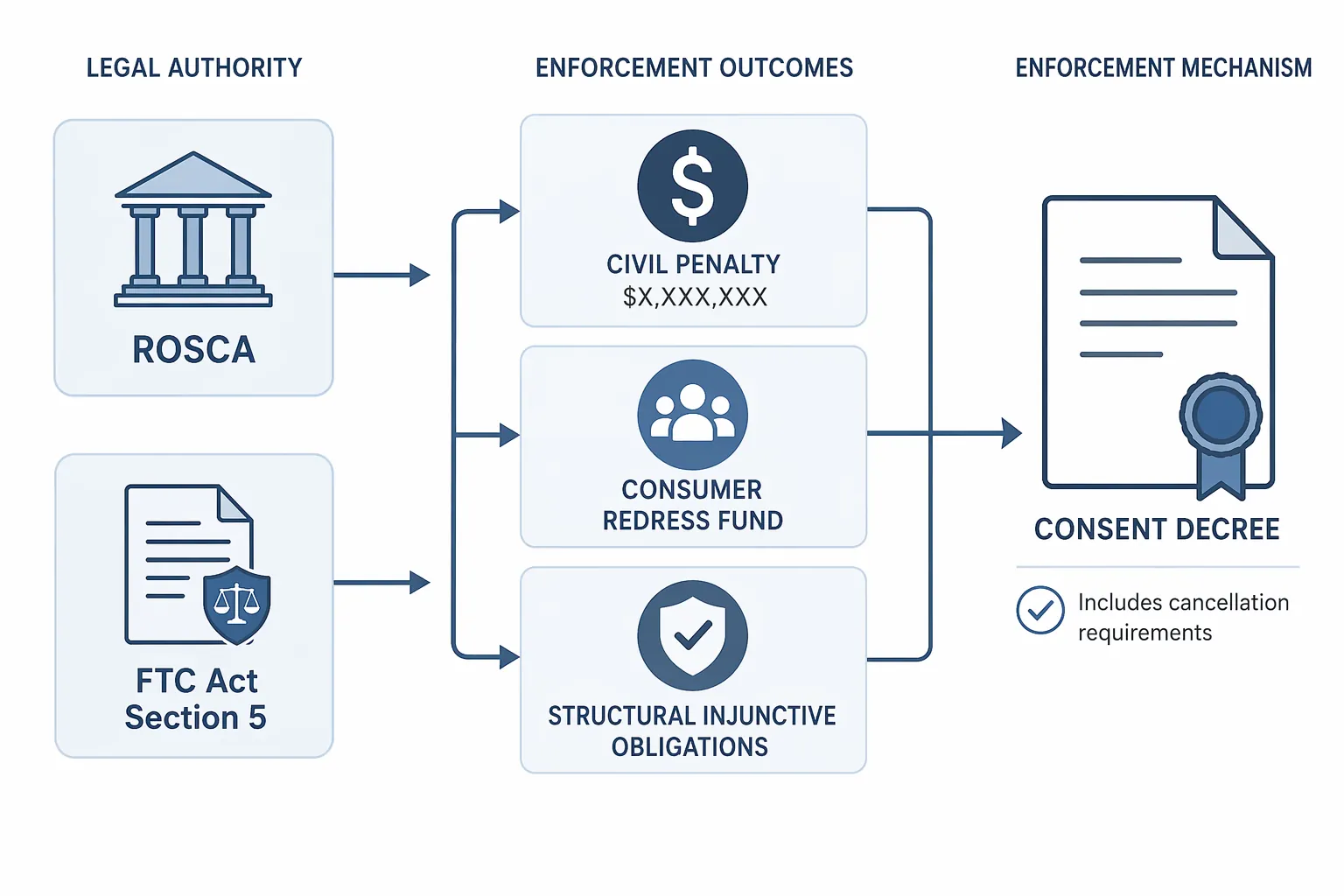
ROSCA and Section 5 gave the FTC enough statutory ground to pursue this result without a surviving click-to-cancel rule. ROSCA addresses negative-option features and online recurring charges; Section 5 addresses unfair or deceptive acts or practices. The Amazon settlement shows how those existing tools can be used to reach enrollment ambiguity, cancellation friction, and interface design choices that allegedly interfere with informed consumer consent. [2][3]
Same-Medium Cancellation Is the Term to Audit First
Among the order’s operational terms, one phrase deserves more attention than the dollar amount: cancellation must be available “through the same medium the consumer used to consent.” The National Law Review analysis treats that requirement as the settlement’s functional click-to-cancel provision, achieved through enforcement rather than rulemaking. [3]
For a subscription business, that is not an abstract consumer-protection ideal. It asks a product team to compare the path into the subscription with the path out of it. If a consumer can enroll online, cancellation cannot be pushed into a phone queue as the only meaningful route. If consent is captured in a mobile flow, the cancellation path needs to be available through that same medium. The order’s logic is not satisfied by saying cancellation technically exists somewhere.
| Design Question | Why It Matters Under the Amazon Order |
|---|---|
| Can a consumer cancel through the same medium used to enroll? | The order requires cancellation to be available through the same medium as consent. [3] |
| Are enrollment screens preserved across versions? | The order requires records of enrollment and cancellation screen iterations. [3] |
| Are hidden links and hover-over text captured? | The recordkeeping obligation reaches details including hidden links and hover-over text. [3] |
| Can compliance reconstruct what a consumer actually saw? | Without screen-version records, a company may struggle to prove what disclosures or choices were presented. |
The recordkeeping terms are just as important as the cancellation path. The stipulated order details described in the FTC materials and legal analysis require Amazon to preserve every iteration of enrollment and cancellation screens, down to hidden links and hover-over text, with oversight from an independent third-party compliance monitor for 10 years. [2][3]
That kind of record retention changes the compliance burden. A company cannot simply tell enforcement staff that the current page is compliant if the alleged injury came from an earlier version. It needs version history, decision logs, tests, screen captures, and enough metadata to show what consumers encountered at the time. For many subscription businesses, the weak spot will not be the legal memo. It will be the inability to reconstruct the product experience after years of A/B testing, localization, growth experiments, and checkout redesigns.
The Executive Terms Are Real, but Narrower Than the Corporate Order
The FTC’s decision to name Neil Lindsay and Jamil Ghani gives the case another layer of deterrence. The agency did not treat the challenged practices as faceless product drift. It put individual executives into the settlement structure, which is a signal that subscription design can become a personal-risk issue when senior leaders are tied to the conduct. [2]
But that point should not be overstated. The individual injunctive obligations last three years, while Amazon’s corporate obligations run for 10 years. [3] That difference matters for counsel advising executives, because the case supports a warning about individual exposure without supporting the broader claim that every senior subscription executive now faces decade-long personal obligations whenever the FTC challenges a cancellation flow.
Pattern Evidence, Not a New Code
The Amazon order is not standing alone. The National Law Review analysis points to similar FTC action against LA Fitness and Match.com, using the same broader concern with negative-option programs, cancellation friction, and subscription consent. [3] Those matters are useful as pattern evidence, not as interchangeable case studies. Each turns on its own facts, its own business model, and its own procedural posture.
That is why the right lesson is neither panic nor complacency. It is not accurate to tell businesses that the Amazon settlement is “the new law” in the way a valid FTC rule or appellate holding would be. It is also not safe to dismiss it as a one-off refund event tied to an unusually large platform. The FTC extracted detailed design, cancellation, recordkeeping, monitoring, penalty, and redress terms using statutes that remain available.
The commission politics around the settlement also deserve a limited reading. The National Law Review analysis notes a 2-1 vote and a Democratic commissioner’s dissent, and the broader 2026 administrative-law environment includes the Slaughter ruling concerning FTC commissioner removal protections. [3] Those facts may shape enforcement weather, but they do not eliminate the concrete settlement terms already entered or the agency’s demonstrated willingness to use ROSCA and Section 5 in this space.
What Subscription Businesses Should Infer
A subscription audit after the Amazon settlement should start with the consumer journey, not the refund amount. Counsel should ask product and growth teams to map where the consumer is asked to enroll, what is disclosed at each decision point, how the consumer cancels, and whether the company can preserve and retrieve the relevant screen versions later. The order’s most durable influence is likely to be in those operating routines.
- Compare enrollment and cancellation by medium: web, app, phone, in-store, or other channel.
- Identify every page, modal, checkout step, upsell, and retention screen involved in subscription consent.
- Preserve screen iterations, including links, hover-over text, and conditional disclosures.
- Separate legal approval of a flow from proof that the approved version actually reached consumers.
- Treat cancellation friction as a regulatory risk, not merely a retention metric.
The most exposed companies are not necessarily the ones with the most aggressive subscription products. They are the ones that cannot answer ordinary questions with evidence: what did the consumer see, where was the recurring charge disclosed, how many steps did cancellation require, what alternatives were presented, and which version of the experience was live during the relevant period?
That is the practical baseline created by the Amazon settlement. It does not make Click-to-Cancel binding again. It does show that the FTC can use ROSCA and Section 5 to seek much of the same practical outcome through enforcement: easy cancellation through the same medium as consent, cleaner enrollment practices, preserved interface records, outside monitoring, civil penalties, and consumer redress.
For consumers, the claim process is the immediate task. For subscription businesses, it is the visible surface of a larger enforcement architecture built to make cancellation friction, enrollment ambiguity, and recordkeeping gaps expensive.
References
- Questions about your Amazon Prime settlement refund? Read on, FTC Consumer Advice, January 2026.
- FTC Secures Historic $2.5 Billion Settlement Against Amazon, Federal Trade Commission, September 2025.
- Beyond the Click-to-Cancel Rule: the FTC Finds its Power in the Amazon Settlement, National Law Review.
Related records
Tool profile
Browse tool evaluations →Governing regulation
Browse the obligations tracker →Preventive workflow
Browse verification workflows →
Report a correction or tip
Spotted an outdated figure, a misstated fact, or a ruling this case record should reflect? Public comments are disabled for this content given the professional cost of a misreported case outcome, penalty amount, or rule text — use the structured correction channel instead.
Report a correction or tip for this record →