
Howard Stern NDA Lawsuit Highlights Signature Risk
The Howard Stern former assistant's NDA lawsuit introduces a novel defense that a typewritten-only signature renders the agreement void ab initio. This article examines the risk signal for employers who rely on informal signature practices and the implications for AI-assisted contract execution.
- Jurisdiction
- New York (US state)
- Court
- New York State Supreme Court, New York County
- AI tool named
- None
- Ruling date
- Jul 27, 2026
- Source document
- View primary court order ↗
- Last verified
- Jul 29, 2026
Lex Machina Review is an independent risk-tracking and reference resource. Nothing on this site is legal advice, and using it does not create an attorney-client relationship. Every record is reviewed against primary sources but may not reflect the most current status of a matter — always verify directly against the cited court order, rule text, or a licensed attorney before relying on it.
Companion explanation — secondary to the source document above
The useful signal in the Howard Stern former assistant NDA lawsuit is not that a famous defendant is in an employment dispute. It is that a confidentiality agreement can become expensive to defend years later because the execution record is thin. Current as Q3 2026, the enforceability issue in Stern v. Kuhn remains an allegation-stage risk item: reported pleadings and attorney correspondence are available, but there has been no judicial ruling on whether the September 2022 confidentiality agreement is enforceable or whether sanctions are warranted.
The load-bearing allegation is simple. In a second amended complaint reportedly filed July 27, 2026 under NYSCEF Index No. 652040/2026, former assistant Elisa Kuhn alleged that the September 2022 Confidentiality Agreement bore only a “typewritten name in the same font,” not a wet signature, and she attacked the NDA as “void ab initio.” Page Six reported the allegation after reviewing the complaint and quoted excerpts from a July 24, 2026 email by Stern’s counsel addressing the new pleading theory.[1]
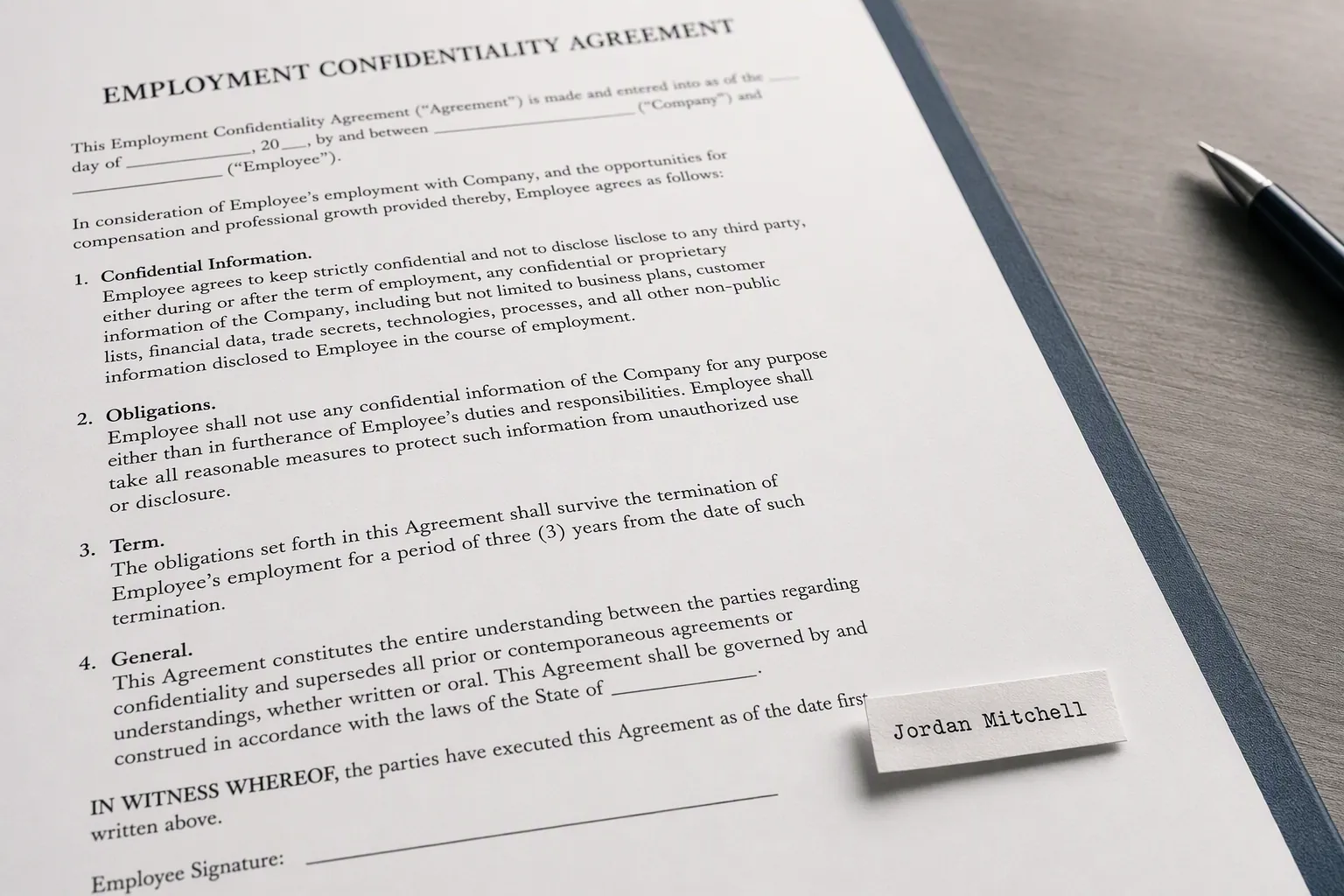
That is the kind of defect that looks clerical until someone has to enforce the document. A typed name may be perfectly ordinary in a well-designed electronic-signature system. A typed name floating at the end of a file, with no reliable proof of who adopted it, when, through what authentication step, and under whose authority, is a different evidentiary object. The Stern pleading matters because it frames that gap as a formation problem, not merely as a public-policy objection to a confidentiality clause.
The signature attack is not the usual NDA enforceability fight
Most recent employment-NDA analysis starts with statutory limits: whether a clause suppresses sexual-harassment allegations, whether it appears in a settlement, whether required carveouts are missing, or whether a release runs afoul of state policy. Those questions still matter, but they do not answer Kuhn’s reported theory.
A formation challenge asks an earlier question: was there ever a valid agreement by this person at all? If the signature was forged, unauthorized, or never adopted by the employee, the employer has a proof problem before it reaches the scope of the confidentiality obligation. The clause might be beautifully drafted and still be useless if the execution record cannot connect the document to the alleged signer.
New York law gives that argument a doctrinal hook. New York authorities have treated forged or unauthorized signatures as rendering an instrument void ab initio, and commentary discussing Knight v. New York & Presbyt. Hosp., Ticor Title Guar. Co. v. E.F.D. Capital, and related cases has also flagged a Third Department debate over whether the void-ab-initio forgery doctrine is limited to deeds or applies more broadly.[2] That uncertainty is not a footnote for litigators. It is the reason a signature-integrity dispute can survive as a serious procedural fight even before anyone knows whether the Stern NDA will be enforced.
| Challenge | What it attacks | Why it does not displace the signature issue |
|---|---|---|
| Speak Out Act | Pre-dispute NDAs and non-disparagement clauses covering sexual-assault or sexual-harassment claims; enacted in December 2022.[3] | Kuhn’s reported hostile-work-environment claim does not explicitly allege sexual harassment, so this statutory route may not do the work the signature theory does.[1] |
| New York GOL § 5-336 | Confidentiality provisions in settlements of discrimination, harassment, and retaliation claims; originally enacted in 2018 and amended in 2023.[4] | The reported September 2022 Confidentiality Agreement is being challenged as an agreement allegedly not validly signed, not simply as an impermissible settlement confidentiality term. |
| Fabricated or unauthorized signature theory | Contract formation itself: whether the named employee ever validly executed the NDA. | If successful, the issue is not whether a particular NDA clause is too broad. The position is that the agreement was void from the start. |
That distinction changes the litigation file an employer needs to defend. A statutory NDA challenge sends counsel to the wording of the provision, the category of claim, and the timing of the agreement. A signature challenge sends counsel to the intake workflow: the email transmitting the NDA, the signing platform metadata, the IP log if there is one, the witness or countersignature record, the employee acknowledgment, and any contemporaneous messages showing adoption of the signature.
A typewritten name is not the same thing as an execution record
The uncomfortable part of Kuhn’s reported allegation is that it does not require exotic facts to be disruptive. Plenty of private-client offices, household employers, small businesses, and fast-moving HR teams have documents that end with a typed name and little else. Sometimes that typed name is the employee’s deliberate electronic signature. Sometimes it is a staff member’s formatting shortcut. Sometimes nobody can reconstruct the process.
Those situations should not be treated as equivalent. The risk is not “typed names never work.” The risk is that a typed name without authentication leaves the enforcing party to prove adoption after the relationship has deteriorated and memories have become litigation positions. Once the former employee says the signature was fabricated or unauthorized, the employer’s cleanest answer is not outrage. It is a chain of custody.
- Who sent the NDA and from what account.
- How the signer’s identity was verified before execution.
- Whether the typed name was adopted through an e-signature platform, a typed-signature consent clause, or a separate written acknowledgment.
- Whether the final PDF preserves audit history rather than only the flattened signature page.
- Who had authority to prepare, revise, transmit, and store the executed version.
The Stern materials do not establish that the NDA was fabricated. They establish that fabrication has been pleaded as a route around enforcement. That is enough to matter operationally, because the employer who cannot produce a credible execution record is forced to litigate over the existence of the contract instead of moving directly to the alleged breach or the statutory enforceability questions.
The expense is also asymmetric. The person trying to enforce the NDA must reconstruct the file. The former employee can often put the issue in play with a denial, an allegation about the appearance of the signature, and the absence of ordinary verification features. Whether that ultimately wins is a legal and factual question. Whether it adds cost is less mysterious.
AI-assisted NDA workflows can reproduce the same weakness faster
The AI implication is not that any court in Stern v. Kuhn has condemned automated contract tools. No court has ruled on Kuhn’s theory. The implication is narrower and more practical: AI-assisted document assembly can make it easier to produce polished agreements that look complete while omitting the boring evidence of execution.
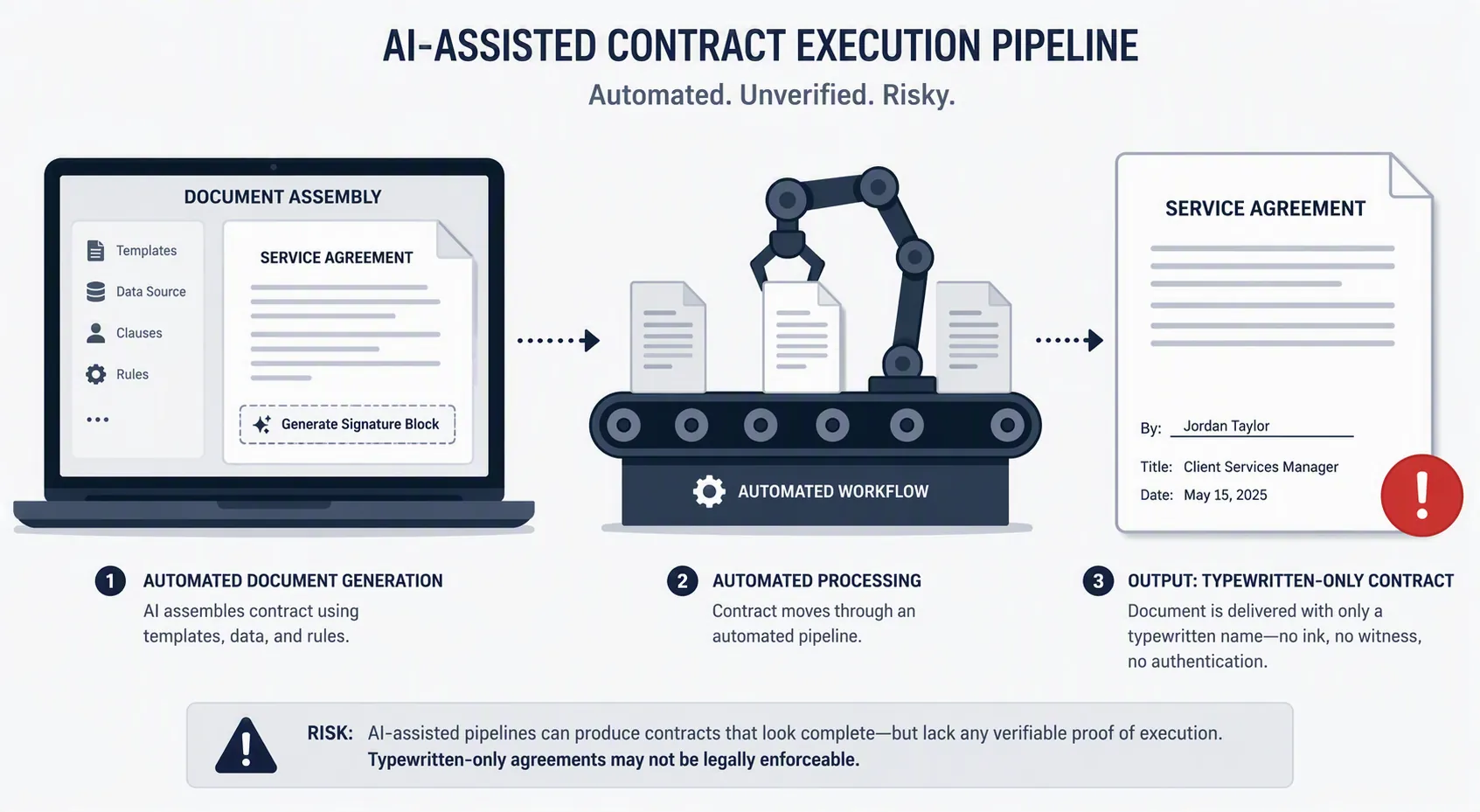
A typical automated NDA pipeline may collect a worker’s name, role, start date, and confidentiality template selection, then generate a signature block at the end of the document. That is document assembly, not execution. If the next step merely saves or emails a PDF with the name already typed in, the system has created the very ambiguity that Kuhn’s reported theory exploits.
The safer design separates drafting from signing. An AI or automated workflow can prepare the document, but adoption of the signature should occur through a controlled step that records identity, intent, time, and final document version. If the workflow uses a typed-name signature, the agreement should say that the signer intends the typed name to operate as an electronic signature, and the system should keep evidence that the signer—not an assistant, manager, or automated tool—performed the act.
This is especially important in private-client and domestic-staff settings, where informality is often mistaken for efficiency. A family office or household manager may ask counsel for a quick NDA, populate the employee’s name, and circulate a finished document through ordinary email. Years later, the file may contain no platform audit trail, no signed acknowledgment, no witness, and no proof that the employee ever returned the document. The absence of bad faith does not cure the absence of proof.
Execution language should match the actual workflow
Some templates make the problem worse by using execution language that does not match the signing process. A document that recites “IN WITNESS WHEREOF” and appears to contemplate handwritten signatures may be routed through a casual typed-name process with no witness at all. Another template may include an electronic-signature clause but be used outside any authenticated e-signature system. Those mismatches give a challenger unnecessary texture.
- If wet signatures are required, preserve the signed original or a reliable scan and document who collected it.
- If electronic signatures are allowed, say so expressly and retain the audit certificate or equivalent metadata.
- If a typed name is accepted, include language that the signer adopts the typed name as a signature and pair it with a verifiable acceptance step.
- If an assistant or automated system prepares the signature block, make clear that preparation is not execution.
The point is not to burden every NDA with ceremonial excess. It is to prevent the enforcement file from depending on a visual assumption: the name appears at the end, therefore the person signed. That assumption may be enough for routine administration. It is a poor litigation record.
The sanctions email creates a separate positioning problem
The sanctions issue deserves attention, but not because it has already produced a sanctions ruling. It has not. Page Six reported that Stern’s counsel, Goldsmith, sent a July 24, 2026 email threatening monetary sanctions over what he described as “frivolous” and “vexatious” new allegations, after having already unconditionally waived all NDA enforcement rights.[1]
That sequencing is awkward for defense counsel. Waiving enforcement may be a rational way to remove an NDA issue from the case, reduce distraction, or avoid giving the plaintiff a platform to litigate confidentiality. But once enforcement has been waived, a threat of monetary sanctions over the newly pleaded signature theory can be characterized by the other side as pressure over an issue the defendant says no longer matters. That does not make the sanctions threat improper. It does make the litigation posture easier to attack.
For risk managers, the lesson is procedural rather than dramatic. Before threatening sanctions over a fabricated-signature allegation, counsel should be able to articulate the enforcement status of the NDA, the factual basis showing the signature was authorized, and why the challenged allegation is frivolous rather than merely disputed. A court may ultimately reject Kuhn’s theory. But until that happens, treating the allegation as obviously sanctionable can create another record for the other side to quote.
What should change before there is a ruling
Stern v. Kuhn does not yet give practitioners a holding. It gives them a concrete pleading-stage warning. An NDA with a typewritten-only signature and no clean authentication trail invites a formation challenge that may be more useful to a former employee than the familiar statutory NDA objections, particularly where the underlying allegations do not clearly fit the Speak Out Act or a settlement-confidentiality statute.
The adjustment is modest but should be made deliberately. Employers should stop treating signature blocks as administrative decoration. AI-enabled legal teams should ensure that automated drafting tools do not silently become automated signing tools. In-house counsel should require retained audit trails for electronic execution, authority records for anyone preparing documents, and template language that accurately describes how signatures are adopted.
None of that depends on Kuhn winning. It depends on the cheaper observation that a plausible unadjudicated theory can still force years-later document forensics. If a confidentiality agreement is important enough to enforce, it is important enough to sign in a way that can be proved.
References
- Howard Stern’s lawyer slams ex-assistant’s ‘frivolous’ new claims over ‘fabricated’ NDA in private email — Page Six, July 27, 2026, https://pagesix.com/2026/07/27/celebrity-news/howard-sterns-lawyer-slams-ex-assistants-frivolous-new-claims-over-fabricated-nda-in-private-email/
- Forged Documents Are Void; Third Department Misstates the Law by Incorrectly Limiting the Doctrine to Deeds — NY Fraud Claims, https://nyfraudclaims.com/forged-documents-are-void-third-department-misstates-the-law-by-incorrectly-limiting-the-doctrine-to-deeds/
- New Speak Out Law Bans Pre-Dispute Sexual Assault and Harassment Non-Disclosure and Non-Disparagement Agreements — Sullivan & Cromwell, December 2022, https://www.sullcrom.com/insights/blogs/2022/December/New-Speak-Out-Law-Bans-PreDispute-Sexual-Assault-and-Harassment-NonDisclosure-And-NonDisparagement-Agreements
- New York Amends Law on Non-Disclosure Agreements in Settling Claims Related to Discrimination, Harassment and Retaliation — WSHB, https://www.wshblaw.com/experience-new-york-amends-law-on-non-disclosure-agreements-in-settling-claims-related-to-discrimination-harassment-and-retaliation
Related records
Tool profile
Browse tool evaluations →Governing regulation
Browse the obligations tracker →Preventive workflow
Browse verification workflows →
Report a correction or tip
Spotted an outdated figure, a misstated fact, or a ruling this case record should reflect? Public comments are disabled for this content given the professional cost of a misreported case outcome, penalty amount, or rule text — use the structured correction channel instead.
Report a correction or tip for this record →