
Are Howard Stern's severance terms legal?
The reported offer of about one week per year of service is not unlawful on its face, but the Howard Stern–SiriusXM dispute turns on release and NDA mechanics, OWBPA duties, and a pending New York severance bill. This risk-digest record separates confirmed facts from reported details and maps the legal questions employment counsel should check before advising on any similar group reduction.
- Jurisdiction
- United States (federal / New York)
- Court
- New York County Supreme Court
- Judge
- Melissa A. Crane
- AI tool named
- None
- Ruling date
- Jul 30, 2026
- Source document
- View primary court order ↗
- Last verified
- Aug 2, 2026
Lex Machina Review is an independent risk-tracking and reference resource. Nothing on this site is legal advice, and using it does not create an attorney-client relationship. Every record is reviewed against primary sources but may not reflect the most current status of a matter — always verify directly against the cited court order, rule text, or a licensed attorney before relying on it.
Companion explanation — secondary to the source document above
Current as of Aug. 2, 2026, the Howard Stern severance pay dispute is still a reported negotiation-stage employment issue, not a publicly reported severance lawsuit. The legal question is narrower than much of the coverage makes it sound: an offer described as roughly one week of pay per year of service may feel thin, especially after long tenure, but that number is not the part that usually decides legality. The harder questions sit in the release, the NDA, the forfeiture language, the review and revocation periods, and—if any affected employees are 40 or older—the Older Workers Benefit Protection Act mechanics.
| Item | Status as of Aug. 2, 2026 | Why it matters legally |
|---|---|---|
| Layoff setting | Reported July 13–14, 2026 Zoom layoffs of roughly a dozen Howard Stern staffers, with a planned reduction to one new show per week after Labor Day. [1] | Gives the factual setting for a possible reduction-in-force review, but does not by itself establish any severance violation. |
| Severance amount | Reported with variance: Page Six described an offer of about one week per year of service; other reporting used different phrasing. [2] | Severance amount is generally contractual, not a statutory floor, unless an employer has created a separate enforceable obligation. |
| NDA and forfeiture condition | Reported, not confirmed: later coverage described staffers rejecting or negotiating severance tied to an NDA and a forfeiture condition. [3] | The enforceability question turns on text: what conduct is restricted, what rights are preserved, and what triggers loss of payment. |
| Employee posture | Reported: some former staffers objected to the terms, negotiated, or later said they reached settlements they considered acceptable. [2][4] | Negotiation is not the same as a legal finding. It shows friction, not necessarily illegality. |
| Public court status | No publicly reported lawsuit over the severance packages themselves as of this date. | That keeps the analysis focused on legal risk, not case outcome. |
That distinction matters because severance disputes are easy to overstate. A stingy-looking number can be lawful. A more generous number can be attached to a defective waiver. The employment-law work starts only after the agreement is on the desk.
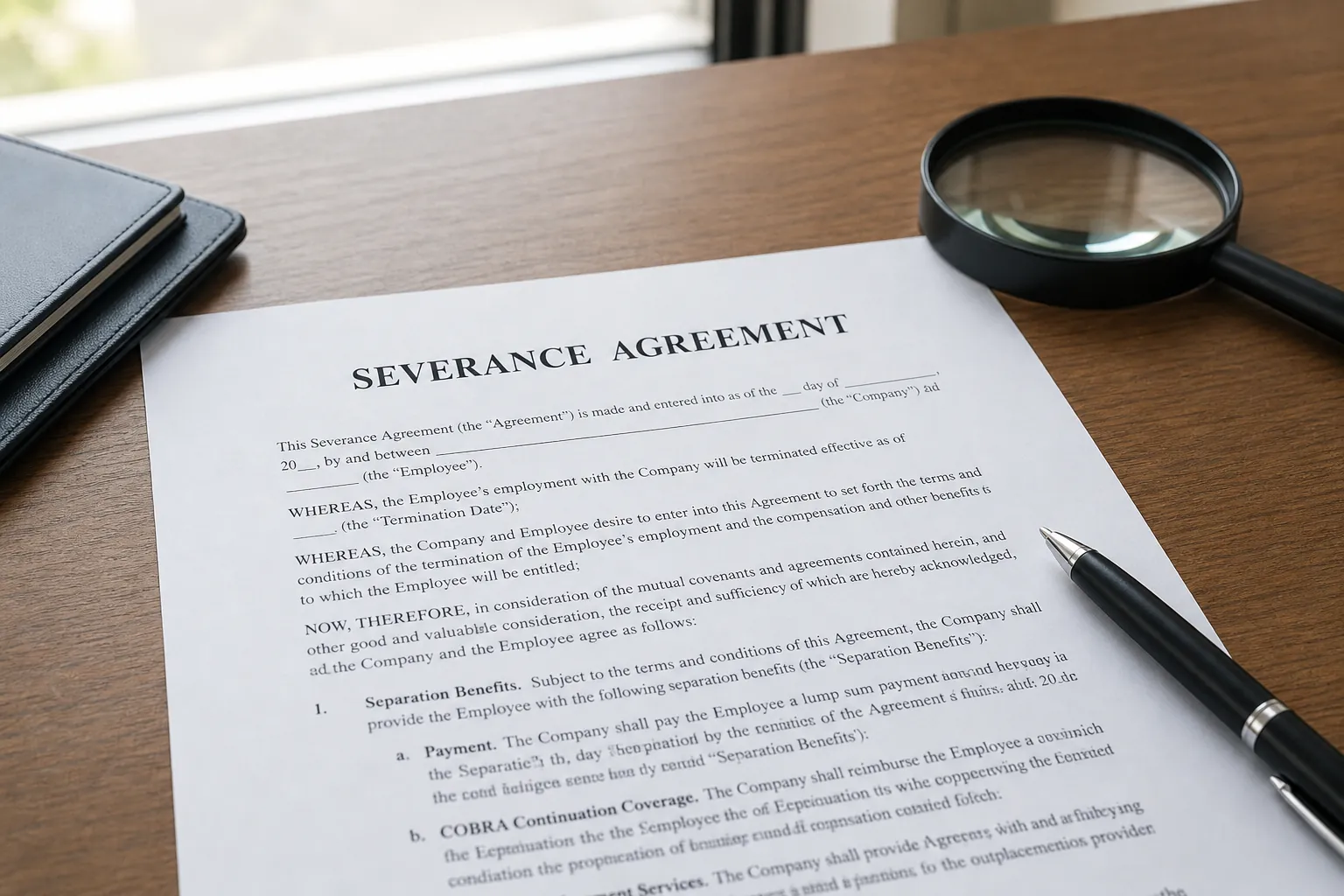
The severance amount is not the legal floor
The Fair Labor Standards Act does not require severance pay. The U.S. Department of Labor describes severance pay as a matter of agreement between an employer and an employee or the employee’s representative, not an FLSA entitlement. [5] New York employment law starts from the same practical place for most private-sector employees: severance usually depends on an agreement, policy, contract, or other enforceable promise, not on a general rule that every laid-off employee must receive a set number of weeks. [6]
That is why the reported “one week per year” figure should not be treated as automatically illegal. There are market expectations around severance, and employers often benchmark offers in weeks of pay per year of service. One common market description puts typical severance in the range of one to two weeks per year, but that is a practice benchmark, not a legal standard. [7]
The better first question is not “was the number low?” It is “what was the employee asked to give up for that number?” If the package required a release of claims, confidentiality obligations, non-disparagement terms, cooperation duties, return-of-property certifications, or forfeiture of unpaid severance for breach, the enforceability analysis moves clause by clause.
What counsel would test in the actual agreement
The public reports do not include the actual Howard Stern or SiriusXM severance forms. That missing document is not a footnote; it is the file. Without it, no responsible review can say whether the packages complied with age-waiver rules, preserved agency rights, or made the NDA too broad. The practical review would start by labeling each term: published document, employer-confirmed term, employee-reported term, media paraphrase, or negotiation rumor.
- Was the payment truly severance, or was part of it already owed as wages, bonus, commission, accrued vacation, or contract pay?
- Did the release cover federal, state, and local employment claims, and did it expressly preserve claims that cannot legally be waived?
- If anyone 40 or older was covered, did the release satisfy OWBPA requirements for a knowing and voluntary ADEA waiver?
- If the terminations were part of a group program, did the employer give the required written decisional-unit disclosures?
- Did the NDA or forfeiture clause interfere with protected rights, including filing an EEOC charge or participating in an agency investigation?
- Were the consideration period and revocation period stated accurately, and were they actually honored?
Those questions do not assume the reported forms failed. They identify the pieces that would matter before advising either side.
The OWBPA issue is the one to slow down on
If the reported reduction included employees age 40 or older, and if those employees were asked to waive age-discrimination claims, the Older Workers Benefit Protection Act becomes the central compliance check. The EEOC’s waiver guidance describes several requirements for a valid ADEA waiver: the waiver must be written in a manner calculated to be understood, must specifically refer to ADEA rights or claims, must not waive future claims, must provide consideration beyond what the employee is already entitled to receive, must advise the employee in writing to consult an attorney, and must provide a revocation period of at least seven days after signing. [8]
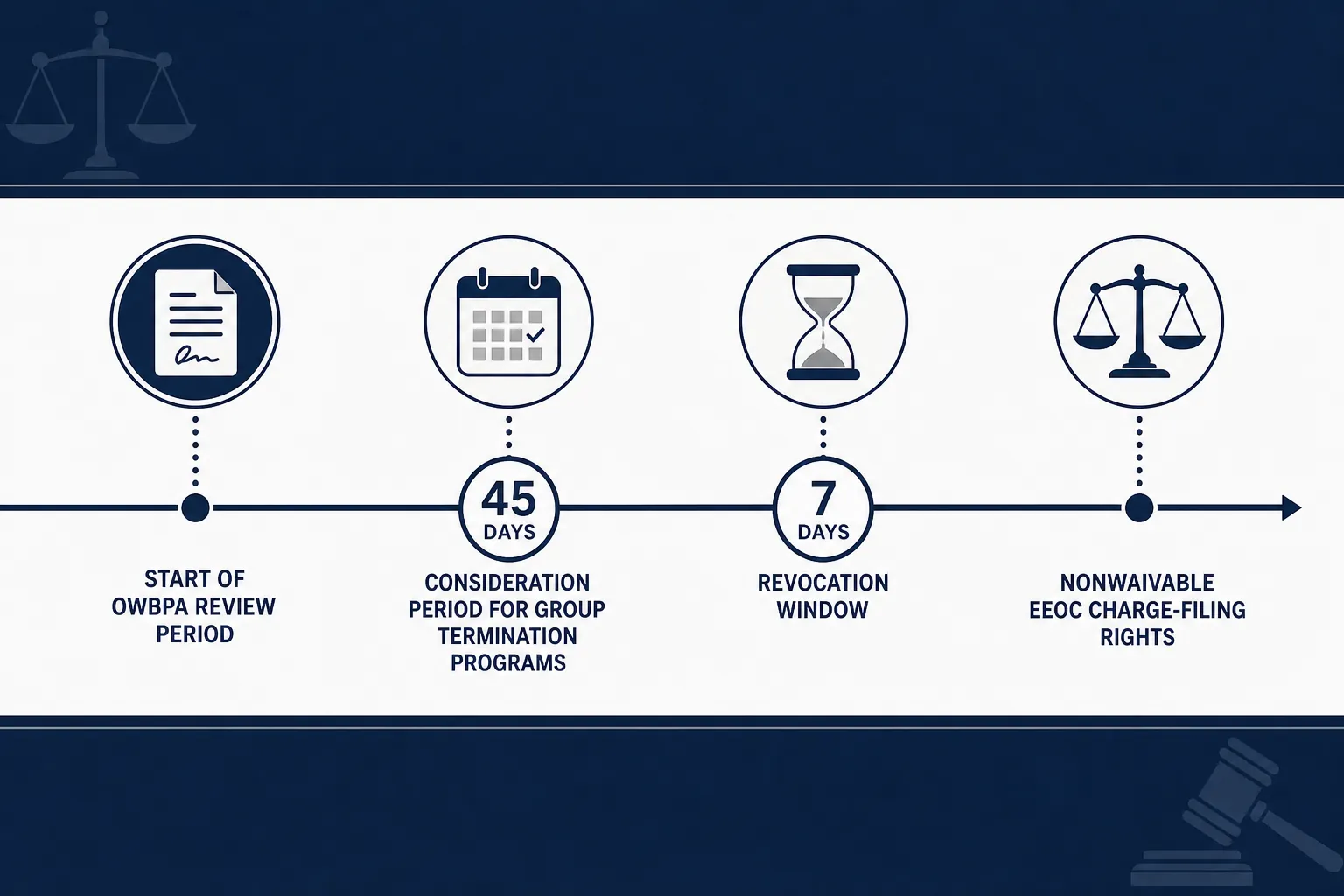
The review period changes depending on the setting. For an individual termination, the OWBPA review period is generally 21 days. For an exit incentive or other employment termination program offered to a group or class of employees, the review period is generally 45 days. The seven-day revocation period is nonwaivable. [8]
The group-program disclosure is often where forms get treated too casually. For a group termination program, the employer must provide written information about the “decisional unit,” eligibility factors, applicable time limits, and the job titles and ages of employees selected and not selected for the program. [8] That disclosure is not just a courtesy attachment. It is part of the statutory machinery that lets an older worker evaluate whether the selection pattern raises an age-discrimination concern.
Applied to the reported Stern facts, the necessary facts are still missing. The public reporting describes roughly a dozen affected staffers, but it does not publish their ages, job titles, decisional unit, selection criteria, review periods, revocation language, or the actual release text. A group layoff involving even a modest number of people can still require OWBPA group-program handling if employees 40 or older are asked to release ADEA claims. The headcount alone does not answer that.
EEOC charge rights cannot be bargained away
A severance agreement may release private claims for money damages if the waiver is otherwise valid, but it cannot stop an employee from filing a charge with the EEOC, cooperating with an EEOC investigation, or participating in agency proceedings. The EEOC guidance is explicit that agreements may not interfere with those protected agency-access rights. [8]
That is where reported NDA forfeiture language would need exact review. A clause saying “do not disclose confidential company information” raises different issues from a clause that threatens forfeiture if a former employee speaks with a government agency, reports discrimination, assists an investigation, or discusses facts protected by statute or public policy. Public reports of an NDA condition are not enough to decide the point; the words and carveouts control.
The NDA dispute is real, but the available facts are still secondhand
The reported employee objection was not only about amount. Page Six reported that former staffers were fighting the severance terms after the layoffs, while The Blast described staffers rejecting a package that included an NDA and a forfeiture condition. [2][3] The Daily Beast later reported staffer statements that some had reached settlements they felt “OK” about. [4] None of those reports publishes a complete agreement.
That leaves several legally distinct possibilities on the table. A former employee might reject a lawful agreement because the price is too low. A former employee might reject an agreement because the confidentiality language is overbroad. An employer might revise language during negotiation without admitting a defect. Employees might settle because the economics are acceptable, not because anyone conceded the original form was enforceable. Public coverage tends to collapse those into one “battle”; employment counsel cannot.
The New York bill is a tracker item, not current law
New York’s pending No Severance Ultimatums Act belongs in this file, but only with the right label. As reported by Squire Patton Boggs, S.372 passed the New York Senate on March 4, 2025 and moved to the Assembly as A.6480. If enacted, it would require a waivable 21-business-day review period and a nonwaivable seven-day revocation period for all New York severance agreements regardless of employee age, and noncompliant agreements would be void. [9]
That would be a meaningful process change because current federal OWBPA timing rules are age-waiver specific. The pending New York proposal would set a broader severance-agreement process floor. But it is not current law as of Aug. 2, 2026, based on the status provided in the legislative tracker source. Treating it as already governing the reported Stern packages would overstate the law. For this bill, the useful questions are status, effective date, affected agreements, and consequence of noncompliance—not the headline.
WARN is probably not the fight on these reported numbers
The federal WARN Act generally requires 60 days’ notice for covered plant closings or mass layoffs, with statutory thresholds including a 50-employee single-site component. [10] Applying that threshold to the reported reduction of roughly a dozen staffers, the federal WARN trigger would almost certainly not be met on the public headcount alone. That is a synthesis from the statutory threshold and the reported layoff size, not a source conclusion about the actual Stern event.
This does not mean WARN should never appear on a reduction-in-force checklist. It means the reported fact pattern does not make WARN the center of this particular severance dispute. The release, NDA, and OWBPA questions are much more plausible pressure points on the available record.
The Kuhn dismissal is adjacent context, not this dispute
There is a separate Howard Stern NDA story in the same news cycle: the reported dismissal of Kuhn v. Stern, Index No. 652040/2026, in New York County Supreme Court. TMZ reported that Judge Melissa A. Crane dismissed the former assistant’s lawsuit in its entirety with costs and disbursements, and that the court found consideration in nine more months of employment, more than $192,000 in pay, and an $80,000 bonus. [11] Entertainment Weekly also reported the dismissal and the hostile-work-environment context. [12]
That dismissal is useful only as cautionary background. It concerned a different NDA dispute, not the reported July 2026 severance packages. The primary order was not located in public search for this record, so the order language should be treated as secondhand reporting unless and until the court document is obtained. It does not answer whether the layoff severance agreements used valid OWBPA language, proper disclosures, adequate review periods, or lawful forfeiture terms.
Where the legal record lands
Nothing in the public record supports declaring the reported one-week-per-year severance offer unlawful on its face. The FLSA does not create a general severance entitlement, New York law generally treats severance as contractual unless another enforceable obligation exists, and market severance benchmarks are not statutes.
The unresolved legal risk is in the paperwork: the release, NDA, forfeiture language, consideration, review period, revocation period, age-waiver disclosures, and preservation of agency-charge rights. Until those documents are public or reviewed by counsel, the safest conclusion is restrained: the reported amount may be negotiable and unpopular, but the enforceability of the severance package depends on mechanics that have not been publicly shown.
References
- Howard Stern lays off a dozen staffers, preparing to drop to one new show per week, Page Six, July 14, 2026
- Inside Howard Stern's ex-staffers' severance battle after brutal layoffs, Page Six, July 31, 2026
- Howard Stern Staffers Reject Severance, The Blast, July 20, 2026
- Howard Stern's Fired Staffers Break Their Silence, The Daily Beast
- Severance Pay, U.S. Department of Labor
- Your Right to Severance Pay After Layoff in NY, Hepworth, Gershbaum & Roth
- Typical Severance Package: How Much Do Employees Get?, Rippling
- Q&A-Understanding Waivers of Discrimination Claims in Employee Severance Agreements, U.S. Equal Employment Opportunity Commission
- New York’s No Severance Ultimatums Act Sets a New Minimum Standard for Severance Agreements Expanding Protections for New York Employees (US), Squire Patton Boggs Employment Law Worldview
- 29 U.S. Code Chapter 23 - Worker Adjustment and Retraining Notification, Legal Information Institute
- Howard Stern NDA Lawsuit Dismissed, TMZ, July 30, 2026
- Howard Stern wins hostile work environment legal battle against assistant, Entertainment Weekly
Related records
Tool profile
Browse tool evaluations →Governing regulation
Browse the obligations tracker →Preventive workflow
Browse verification workflows →
Report a correction or tip
Spotted an outdated figure, a misstated fact, or a ruling this case record should reflect? Public comments are disabled for this content given the professional cost of a misreported case outcome, penalty amount, or rule text — use the structured correction channel instead.
Report a correction or tip for this record →