
Howard University's Platform Migration Mistakenly Unenrolled 502 Freshmen
Howard University's transition from BisonWeb to BisonHub delayed account updates for approximately 1,000 students, leading to the unenrollment of 502 freshmen on July 22, 2026. This entry documents how conflicting deadlines and system migration failures created legal exposure for the institution.
- Jurisdiction
- United States
- Ruling date
- Jul 22, 2026
- Source document
- View primary court order ↗
Lex Machina Review is an independent risk-tracking and reference resource. Nothing on this site is legal advice, and using it does not create an attorney-client relationship. Every record is reviewed against primary sources but may not reflect the most current status of a matter — always verify directly against the cited court order, rule text, or a licensed attorney before relying on it.
Companion explanation — secondary to the source document above
Howard University’s July 22, 2026 unenrollment action is not just a story about a campus billing system that confused students. The reported result was immediate and concrete: 502 first-time-in-college students were unenrolled after the university treated their accounts as insufficiently paid, according to DC News Now/Yahoo reporting that cited university communication; Howard’s own July 23 public statement acknowledged the incident but did not publish that number.[1][2]
The university’s statement matters because of what it concedes. Howard said “students with pending outside scholarships and other financial aid resources may have been impacted” by the enrollment updates.[2] That is the point where a platform-migration problem stops being ordinary administrative friction. If pending aid and outside scholarship records were unstable, incomplete, or slow to post, the institution needed a control before using those records to remove enrollment status.
The risk was in the collision of dates
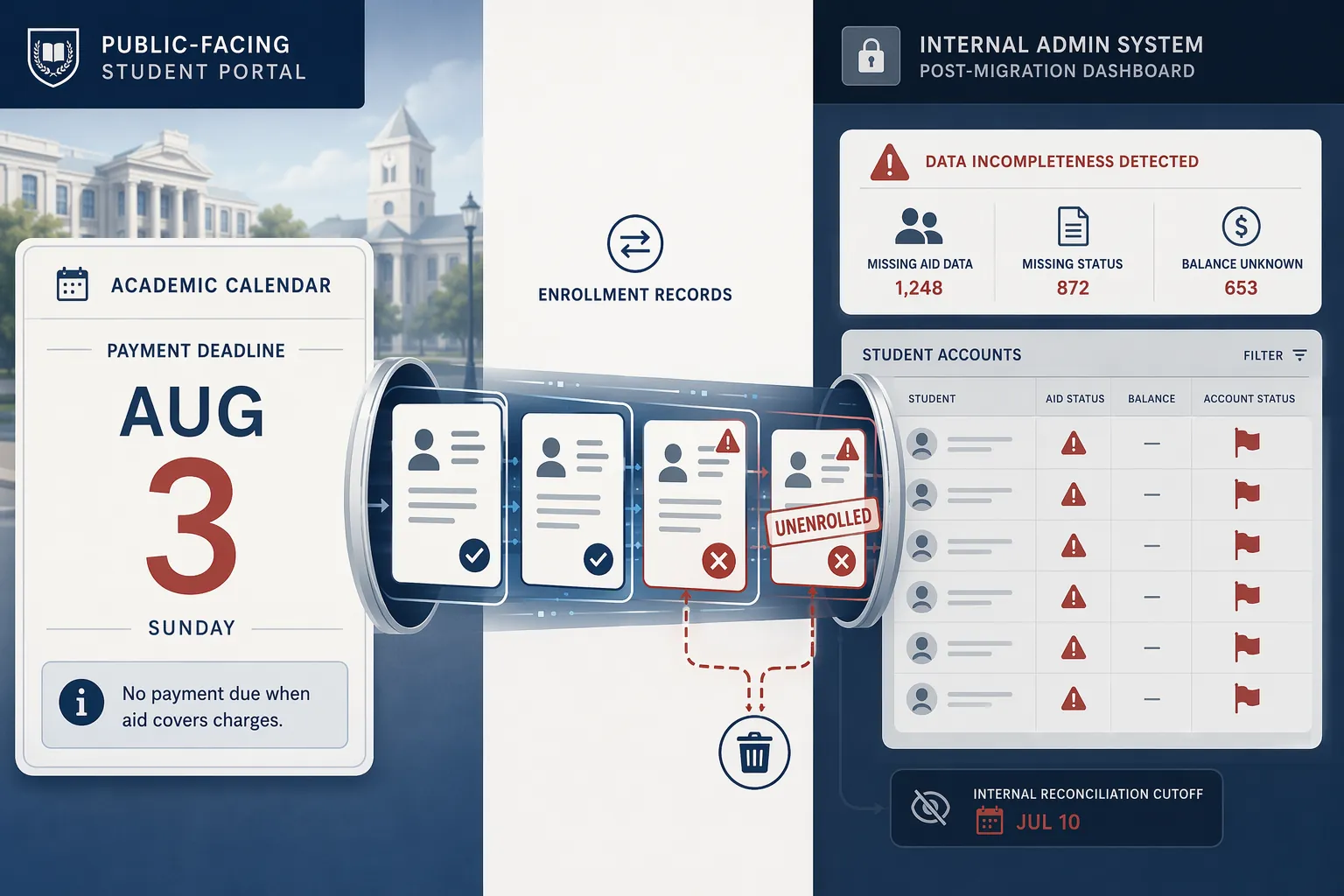
The public record points to two different clocks. Howard’s Office of the Bursar page listed August 3 as the Fall 2026 payment deadline.[3] The July 10 date, by contrast, appears in student account reporting and in the DC News Now/Yahoo account as a first-time-in-college payment requirement tied to a 50% threshold; available sources do not identify a published university policy document confirming that July 10 rule.[1]
That distinction is not clerical. A published bursar deadline is the kind of source students and families reasonably rely on when deciding whether an account is timely. An internal or account-level enforcement date may be administratively useful, but it becomes legally dangerous when it is treated as decisive without equally clear notice.
A first-time student looking at the public bursar calendar could see August 3 as the operative Fall 2026 deadline.[3] A different view of the account, however, reportedly treated July 10 as the date by which 50% payment had to be satisfied.[1] On July 22, before the public August 3 date arrived, the university acted on the earlier threshold and unenrolled students whose records apparently did not show enough payment or credited aid.[1][3]
| Date or rule | What the record shows | Why it matters |
|---|---|---|
| July 10, 2026 | Reported FTIC account-level deadline requiring 50% payment; not confirmed in a published policy document in available sources | Students may have been penalized under a rule less visible than the public bursar deadline |
| July 22, 2026 | Reported mass unenrollment of 502 first-time-in-college students | The hard consequence occurred before the public Fall 2026 payment deadline |
| July 23, 2026 | Howard statement acknowledged that students with pending outside scholarships and other financial aid resources may have been impacted | The university recognized that aid-status issues were part of the affected population |
| August 3, 2026 | Public bursar page listed the Fall 2026 payment deadline | This is the date a student could reasonably treat as the visible payment deadline |
Aid timing made the enforcement posture harder to defend
The deadline conflict would be serious even in a simple cash-balance case. It becomes more serious in a first-year financial-aid case because Howard’s own guidance says no out-of-pocket payment is due when anticipated aid exceeds charges, while first-time federal loan borrower disbursements begin 30 days after classes start.[4]
Those two statements can coexist on paper only if the institution’s account system is able to recognize anticipated aid reliably. If anticipated aid covers charges, the student’s apparent unpaid balance is not necessarily a collection failure. It may be a timing issue, a pending scholarship record, an aid-packaging delay, or a loan-disbursement rule doing exactly what the rule says it will do.
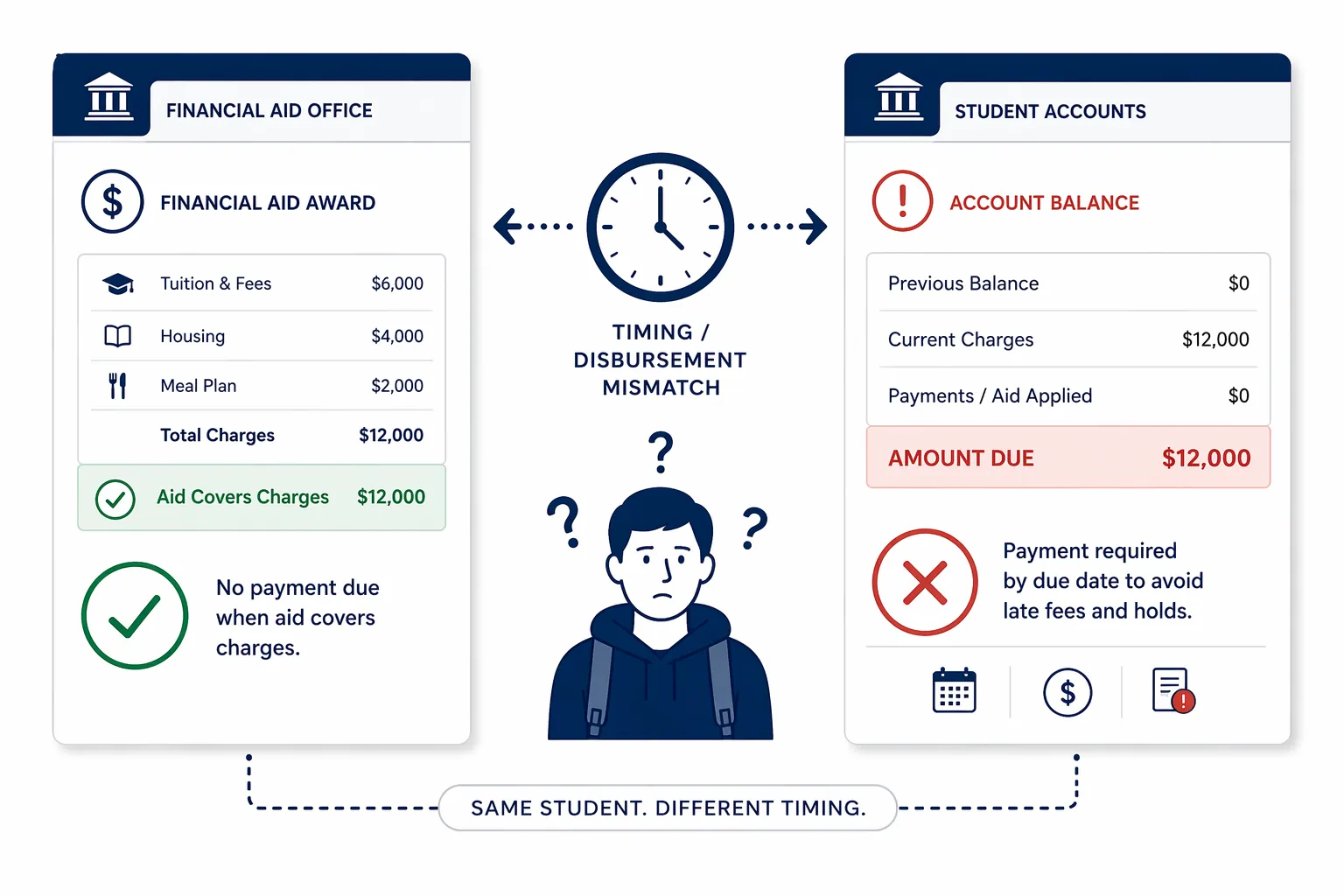
This is why Howard’s July 23 acknowledgment is so important. The university did not merely say students were confused. It said students with pending outside scholarships and other financial aid resources may have been impacted.[2] That narrows the problem: the enforcement process appears to have reached students whose account status depended on aid data that had not yet settled.
For a continuing student, that may be frustrating but navigable. For an incoming freshman, the burden is different. The student is trying to interpret a new portal, a new bill, aid terms, loan timing, housing and enrollment consequences, and family payment expectations at the same time. If the visible university guidance says one thing and the account-enforcement rule operates on another date, the student is left guessing which university record controls.
Howard had already seen account data instability
The July 22 action did not occur in a system with no warning signs. In July 2025, Howard publicly said its transition from BisonWeb to BisonHub had delayed account updates for approximately 1,000 of 14,500 students between January and June 2025.[5] That disclosure does not prove the same defect caused every July 2026 unenrollment. It does show that the university had notice, before the 2026 enforcement event, that account updates during the migration environment could be delayed at meaningful scale.
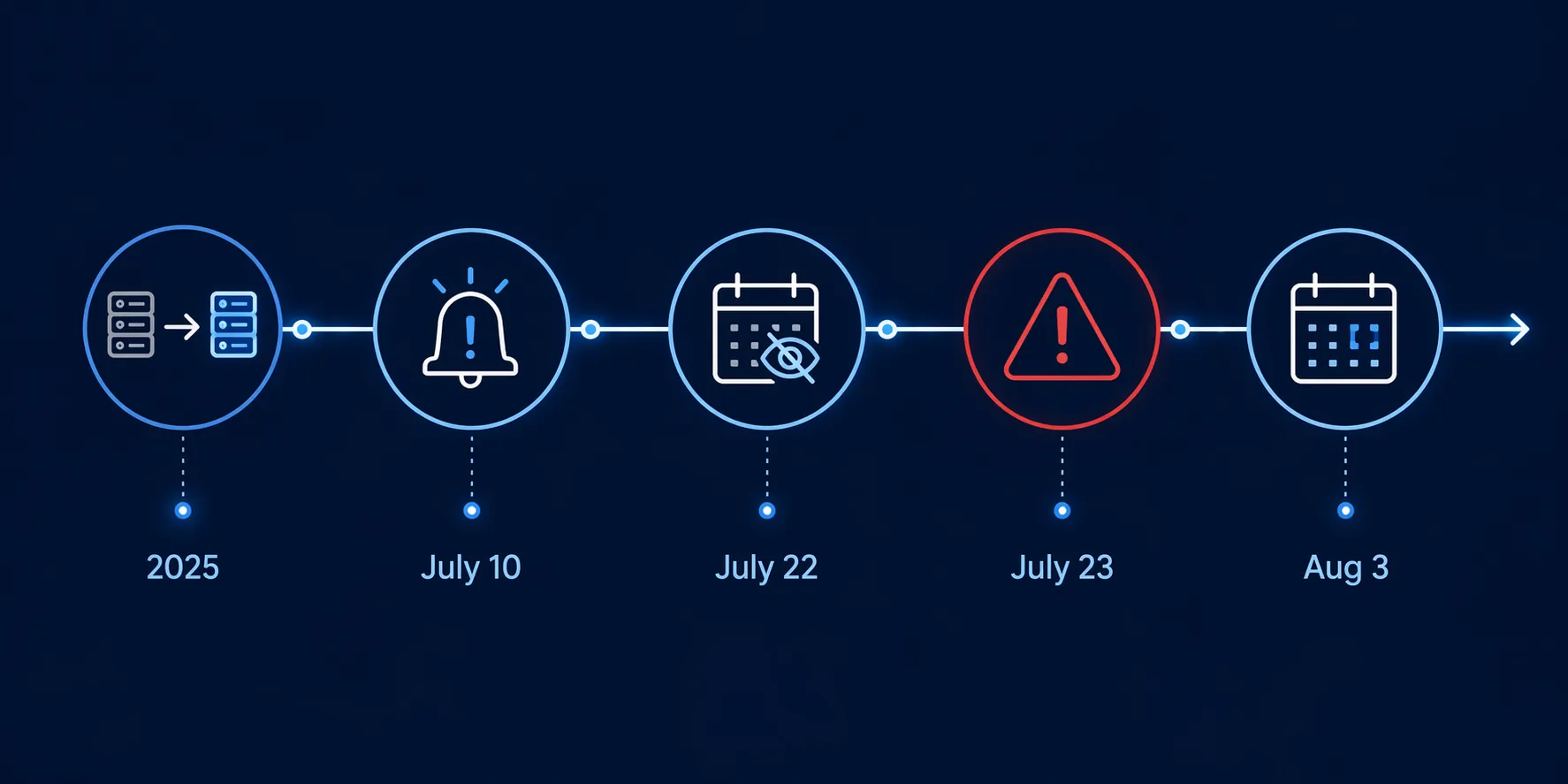
That notice should have changed the controls around any automated or semi-automated enrollment consequence. Before a migrated account balance becomes the basis for unenrollment, someone has to ask whether the data is complete enough to support the consequence. That is not a philosophical preference for manual review. It is the basic compliance distinction between using a system to flag a problem and using the same system to impose a penalty.
A safer process would have separated the account-hold function from the unenrollment function for students with pending aid indicators, outside scholarship records, recent account-update delays, or first-time borrower timing issues. It also would have reconciled public-facing dates with internal enforcement thresholds before acting. The record available as of July 24, 2026 does not show whether Howard performed that kind of exception review before the July 22 action.
The older record is pressure, not proof
Howard’s prior financial-aid history belongs in the file, but it should not be stretched beyond what it proves. The Hilltop reported in 2018 on a whistleblower matter involving approximately $1 million in misdirected grants, a Department of Education Heightened Cash Monitoring 2 placement, and six employee terminations.[6] That history does not establish what happened in July 2026. It does make financial-aid governance a less forgiving area for another preventable control failure.
The same is true of the more recent institutional pressure points. Howard reached a $2,073,680 settlement in a COVID-related class action in 2024.[7] The Hilltop also reported in 2025 that undergraduate enrollment had grown 46% in five years, cost of attendance had risen from about $51,345 to about $64,700, and student loans processed had increased 17% year over year.[8] Those figures do not convert a billing-system incident into a character judgment. They do help explain why migrated aid and account data carried higher stakes: more students, higher bills, and more loan activity leave less room for brittle administrative assumptions.
Where the legal exposure sits
The strongest legal-risk frame is not that a technology migration caused inconvenience. Institutions can and do survive difficult migrations. The exposure sits in the sequence: known account-update delays, unclear or conflicting deadlines, aid guidance that allowed students to rely on anticipated aid, first-time borrower timing that made aid appear later than charges, and an enrollment consequence imposed before the public payment deadline.
Notice is the first issue. If August 3 was the public Fall 2026 payment deadline, students needed clear notice that a July 10 FTIC threshold could trigger unenrollment.[3] A deadline buried in an account view, especially during a known migration period, is a weak foundation for removing enrollment status.
Reliance is the second. Howard’s own aid guidance told students that no out-of-pocket payment was due when anticipated aid exceeded charges.[4] If a student relied on that guidance while scholarships, aid resources, or federal loan disbursements were pending, the institution needed to distinguish that student from someone who simply ignored a bill.
Proportionality is the third. An account flag, registration hold, individualized notice, or temporary exception review would preserve institutional collection leverage while limiting harm from bad data. Unenrollment is different. It threatens course seats, housing plans, visa or family logistics in some cases, and the student’s practical ability to start college. The harder the consequence, the more reliable the record must be before the institution acts.
The developing-status caveat remains important. As of July 24, 2026, the public materials do not establish how many students were restored, how many accounts were ultimately found to be correctly unpaid, what internal exception process existed, or whether any litigation will follow. Those unknowns matter. They do not erase the documented failure mode.
This incident stands on its own as an institutional system-failure entry because it shows how a platform migration becomes legally actionable when the institution uses incomplete or delayed data to impose a hard student consequence. The mistake was not simply that Howard’s systems lagged. It was that the university appears to have enforced an opaque account threshold against incoming students while public deadlines, aid guidance, and migration history all pointed to the need for a slower and more careful review.
References
- Howard University mistakenly unenrolls 502 incoming freshmen, students say, DC News Now via Yahoo, July 2026.
- First-Time-In-College Enrollment Updates, The Dig, July 23, 2026.
- Important Deadlines, Howard University Office of the Bursar.
- Financial Aid Guidance and Published Loan Terms, Howard University.
- Howard University Works to Support Students Facing Financial Aid and Account Challenges, The Dig, July 25, 2025.
- Howard University financial aid whistleblower reporting, The Hilltop, 2018.
- Howard University COVID class-action settlement, Silverman Thompson, 2024.
- Howard enrollment growth, cost of attendance, and student-loan processing reporting, The Hilltop, August 2025.
Related records
Tool profile
Browse tool evaluations →Governing regulation
Browse the obligations tracker →Preventive workflow
Browse verification workflows →
Report a correction or tip
Spotted an outdated figure, a misstated fact, or a ruling this case record should reflect? Public comments are disabled for this content given the professional cost of a misreported case outcome, penalty amount, or rule text — use the structured correction channel instead.
Report a correction or tip for this record →