
Humboldt Park mass shooting legal investigation for Illinois practitioners
A structured legal risk assessment of the July 26, 2026 Humboldt Park mass shooting, covering criminal investigation timelines, civil liability theories under Illinois law, victim compensation caps, and insurance considerations for legal practitioners.
- Jurisdiction
- Illinois
- Court
- Cook County Circuit Court
- AI tool named
- None
- Ruling date
- Jul 30, 2026
- Source document
- View primary court order ↗
- Last verified
- Jul 30, 2026
Lex Machina Review is an independent risk-tracking and reference resource. Nothing on this site is legal advice, and using it does not create an attorney-client relationship. Every record is reviewed against primary sources but may not reflect the most current status of a matter — always verify directly against the cited court order, rule text, or a licensed attorney before relying on it.
Companion explanation — secondary to the source document above
Legal Risk Assessment Record
Last verified: July 30, 2026, UTC. This Humboldt Park Chicago mass shooting legal investigation record is a practitioner-oriented risk assessment, not legal advice and not a prediction that charges or civil claims will be filed.
| Item | Verified record |
|---|---|
| Incident date and time | July 26, 2026, about 2:09 a.m. |
| Location | 900 block of North Central Park Avenue, Chicago |
| Reported setting | Outdoor gathering with more than 100 attendees |
| Reported gunfire | Up to 30 rounds fired |
| Reported injuries | Six people wounded; two listed in critical condition |
| Investigative assignment | Harrison Area detectives |
| Custody and charging status | No suspects in custody as of the cited July 27 reporting; no public criminal charges or civil complaints identified in the provided record |
The working file starts with those limits because the shooting was only four days old as of this article's verification date. Block Club Chicago reported that police said the shooting happened at about 2:09 a.m. on July 26, 2026, in the 900 block of North Central Park Avenue, at a gathering of more than 100 people, with up to 30 rounds fired and six people wounded, two critically; the same report said Harrison Area detectives were investigating and no suspects were in custody as of July 27.[1]
Two reported details should stay out of any matter-intake memo unless independently confirmed: a claimed person of interest and a claimed firearm recovery. The available research identifies those details as coming from a single unverifiable social-media post. They may become important later, but they are not part of the verified record used here.

Four Tracks Are Open, But Not at the Same Speed
For Illinois practitioners, the first week after a mass shooting is not one legal event. It is four overlapping tracks with different proof thresholds, different institutional owners, and different consequences for delay: criminal investigation, civil exposure, victim compensation, and insurance coverage.
| Track | Current posture | Immediate legal question |
|---|---|---|
| Criminal investigation | Detective investigation reported; no suspect in custody in the cited record | What can be verified before charge review, and what remains investigative theory? |
| Civil liability | No public Humboldt Park complaint identified in the provided record | Which defendants are legally plausible only if facts later support duty, causation, or statutory predicates? |
| Victim compensation | Illinois administrative route may matter before any civil recovery | What expenses may be submitted, and how does the statutory cap shape expectations? |
| Insurance | Coverage depends on policy language and exclusions, not the news label assigned to the event | Do general liability exclusions, assault-and-battery wording, or active-shooter coverage change the triage? |
The ordering matters. Criminal facts can narrow or expand civil theories. Civil pleadings, if filed, may add allegations that are not yet independently established. Compensation forms may proceed while liability remains unresolved. Insurance notices may be due before anyone knows whether the shooter, a host, a property owner, or a seller will ever be named.
The Criminal Track: Assignment Is Not a Charging Decision
The phrase "Harrison Area detectives are investigating" is useful, but it does not answer who fired, whether one or more firearms were used, whether any weapon was recovered, or whether prosecutors will approve charges. CPD's Bureau of Detectives describes a post-2020 structure with five Area Detective Divisions, and the public incident reporting places this case with Harrison Area detectives.[1][2]
In practical terms, a day-four matter note should separate three buckets: confirmed police-reported incident facts, investigative steps likely to occur, and unverified claims. Witness interviews, scene work, shell-casing analysis, camera collection, medical records, and ballistics may all matter, but they do not become confirmed facts simply because they are common in shooting investigations.
Video recovery deserves its own caution. CPD Area Technology Centers are part of the local investigative infrastructure, and a December 2025 University of Chicago Crime Lab report evaluated their role in strengthening homicide investigations.[3] That supports the reasonable expectation that video and technology-assisted leads may be part of a serious shooting investigation. It does not establish that a usable Humboldt Park video exists, that it identifies a shooter, or that it will support charges.
Charge review is a separate procedural handoff. The Cook County State's Attorney's Office has published a policy memo describing screening protocol for felony review.[4] For this case, the disciplined phrasing is that any charges would have to move through law-enforcement investigation and prosecutorial review. The available record does not support saying charges are imminent, likely, or directed at any named person.
Early criminal-investigation questions to preserve
- Has CPD or the State's Attorney publicly identified any suspect, arrestee, or charged defendant?
- Has any firearm recovery been confirmed by an official source rather than social media?
- Do public filings later identify one shooter, multiple shooters, or no charged shooter?
- Are the wounded victims' injury descriptions updated in a way that affects potential charges or damages?
- Has any warrant, bond proffer, indictment, or preliminary-hearing record added facts that can be cited?
Civil Exposure Starts With the Shooter, Then Gets Conditional
The most direct civil defendant category is also the least complicated legally: the person or people who fired the shots. If later identified, they may face intentional-tort claims and damages exposure separate from any criminal sentence. At this stage, however, the verified record does not identify a shooter, which means no intake note should skip from "mass shooting" to a named civil defendant.
The harder work begins with everyone around the shooting rather than behind the trigger: a property owner, occupier, promoter, informal host, security provider, or other person alleged to have controlled the gathering. The reported facts say the shooting occurred at an outdoor gathering with more than 100 attendees.[1] They do not, by themselves, identify who controlled the space, who invited attendees, whether anyone charged admission, whether alcohol was sold or served, whether security was present, whether prior warnings existed, or whether the gathering was permitted.
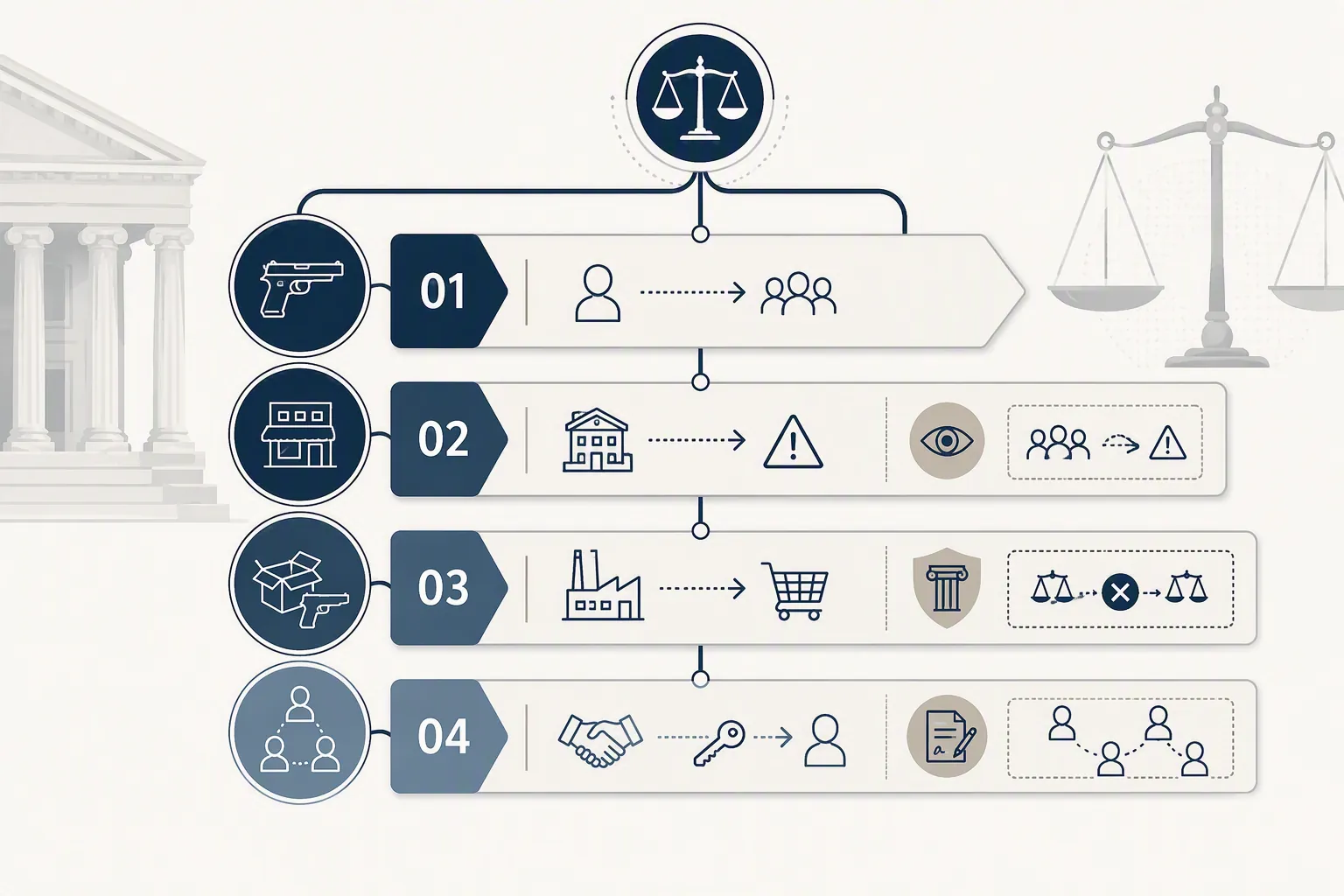
That missing information is not a drafting inconvenience; it is the premises-liability case. Illinois exposure for a property or event-side defendant would turn on control, duty, foreseeability, breach, causation, and damages. A large unpermitted or informal gathering may raise questions worth investigating, but size alone is not a substitute for proof that a particular defendant owed a duty and failed to take legally relevant precautions.
| Potential defendant category | What would have to be developed | Current Humboldt Park posture |
|---|---|---|
| Shooter or shooters | Identification, causation, injury link, collectability | No suspect in custody in cited reporting |
| Property owner or occupier | Control of premises, notice or foreseeability, security facts, causation | Location known; control facts not established in provided record |
| Host, organizer, or promoter | Role in convening the event, crowd management, alcohol or admission facts, ability to prevent or mitigate risk | Gathering size reported; organizer facts not established |
| Security contractor or vendor | Contract scope, assumed duties, staffing, breach, causation | No security-provider facts in provided record |
| Firearm seller or manufacturer | Product, transaction chain, statutory predicate, marketing or sales theory, PLCAA analysis | No firearm recovery or transaction chain confirmed |
| FOID co-sponsor | Minor applicant, sponsorship, firearm use, damages link under Illinois FOID framework | No minor-shooter or sponsor facts in provided record |
The Highland Park analogy is important, but narrow
The closest Illinois gun-industry civil-liability reference in the research record is not Sandy Hook or Buffalo. It is the Highland Park litigation. On April 1, 2025, a Lake County judge in Roberts v. Smith & Wesson denied the manufacturer's motion to dismiss as to unfair-business-practices and negligence claims and denied firearm retailers' motions entirely, allowing major claims by Highland Park survivors to proceed past the pleading stage.[5]
That ruling matters because it is Illinois-specific and because it shows one pathway around an early dismissal in a gun-industry case. It should not be inflated into a rule that manufacturers or retailers are liable whenever a mass shooting occurs. Highland Park involved its own alleged weapon, sales chain, marketing facts, retailer conduct, and pleadings. For Humboldt Park, no verified record presently identifies the firearm, the seller, the purchaser, or any product-marketing theory.
PLCAA analysis belongs here, but carefully. The Protection of Lawful Commerce in Arms Act generally creates a federal shield for gun-industry defendants, while leaving room for defined exceptions, including certain predicate-statute theories. The Highland Park ruling is useful because it shows how plaintiffs in Illinois have pleaded around dismissal in one case. It does not eliminate the need to connect a specific defendant's conduct to a specific exception.
FOID co-sponsor theories require a specific fact pattern
Illinois FOID materials add another possible but fact-dependent civil route. The research record identifies 430 ILCS 65 and Ill. Admin. Code tit. 20, section 1230.40, and notes that FOID co-sponsors may be liable for damages from a minor's firearm use; that theory was tested in Highland Park litigation against Robert Crimo Jr.[6]
For Humboldt Park, the theory is only a checklist item unless later facts identify a minor shooter, a FOID sponsorship relationship, and a firearm-use connection that fits the statute and regulation. Without those facts, it should not be described as an active claim.
National settlements are comparison points, not templates
Several national mass-shooting resolutions belong in the background file because clients will ask about them. The Remington-Sandy Hook settlement was reported at $73 million in 2022, and the MGM Las Vegas settlement was reported at $800 million in 2019.[7] The Trace also reported a $1.75 million February 2026 settlement involving a magazine manufacturer in litigation arising from the Buffalo Tops shooting.[8]
Those figures can distort an early Illinois memo if they are treated as benchmarks before liability architecture is known. MGM is principally useful as a venue-liability reference. Sandy Hook and Buffalo are useful for gun-industry litigation posture and settlement context. None supplies the missing Humboldt Park facts: control of the event, identity of the shooter, weapon source, insurance tower, security record, or damages record for the six wounded people.
Victim Compensation Is Not a Substitute for Liability, But It May Be First
The people wounded in Humboldt Park may face medical bills, missed work, counseling needs, transportation costs, and paperwork before any defendant is charged or sued. That is where the Illinois Crime Victims Compensation Act belongs in the risk assessment: not as damages valuation, but as an immediate administrative route that may help before litigation produces answers.
The Illinois Attorney General's crime-victim-compensation materials state that eligible victims may receive up to $45,000 per victim, with the cap raised from $27,000 for crimes occurring on or after August 7, 2022.[9] The research record also identifies a reported average reimbursement of $6,600 per person from 2024 reporting using Illinois Attorney General data, but that average is not a promise of what any 2026 Humboldt Park applicant will receive.[9]
| Compensation point | Practical note |
|---|---|
| Cap | Up to $45,000 per eligible victim under the Illinois AG materials |
| Average reimbursement | $6,600 figure is a prior reported average, not a current guarantee |
| Relationship to civil claims | Administrative compensation does not resolve civil fault or identify defendants |
| Matter-intake use | Flag for victims and families while preserving possible civil remedies |
Practitioners should avoid making the compensation program sound cleaner than it feels to a wounded person. The cap is real, the eligibility rules matter, and documentation can be burdensome. Still, this is one of the few concrete Illinois-specific tools available before a criminal case or civil complaint matures.
Insurance Triage Turns on Wording, Not the News Category
Insurance review should start early for any venue, business, property owner, promoter, school, security firm, or organization that may receive a tender or preservation letter. A Joliet law-firm analysis in the research record states that standard general liability policies typically exclude mass-shooting coverage and that active-shooter policies are increasingly carried by Illinois businesses and schools.[10]
That is enough to justify a coverage checklist. It is not enough to assume no coverage. The actual policy language controls: assault-and-battery exclusions, firearms exclusions, expected-or-intended injury wording, negligent-security allegations, additional-insured status, event endorsements, liquor-liability terms, umbrella layers, and notice provisions may each change the position.
- Identify all potentially responsive policies before deciding which defendant theory matters most.
- Preserve notice deadlines even where liability facts remain undeveloped.
- Separate defense-cost questions from indemnity questions.
- Check whether active-shooter or workplace-violence coverage exists outside the general liability program.
- Do not treat an insurer's reservation of rights as a merits finding on civil liability.
Public-Nuisance Legislation Is a Watch Item, Not a Humboldt Park Claim
State gun-public-nuisance statutes may affect future Illinois gun-industry pleading strategy, but they should not be smuggled into the Humboldt Park file as if already controlling. The Trace reported that more than 12 states have gun-specific public-nuisance laws, that the Second Circuit upheld New York's law in July 2025, and that Illinois HB 4471, the Responsible Gun Manufacturers Act, was under consideration in the 2026 session.[8]
The practical entry is narrow: monitor whether Illinois enacts or materially advances a gun-public-nuisance statute and whether any later Humboldt Park complaint pleads a theory affected by that legislation. Until then, Highland Park's existing Illinois litigation posture is the closer civil reference.
Practitioner Monitoring Checklist, Last Verified July 30, 2026
- Criminal status: any CPD, Cook County State's Attorney, bond-court, indictment, or preliminary-hearing record identifying suspects, charges, or declined charges.
- Evidence status: official confirmation of firearm recovery, shell-casing analysis, video evidence, vehicle evidence, or witness-based identification.
- Civil filings: any Cook County or federal complaint naming a shooter, property owner, organizer, promoter, security provider, firearm seller, manufacturer, or FOID co-sponsor.
- Event-control facts: permit status, property control, organizer identity, alcohol or admission facts, security arrangements, and prior-warning evidence.
- Victim-support updates: Illinois Attorney General compensation guidance, eligibility changes, documentation requirements, and any local victim-assistance coordination.
- Insurance positions: tenders, reservations of rights, exclusions invoked, active-shooter policy availability, additional-insured disputes, and defense-cost arrangements.
- Legislative movement: any material action on Illinois HB 4471 or other Illinois gun-public-nuisance legislation that could affect future pleading strategy.
The current file supports four active legal tracks, not four conclusions. Criminal investigation controls the verified factual record. Civil exposure depends on defendant-specific facts that are not yet public. Victim compensation offers an Illinois administrative route with a real cap and uncertain individual outcomes. Insurance review should begin before liability theories are settled, because notice and exclusions will not wait for a clean narrative.
References
- Mass Shooting At Humboldt Park Gathering Wounds 6, Police Say, Block Club Chicago, July 26, 2026.
- Bureau of Detectives, Chicago Police Department.
- Strengthening Homicide Investigations, University of Chicago Crime Lab, December 2025.
- Policy Memo, Cook County State's Attorney's Office.
- In Major Victory for Survivors of Highland Park Mass Shooting, Judge Allows Majority of Claims in Civil Case Against Smith & Wesson and Firearm Retailers to Proceed, Everytown Law, April 1, 2025.
- Who's on the Hook? Expanding Liability in the Mass Shooting Context, UIC Law Review.
- Mass Shootings Trigger Litigation, New York State Bar Association.
- Gun Lawsuit Public Nuisance State Laws, The Trace, March 2026.
- Crime Victim Compensation, Illinois Attorney General.
- Who Is Liable for Injuries and Deaths From a Mass Shooting?, JolietLaw.com.
Related records
Tool profile
Browse tool evaluations →Governing regulation
Browse the obligations tracker →Preventive workflow
Browse verification workflows →
Report a correction or tip
Spotted an outdated figure, a misstated fact, or a ruling this case record should reflect? Public comments are disabled for this content given the professional cost of a misreported case outcome, penalty amount, or rule text — use the structured correction channel instead.
Report a correction or tip for this record →