
Hunger Strike Prisoners' Legal Rights, Court by Court
There is no settled standalone right to hunger strike, and force-feeding outcomes split by jurisdiction: some courts authorize the practice, others enjoin it. This verified record set maps the controlling rulings by forum, each entry linked to a primary court order.
- Jurisdiction
- US federal (Alabama)
- Court
- U.S. District Court for the Northern District of Alabama
- Judge
- Anna Manasco
- AI tool named
- ChatGPT
- Ruling date
- Jul 1, 2025
- Source document
- View primary court order ↗
- Last verified
- Aug 4, 2026
Lex Machina Review is an independent risk-tracking and reference resource. Nothing on this site is legal advice, and using it does not create an attorney-client relationship. Every record is reviewed against primary sources but may not reflect the most current status of a matter — always verify directly against the cited court order, rule text, or a licensed attorney before relying on it.
Companion explanation — secondary to the source document above
Legal information, not a shortcut
There is no settled standalone U.S. legal right to hunger strike in prison. The safer question is narrower and more useful: in this forum, on this record, has a competent prisoner’s refusal-of-treatment interest or procedural objection survived the government’s showing of medical danger, institutional order, security, and court authorization?
This record set is legal-risk research, not legal advice. It is built for citation checking before a filing, not for moral shorthand. Each entry below is tied to a primary court order or regulation where available; entries that still depend on secondary reporting are visibly flagged. Last verified for this article: August 4, 2026.

Record map: hunger strikes, force-feeding, and forum risk
The map matters because hunger-strike cases are usually litigated under pressure: a body is deteriorating, a prison doctor is documenting risk, officials are asking for authority, and a lawyer may be drafting an emergency motion from a partial record. A slogan about autonomy or prison security will not answer the next question the court asks.
| Forum | Record | Posture and outcome | Core rule or risk signal | Verification status |
|---|---|---|---|---|
| New York Court of Appeals | Matter of Bezio v. Dorsey | State corrections officials obtained court authorization to nasogastrically feed Leroy Dorsey; the New York Court of Appeals upheld the order. | Applied Turner factors and rejected the asserted refusal-of-treatment interest where the strike was treated as coercive pressure on prison administration. | Primary opinion available; pin cites should be checked against the PDF before filing. [1] |
| Connecticut Supreme Court | Coleman v. Commissioner of Correction, reported 2012 decision | Reported 7-0 ruling allowed force-feeding of William B. Coleman after a roughly five-year hunger strike. | Reported holding treated medically necessary feeding as permissible despite international-authority arguments. | Secondary report only in this article’s materials; official citation and primary order should be pulled before reliance. [2] |
| D.C. Circuit | Aamer v. Obama | Guantánamo detainees could use habeas to challenge conditions of confinement, but the panel denied injunctive relief against force-feeding. | Important vehicle holding for habeas; merits relief still failed once the court weighed death risk and prison authority. | Primary appellate opinion available through Justia. [3] |
| D.D.C. | Dhiab v. Obama | Judge Gladys Kessler briefly entered May 2014 temporary relief concerning Guantánamo force-feeding; relief was later denied. | Shows a short-lived procedural interruption, not a durable rule against force-feeding. | Secondary-source flag; primary orders should be pulled before citation. [4] |
| N.D. California / California prison litigation | Ashker v. Governor settlement and related 2013 refeeding order | The 2015 Ashker settlement ended indeterminate solitary confinement after the 2013 California prisoner hunger strike; a 2013 refeeding order was part of the adjacent record. | Useful conditions-of-confinement record, but not a general history of all hunger-strike rights. | Secondary-source flag here; settlement and refeeding order should be verified directly. [5] |
| Georgia Supreme Court | Zant v. Prevatte | Recognized a privacy-right claim by a prisoner refusing food. | The main outlier: it shows that the answer is not uniform across jurisdictions. | Secondary-source flag here; primary Georgia opinion should be pulled. [6] |
| Wisconsin, Dodge County | Recent injunction against continued DOC force-feeding | A state court injunction reportedly prohibited continued force-feeding of an inmate. | Meaningful anti-force-feeding result; the report says the court cited international law and Guantánamo federal decisions. | Caption and date unverified here; do not cite without the primary order. [7] |
| Federal Bureau of Prisons | 28 C.F.R. Part 549, Subpart E | Regulatory procedures define and manage hunger strikes in federal custody. | A practical floor: 72-hour definition, monitoring, and forced treatment without consent only on documented life- or health-threatening necessity. | Current federal regulation available through eCFR. [8] |
The operative test is not the phrase “right to hunger strike”
A hunger strike can be speech, protest, self-harm, medical refusal, institutional disruption, or some mixture of all of those. Courts do not always say which part they are addressing. That is why the first legal move is to separate the prisoner’s interests from the remedy being sought.
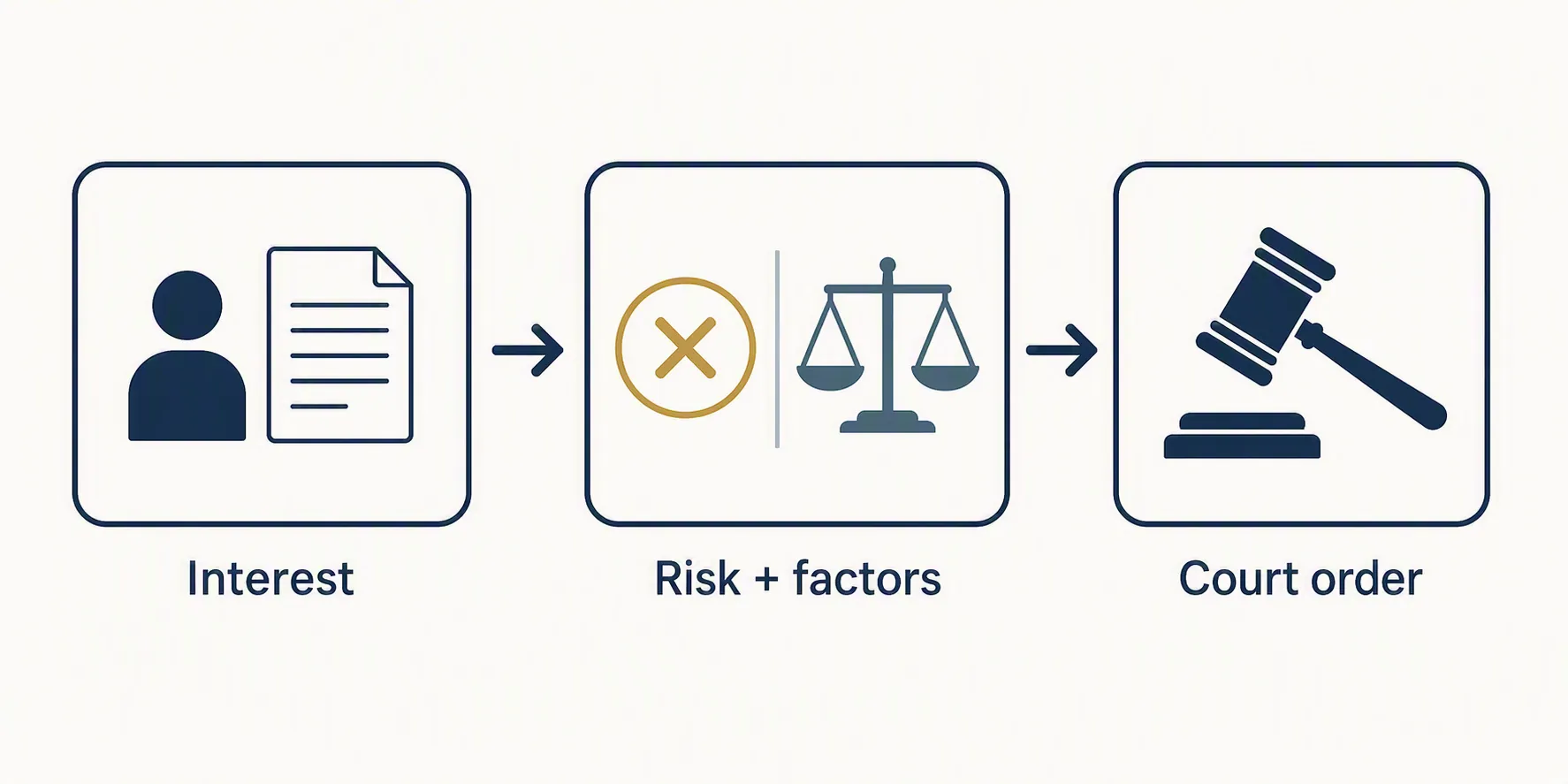
The prisoner’s strongest doctrinal starting point is usually not a freestanding hunger-strike right. It is a competent person’s liberty interest in refusing unwanted medical treatment, often discussed in Cruzan terms, plus whatever procedural protections the forum requires before officials may override that refusal. In prison, that interest is then filtered through Turner v. Safley’s deferential penological-interest analysis, where courts ask whether the restriction or intervention is reasonably related to legitimate prison objectives. The Harvard Law Review discussion of prison strikes puts the point bluntly enough for risk work: the doctrine does not supply a clean freestanding right, and Turner often becomes the operative frame once the dispute enters custody administration. [9]
That translation is where many bad summaries become dangerous. A competent patient outside custody may have a powerful refusal-of-treatment claim. A prisoner refusing food during a strike still has bodily and procedural interests, but those interests are litigated against a government record that may include weight loss, lab results, physician declarations, prison-order concerns, suicide-prevention protocols, security staffing, and an emergency application for judicial authorization. Once a court accepts a life-threatening risk record, the refusal interest commonly weakens.
None of that makes nasogastric force-feeding a merely administrative step. It is invasive, physical, and repeated. The fact that many courts authorize it under certain records does not make the body disappear from the legal analysis. It means the record must be read as a record: who found medical necessity, what process occurred, what alternative was available, whether the order was temporary or open-ended, and whether the forum treats preservation of life, discipline, and security as enough to override refusal.
Where courts authorized or refused to stop force-feeding
New York: Bezio is the cleanest state high-court authorization record
Matter of Bezio v. Dorsey is the entry most likely to matter in a forum-specific filing because it is a state high-court decision with a primary opinion. The case involved Leroy Dorsey, a New York prisoner who refused food; corrections officials sought and obtained authorization for nasogastric feeding; and the New York Court of Appeals upheld that order. [1]
The opinion matters less for the bare result than for the route. New York did not simply announce that prisoners have no autonomy. It treated the refusal claim as subject to prison-administration limits, applied Turner’s four-factor framework, and credited the state’s interests in preserving life, preventing suicide or serious harm, maintaining institutional order, and avoiding the coercive use of self-starvation against prison officials. [1]
For a lawyer, Bezio supports a narrower proposition than “force-feeding is legal.” It supports the proposition that, in New York, a court-authorized feeding order can survive a constitutional challenge where the record shows serious medical risk and penological interests strong enough to override the asserted refusal-of-treatment interest. That distinction matters if the pending facts lack a current medical declaration, if the prisoner’s competence is disputed, or if officials acted first and asked for authorization later.
Connecticut: Coleman is important, but the citation risk is visible
The Connecticut Coleman record is frequently relevant because the reported facts are stark: William B. Coleman was described as having been on a hunger strike for roughly five years, and the Connecticut Supreme Court reportedly ruled 7-0 in favor of the Department of Correction on March 5, 2012. CT News Junkie reported that the court concluded “the weight of international authority does not prohibit medically necessary force-feeding under such circumstances.” [2]
That quote should not be dropped into a brief from this record set alone. The official Connecticut citation and primary order still need to be confirmed. The useful risk point is still clear: Connecticut is reported as another authorization forum, but any filing should pull the court’s own text before asserting the holding, quoting the opinion, or comparing it to New York and D.C. Circuit authority.
D.C. Circuit: Aamer opened the habeas door and still denied the injunction
Aamer v. Obama is easy to misread because the detainees won something real and lost the thing they urgently wanted. The D.C. Circuit held that habeas could reach conditions-of-confinement challenges by Guantánamo detainees, rejecting the idea that habeas was categorically unavailable for that kind of claim. But the court denied the requested injunction against force-feeding. [3]
That procedural split is the lesson. Aamer is not a general anti-force-feeding case. It is a vehicle case with an adverse emergency-relief outcome. It helps a petitioner get into the habeas forum on certain conditions claims, but it does not prove that a court will stop feeding when the government has a starvation-risk record. If a brief cites Aamer only for access to habeas, it can be useful. If it cites Aamer as though the detainees obtained a merits injunction against force-feeding, it is wrong.
Dhiab: a temporary interruption, not a stable rule
Dhiab v. Obama belongs in the map because it shows that judges have, at least briefly, interrupted force-feeding practices. The available materials describe a May 2014 temporary restraining order by Judge Gladys Kessler concerning Guantánamo force-feeding, followed by denial of further relief. [4]
That is not enough to make Dhiab a broad rule against force-feeding. It is a cautionary entry: temporary relief may be available on a particular record, especially where process, access, or treatment conditions are contested, but the lasting merits result must be checked against the orders themselves.
The outliers are not decorative

Georgia and Wisconsin prevent the map from collapsing into a single federal-prison answer. Zant v. Prevatte is described in the available materials as a Georgia Supreme Court privacy-right outlier involving a prisoner refusing food. [6] The Dodge County, Wisconsin injunction is reported as prohibiting continued force-feeding of an inmate and as relying in part on international-law principles and Guantánamo federal decisions. [7]
Both entries need careful handling. Zant should be pulled from the Georgia reports before use. The Wisconsin ruling’s caption and date are unverified here, and the primary order is essential before any claim about its scope. Still, they matter. A verified Georgia or Wisconsin authority can change a filing from “courts usually allow this” to “this forum may not.”
International-law and medical-ethics arguments often enter through these outlier records. The ICRC’s position is opposed to forced feeding of hunger strikers, and that stance is important background for advocates, doctors, and courts confronting the practice. [10] But in a U.S. prison-rights filing, international condemnation does not itself control the forum unless the court makes it part of the governing analysis. Coleman’s reported treatment of international authority and Wisconsin’s reported reliance on it point in different directions, which is exactly why the primary orders matter.
The federal regulation is a floor, not the constitutional answer
For federal custody, 28 C.F.R. Part 549, Subpart E gives a practical baseline. The regulation defines a hunger strike as a situation where an inmate has not eaten for 72 hours or has missed nine consecutive meals, and it sets monitoring and medical-evaluation procedures. It also permits forced medical treatment without consent only when, in the physician’s medical judgment, there is a documented immediate threat to the inmate’s life or permanent health. [8]
That regulation is not a constitutional holding. It does not decide whether a state prisoner in Georgia has a privacy claim, whether a Wisconsin injunction bars a particular procedure, or whether habeas is available in a federal detainee case. It does identify what federal prison officials are supposed to document before moving from observation to involuntary treatment.
A recent medical-capacity study from the New Jersey Department of Corrections context helps calibrate ordinary hunger-strike management without turning one system’s experience into a universal rule. The JAAPL article reported 213 hunger strikes from 2015 through 2022, a median duration of three to four days, zero deaths, and one 2016 instance where force-feeding was authorized but never performed. [11] That does not prove that every prison system can avoid force-feeding. It does show why many cases never become reported litigation: monitoring, negotiation, and short duration may resolve the strike before a court order is sought.
California belongs in the conditions record, not as a universal hunger-strike rule
The 2013 California prisoner hunger strike is often remembered for its scale. The available materials describe participation by more than 29,000 inmates and connect the strike to the later Ashker v. Governor settlement, which ended indeterminate solitary confinement in California. It also identifies an August 19, 2013 refeeding order by Judge Thelton Henderson. [5]
For this map, the settlement and refeeding order are more useful than a retelling of the strike. The legal relevance is adjacent to solitary confinement, long-term isolation, prison conditions, and emergency medical authority. The settlement does not create a general right to refuse nutrition. The refeeding order, once pulled, may matter for how courts authorize medical intervention during mass prison protest.
What a filing should actually verify
A lawyer or pro se litigant preparing a hunger-strike filing should not begin with the broadest moral claim and then hunt for cases that sound sympathetic. The record should be assembled in the order the court is likely to need it.
- Forum: federal habeas, § 1983, state emergency medical petition, prison administrative review, or appeal from a feeding order.
- Custody system: federal Bureau of Prisons, state corrections department, county jail, immigration detention, military detention, or another setting.
- Medical record: duration without food, weight loss, lab findings, capacity evaluation, physician declaration, and whether the risk is described as imminent, serious, permanent, or speculative.
- Procedure: notice, hearing, counsel, opportunity to contest competence or necessity, and whether the order is time-limited.
- Authority: primary order, controlling appellate decision, regulation, or merely a news report.
- Requested remedy: injunction against feeding, access to counsel or medical records, challenge to restraint methods, damages after feeding, or declaratory relief.
The posture may decide the case before the moral argument is reached. Aamer shows that a court may recognize a procedural vehicle and still deny emergency relief. Bezio shows that a court may acknowledge autonomy concerns and still uphold feeding once prison interests and medical risk are credited. Wisconsin, if verified, shows that a court may stop continued feeding on a different record. A summary that erases posture is not a summary; it is a citation trap.
AI citation risk is now part of prisoner-safety litigation
The need for primary orders is not academic. In July 2025, U.S. District Judge Anna Manasco in the Northern District of Alabama sanctioned three Butler Snow lawyers in a prisoner-safety suit after filings contained ChatGPT-hallucinated citations. The reported order described citations as “completely made up” and the conduct as “recklessness in the extreme”; the sanctions included removal from the case, disclosure duties, and referral to the Alabama State Bar. [12]
That sanction record belongs next to hunger-strike litigation because the docket has the same danger profile: urgent facts, rights-heavy claims, incomplete records, detained or pro se parties, and a high temptation to rely on a case summary that sounds correct. The Charlotin database reported 1,811 AI-hallucination decisions as of July 29, 2026. [13] DISCO’s March 27, 2026 analysis of that database reported 2025 figures of 304 pro se matters and 219 attorney matters, which should be treated as third-party analysis rather than an official court count. [14]
The consequences are sharper for prisoners. A Colorado Law Review forum piece, relying on U.S. Courts data, reported that 91% of prisoner petitions are filed pro se and compared judgment rates of about 2% for pro se prisoner petitions with 43% for counseled petitions; the same context includes Prison Litigation Reform Act three-strikes exposure under 28 U.S.C. § 1915(g). [15] Those figures do not prove that AI caused poor outcomes. They explain why a fabricated hunger-strike citation can do more than embarrass a filer: it can distort emergency review and add procedural damage to an already fragile case.
The safe answer to “hunger strike prisoners legal rights” is therefore court-by-court. There is no settled freestanding right to hunger strike. There are real refusal-of-treatment and procedural interests. Courts frequently override them when death risk, medical necessity, institutional interests, and a feeding order are shown. Georgia and Wisconsin keep the map from being uniform. And before anyone files, every case name, quote, docket posture, and order should be verified against the primary record.
References
- Matter of Bezio v. Dorsey, New York Court of Appeals, May 2013
- Supreme Court Rules In Favor of DOC In Hunger Striking Case, CT News Junkie, March 5, 2012
- Aamer v. Obama, Justia, February 11, 2014
- Guantanamo force feeding, Wikipedia
- 2013 California prisoner hunger strike, Wikipedia
- Hunger strike, Wikipedia
- Ruling Prohibits Continued Force-Feeding Of Inmate, Wisconsin Public Radio
- 28 CFR Part 549 Subpart E — Hunger Strikes, Inmate, eCFR
- Striking the Right Balance: Toward a Better Understanding of Prison Strikes, Harvard Law Review
- Hunger strikes in prisons: ICRC position, International Committee of the Red Cross
- Hunger Strikes in Correctional Settings: Characteristics, Outcomes, and Ethical Considerations, Journal of the American Academy of Psychiatry and the Law, January 16, 2025
- Judge sanctions lawyers for using fake AI citations in Ala. prison case, Corrections1/AP, July 2025
- AI Hallucination Cases Database, Damien Charlotin
- AI Hallucinations in Legal Decisions: Trends, DISCO, March 27, 2026
- No Sword, No Shield, No Problem? AI in Pro Se Section 1983 Suits, Colorado Law Review
Related records
Tool profile
How to Read Legal AI Benchmarks Ahead of the OpenAI IPOGoverning regulation
Browse the obligations tracker →Preventive workflow
Browse verification workflows →
Report a correction or tip
Spotted an outdated figure, a misstated fact, or a ruling this case record should reflect? Public comments are disabled for this content given the professional cost of a misreported case outcome, penalty amount, or rule text — use the structured correction channel instead.
Report a correction or tip for this record →