
I-75 Street Takeover Charges Rest on Camera Evidence
Four arrests followed the Aug. 1, 2026 I-75 street takeover near Thonotosassa after a driver fled at roughly 140 mph. This record breaks down the charges filed and the FHP camera and Flock ALPR evidence trail that defense counsel should verify before trial.
- Jurisdiction
- Florida (Hillsborough County)
- Court
- Thirteenth Judicial Circuit, Hillsborough County, Florida
- AI tool named
- Flock Safety ALPR
- Ruling date
- Aug 1, 2026
- Source document
- View primary court order ↗
- Last verified
- Aug 2, 2026
Lex Machina Review is an independent risk-tracking and reference resource. Nothing on this site is legal advice, and using it does not create an attorney-client relationship. Every record is reviewed against primary sources but may not reflect the most current status of a matter — always verify directly against the cited court order, rule text, or a licensed attorney before relying on it.
Companion explanation — secondary to the source document above
The Aug. 1, 2026 I-75 street takeover near Thonotosassa is being charged as more than a bad traffic night. Florida Highway Patrol-linked reporting places the incident at mile marker 266, describes more than 100 vehicles blocking the interstate, and says a green BMW fled from troopers at roughly 140 mph before four arrests followed.[1] Fox News described the same event as involving “hundreds” of vehicles, which is useful as a media discrepancy but not a charging element.[2]
The filed charges reported so far are straightforward. Yulian Lugo, identified as the BMW driver, faces aggravated fleeing to elude and participating in a street takeover. Three passengers face ride-related charges tied to the alleged event.[1] That is the current public posture: four arrests, one alleged fleeing driver, and three alleged passengers, with the case record still dependent on what the state can prove through witnesses and camera evidence.
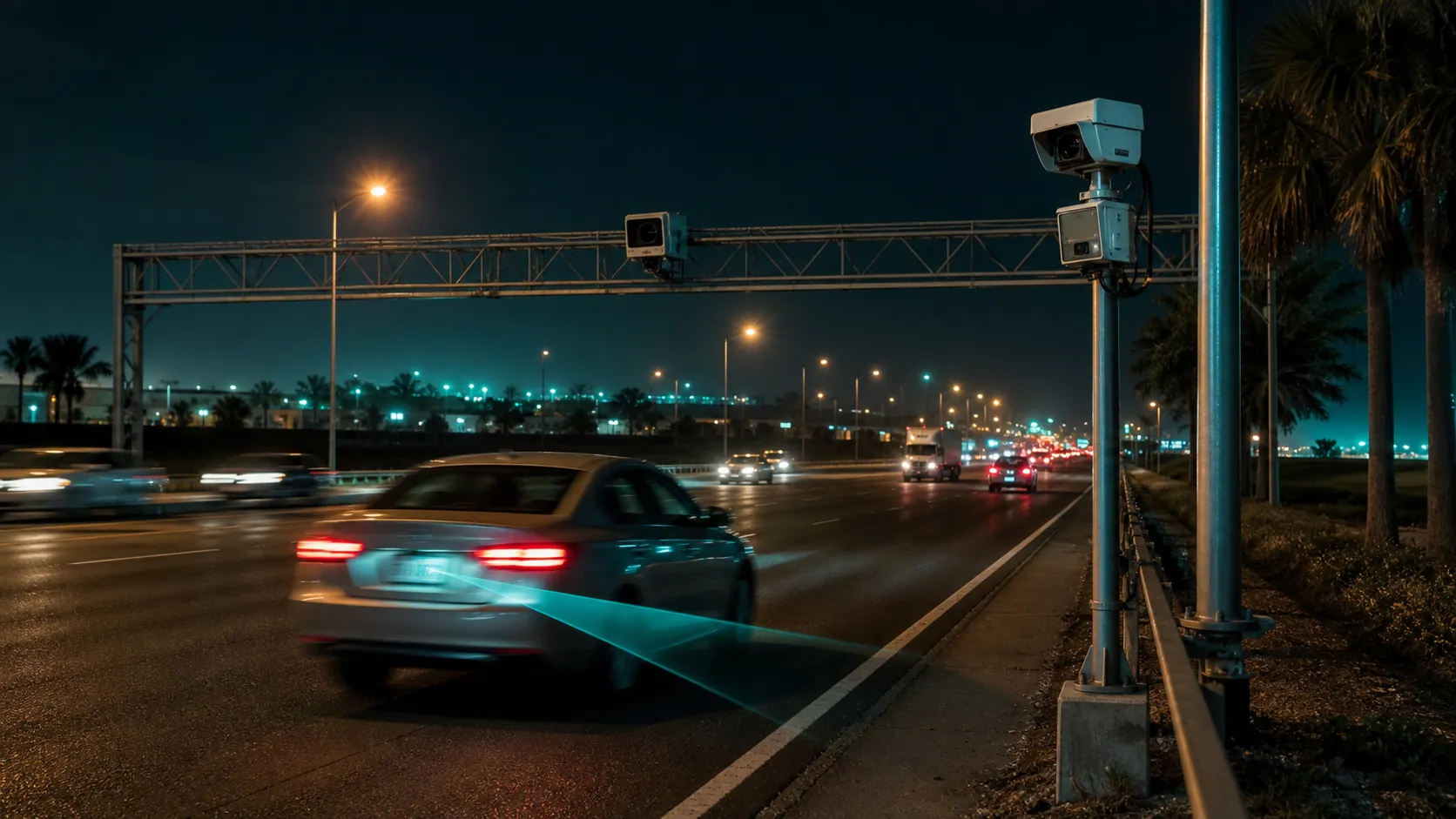
The important handoff is from roadway observation to identification
The chase allegation is the part that will get replayed. The record question is quieter: how did officers connect the green BMW, its plate or occupants, and the charged conduct across a blocked interstate, a flight sequence, and an arrest?
The arrest-affidavit reporting matters because it names FHP traffic cameras as part of the evidence trail.[2] That is not the same thing as saying the case rests only on an automated license-plate reader. A traffic camera may show a vehicle in a lane, at a location, or in a sequence. An ALPR hit, by contrast, is plate-focused data produced through optical character recognition and matched against a searched or watched plate. Those two systems can reinforce each other, but they create different trial questions.
| Evidence layer | What it may prove | What defense counsel should verify |
|---|---|---|
| FHP traffic-camera footage | Vehicle presence, lane position, traffic blockage, movement sequence, possible continuity from scene to pursuit | Camera location, timestamp, field of view, preservation, whether the same vehicle can be visually followed without assumption |
| Officer observations | Driving conduct, pursuit decisions, identification at stop or arrest, lay narration of video | Vantage point, lighting, distance, basis for recognizing the vehicle, consistency with the camera sequence |
| ALPR or plate-based data | Plate read, time and location of a plate detection, possible investigative lead | OCR accuracy, human review before reliance, retention window, sharing path, whether the alert triggered any stop or escalation |
That distinction keeps the suppression issue from becoming too broad. If the state has a visible roadway-camera sequence, a clean affidavit, and officer testimony tying the BMW to the charged conduct, a generic objection to “camera evidence” is unlikely to do much work. The better fight is over continuity and use: what each camera actually captured, who interpreted it, whether the plate or vehicle identification required a leap, and whether any automated alert was treated as confirmation before a person verified it.
Mapson makes the initial capture argument a poor center of gravity
The Eleventh Circuit’s treatment of ALPR-derived roadway data in United States v. Mapson is the reason the collection-stage challenge should be handled with discipline. In that case, the court allowed ALPR-derived information on a plain-view-style theory and treated officer testimony about the system as lay testimony rather than expert testimony.[3] That does not make every ALPR record accurate. It does mean that, in this circuit, the defense should not assume the first capture of a plate on a public roadway is the strongest suppression target.
Mapson narrows the useful question. If a camera captured a plate or vehicle traveling on an interstate, and an officer can explain how that record was used in the investigation, the state has a workable path around a broad privacy objection. The pressure then moves to foundation, reliability, and causation: what did the system read, what did a human confirm, and what investigative act followed from that record?
That is especially important in a case with multiple vehicles and a fast-moving scene. A blocked interstate involving more than 100 vehicles is a poor environment for loose identification work.[1] A court may not be troubled by the fact that a roadway camera saw a car. It may care a great deal if the state cannot show why this car, this plate, this driver, and this charge remain connected through the whole sequence.
The ALPR questions are practical, not atmospheric
Flock Safety cameras and other ALPR systems do not identify guilt. They generate plate reads, locations, timestamps, and possible matches. In a prosecution file, those records may become leads, corroboration, or timeline anchors. The danger for trial lawyers is letting the record slide from “the system produced a hit” to “the system correctly identified the charged vehicle” without making the state prove the middle steps.
The first verification point is OCR accuracy. Plate-reading systems can misread similar characters. A simple 8-versus-B confusion, or a partial obstruction, can matter if the ALPR record becomes the reason officers focused on a vehicle. In this case, the defense should request the original image, not only the text plate result; the confidence data if retained; any cropped plate image; and any audit trail showing whether a person reviewed the hit before it influenced a stop, pursuit decision, or identification.
The second point is sequence. If the prosecution uses traffic cameras to show the BMW at the takeover and later uses ALPR or other camera data to connect that vehicle to a plate or registered owner, the state should be able to walk the court through each handoff. A blurry green vehicle in one frame, a plate read at another location, and an arrest later in the night may be enough if the connective testimony is solid. They are not the same fact.
The third point is retention. Flock’s commonly discussed default retention period is 30 days, while some Florida agency practices may extend retention to three years under FDLE-guideline-based arrangements. The trial file should not leave that as an assumption. Counsel should identify the actual agency account, the governing retention setting on Aug. 1, 2026, any hold or export that preserved the record, and whether the defense received the native image or only a report generated after the fact.
The fourth point is sharing. If a Hillsborough-area agency, FHP, or another law-enforcement user accessed a Flock record, the defense needs the access path. Who searched? What plate or vehicle descriptor was entered? Was the search tied to an active investigation? Was the result shared across agencies inside permitted limits? These are not abstract privacy questions. They determine whether the evidence trail is clean enough to support the state’s identification theory.
A stop based on an unverified alert is a different problem
The known reporting does not establish that an ALPR alert caused the initial police response, the pursuit, or any later stop. That point should stay marked as unknown unless the discovery says otherwise. But if an automated plate alert did trigger an investigative decision, the record should show whether a human verified the plate image before officers acted on it.
That is where automated evidence becomes operationally risky. A verified ALPR hit used as one piece of a larger investigation is easier for the state to defend. An unverified alert that causes officers to stop or escalate against the wrong vehicle creates a cleaner defense issue, particularly if the original image shows ambiguity or if the plate text was accepted without review.
A useful discovery demand is therefore narrow. It should ask for the original ALPR images and metadata, the agency audit logs, the alert configuration, any hot-list or search entry that produced the hit, the user who received it, the time of human review, and the body-camera or radio traffic showing how the information moved from screen to street. That request is more likely to produce usable litigation facts than a broad attack on surveillance technology.
The passenger charges still depend on proof of role
The three passenger cases should not be treated as evidentiary duplicates of the driver’s case. The driver charge reported against Lugo includes aggravated fleeing to elude and participating in a street takeover.[1] Passenger exposure is different. The state still has to prove the statutory theory charged against each person and the facts that make that person more than merely present in a vehicle after a chaotic interstate event.
Camera evidence may show where the BMW was. It may show how it moved. It may support a timeline. It will not automatically prove what each passenger knew, intended, or did. If the passenger charges are ride-related, the defense review should separate vehicle identity from individual conduct: who was visible, who made statements, who possessed a phone with relevant media, who allegedly coordinated anything, and what the state can prove without importing the driver’s flight into every seat.
What the current record supports
The public-safety allegation is serious: an interstate blocked near Thonotosassa, a large group of vehicles, and a reported 140 mph flight from troopers.[1][2] Those facts explain why the case drew attention. They do not answer the evidentiary questions that will matter if the case is litigated.
On the known materials, the prosecution’s camera-collection theory likely has room to survive, especially if FHP can produce the affidavit basis, the traffic-camera sequence, and officer testimony connecting the BMW to the charged conduct. The more live defense exposure sits elsewhere: whether any automated plate read was accurate, whether it was verified before use, whether the relevant record was retained under the correct agency policy, and whether the state can prove continuity from the takeover scene to the arrest without asking the court to fill gaps created by automation.
References
- Troopers arrest four after alleged street takeover, 140 mph chase on I-75: FHP, Tampa Bay 28/WFTS
- Hundreds block Florida interstate in alleged street takeover, leading to 140 mph police chase, Fox News
- United States v. Mapson, No. 22-11159, U.S. Court of Appeals for the Eleventh Circuit
Related records
Tool profile
Browse tool evaluations →Governing regulation
Browse the obligations tracker →Preventive workflow
Browse verification workflows →
Report a correction or tip
Spotted an outdated figure, a misstated fact, or a ruling this case record should reflect? Public comments are disabled for this content given the professional cost of a misreported case outcome, penalty amount, or rule text — use the structured correction channel instead.
Report a correction or tip for this record →