
After a Fatal Tire Blowout on I-10, Which Parties Are Liable?
This record documents the May 2026 fatal I-10 Tucson truck crash that killed driver Jaime Lopez, analyzing the multi-party liability framework under Arizona law, the evidence chain complicated by a post-crash EV battery fire, and the two-year statute-of-limitations window for wrongful-death claims.
- Jurisdiction
- Arizona
- Court
- Not applicable
- AI tool named
- None
- Ruling date
- May 13, 2026
- Source document
- View primary court order ↗
- Last verified
- Jul 30, 2026
Lex Machina Review is an independent risk-tracking and reference resource. Nothing on this site is legal advice, and using it does not create an attorney-client relationship. Every record is reviewed against primary sources but may not reflect the most current status of a matter — always verify directly against the cited court order, rule text, or a licensed attorney before relying on it.
Companion explanation — secondary to the source document above
On May 13, 2026, a loaded car hauler crashed on I-10 near Valencia Road in Tucson after a reported front passenger-side steer-tire blowout. The driver, Jaime Lopez, 62, of Fontana, California, died after the truck rolled over and caught fire; no lawsuit had been publicly reported as of the June 5 law-firm update, leaving Arizona’s two-year wrongful-death limitations period still open in Q3 2026. [1][2]
For anyone evaluating legal responsibility after the fatal I-10 Tucson truck-tire blowout, the word “blowout” does not answer the legal question. It only identifies the point where the proof work begins. A steer tire can fail because of a manufacturing defect, road impact, underinflation, overload, poor maintenance, excessive wear, heat, improper repair, or some combination that will not sort itself out from a crash headline.
This record should therefore be read in a narrow posture: it is a legal-reference assessment based on local reporting, law-firm summaries, statutory and regulatory frameworks, and analogous litigation. It is not a court-tested liability finding, and it does not assume that the tire manufacturer, carrier, maintenance provider, loader, or driver’s estate is liable before the physical and documentary record is built.
The failed steer tire is the evidence problem
In an ordinary truck-tire case, the failed tire is the object everyone wants first. Experts look for belt separation, inner-liner condition, bead damage, punctures, impact marks, repair history, tread depth, weathering, inflation evidence, manufacturing identifiers, and signs of prior misuse. The Lopez crash starts with the hardest version of that inquiry because the reported failed component was the front passenger-side steer tire on a loaded car hauler, followed by a rollover and a fire involving electric vehicles being transported. [1][2]
KOLD reported that the post-crash fire tested Tucson Fire Department tools because lithium-ion battery packs complicated suppression. That fire detail matters legally less for spectacle than for preservation. If the steer-tire remnants were in or near the burn field, the primary product evidence may have been consumed, altered, or rendered far less useful for defect analysis. [3]
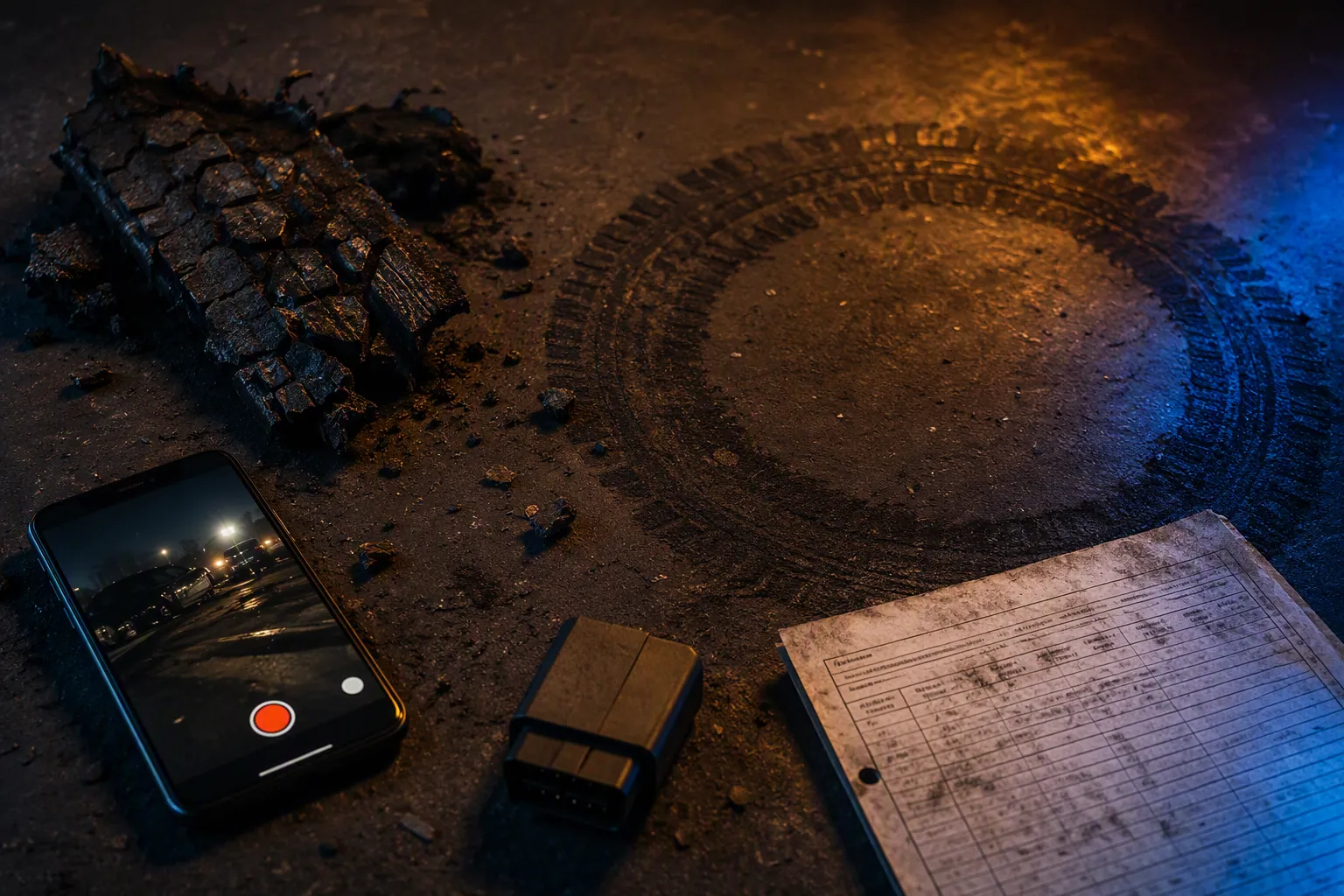
That shifts the investigation away from a clean “inspect the tire and plead the defect” path. The substitute record becomes more important: scene photographs, fire-department observations, tow-yard inventories, carrier maintenance files, inspection reports, ECM or telematics data, dashcam footage, load documentation, purchase records, tire casing history, and any pre-crash images showing the tire’s condition.
There is also an unusual non-party evidence pool. AZPM reported that the Arizona Department of Public Safety cited 67 drivers under Arizona’s Hands-Free law after they filmed the fiery crash scene in Tucson. Those citations are not liability evidence by themselves, but they may identify people who captured subpoena-reachable video or photographs of the vehicle position, fire progression, tire area, roadway debris, emergency response, or cargo configuration. [4]
| Evidence category | Why it matters | Current public posture |
|---|---|---|
| Failed steer tire remnants | Central to defect, impact, wear, inflation, and causation analysis | Likely compromised by the post-crash EV-fed fire; public reports do not identify preserved remnants |
| Tire identifiers | Manufacturer, model, DOT serial number, age, production plant, and recall or claims history depend on them | Not publicly released |
| Retread or casing status | Changes the party map and the technical failure analysis | Unknown |
| Carrier inspection and maintenance records | May show tread depth, inflation checks, replacement timing, pre-trip reports, defects noted or ignored, and compliance practices | Not public |
| ECM, telematics, and dashcam data | May show speed, braking, steering input, warning events, and vehicle movement before rollover | Not public |
| Fire-department observations and scene photos | May preserve what the fire later destroyed or altered | Potentially important because suppression involved lithium-ion battery complications |
| Bystander video | May capture the truck path, fire development, cargo, debris field, or emergency response timing | Potentially identifiable through the 67 AZDPS hands-free citations |
What is known, and what is still missing
The public record supports a limited set of crash facts: the date and location, Lopez’s identity and age, the report of a front passenger-side steer-tire blowout, the rollover, the fire, and the presence of EV battery-fire complications. It does not yet supply the official AZDPS crash report, the carrier’s full maintenance history, the tire manufacturer, the tire model, the DOT serial number, the tire age, the retread status, the tire’s pre-crash tread depth, or any filed complaint. [1][2][3]
Those omissions are not clerical. They mark the difference between a plausible intake theory and a pleading that can survive pressure. A defect theory without tire identification is incomplete. A negligent-maintenance theory without inspection records is incomplete. A driver-fault theory without vehicle data, roadway evidence, witness accounts, and maintenance context is incomplete.
Witness evidence also complicates any quick attempt to place the crash on Lopez. KOLD reported that a man and woman who witnessed the crash said Lopez’s final maneuver kept the out-of-control truck from striking their family’s SUV. That account does not legally eliminate comparative-fault arguments, but it is directly relevant to whether Lopez reacted reasonably after the reported tire failure began. [5]
Potential defendants and claims remain fact-dependent
Arizona product-liability and wrongful-death frameworks can accommodate a multi-party truck-tire case, but the law does not fill gaps in proof. The likely party map runs through the tire chain, the carrier and maintenance chain, possible loading or operational actors, and the driver’s estate only if later facts support a comparative-fault theory.
Tire manufacturer or seller
A manufacturer-facing theory would likely look to Arizona’s product-liability statutes, including A.R.S. § 12-681 et seq., and would require proof that the tire was defective and that the defect caused or contributed to the crash. In a steer-tire blowout case, the technical questions may include design, manufacturing consistency, belt adhesion, inner-liner performance, age, heat history, prior damage, and whether any warnings or instructions were adequate.
The immediate obstacle is identification. Without the manufacturer, model, DOT serial number, and tire history, the product case cannot be responsibly treated as more than a possible channel. If the failed tire remnants are gone, counsel would have to work backward from purchase records, carrier tire inventories, maintenance invoices, pre-crash inspection records, fleet photographs, surviving companion tires, and any images that captured the failed wheel position before the fire consumed or altered the evidence.
Carrier, fleet owner, and maintenance providers
The carrier and any maintenance contractor sit closer to the daily condition of the truck. Federal motor-carrier rules include tire-condition requirements under 49 CFR § 393.75, including a minimum 4/32-inch tread-depth standard for front tires, and inspection, repair, and maintenance duties under Part 396. Those rules do not prove a violation in the Lopez crash; they identify the records that should exist if the truck was being managed in compliance with commercial-vehicle duties.
The relevant files would include driver vehicle inspection reports, maintenance logs, roadside inspection history, tire replacement records, inflation checks, repair orders, lease documents, post-crash preservation notices, and any carrier policy on steer-tire age or retread use. If those records show chronic underinflation, ignored defects, overdue replacement, or inspection failures, the case changes. If they show a recent compliant inspection and no known defect, the analysis changes again.
Loading and operational actors
A loaded car hauler raises operational questions, but the public record does not yet support a loading-liability conclusion. Counsel would need weight tickets, vehicle manifests, securement records, axle-weight information, route planning, and communications about the load. A tire failure on a loaded vehicle does not automatically mean the load was improper.
Driver’s estate and comparative fault
The driver’s estate can become part of a comparative-fault analysis in some fatal commercial-vehicle cases, especially where speed, distraction, inspection conduct, or evasive steering are disputed. That channel should not be erased simply because Lopez died. It also should not be used as a shortcut before the tire, maintenance, vehicle-data, and witness record is assembled.
The reported witness account of Lopez steering away from a family’s SUV is significant because it describes conduct after the emergency began, not a generalized character judgment. A driver can be both the person who made a life-saving maneuver and a legally relevant actor whose pre-crash inspection or operation may still be examined. The record has to hold both possibilities until discovery narrows them. [5]
| Potential channel | What could be evaluated now | What likely requires discovery |
|---|---|---|
| Product liability against tire manufacturer or seller | A steer-tire blowout on a loaded commercial vehicle is a recognized defect-investigation trigger | Manufacturer, model, DOT number, tire age, defect mechanism, prior claims, and expert inspection or substitute proof |
| Carrier or fleet negligence | Commercial carriers have inspection and maintenance duties; tire condition is central | Maintenance logs, driver reports, inspection history, tire-pressure records, replacement timing, and carrier policies |
| Maintenance contractor negligence | Possible if a third party inspected, repaired, mounted, or serviced the tire | Contracts, service tickets, technician notes, repair history, and communications |
| Loading or operational negligence | Possible only if the load or operation affected tire stress or vehicle control | Weight records, cargo manifests, axle-weight data, securement records, and dispatch communications |
| Driver or estate comparative fault | Possible in principle, but witness accounts describe an evasive maneuver that may cut against a simple driver-blame narrative | ECM data, phone records if relevant, inspection conduct, speed, steering inputs, and complete witness statements |
The Walsh/Goodyear I-40 case is an analogy, not a prediction
The closest public analogue in the current record is not an Arizona precedent. InvestigateTV reported on active litigation arising from a July 2023 I-40 crash in New Mexico that killed three people, where plaintiffs alleged an inner-liner defect in a Goodyear tire. The case is useful because it shows how a catastrophic truck-tire failure can become a defect-focused lawsuit; it does not establish that the Lopez tire was defective, that Goodyear was involved, or that an Arizona court would treat the facts the same way. [6]
Its practical value is procedural. A blowout-defect case usually turns on tire identification, expert reconstruction, preservation fights, company records, prior-incident evidence, warnings, testing history, and alternative-cause defenses. If the primary tire evidence in the Lopez crash was destroyed or badly altered by fire, those same categories become harder, not irrelevant.
National tire-failure data supplies context, not liability
The Lopez crash also fits a broader safety and litigation pattern. InvestigateTV identified more than 200 fatal large-truck crashes from 2021 through 2023 in which a tire issue was cited as a cause or contributing factor, involving 173 deaths. The same reporting cited NHTSA’s figure of 511 tire-related crash fatalities overall, a category that includes passenger vehicles and light trucks rather than only large commercial trucks. [6]
The maintenance context is not abstract either. InvestigateTV reported that tire problems were the top vehicle out-of-service violation in FMCSA data for 2024 and 2025, with about 250,000 vehicles cited and roughly 84% of those tire violations involving flat, leaky, or underinflated tires. Those figures support the modest conclusion that tire condition is a recurring commercial-vehicle enforcement problem; they do not prove what happened to Lopez’s front passenger-side steer tire. [6]
That distinction matters. National statistics can justify urgency, expert attention, and preservation. They cannot substitute for the missing DOT number, maintenance file, inflation history, or physical tire analysis in a specific Arizona crash.
The open deadline is longer than the evidence window
As of Q3 2026, the legal filing window appears open. Arizona’s general two-year personal-injury and wrongful-death limitations framework under A.R.S. § 12-542 would place a May 13, 2026 crash on a May 13, 2028 outside deadline, absent tolling or case-specific complications. The June 5 law-firm update reported no publicly filed lawsuit in the Lopez crash. [1]
The evidence window is less forgiving. Physical tire remnants may already be gone or compromised. The truck, trailer, transported vehicles, surviving tires, ECM modules, camera systems, maintenance files, dispatch records, inspection reports, tow-yard materials, fire-department photographs, and bystander videos can disappear on ordinary business timelines unless preservation letters, subpoenas, or court orders reach them quickly.
That is the central legal posture of the Lopez crash in 2026. Liability remains multi-party and fact-dependent. The urgent issue is preservation before the remaining record becomes as unavailable as the failed tire may already be.
References
- Jaime Lopez Dies in Crash After Truck Has a Tire Blowout on I-10 Near Valencia Road — Ammons Law, June 2026.
- Hero truck driver killed in rollover crash on I-10 in Tucson identified — KOLD, May 19, 2026.
- Deadly rollover crash involving EVs in Interstate 10 tests TFD's tools — KOLD, May 15, 2026.
- AZDPS cited 67 people in Tucson after drivers filmed fiery truck crash — AZPM, June 2026.
- Man, woman who witnessed fatal I-10 crash say truck driver's final maneuver saved their lives — KOLD, May 15, 2026.
- Big-rig blowouts highlight safety tech gap on US highways — InvestigateTV, March 30, 2026.
Related records
Tool profile
Browse tool evaluations →Governing regulation
Browse the obligations tracker →Preventive workflow
Browse verification workflows →
Report a correction or tip
Spotted an outdated figure, a misstated fact, or a ruling this case record should reflect? Public comments are disabled for this content given the professional cost of a misreported case outcome, penalty amount, or rule text — use the structured correction channel instead.
Report a correction or tip for this record →