
Idaho Murders: Digital Forensics Tool Risks Under Daubert
This article examines the three categories of digital and technical evidence in the Kohberger case—phone extraction, forensic genealogy, and cell-tower mapping—to identify documented admissibility risks under Daubert and Frye standards, providing counsel with a practical checklist for challenging or relying on such evidence.
- Jurisdiction
- US-Idaho
- Court
- Idaho state court
- AI tool named
- Cellebrite UFED
- Ruling date
- Jul 1, 2025
- Source document
- View primary court order ↗
- Last verified
- Jul 30, 2026
Lex Machina Review is an independent risk-tracking and reference resource. Nothing on this site is legal advice, and using it does not create an attorney-client relationship. Every record is reviewed against primary sources but may not reflect the most current status of a matter — always verify directly against the cited court order, rule text, or a licensed attorney before relying on it.
Companion explanation — secondary to the source document above
The unresolved posture controls the evidence analysis
The public record in the Idaho murders contains grief, accusation, and technical claims. For admissibility purposes, the starting point is narrower: Bryan Kohberger pleaded guilty in July 2025, so the case did not produce an adversarial Daubert hearing testing the prosecution’s Cellebrite extraction, investigative genetic genealogy, or cell-site mapping in this specific prosecution.[1]
That caveat is not procedural housekeeping. It is the reason the case is useful, and also the reason it is easy to overstate. The reported legal case details that matter here are limited: the King Road residence, the DNA on the knife sheath, the phone going silent from about 2:47 a.m. to 4:48 a.m. on November 13, 2022, and reported cell-tower activity used to place Kohberger’s phone near relevant areas.[2]
No Idaho ruling in this case tells lawyers that a particular Cellebrite UFED method, genetic genealogy workflow, or cell-tower map satisfied Daubert or Frye. The risk assessment has to come from adjacent materials: Cellebrite Daubert/Frye preparation guidance, reported case timelines, scholarship on investigative genetic genealogy, and the reported defense challenge to the cell-phone mapping.[1][2][3][4]
| Evidence category | Reported role in the case | Main admissibility pressure point | What the plea left unresolved |
|---|---|---|---|
| Cellebrite / phone extraction | Phone activity and inactivity helped frame the movement narrative around the homicide window.[2] | Whether the exact tool version and extraction method used were validated for the device, operating system, and artifacts at issue. | No litigated ruling on method-specific reliability, error rates, or expert foundation in this prosecution. |
| Othram / GEDmatch / MyHeritage genealogy | SNP genotyping and genealogy searching reportedly helped develop an investigative lead from knife-sheath DNA.[4] | Scientific reliability plus Fourth Amendment, policy, and consent problems tied to database searching. | No ruling on whether the reported search process, including consent-policy compliance, could survive suppression or reliability challenges. |
| Cell-tower mapping | Phone pings and periods of silence helped support a location narrative.[2] | Whether the map fairly reflected raw carrier data, uncertainty, gaps, and alternative interpretations. | No adversarial resolution of the defense claim that the prosecution’s location presentation was distorted or incomplete.[1][2] |
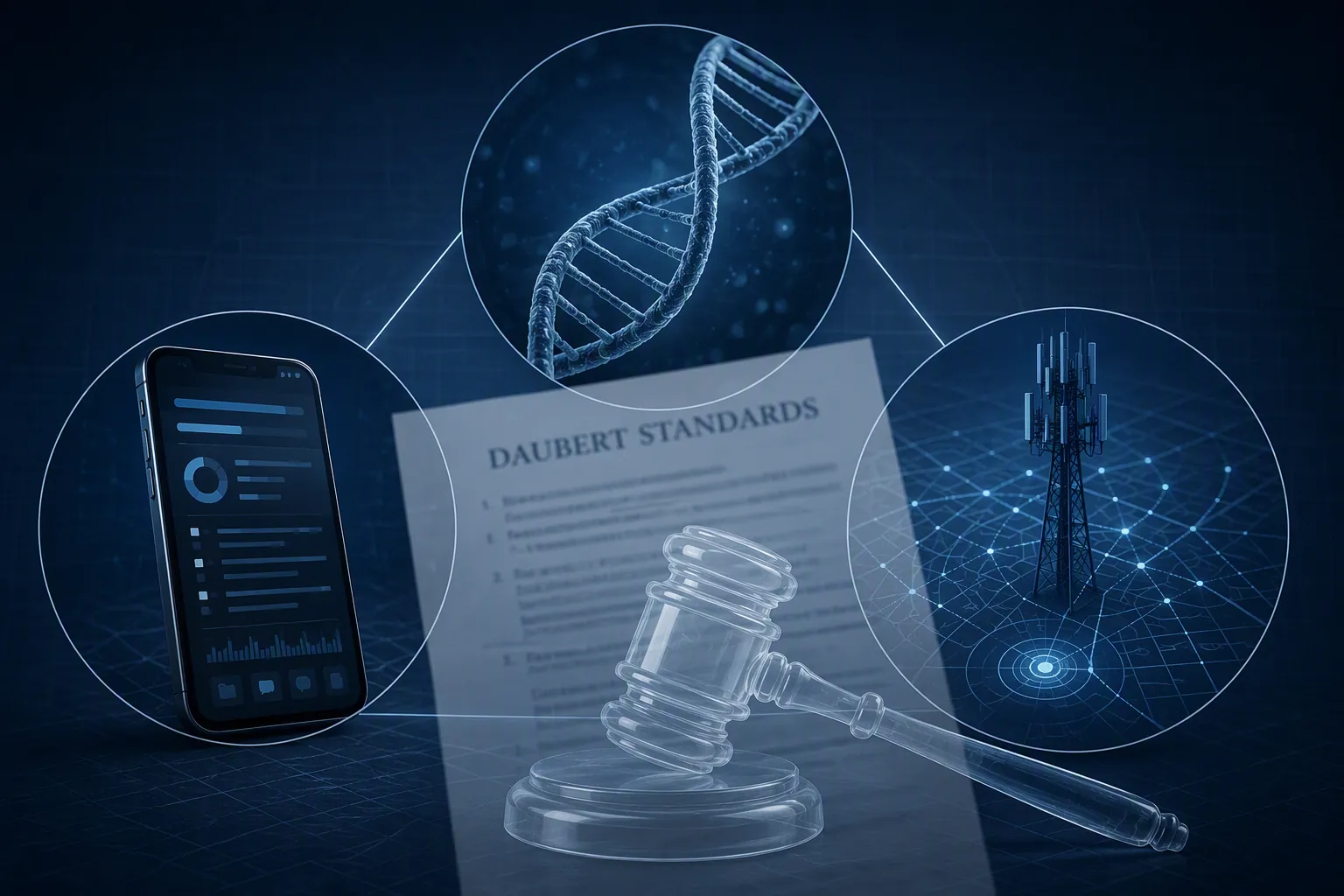
Cellebrite evidence: the brand name is not the foundation
Cellebrite is not a fringe tool. That is exactly why lawyers can get careless with it. A phone extraction report looks clean: timestamps, device identifiers, application artifacts, deleted or live data, and an exhibit-ready summary. In a file cabinet, the same evidence should raise more granular questions: which UFED version, which extraction type, which device model, which operating system, which artifact parser, which validation study, and which known or published error rate.
The Forensic Resources Daubert/Frye preparation material for Cellebrite UFED is useful because it does not treat “Cellebrite” as one admissibility object. It directs counsel toward version-specific and method-specific proof: the particular UFED release, the extraction method, available validation studies, published error rates, and whether the expert can actually defend the method used rather than the vendor’s general reputation.[3]
That distinction matters in a case where the phone evidence was part of the timeline. The reported blackout from about 2:47 a.m. to 4:48 a.m. is not merely a fact to drop into a map; it is a conclusion built from records, device behavior, extraction choices, and interpretation.[2] If a witness says the phone “went dark,” counsel still has to ask what data source proves that proposition: handset extraction, carrier records, application artifacts, network logs, or some combination.
A prosecutor trying to use this evidence has a foundation problem that should be solved before motion practice, not during cross-examination. The file should identify the UFED version and build, the device and operating-system information, the extraction type, the examiner’s steps, lab validation, and any limitations known for the artifact categories being offered. If the report relies on parsed artifacts, the expert should be able to explain how the parser was validated and what was checked manually.
A defense lawyer has the mirror-image task. The useful attack is not “Cellebrite is unreliable” in the abstract. The useful attack is that this extraction, from this device, using this method, interpreted through this parser, has not been shown reliable enough for the proposition the proponent wants the jury to accept. A tool may accurately copy one category of data and still be weak support for a broader behavioral inference.
The clean exhibit is often where the overstatement enters. A phone extraction can show that a record exists, that an artifact was parsed, or that a timestamp appears in a database. It may not, without more, show who physically held the phone, why a setting changed, whether a gap reflects intentional concealment, or whether a timestamp has the meaning counsel wants to assign it. Those are separate evidentiary steps, and each one needs its own foundation.
Forensic genealogy has two failure surfaces, not one
The genetic genealogy issue is different from Cellebrite because the admissibility problem is not only technical reliability. It is also the lawfulness and policy posture of the search. UNC Journal of Law & Technology scholarship reports that the FBI used Othram’s SNP genotyping to develop a DNA profile from the knife-sheath sample and uploaded it to GEDmatch and MyHeritage without user opt-in consent, contrary to then-current DOJ policy for forensic genetic genealogy searches.[4]
That reported policy mismatch is not a decorative privacy objection. It is a concrete litigation seam. Counsel would need to know who made the upload, under what authority, under which platform terms, under which DOJ policy version, whether the database users had opted in, whether the government obtained a warrant or other legal process, and what information the search returned. A genealogy lead is not the same thing as a courtroom identification, but the path from one to the other still matters.
The scientific side also deserves precision. SNP genotyping for investigative genealogy is not the same courtroom object as a traditional STR match offered as direct proof that a particular person left DNA at a scene. The genealogy search may identify relatives, family trees, and investigative leads. If the case later uses conventional DNA testing to connect a suspect to an item, counsel should separate the lead-generation step from the confirmatory step instead of letting the word “DNA” flatten both into a single claim.
For prosecutors, that separation can protect the case. The government may be able to argue that genealogy was only an investigative lead and that trial evidence rests on later, independently admissible testing. But that argument is weaker if discovery is thin, if the genealogy process is described vaguely, or if policy noncompliance is minimized. A court may treat a DOJ policy violation differently from a Fourth Amendment violation, but counsel should not assume the former has no effect on credibility, suppression briefing, or discovery obligations.
For defense counsel, the strongest questions are not limited to whether Othram’s laboratory work was scientifically competent. They include whether the government search exceeded user consent, whether a private vendor was acting as an agent of law enforcement, whether platform terms permitted the search, whether the search scope was broader than disclosed, and whether any later warrant affidavit or probable-cause showing depended on a genealogy lead that should have been described more carefully.
This is where the Kohberger case remains more warning than precedent. The reported genealogy workflow attracted serious legal-policy concerns, but the guilty plea left those questions without the kind of suppression ruling or Daubert record that lawyers could cite as validation or rejection.[1][4]
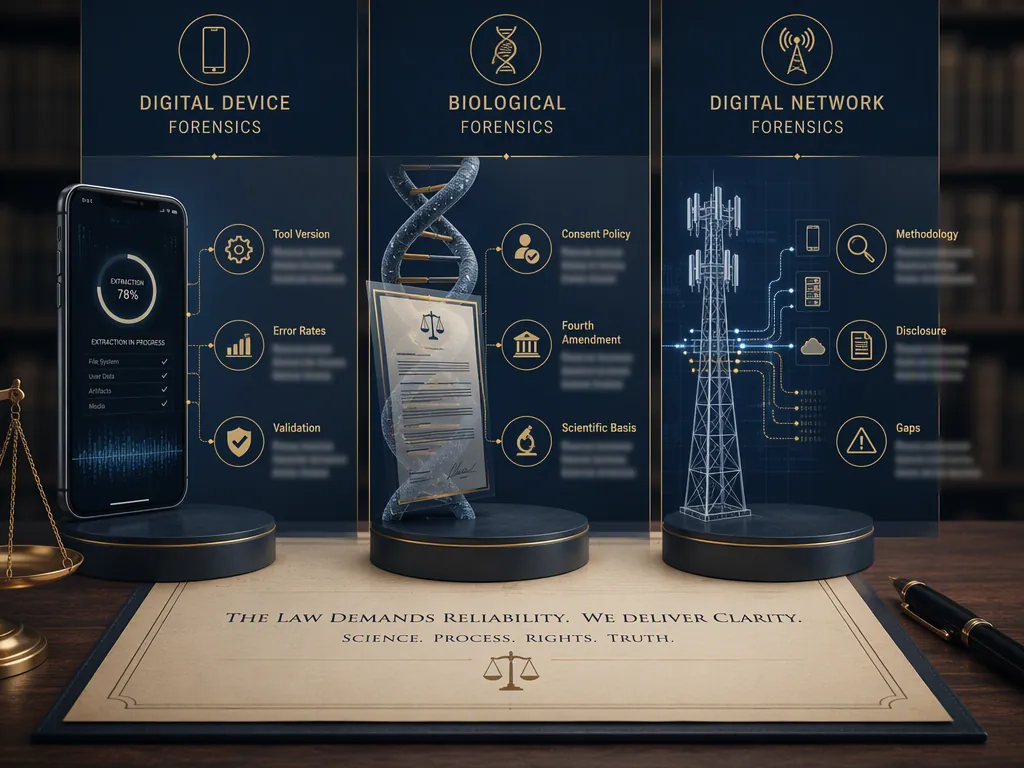
Cell-tower mapping: the map is an argument about the data
Cell-site evidence often arrives in court wearing the costume of geography. A dot, a tower, a coverage shape, a road, a time. The danger is that the map can make uncertain data look measured to the curb. In the reported Kohberger timeline, phone silence and tower activity mattered because they helped frame movement before and after the homicides.[2]
The defense retained cell-phone data expert Sy Ray, who reportedly challenged the prosecution’s cell-phone data presentation as distorted and argued that exculpatory gaps had not been properly disclosed.[1][2] Whether that claim would have succeeded is unknowable from the final posture of the case. The point for other cases is narrower: a cell-site map is not the raw carrier return, and counsel should not treat it as if it were.
A fair cell-site presentation should let the other side test the underlying records, not just the demonstrative. That means carrier records, tower and sector information, timing, any mapping software or methodology, assumptions about coverage, excluded records, and the handling of gaps. If the exhibit emphasizes inculpatory pings but does not show non-pings, ambiguous data, or periods where the phone generated no usable location signal, the exhibit may be persuasive without being complete.
The recurring trial problem is over-translation. A record may support that a device connected to a tower or sector at a time. It may not support that the device was at a specific house, on a specific street, or traveling a specific route unless the expert has supplied the additional method and uncertainty analysis. Cross-examination should force the witness to identify each step from raw network event to location conclusion.
Counsel checklist before relying on or attacking the evidence
The practical checklist comes after the failure modes because the questions only matter when they are tied to the claim being offered. A lawyer does not need a ritual demand for every technical file in every case. The demand should match the proposition the expert wants the court or jury to accept.
- For phone extractions: identify the tool, exact version and build, extraction type, device model, operating system, acquisition logs, examiner notes, lab validation, vendor documentation, published or known error rates, and any manual verification of key artifacts.
- For Cellebrite testimony: ask whether the expert is defending the specific method used or speaking generally about UFED. A general reputation foundation should not substitute for method-specific reliability.
- For timestamps and gaps: separate what the extraction shows from what counsel wants to infer. A missing activity record, a powered-off period, airplane mode, network unavailability, or unsupported artifact interpretation can point in different directions.
- For forensic genealogy: obtain the policy version, platform terms, consent settings, upload history, vendor communications, agency approvals, warrant or subpoena materials, and the complete path from genealogy lead to later confirmatory testing.
- For genetic-search motions: distinguish scientific reliability from constitutional and consent questions. A lab method can be technically sound while the search process remains vulnerable.
- For cell-site evidence: demand raw carrier records, tower and sector data, mapping methodology, software settings if any, excluded records, uncertainty explanations, and a disclosure of gaps that cut against the proponent’s route narrative.
- For expert reports: require the witness to state the exact proposition supported by the data. “Consistent with” should not be allowed to become “placed at” without additional foundation.
- For motions in limine or Daubert/Frye briefing: ask the court to rule at the level of the method and conclusion, not at the level of the product name, vendor, or investigative popularity.
The hardest version of this work is often defensive rather than aggressive. If your own expert used a forensic tool, the file should already contain the validation and limitation material that an opponent will request. If it does not, the problem is not only cross-examination exposure. It is also the risk that a late-stage evidentiary fight forces the trial team to reverse-engineer a foundation for a technical claim already embedded in the case theory.
What the Kohberger case should not be cited for
The Kohberger matter should not be cited as a judicial endorsement of Cellebrite, Othram, GEDmatch, MyHeritage searching, or cell-tower mapping. The plea left the tool questions unresolved. That does not mean the investigation was unsound, and it does not mean the evidence would have been excluded. It means the admissibility work was never completed in public through an adversarial reliability hearing.
Its value is more disciplined than that. It shows where the courtroom pressure points sit when technical evidence moves from lead generation to proof: tool-version evidence, extraction-method validation, published or known error rates, genetic-search consent and policy compliance, and full disclosure of location-data gaps. Those are the places where a confident slide presentation starts to become a litigable record.
References
- 2022 Idaho student murders — Wikipedia
- Inside Idaho Murder: How Digital & DNA Forensics Uncovered Truth — SANS
- Preparing Testimony About Cellebrite UFED in a Daubert or Frye Hearing — Forensic Resources
- The Wild West of Investigative Genetic Genealogy — UNC Journal of Law & Technology
Related records
Tool profile
Browse tool evaluations →Governing regulation
Browse the obligations tracker →Preventive workflow
Browse verification workflows →
Report a correction or tip
Spotted an outdated figure, a misstated fact, or a ruling this case record should reflect? Public comments are disabled for this content given the professional cost of a misreported case outcome, penalty amount, or rule text — use the structured correction channel instead.
Report a correction or tip for this record →