
Idaho murders documentary warns of AI evidence risks
The Kohberger investigation's digital evidence battles foreshadow a broader admissibility crisis as AI tools become embedded in forensic analysis. This case companion explains the key evidence chains and what practitioners should watch for under Daubert and proposed FRE 707.
- Jurisdiction
- Idaho, United States
- Court
- Idaho District Court (Latah County)
- AI tool named
- probabilistic genotyping system
- Ruling date
- Feb 1, 2025
- Source document
- View primary court order ↗
- Last verified
- Jul 31, 2026
Lex Machina Review is an independent risk-tracking and reference resource. Nothing on this site is legal advice, and using it does not create an attorney-client relationship. Every record is reviewed against primary sources but may not reflect the most current status of a matter — always verify directly against the cited court order, rule text, or a licensed attorney before relying on it.
Companion explanation — secondary to the source document above
The Netflix documentary about the Idaho murders arrived at a procedurally awkward moment. It was released on July 29, 2026, just as Bryan Kohberger’s July 27 petition to withdraw his guilty plea put the case back into legal circulation; CNN’s reporting also notes expert skepticism about the odds of undoing the plea under Idaho’s post-sentencing standard.[1] That timing makes the documentary useful, but not as a scene-by-scene authority on the case.
The narrower question is more durable: which evidence chains in the Kohberger investigation would survive serious foundation, reliability, and authentication pressure if they had to be tried, and what happens when the same categories are increasingly processed through AI-assisted forensic tools?
That question does not require claiming that AI fabricated evidence in Kohberger. It also does not require predicting whether the plea-withdrawal effort succeeds. The useful work is in the record already visible: cell-phone geolocation, investigative genetic genealogy, device extraction, browser artifacts, blackout periods, and purchase records. Each sounds straightforward when compressed into a documentary phrase. Each is less straightforward when a lawyer asks what was collected, what was missing, who interpreted it, and which assumptions turned raw artifacts into courtroom meaning.

The Case Is a Better Evidence Map Than a Streaming Hook
The digital-forensics account published by SANS is unusually concrete. Heather Barnhart, identified there as the SANS DFIR Curriculum Lead, led the team that examined Kohberger’s phone and hard drive. The account describes a phone blackout from 2:54 a.m. to 4:48 a.m., downloads of materials concerning more than 20 serial killers, graphic autofill search terms, and an Amazon knife purchase record.[2]
Those details matter because they are not one thing. A phone blackout is a time-window inference. Downloads and browser artifacts are device-level artifacts that require extraction, preservation, parsing, and attribution. Autofill terms are not the same evidentiary object as a typed query, a saved page, or a downloaded file. A purchase record must be tied to an account, a transaction, a device or user context, and a chain of records sufficient to make the exhibit usable.
The SANS account is valuable because it points to artifacts rather than treating “digital footprint” as a substitute for proof. But the courtroom question is not whether the artifacts sound incriminating in sequence. It is whether each artifact can be authenticated and explained without overstating what the collection method can show.
| Evidence category | What it can appear to show | Where the foundation fight begins |
|---|---|---|
| Cell-phone geolocation | Approximate device movement or location in a relevant window | Source records, tower data, provider metadata, mapping assumptions, and expert methodology |
| Investigative genetic genealogy | A lead generated from DNA comparison and family-tree research | Database use, privacy doctrine, lab process, genealogy method, and scope of suppression remedy |
| Device blackout period | A period when a phone was apparently not communicating or not producing expected location data | Whether the gap reflects deliberate action, technical conditions, device state, network behavior, or missing records |
| Browser and download artifacts | Searches, page visits, downloads, or autofill suggestions connected to a device | Extraction method, artifact type, user attribution, timestamp reliability, and interpretive limits |
| Amazon purchase record | A transaction connected to an item and account | Business-record foundation, account attribution, delivery or possession link, and user-access assumptions |
Cell-Tower Evidence Shows the Problem Before AI Enters the Room
The cell-phone geolocation dispute is the cleanest warning because it does not need a futuristic premise. CNN’s timeline reports that Kohberger’s defense challenged the reliability of cell-phone geolocation evidence. Defense expert Sy Ray testified that missing AT&T source data and “piecemealing” of records made some prosecution analysis statements “incredibly inaccurate.”[3]
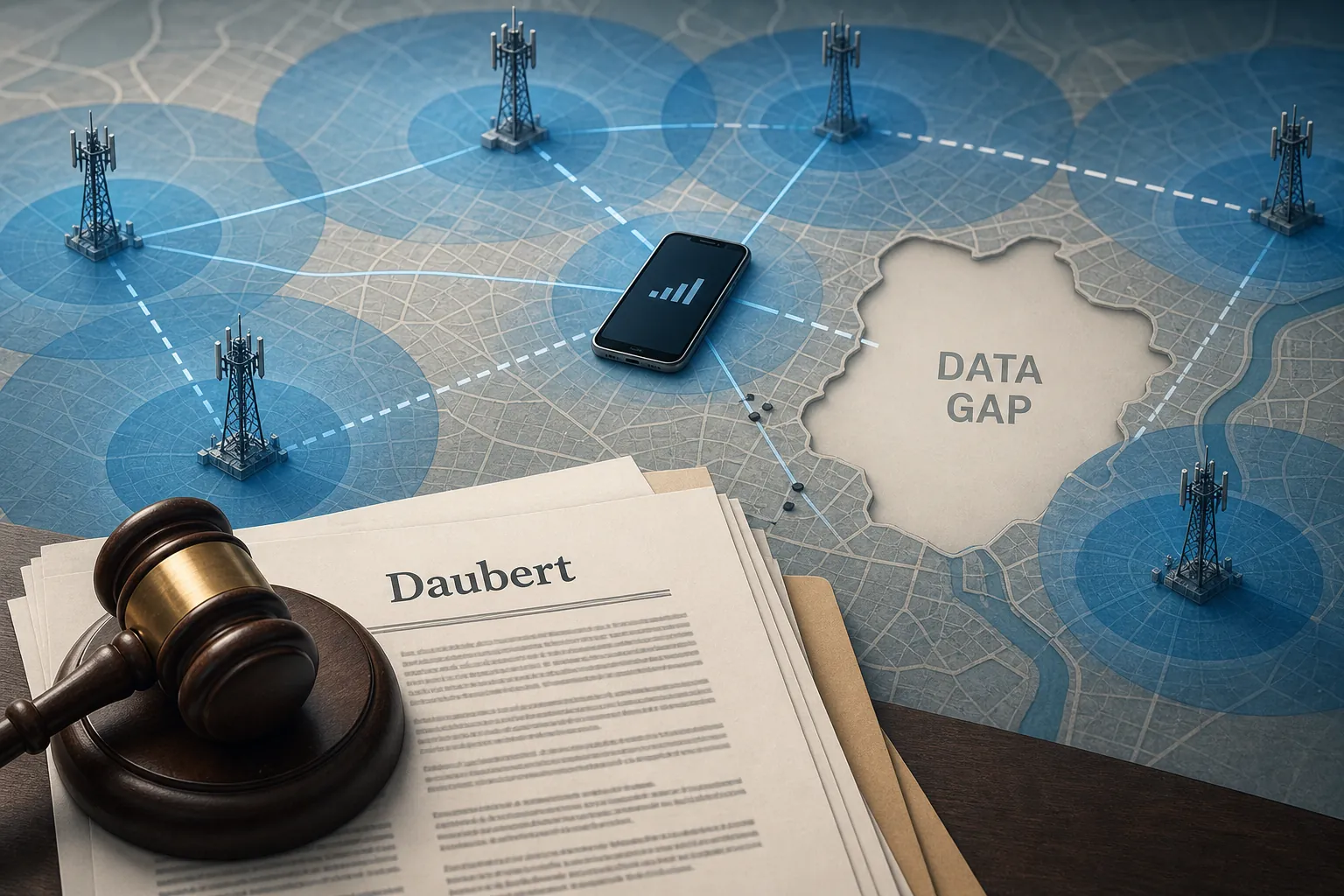
That is not a minor quarrel about graphics. If source data is missing, the dispute begins before the jury sees a map. A location opinion can depend on call-detail records, provider-specific fields, tower-sector information, timing data, handset behavior, network load, propagation assumptions, and the analyst’s decision to include or exclude records. A persuasive exhibit may show a neat route. The admissibility fight asks whether the route is an expert reconstruction built from complete and reliable inputs, or a narrative laid over fragments.
The phrase “piecemealing” is especially important for AI evidence risk. AI-assisted geolocation tools can make fragmentation less visible. A system may normalize provider records, infer likely positions, smooth gaps, rank possible movements, or generate confidence-like outputs. None of that is inherently inadmissible. But the more the tool hides intermediate decisions, the harder it becomes for counsel to test whether the output rests on missing carrier data, a model assumption, or an analyst’s post hoc selection.
Under Daubert, the familiar questions still matter: testing, error rate, peer review, standards, and general acceptance. In this setting, however, they have to be asked at the right level. It is not enough to say that cell-site analysis is generally accepted, or that mapping software is commonly used. The party offering the evidence should be able to identify the source records, the preprocessing steps, the tool’s role, the human analyst’s role, the validation evidence for the specific method, and the way uncertainty was represented.
IGG Is Innovation Arriving Before Doctrine Settles
Investigative genetic genealogy occupies a different evidentiary posture. It is often a lead-generation method before it is trial proof, but suppression fights can still determine whether the investigative path remains usable. CNN reports that Kohberger’s defense challenged investigative genetic genealogy on Fourth Amendment grounds and that the judge denied suppression in February 2025.[3]

The suppression ruling does not make IGG simple. It shows the more common sequence: forensic innovation reaches investigators, produces a lead, and then doctrine has to decide how privacy, database access, genealogy work, and downstream warrants fit together. A judge may deny suppression while leaving future litigants with significant disputes over scope, consent, database terms, minimization, expert disclosure, and whether the genealogy work is being offered as proof or as investigative background.
AI complicates that already crowded record. Forensic DNA interpretation tools, probabilistic genotyping systems, kinship inference, and pattern-recognition methods can all sit near the DNA-to-identity pipeline. The legal problem is not that a computer touched the evidence. The problem is that counsel may receive a result without enough visibility into the model, training or validation population, laboratory workflow, parameter choices, analyst overrides, and error behavior in conditions comparable to the case.
For IGG, the authentication question also has a translation problem. A genealogical lead may be investigative, while a later DNA comparison may be evidentiary. If those stages are blurred, a factfinder can hear the authority of “DNA” without understanding which part came from a lab test, which part came from genealogy research, and which part came from inferential software or analyst judgment. That boundary matters because different stages carry different legal risks.
Browser Artifacts and Purchase Records Need Less Drama, More Accounting
The browser-history and purchase-record material is easier to sensationalize than to authenticate. SANS describes downloads of materials involving more than 20 serial killers, graphic autofill search terms, and an Amazon knife purchase record.[2] In a true-crime frame, those facts tend to become character evidence by atmosphere. In litigation, they are a chain of custody and interpretation problem.
A device artifact should be identified with precision. Was it a typed search, an autofill suggestion, a cached page, a download record, a thumbnail, a synced artifact, a cloud history item, or a remnant from an application database? Was the timestamp created by the device, a browser, a server, an extraction tool, or a later parsing process? Was the artifact tied to a user session or merely to a device that more than one person could access? The answers do not necessarily exclude the evidence, but they control how much weight it can fairly bear.
The blackout period belongs in the same accounting exercise. A phone not reporting during a relevant window may be powerful when paired with other evidence. Standing alone, it still requires care: a device can be off, disconnected, out of coverage, in airplane mode, inactive, damaged, shielded, or simply absent from the available records. The inference that a blackout was deliberate has to be earned from surrounding proof, not smuggled in through the word itself.
Purchase records raise their own modest but important foundation questions. A business record can show a transaction. It does not automatically show who clicked, who paid, who received, who possessed, or who used an item. Those links may be provable, but each link is separate. A clean exhibit should not make them appear fused.
The AI Authentication Layer
Once the conventional disputes are visible, the AI problem becomes less abstract. The same categories that made Kohberger’s evidentiary record contested are categories where AI-assisted tools are already attractive: location analysis, DNA interpretation, video enhancement, facial or object recognition, anomaly detection, timeline generation, and pattern matching across large datasets. Industry-facing commentary in 2026 describes digital evidence, AI, and risk as converging operational concerns for forensic and discovery teams.[4]
The National Center for State Courts has warned that “AI-generated evidence is a threat to public trust in the courts.”[5] The warning is not limited to deepfakes. Public trust is also strained when an exhibit looks technical enough to be objective but the court cannot determine whether it is a human interpretation, a machine-generated reconstruction, an AI-enhanced artifact, or a hybrid output whose most important assumptions are undocumented.
A 2026 SSRN study found that courts “exhibit variability in acceptance of AI evidence due to limited technical literacy and lack of standardized validation protocols.”[6] That variability is predictable. Courts are being asked to evaluate tools whose vendors may treat model details as proprietary, whose validation studies may not match the case conditions, and whose outputs can be difficult to separate from ordinary-looking forensic reports.
Proposed Federal Rule of Evidence 707, described in practitioner commentary in May 2025, would create a specific authentication framework for AI-generated materials.[7] Whatever its final form, the proposal is a useful signal: ordinary authentication doctrine may not be enough when the exhibit’s apparent content depends on a generative or AI-assisted process. Rule 901 asks whether evidence is what the proponent claims it is. AI evidence often adds another question: what exactly is the proponent claiming the system did?
That question has practical consequences. If AI upscales a surveillance video, the proponent may claim the exhibit merely improves visibility. The opponent may argue that the tool generated details not present in the original. If software ranks a likely device location, the proponent may call it an analytical aid. The opponent may ask whether the system inferred movement from incomplete carrier data. If an AI-assisted DNA tool contributes to a kinship or mixture interpretation, the court needs to know whether the output reflects validated statistical inference, analyst judgment, or an opaque model result.
What Counsel Should Demand Before Treating the Output as Courtroom-Ready
The first demand is source-data access. In the cell-tower dispute, the reported criticism centered on missing AT&T source data and piecemealed records.[3] AI does not cure that defect. A model cannot make absent provider data complete; at most, it can infer around the absence. That inference may be useful for investigation, but admissibility requires a record showing what was missing and how the gap affected the result.
- Preserve the original evidence separately from any AI-enhanced or AI-generated derivative.
- Identify every tool used, including version, settings, model type where known, and whether the tool produced an output or merely assisted an analyst.
- Document preprocessing steps, excluded records, missing data, manual edits, analyst overrides, and post-processing.
- Request validation materials that match the task actually performed, not generic vendor statements about accuracy.
- Separate investigative leads from evidence offered for the truth of the matter asserted.
- Force the proponent to state the claim precisely: enhancement, classification, inference, identification, reconstruction, or timeline synthesis.
For procurement teams, the same list should become a buying requirement before a forensic tool enters the organization. A tool that cannot produce audit logs, preserve intermediate steps, identify model changes, or support expert testimony may be operationally convenient and litigation-hostile at the same time.
For trial teams, the immediate motion practice should stay disciplined. Do not challenge “AI” as a category if the record shows only ordinary digital extraction. Do not accept “human reviewed” as a complete answer if the human reviewer lacked access to inputs, settings, or validation materials. The admissibility argument should attach to the specific task the tool performed and the specific proposition the party wants the factfinder to accept.
Daubert Still Matters, but It Needs a Better Record
Daubert remains the baseline gatekeeping structure. It is still the place to test whether a method can be and has been tested, whether it has a known or knowable error rate, whether standards govern its use, and whether it is accepted in a relevant expert community. The mistake is to ask those questions at the level of branding.
A forensic vendor’s tool may be accepted for one task and weak for another. A DNA interpretation system may be validated for certain mixture conditions but not for the case conditions presented. A video-enhancement workflow may preserve edges in one setting and hallucinate detail in another. A location-analysis platform may perform well with complete records and degrade when carrier fields are missing. Daubert is useful only if counsel forces the method into that level of specificity.
Proposed FRE 707-style authentication would not replace that inquiry. It would sit closer to the exhibit’s identity and provenance: whether the AI-generated or AI-assisted material is what the proponent claims, whether the process is disclosed enough to evaluate, and whether the output has been preserved in a way that allows meaningful challenge. That is a different pressure point from expert reliability, and in AI-heavy forensic work both pressure points may be necessary.
Practitioners working through adjacent problems can use the same architecture across domains: AI-upscaled video, AI evidence authentication, proposed FRE 707 disclosures, and social-media artifact authentication all turn on provenance, method visibility, and the difference between an original record and a machine-mediated version of that record.
The Practical Lesson From Kohberger’s Evidence Fights
The murders themselves do not make the forensic claims self-proving. That is the uncomfortable discipline required in a case like this. Brutal facts may explain why investigators moved quickly and why the public remains fixed on the case, but admissibility still depends on collection, preservation, interpretation, disclosure, and a method that can be defended under cross-examination.
If Kohberger’s plea stands, many of the evidentiary disputes may never receive the trial testing that practitioners would prefer. If the plea challenge succeeds, the fights over cell-site evidence, IGG, and digital artifacts could regain immediate procedural force. Either way, the case is already useful because it shows how fragile digital proof can become before AI is added.
Counsel should treat AI-assisted forensic outputs in these domains as presumptively vulnerable until the proponent can produce validation protocols, source-data access, chain-of-custody records, and method disclosures sufficient for Daubert and any emerging FRE 707-style authentication demand. The point is not to exclude modern forensic tools on sight. It is to keep a polished output from substituting for a foundation.
References
- What experts say about Bryan Kohberger's chances of reversing his plea deal — CNN, 2026-07-28.
- Inside the Idaho Murders: How Digital and DNA Forensics Helped Uncover the Truth — SANS.
- Docuseries recounts Idaho student murders as Bryan Kohberger seeks plea change — CNN.
- Forensics And Futures: Navigating Digital Evidence, AI, And Risk in 2026 — LCG Discovery.
- AI-generated evidence is a threat to public trust in the courts — National Center for State Courts.
- SSRN study on judicial acceptance of AI evidence — SSRN, 2026.
- Quinn Emanuel client note on proposed Federal Rule of Evidence 707 — Quinn Emanuel, May 2025.
Related records
Tool profile
Browse tool evaluations →Governing regulation
Browse the obligations tracker →Preventive workflow
Browse verification workflows →
Report a correction or tip
Spotted an outdated figure, a misstated fact, or a ruling this case record should reflect? Public comments are disabled for this content given the professional cost of a misreported case outcome, penalty amount, or rule text — use the structured correction channel instead.
Report a correction or tip for this record →