
Intel AI Data Center Growth Creates Legal Risks for Chip Buyers
Intel reported 59% YoY data center revenue growth in Q2 2026, yet its AI chip market share fell to 6% and server CPU share dropped below 55%. This divergence creates material legal risk in securities disclosure, antitrust standing, and supply-chain contracts that law firms and in-house counsel must evaluate.
- Jurisdiction
- European Union
- Court
- General Court of the European Union
- AI tool named
- Intel Gaudi
- Ruling date
- Dec 10, 2025
- Source document
- View primary court order ↗
- Last verified
- Jul 24, 2026
Lex Machina Review is an independent risk-tracking and reference resource. Nothing on this site is legal advice, and using it does not create an attorney-client relationship. Every record is reviewed against primary sources but may not reflect the most current status of a matter — always verify directly against the cited court order, rule text, or a licensed attorney before relying on it.
Companion explanation — secondary to the source document above
Intel’s latest data-center number is the kind of figure that can make a risk committee relax too quickly. In Q2 2026, the company reported $6.3 billion of Data Center and AI revenue, up 59% year over year, while outside coverage described it as Intel’s strongest revenue growth in more than fifteen years.[1][2] Set beside that, however, are two less comforting measures: UBS, as summarized by Barchart, put Intel’s server CPU share at 54.9% in Q1 2026, down from 64.4% a year earlier, and Visual Capitalist’s Bloomberg-based peer-set analysis put Intel at roughly 6% of AI data-center revenue among Intel, Nvidia, and AMD, down from 68% in 2021.[3][4]
That is the relevant opening ledger for the legal and competitive risk analysis. The revenue growth may be real. It may also be legally incomplete as a reliance point if it reflects CPU participation in AI infrastructure whose accelerator economics, procurement priorities, and bargaining power are increasingly controlled elsewhere.

| Metric | What it shows | What it does not prove |
|---|---|---|
| DCAI revenue: $6.3 billion in Q2 2026, up 59% YoY[1] | Intel is still selling into data-center demand at scale. | It does not prove Intel is gaining durable AI accelerator power. |
| Server CPU share: 54.9% in Q1 2026, according to UBS as summarized by Barchart[3] | Intel’s historical CPU position appears to be under pressure. | The figure is secondhand reporting of a paywalled analyst note, not a primary company disclosure. |
| AI data-center peer-set share: Nvidia 86%, AMD 7%, Intel about 6%[4] | Within the Intel-Nvidia-AMD comparison, accelerator-linked revenue is highly concentrated. | The Visual Capitalist chart excludes Google TPU, AWS Trainium, Microsoft Maia, and other custom ASICs. |
Revenue Growth Can Increase Disclosure Pressure
A securities-disclosure problem does not require the headline number to be false. It can arise when a public growth story invites reliance on one kind of strength while the operational facts point to another. Intel’s Q2 DCAI growth tells investors and counterparties that the company is participating in the AI data-center buildout.[1] It does not, by itself, answer whether that participation comes from a strengthening Intel AI accelerator franchise, from CPU attach in Nvidia-centered systems, or from a demand surge that Intel itself had not planned its factories around.
The distinction matters because Intel’s Gaudi line is part of the company’s own AI-chip competitiveness story, and the research materials indicate that Gaudi fell short of internal expectations. A buyer or plaintiff-side securities lawyer would not treat that as the same fact pattern as general data-center CPU volume. CPU demand can rise because customers are building more AI infrastructure. That does not mean Intel has solved the accelerator-share problem shown in the peer-set figures.
The capacity record sharpens the point. In January 2026, Reuters reported that CEO Lip-Bu Tan said Intel could not fully meet AI data-center demand, and CFO David Zinsner said the company was not managing its factories with the expectation that data-center demand would change; Intel shares dropped 13% after that report.[5] For disclosure purposes, those are not background color. They go to whether reported growth is being accompanied by adequate statements about capacity constraints, demand forecasting, and the company’s ability to convert demand into fulfilled, repeatable commitments.
A clean revenue-growth sentence can therefore make the legal risk harder, not easier. If Intel speaks about capturing sustainable growth while the same business is capacity-constrained and losing relevant share measures, counsel has to compare the wording against the operational substrate. The issue is not whether every risk was disclosed somewhere in a filing. The practical question is whether the total mix would leave a reasonable investor or counterparty understanding that Intel’s AI data-center growth may be exposed to external accelerator dominance and internal capacity limits.
Intel’s Q2 2026 GAAP net loss also needs careful handling. The company reported an $11.0 billion GAAP net loss, but the figure was heavily affected by non-cash charges that Intel excludes from non-GAAP reporting.[1] That loss headline is less useful for legal-risk assessment than the more specific operating admissions: capacity pressure, unexpected demand mix, and an AI accelerator program that did not carry the growth narrative on its own.
The Antitrust Point Is Real, but Narrow
Intel’s diminished share in AI accelerators could tempt a simple antitrust framing: Nvidia dominates, Intel is injured, and the market needs correction. That is too quick. Intel’s own competition-law history complicates how any injury theory would be received, especially in Europe.
Reuters reported that on December 10, 2025, Intel lost its challenge to an EU antitrust ruling but won a reduction of the fine from €376 million to €237 million; the General Court upheld a competition violation while reducing the penalty.[6] This article relies on the Reuters account, not the full judgment text, so the conclusion should stay appropriately narrow. The point is not that Intel could never bring or support a competition claim in a different market. The point is that its own exclusionary-history record would be part of the credibility and remedial posture if Intel positioned itself as the competitively injured party.
The current concentration figures are also useful only within their stated boundary. Visual Capitalist’s chart, based on Bloomberg data, shows Nvidia at 86%, AMD at 7%, and Intel near 6% of AI data-center revenue within that three-company peer set.[4] It does not measure the whole AI silicon market because it excludes custom ASICs and hyperscaler chips. Even so, it is relevant to counsel because many commercial disputes and procurement analyses do not require a complete market-definition trial before they identify dependency risk.
For antitrust standing, that distinction matters. Concentration can support scrutiny, but it does not automatically establish a viable plaintiff posture, causation, or remedy. Intel’s lower share may show commercial pressure. It does not, without more, show unlawful exclusion by a rival rather than product execution, capacity limits, buyer preference, software ecosystem effects, or hyperscaler purchasing strategy.
Second-Source Contracting Is Where the Risk Becomes Immediate
For legal-tech buyers and enterprise counsel, the most immediate question is not whether Intel’s public narrative is optimistic. It is whether Intel can safely function as a second source in a contract designed to reduce dependency on Nvidia, AMD, a hyperscaler, or a single foundry path. The answer cannot be read from DCAI revenue alone.
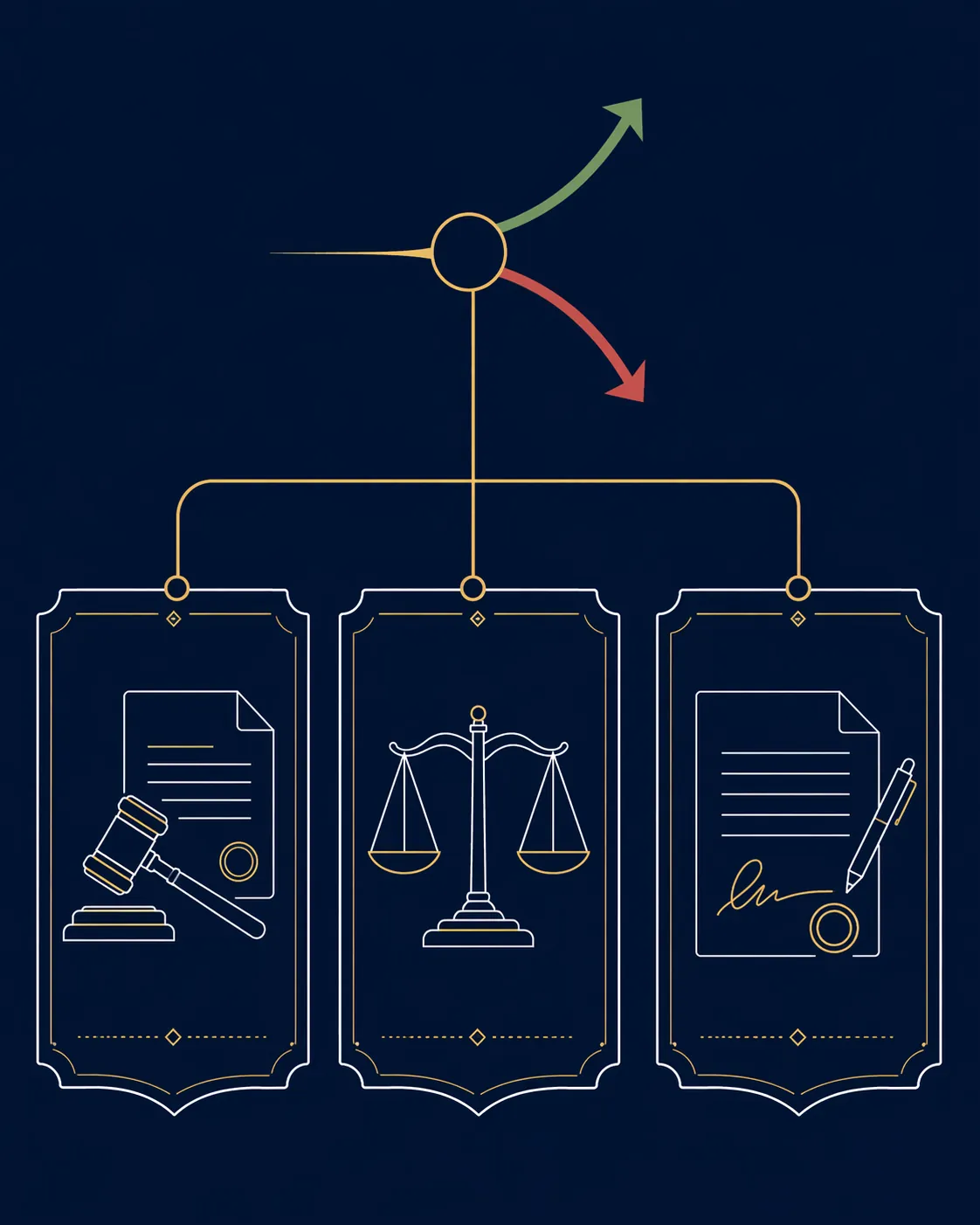
A second-source clause is meant to preserve performance when the preferred supplier, product line, or geopolitical route becomes unavailable. If the alternative supplier is itself capacity-constrained, losing share in the relevant segment, and subject to changing government-support terms, the clause may reduce one dependency while importing another.
The January 2026 capacity comments are central here. A supplier that says it could not fully meet AI data-center demand creates a different contract-review problem than a supplier merely reporting cyclically uneven revenue.[5] Counsel should ask whether allocation rights, delivery schedules, priority commitments, cure periods, and termination remedies still work if demand exceeds the supplier’s available factory plan. Boilerplate supply assurances are thin protection if the contract does not specify what happens when the shortfall is systemic rather than order-specific.
Government support adds another layer. Intel announced a government equity agreement under which CHIPS Act grant funding was converted into an equity investment, and the company said the conversion eliminated claw-back provisions on $2.2 billion already disbursed.[7] That may strengthen Intel’s balance-sheet or policy position in one sense, but it changes how a commercial counterparty should think about recourse. If public-support terms evolve, contract counsel should not assume that the ordinary private-creditor or customer-remedy model captures the whole risk environment.
The five-year warrant structure tied to the government agreement also intersects with foundry-separation uncertainty.[7] A customer that is relying on Intel Foundry as a separate strategic hedge needs to know what corporate actions would trigger rights, restrictions, or practical delay. That is not a political judgment about industrial policy. It is a contracting question: who can compel performance, who can block restructuring, and who bears the cost if the supply theory changes during the term.
The diligence list is therefore more concrete than a market-share debate. A buyer should test whether the contract identifies the specific products and process nodes that matter, whether capacity commitments are hard obligations or planning assumptions, whether remedies survive allocation events, whether the supplier may substitute parts or routes, and whether government-support covenants affect assignment, separation, liens, warrants, or change-of-control provisions.
Contract Terms That Deserve More Than Boilerplate Review
- Capacity commitments: state whether Intel is guaranteeing supply, reserving capacity, or merely forecasting availability.
- Allocation priority: identify where the buyer sits if AI data-center demand exceeds available production.
- Product substitution: define when CPU, accelerator, board, foundry, or packaging substitutions require written consent.
- Government-support effects: require notice of covenants, warrants, claw-back changes, or restructuring constraints that could affect performance.
- Remedies: preserve termination, cover, audit, and step-in rights for systemic capacity failures, not only missed shipment dates.
What Each Side Can Safely Rely On
Competitors can rely on the public evidence to say Intel remains commercially relevant in data centers while losing ground in important share measures. They should be more careful about saying the market as a whole is fully captured by the Intel-Nvidia-AMD peer set, because custom ASICs and hyperscaler silicon sit outside the Visual Capitalist comparison.[4]
Customers can rely on the revenue growth to show that Intel is not absent from AI infrastructure demand. They should not rely on it as proof that Intel can provide a clean second-source remedy. The harder questions are capacity allocation, product competitiveness, government-support constraints, and whether the contracted supply actually addresses the customer’s dependency exposure.
Securities litigators can rely on the divergence as a screening signal, not as a completed claim. The evidence worth testing is the gap between public language about sustainable growth and the known facts about factory planning, unmet demand, Gaudi shortfall, and declining share. A complaint or defense would still need the usual work: specific statements, timing, materiality, scienter, loss causation, and the effect of cautionary language.
Intel’s growth may be genuine. The legal mistake would be treating that growth as proof that risk has fallen. A counterparty whose legal position depends on Intel’s AI data-center story should independently verify market position, capacity commitments, disclosure language, and contractual remedies before treating the company as a stabilizing answer to chip-supply exposure.
References
- Intel Reports Second-Quarter 2026 Financial Results, Intel, 2026.
- Intel reports its strongest revenue growth in more than fifteen years, The Verge, 2026.
- Intel Is Supposed to Be in a New CPU Era But Its Losing Market Share to AMD and Arm, Barchart.
- Charted: The Battle for AI Data Center Revenue (2021–2025), Visual Capitalist.
- Intel struggles to meet AI data center demand, shares drop 13%, Reuters, January 22, 2026.
- Intel loses challenge against EU antitrust ruling but wins reduced fine, Reuters, December 10, 2025.
- Intel/Trump Administration agreement press release, Intel Newsroom.
Related records
Tool profile
Browse tool evaluations →Governing regulation
Browse the obligations tracker →Preventive workflow
Browse verification workflows →
Report a correction or tip
Spotted an outdated figure, a misstated fact, or a ruling this case record should reflect? Public comments are disabled for this content given the professional cost of a misreported case outcome, penalty amount, or rule text — use the structured correction channel instead.
Report a correction or tip for this record →