
The Iran Strike Pause Exposes the War Powers Resolution's Blind Spot
The July 2026 Iran strike pause reveals a War Powers Resolution gap that allows the executive to reset the 60-day clock while maintaining a coercive posture—an argument no prior administration has tested. Legal practitioners will find an analysis of the constitutional stakes and potential litigation pathways.
- Jurisdiction
- US Federal
- Court
- U.S. Federal Courts
- AI tool named
- None
- Ruling date
- Jul 25, 2026
- Source document
- View primary court order ↗
- Last verified
- Jul 26, 2026
Lex Machina Review is an independent risk-tracking and reference resource. Nothing on this site is legal advice, and using it does not create an attorney-client relationship. Every record is reviewed against primary sources but may not reflect the most current status of a matter — always verify directly against the cited court order, rule text, or a licensed attorney before relying on it.
Companion explanation — secondary to the source document above
The July 25 pause in U.S. strikes on Iran is not just a battlefield interval. The harder question is what happens to the War Powers Resolution clock when the executive stops firing, keeps the coercive machinery in place, and reserves the option to resume at once. As of the July 25-26 reporting window, the pause was still a developing operational event, not a verified end to the confrontation. Its legal importance lies in the administration's apparent theory that a break in exchanges of fire can function as a termination of hostilities, even while ships, aircraft, targeting staffs, and public threats remain part of the same pressure campaign.
That theory matters because the War Powers Resolution does not ask only whether the president has filed a report. It imposes a statutory consequence: absent congressional authorization, U.S. forces introduced into hostilities must be withdrawn within 60 days, with a limited additional withdrawal period. If each operational pause can be treated as a legal endpoint, the deadline can become cyclical. The executive can stop, declare hostilities terminated, preserve the posture that makes renewed force immediately available, and then characterize the next round as a separate episode.

The May 1 Letter Is the Hinge
The load-bearing document is the administration's May 1 War Powers Resolution letter, as reproduced and analyzed by Lawfare through DocumentCloud. The letter said that hostilities with Iran had terminated because there had been "no exchange of fire" since April 7, even though the United States continued a maritime blockade and administration officials continued threatening resumed major combat if Iran did not comply with U.S. demands.[1]
The phrase "no exchange of fire" does considerable work. It narrows hostilities to kinetic contact and treats the absence of recent shooting as legally dispositive. The difficulty is that the broader posture did not disappear. A blockade continued after April 13, and the administration did not disclaim renewed force. If the May 1 letter supplies the template, the July pause becomes more than a temporary military decision. It becomes the next opportunity to say that one clock has ended and another can begin.
This is not the same as saying every deployment, sanction, threat, or interdiction is automatically "hostilities" under the statute. Presidents have long defended flexibility at the margins, and courts have often been cautious when asked to police active military operations. The narrower point is more consequential for future lawyers: the administration appears to be using the stopping and starting of fire as the boundary line, while leaving in place the coercive structure that gives the renewed fire its immediate force.
A Sequence Built for Compartmentalization
The legal theory becomes clearer when the dates are kept in order rather than folded into a generic Iran conflict narrative. The administration treated Operation Epic Fury, Project Freedom, the February-April phase, the June-July bombing campaign, and the July 25 pause as separable legal containers. That sequencing is the core of the intermittent-hostilities argument described in Lawfare's "After the First 60 Days" analysis.[2]
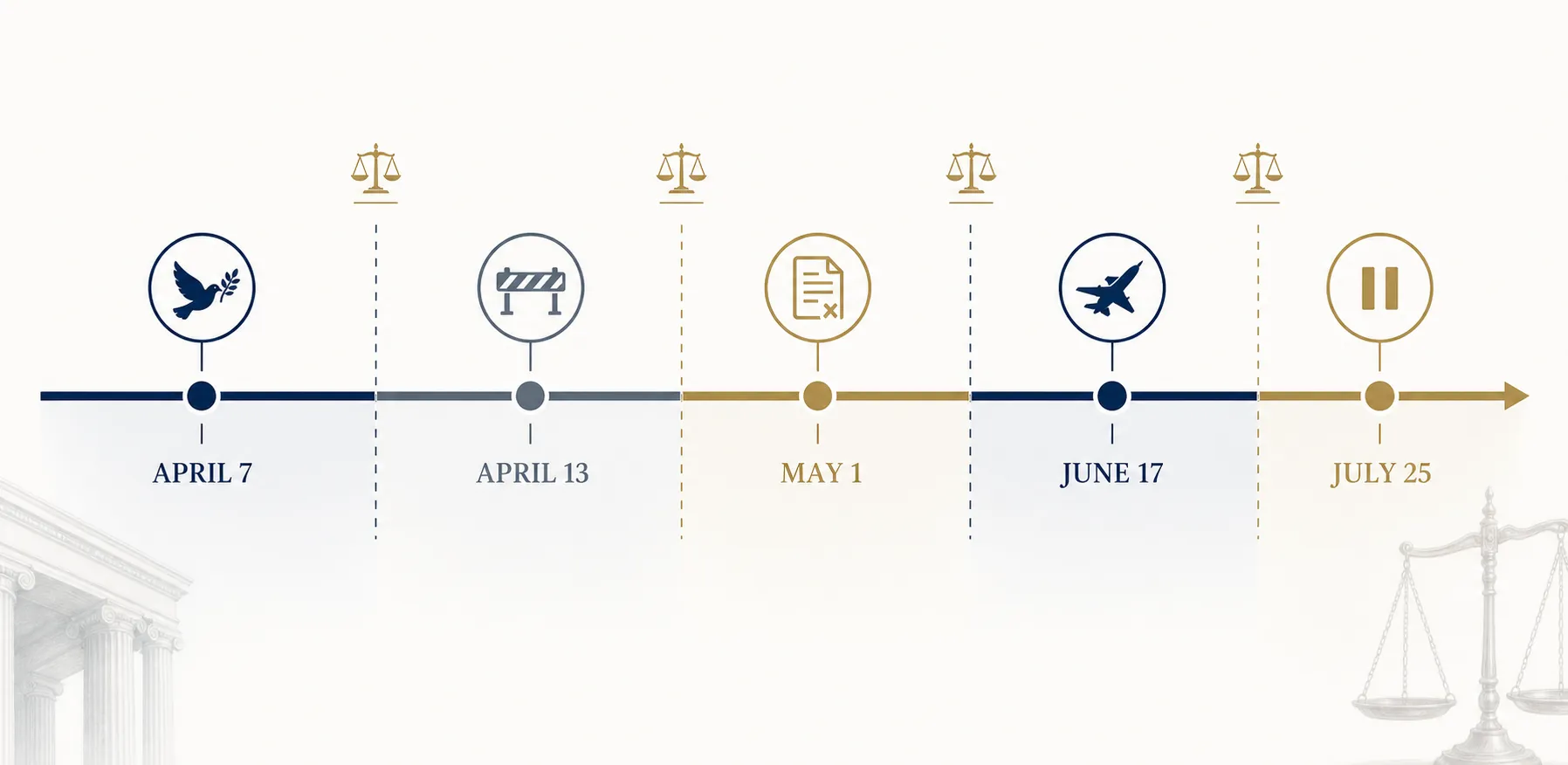
| Date | Operational Event | Legal Significance |
|---|---|---|
| April 7 | Cease-fire and no further exchange of fire, according to the administration's later account | Becomes the factual basis for saying hostilities had terminated |
| April 13 | Maritime blockade begins | Maintains coercive pressure after the claimed end of shooting |
| May 1 | War Powers Resolution letter claims hostilities have terminated | Frames the statutory clock as no longer running |
| June 17 | Strikes resume after the collapse of the memorandum of understanding | Administration treats the renewed campaign as a separate episode |
| July 25 | Bombing pause reported | Creates the next possible asserted reset point |
The April 13 blockade is the most awkward fact for the May 1 termination claim. Secretary Hegseth reportedly described Project Freedom as "separate and distinct from Operation Epic Fury," a formulation that matters because it attempts to keep the blockade from being swept into the same 60-day War Powers Resolution clock. Yet Just Security's backgrounder notes that maritime blockades are treated in international law as acts of war, which sharpens the tension between the administration's domestic statutory framing and the continuing coercive posture at sea.[2][3]
That does not by itself answer the War Powers Resolution question. Domestic statutory "hostilities" and international-law labels do not have to map perfectly onto one another. But the mismatch is not cosmetic. A blockade is not merely a press statement or a sanctions designation. It is an operational measure backed by force, and it sits uneasily beside a claim that hostilities have ended because no one has fired recently.
Pause, Termination, and the Missing Statutory Switch
The War Powers Resolution was built around introduction, reporting, authorization, and withdrawal. It was not written with a clean mechanism for distinguishing an operational pause from a legal termination. That omission is now doing real work. The statute can force attention to the first deployment into hostilities, but it is less precise when an administration says hostilities have stopped while preserving the ability and intent to resume them quickly.
Prior administrations supplied pieces of this practice. They have argued over what counts as hostilities, narrowed the significance of risk to U.S. forces, emphasized limited missions, and relied on episodic uses of force without formal declarations of war. The asserted extension here is the reset under a maintained combat-ready posture: the idea that the absence of fire in one interval can terminate the clock even when the campaign's coercive apparatus and public demands continue.
For military lawyers, the difference is not academic. If the statutory deadline is running, advice to commanders must account for a congressionally imposed endpoint. If the deadline has terminated, resumed force can be packaged as a new introduction or a new phase, with a fresh reporting and withdrawal analysis. The same aircraft, ships, munitions planners, and target lists may remain involved, but the legal file changes labels.
The July 25 pause tests the theory at scale. According to Guardian reporting and New York Post reporting, Adm. Bradley Cooper, the CENTCOM commander, and Gen. Dan Caine, the Chairman of the Joint Chiefs of Staff, advised President Trump to halt the bombing because precision-munition stockpiles were depleted and target lists were exhausted.[4][5] If that account is correct, the proximate reason for the pause was operational logistics, not deference to the 60-day clock.
That distinction is important. A pause driven by munitions and targets does not become a legal termination just because the shooting stops. Nor does it become irrelevant to law because commanders recommended it for military reasons. The legal question is whether the administration may use an operational break to erase accumulated statutory time while maintaining the posture that makes renewed force possible without a new congressional authorization.
Article II Supplies the Front-End Authority
The administration's confidence also rests on a separate constitutional foundation. Lawfare's analysis of the January 2026 Maduro Office of Legal Counsel opinion describes the controlling Article II framework as a two-part inquiry: whether the president has identified a sufficiently important national interest, and whether the anticipated nature, scope, and duration of the operation fall short of "war" in the constitutional sense.[2]
The Maduro opinion, as described in that analysis, set an unusually permissive casualty baseline. It reasoned that even if the entire team of U.S. personnel involved in the contemplated operation were killed, the risk still would not raise constitutional concerns comparable to the scale of U.S. casualties in Vietnam or Iraq for purposes of identifying "war."[2]
That framework helps explain why the administration may see initiation and resumption as constitutionally manageable. If the national interest is framed broadly and the operation is described as limited in nature, scope, and duration, Article II can carry the front-end decision to use force. The War Powers Resolution then becomes the separate statutory constraint that is supposed to determine how long the president may continue without Congress.
Keeping those two questions separate prevents a common analytical mistake. A president may have Article II authority to begin a limited operation and still face a statutory withdrawal requirement if Congress does not authorize continued hostilities. Conversely, a weak War Powers Resolution enforcement mechanism does not itself enlarge Article II. The Iran pause problem arises at the seam: Article II supports the start, while the administration's intermittent-hostilities theory weakens the statutory consequence that should attach with time.
The June-July Campaign Shows How the Reset Would Operate
The 13-day June-July bombing campaign resumed after the collapse of the memorandum of understanding and was characterized by the administration as separate from the earlier February-April phase.[2] In a conventional statutory timeline, that kind of continuity would invite a simple question: was this the same set of hostilities continuing after a pause, or a new introduction of forces into hostilities?
The administration's compartmentalized answer appears to be the latter. April 7 to June 17 is treated as a cease-fire interval. June 17 to July 25 becomes a renewed, distinct bombing period. July 25 then becomes another possible stopping point. If accepted, the model permits a rolling series of discrete hostilities, each measured from its own start date, even though the strategic pressure campaign and readiness posture bridge the gaps.
The key move is not calling the June-July strikes limited. Limited operations are familiar terrain in executive-branch war powers practice. The key move is claiming legal discontinuity from the previous phase while retaining enough operational continuity to restart rapidly. That is why the blockade, the readiness posture, and the threats to resume major combat matter more than a detailed account of each strike package.
Litigation Risk Is Real, but Still Prospective
No suit had been filed as of the most recent sources available on July 26, 2026, so the litigation discussion remains a risk map rather than a case forecast.[2] The likely plaintiffs are not abstract opponents of the policy. The more plausible paths are service members ordered into the allegedly unauthorized hostilities and state plaintiffs asserting concrete fiscal injuries, including tuition-reimbursement theories associated with California or Virginia.[2]
Service-member standing would try to connect the claimed statutory violation to an immediate duty to participate in operations that should have ended absent congressional authorization. State-plaintiff theories would need a different chain: a specific state expenditure or legal obligation traceable to the continuation of hostilities beyond the War Powers Resolution deadline. Neither theory is automatic. Both are more disciplined than a generalized taxpayer or citizen objection.
The political-question doctrine remains a barrier, though not the barrier it once appeared to be. Lawfare's analysis points to Zivotofsky v. Secretary of State as narrowing the circumstances in which courts may avoid separation-of-powers disputes simply because they touch foreign affairs.[2] A court could still find remedial, evidentiary, or prudential reasons to hesitate in an active-force case. Zivotofsky reduces the escape route; it does not guarantee merits review.
For counsel tracking exposure, the most important pleadings question would be how to frame the injury without asking the court to supervise targeting or second-guess battlefield judgments. A cleaner complaint would focus on statutory time: when hostilities began, whether they terminated, whether the blockade and readiness posture defeat the claimed termination, and whether resumed strikes were legally continuous with the earlier operation.
The Blind Spot
The July pause exposes a statutory blind spot rather than a settled violation that a court has already recognized. The War Powers Resolution can require reporting and withdrawal when U.S. forces are in hostilities. It does not clearly say what happens when the executive stops shooting for operational reasons, says hostilities have ended, keeps coercive force on station, and later resumes strikes under a new label.
That gap is durable because it depends on characterization. "Hostilities have terminated" sounds final. "Separate and distinct" sounds administrable. "No exchange of fire" sounds factual. Put together, those phrases can turn one sustained pressure campaign into a series of legally isolated episodes. The operational file may show continuity; the statutory file may show resets.
The unresolved question is whether the War Powers Resolution's 60-day limit can be made to disappear whenever firing pauses, even if the forces and threats that make renewed combat possible never leave the field. On the current record, the administration's position is best understood as an untested extension of earlier executive-branch practice: hostilities end when exchanges of fire stop, and the next round can begin with a fresh clock. Last verified against available reporting and analysis through July 26, 2026.
References
- The Trump Administration's May 1 War Powers Resolution Letter, Lawfare, May 8, 2026, link
- After the First 60 Days, Lawfare, link
- Project Freedom and the Iran Blockade Backgrounder, Just Security, link
- Iran strike pause reporting, The Guardian, July 26, 2026, link
- Iran bombing halt reporting, New York Post, July 25, 2026, link
Related records
Tool profile
Browse tool evaluations →Governing regulation
Browse the obligations tracker →Preventive workflow
Browse verification workflows →
Report a correction or tip
Spotted an outdated figure, a misstated fact, or a ruling this case record should reflect? Public comments are disabled for this content given the professional cost of a misreported case outcome, penalty amount, or rule text — use the structured correction channel instead.
Report a correction or tip for this record →