
Is Japan's food consumption tax reduction really temporary?
Japan's 2027 food consumption tax cut includes a sunset clause promising restoration in 2029, but no legal mechanism binds a future Diet to raise the rate. This article analyzes the legal and political risks that the temporary reduction could become permanent, drawing on precedent from Japan's 2012–2019 tax hike postponements and current legislative uncertainty.
- Jurisdiction
- Japan
- Court
- National Diet of Japan
- AI tool named
- None
- Ruling date
- Jul 30, 2026
- Source document
- View primary court order ↗
- Last verified
- Jul 30, 2026
Lex Machina Review is an independent risk-tracking and reference resource. Nothing on this site is legal advice, and using it does not create an attorney-client relationship. Every record is reviewed against primary sources but may not reflect the most current status of a matter — always verify directly against the cited court order, rule text, or a licensed attorney before relying on it.
Companion explanation — secondary to the source document above
Japan’s announced food consumption tax reduction for 2027 is being sold with a restoration date: the rate cut would last two years, then return in April 2029. That sounds tidy enough for a fiscal-policy slide. It is less tidy as law. The central issue is not whether the government has promised a sunset, but what legal act would make that sunset operate and what a later Diet could do to avoid it.
Prime Minister Sanae Takaichi announced the reduction on July 30, 2026, and said she would “take full responsibility for restoring the tax rate.” The same report notes that her Liberal Democratic Party presidency expires in fall 2027, well before the scheduled April 2029 restoration date.[1] That does not make her statement meaningless. It does make it a political undertaking by a leader whose formal party mandate ends before the most difficult vote, or non-vote, arrives.

A Sunset Clause Is Not a Lockbox
The full amendment text has not yet been made available, so the legal analysis has to stop short of pretending that the exact statutory mechanism is known. Public reporting describes a temporary reduction and related credit measures under Diet consideration, but not the final operative language that tax advisers would need before treating April 2029 as a legally settled outcome.[1][2]
That caveat cuts both ways. It is premature to say the food rate is already permanent in disguise. It is also premature to say the sunset clause solves the restoration problem. A statutory schedule can state that a reduced rate ends on a date. A later Diet can still amend the statute before that date, extend the reduction, replace the mechanism, or change the tax structure altogether. The point is not that restoration cannot happen. The point is that the present Diet cannot convert a future tax increase into an event beyond future legislation.
For clients modeling the 1% food rate, the legal question is therefore narrower than the political promise. Does the eventual bill create an automatic lapse that restores the prior rate unless lawmakers intervene, or does it require some future affirmative act to raise the rate? Those are different defaults. The first gives restoration procedural momentum; the second makes restoration depend more visibly on a future vote. Neither default prevents a later Diet from rewriting the schedule.
The 2012–2019 Consumption-Tax Precedent
Japan has already run this experiment with a much larger consumption-tax schedule. In 2012, under Prime Minister Yoshihiko Noda, legislation set a path to raise the consumption tax to 8% in April 2014 and then to 10% in October 2015. The 8% increase took effect. The 10% increase did not happen on the original schedule: Prime Minister Shinzo Abe first postponed it to April 2017, then postponed it again to October 2019.[3]
That history does not prove the 2029 food-rate restoration will be postponed. It does establish the institutional character of such schedules in Japan. A legislated consumption-tax timetable can be politically weighty, administratively important, and fiscally relevant, while still remaining vulnerable to later political revision. The 2012 law did not bind the Abe government in the way a private covenant binds a borrower.
The Japan Center for Economic Research drew the same practical lesson before Takaichi’s July announcement. In February 2026, JCER warned that a temporary consumption-tax reduction could become effectively permanent because “the return to the original level is a tax increase for the people at that time” and political opposition to that return would be easy to mobilize.[4] That is not a claim about legal impossibility. It is a warning about how the legal form of temporariness interacts with electoral incentives.
The Calendar Does More Work Than the Promise
The restoration problem becomes clearer when the sequence is laid out as a governance problem rather than a fiscal slogan.
| Date | Event | Legal-policy significance |
|---|---|---|
| July 2026 | Food consumption tax cut announced | The government creates a relief measure and promises restoration before the bill text is publicly available. |
| Fall 2027 | Takaichi’s LDP presidency expires | The leader who promised to take responsibility may no longer control the governing party when restoration politics harden. |
| Summer 2028 | House of Councillors election | Lawmakers face voters less than a year before the scheduled tax restoration. |
| April 2029 | Scheduled restoration | The legal default will matter, but a future Diet can still extend, amend, or replace the cut. |
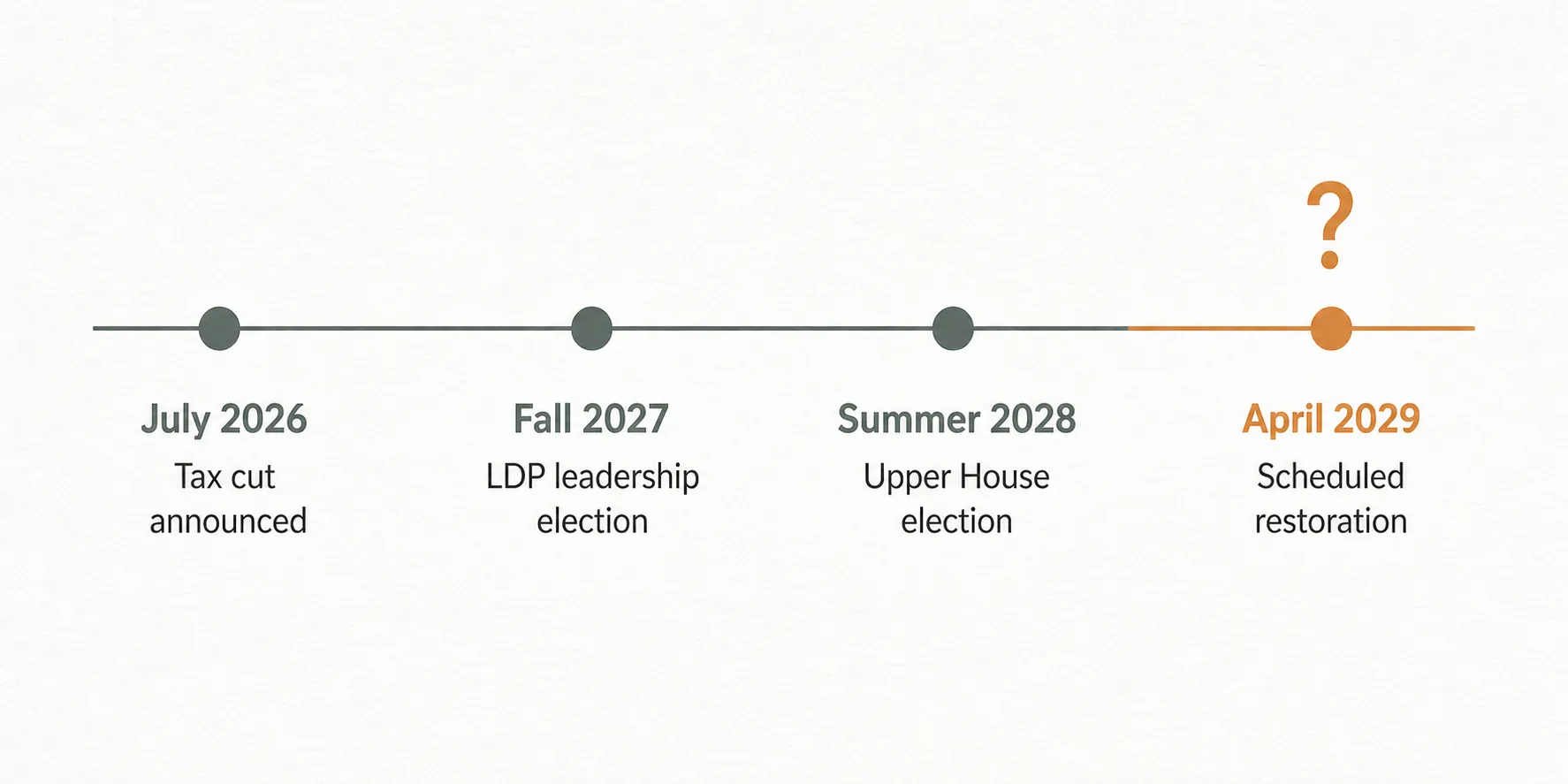
The first weak point is leadership tenure. Takaichi’s “full responsibility” commitment is attached to a party presidency that expires in fall 2027, while restoration is due in April 2029.[1] A successor party leader or coalition configuration would inherit the statutory timetable but not necessarily the same political ownership. In tax legislation, ownership matters because someone has to spend political capital when the bill stops being relief and becomes restoration.
The second weak point is the 2028 upper-house election. If the temporary cut is visible to households and retailers by then, the scheduled 2029 restoration will be easy to describe as a tax increase, regardless of how the 2026 documents label it. That is the moment at which the sunset clause becomes less a legal conclusion than a campaign issue. A government may decide that credibility requires restoration; an opposition party may decide that extension is easier to sell; a coalition partner may ask for a replacement benefit first. None of those moves would be constitutionally exotic. They are ordinary legislative politics.
The internal LDP reaction already shows that this is not just an outside analyst’s anxiety. Former election strategy chief Yuko Obuchi resigned from a senior tax-system role in protest, and former Foreign Minister Taro Kono warned that there was “no guarantee” the cut would lead to lower prices and that prices could “spike significantly” when the rate is restored.[1] Those objections go directly to the mechanics of exit. If consumers do not clearly see the reduction, the government gets less political credit. If they do see it, restoration becomes more painful.
Automatic Restoration Would Help, but It Would Not Bind
The most important unresolved drafting question is whether the bill uses an automatic lapse. If the amendment says the reduced rate applies only through a fixed period and the prior rate revives without further action, the legal default favors restoration. In that structure, lawmakers who want to extend the cut would need to pass new legislation.
That would be a stronger design than a provision requiring a future Diet to enact a rate increase in 2029. It would shift inertia toward the treasury rather than toward taxpayers. For bond analysts and tax counsel, that difference is worth modeling.
But it should not be confused with legal insulation. A later Diet could still pass an extension before the lapse date. It could replace the food-rate schedule with a new reduced-rate category. It could pair restoration with credits, rebates, or other compensating measures. The automatic-lapse version improves the default; it does not remove the 2027–2028 political problem.
Fiscal Pressure Exists, but It Is Not the Legal Mechanism
There are reasons a future government might restore the rate. The announced two-year reduction is estimated to reduce revenue by about ¥10 trillion.[1] Japanese government bond yields reached a 27-year high in January 2026, with the 20-year yield reported at 2.275% on January 19, according to Asahi and Japan Bond Trading Co. data.[5] Nomura has also warned that fiscal instability linked to consumption-tax reduction debates could weaken the usual relationship between the yen and interest-rate differentials.[6]
Those facts matter because they create pressure against indefinite tax relief. They do not make the 2029 restoration legally self-executing. A bond-market constraint can make postponement costly; it cannot compel the Diet to choose one statutory text over another. That distinction is easy to lose when fiscal commentary treats market discipline as if it were a court order. A sovereign-risk model can assign probability to restoration pressure; a lawyer should not convert that probability into a legal assurance.
The Refundable Credit Is an Off-Ramp, Not Yet a Bridge
The planned refundable tax credit system is relevant because it could give lawmakers a way to end the temporary food-rate cut without leaving lower-income households exposed to the full restoration shock. Reporting in July 2026 described debate over temporary consumption-tax relief and alternative credit measures, while policy design work has discussed refundable credits as a more targeted replacement.[2][7]
The difficulty is timing. The credit system is planned for FY2029, the same fiscal year in which the food-rate restoration is due. Until enabling legislation is enacted and administrative design is settled, it cannot supply the legal certainty that the sunset clause itself lacks. It may become the political bargain that makes restoration possible. As of Q3 2026, it is not yet that bargain in statutory form.
What Practitioners Can and Cannot Say in 2026
A cautious opinion in 2026 should separate three propositions that are often blurred.
- The government has announced a temporary food consumption tax reduction with a scheduled April 2029 restoration.
- The final legal effect depends on the amendment text, including whether restoration occurs automatically by lapse or requires future affirmative legislation.
- Even if the bill uses an automatic lapse, a later Diet can amend, extend, or replace the schedule before restoration occurs.
- Japan’s 2012–2019 consumption-tax history shows that legislated rate schedules can be postponed when political conditions change.
- The 2027 LDP leadership timetable and 2028 upper-house election make the April 2029 restoration politically exposed.
That is enough to reject two overconfident answers. The cut is not legally permanent merely because restoration will be unpopular. Nor is it legally secure merely because the government says it is temporary. The correct classification is more prosaic and more useful: the restoration date is a statutory and political schedule whose credibility depends on future legislative choices.
For tax advisers, the practical consequence is that April 2029 should be modeled as a scheduled restoration, not as a guaranteed rate change. For sovereign-risk teams, the relevant risk is not only the revenue cost of the two-year cut, but the possibility that the exit requires lawmakers to accept visible tax pain just after a leadership transition and an upper-house election cycle. For counsel asked to bless the temporary character of the 1% rate, the answer should remain conditional until the amendment text is available, and even then it should acknowledge the later Diet’s power to revise it.
As of Q3 2026, the 2029 restoration is best treated as legally non-guaranteed and politically fragile: a promised sunset with historical precedent for postponement, fiscal reasons for discipline, and an electoral calendar that gives future lawmakers every incentive to look for another delay.
References
- Takaichi vows responsibility for restoring food tax rate, Kyodo News, July 30, 2026.
- Japan Lower House Considers Bill to Temporarily Reduce Consumption Tax on Food, Beverages, Introduce Credits, Bloomberg Tax.
- The Political History of Japan’s Consumption Tax, Nippon.com.
- How Consumption Tax Has Evolved in Japan, Japan Center for Economic Research, February 17, 2026.
- Japan bond yields hit 27-year highs on BOJ rate hike bets, The Asahi Shimbun, January 19, 2026.
- Japan’s ruling coalition considers eliminating consumption tax, Nomura Connects.
- Japan's temporary consumption tax cut plan raises questions over alternative system, The Mainichi, July 9, 2026.
Related records
Tool profile
Browse tool evaluations →Governing regulation
Browse the obligations tracker →Preventive workflow
Browse verification workflows →
Report a correction or tip
Spotted an outdated figure, a misstated fact, or a ruling this case record should reflect? Public comments are disabled for this content given the professional cost of a misreported case outcome, penalty amount, or rule text — use the structured correction channel instead.
Report a correction or tip for this record →