
What Jes Staley's Testimony Teaches About Digital Records Risk
Jes Staley's July 2026 congressional testimony shows how exhaustive digital records can turn a witness's 'I don't recall' into a material false statement risk. This analysis helps defense counsel understand why traditional preparation methods are no longer sufficient and how to review a client's digital footprint before investigators do.
- Jurisdiction
- US Federal
- Court
- U.S. House Oversight Committee
- AI tool named
- None
- Ruling date
- Jul 23, 2026
- Source document
- View primary court order ↗
- Last verified
- Jul 24, 2026
Lex Machina Review is an independent risk-tracking and reference resource. Nothing on this site is legal advice, and using it does not create an attorney-client relationship. Every record is reviewed against primary sources but may not reflect the most current status of a matter — always verify directly against the cited court order, rule text, or a licensed attorney before relying on it.
Companion explanation — secondary to the source document above
Jes Staley’s Capitol Hill problem began, at least as reported, with a familiar witness-preparation fault line: the gap between a relationship as the witness now describes it and the relationship as the retained record describes it. After a closed-door House Oversight transcribed interview on July 23, 2026, lawmakers said Staley characterized Jeffrey Epstein as a “client” and “business acquaintance,” denied a close personal friendship, and then faced questions about Financial Conduct Authority findings that his own emails had called Epstein “family” and described the relationship as “profound.”[1]
That is the legal problem worth taking seriously. Not the theater of a former banking executive behind closed doors. Not the reflexive assumption that every memory gap is strategic. The problem is that a witness can speak in the soft language of recollection while investigators, regulators, and opposing counsel work from a searchable institutional record.
One caveat belongs near the front. The full House Oversight transcript has not been published as of July 24, 2026. The account of Staley’s answers rests on reported characterizations from lawmakers and press coverage after the interview, not on a public line-by-line transcript. That matters. Exact wording matters in any false-statement analysis, and a careful lawyer should resist treating press-conference paraphrase as transcript text.
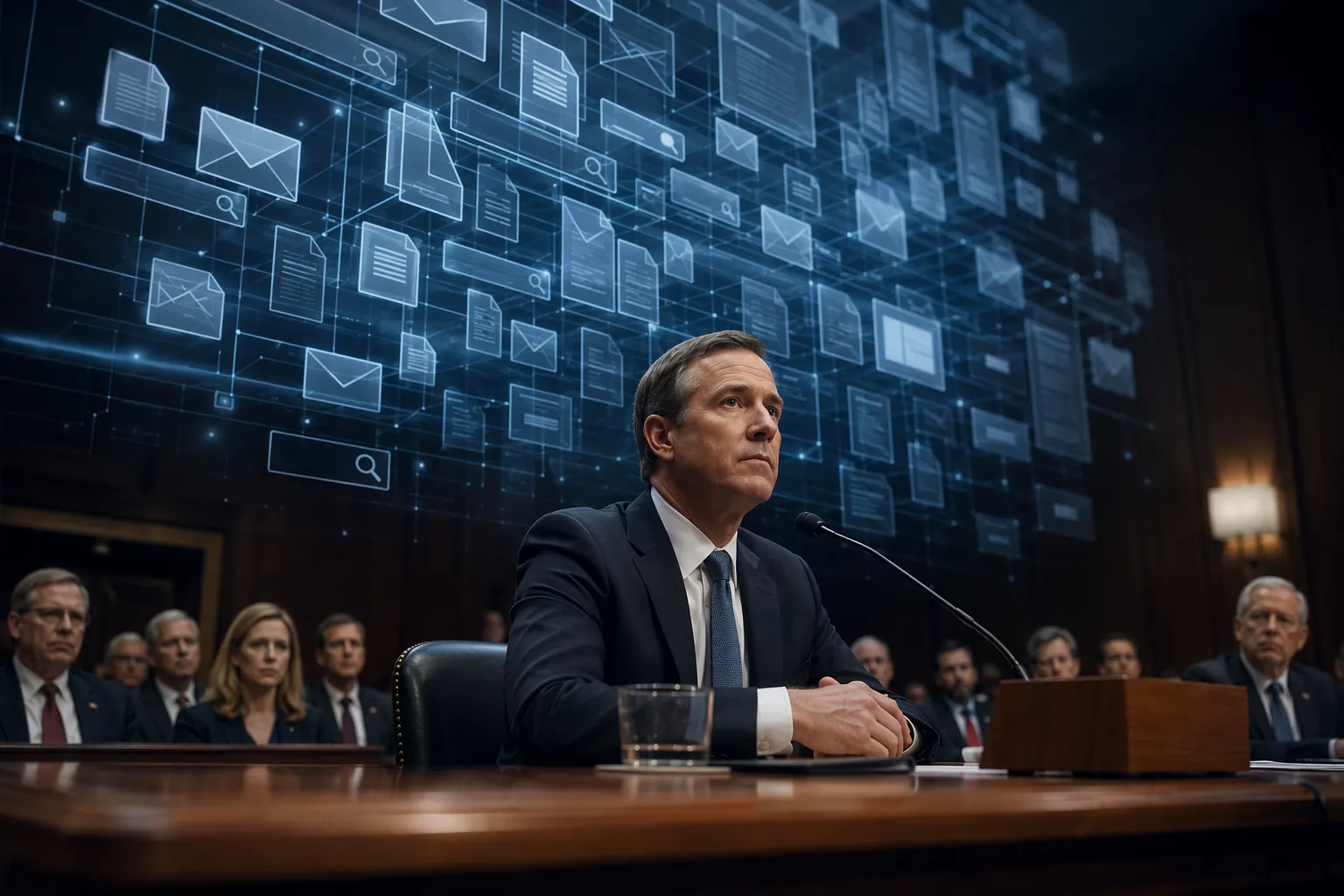
The Record Was Already There
The sharpest part of the Staley record is not that Congress asked about Epstein. It is that Congress had a ready-made contradiction from another forum. The FCA proceeding that led to Staley’s lifetime UK banking ban and £1.1 million fine was triggered by 1,200 emails from JPMorgan records, spanning 2008 through 2017. According to the FCA, those emails showed Staley describing Epstein as one of his “deepest” and “most cherished” friends, contrary to a Barclays letter Staley approved that said he and Epstein “did not have a close relationship.”[2]
That phrasing does real work. “Client” and “business acquaintance” are not necessarily false labels in isolation. A person can be both a client and a friend. A witness can truthfully remember the commercial dimension more readily than the personal one. But once the record contains the witness’s own language — “family,” “profound,” “deepest,” “most cherished” — the preparation question changes. Counsel is no longer preparing against an abstract allegation of closeness. Counsel is preparing against the client’s archived adjectives.
The Upper Tribunal’s finding, as summarized by the FCA, is the hinge. The Tribunal found that Staley “had no reason to believe the full position about his relationship would emerge through the emails obtained by the FCA.”[2] In plainer litigation-support terms, he took the risk that the custodial record would not be assembled in a way that defeated the narrative.
That risk looks worse in 2026 than it did even a few years ago. The question is no longer whether a regulator can find the one bad email if someone already knows what to search for. The question is whether a document universe can be queried, clustered, cross-referenced, and re-used across matters until the witness’s old language becomes easier to retrieve than the witness’s present memory.
Eight Thousand References Change the Room
The Epstein Files add scale, not certainty. PBS reported that Staley’s name appears approximately 8,000 times in the millions of Epstein Files documents released by the Justice Department.[3] That number does not prove any particular statement false. It does, however, describe the evidentiary environment in which any testimony about the relationship now lands.
For a defense team, a footprint that large should not be treated as background noise. It means that a seemingly narrow answer — how often did you communicate, how close were you, what did you understand the relationship to be, when did you last have contact — may be testable against a population of documents counsel has not personally read. The danger is not simply that investigators have a smoking gun. It is that they may have dozens of ordinary, cumulative documents that make the witness’s framing look selected rather than remembered.
This is where the old witness-preparation binder begins to fail. A chronology, a list of likely questions, and a handful of key documents may still be necessary. They are not enough when the other side can search across years of messages, aliases, custodians, repositories, and file references. The adversary is not only the questioner. It is the searchable record the questioner can bring to the table.

False Statement Exposure Is Not Perjury, and It Is Not Automatic
The legal category most relevant to this kind of congressional testimony is often 18 U.S.C. § 1001, not perjury. Perjury under 18 U.S.C. § 1621 requires an oath. Section 1001 does not. A closed-door transcribed interview can still create false-statement exposure if the statement is knowingly and willfully false, within federal jurisdiction, and material.
Materiality is not a demand that the statement actually changed the government’s outcome. The familiar formulation asks whether the statement had a natural tendency to influence, or was capable of influencing, the government’s work. In a congressional investigation into institutional handling of Epstein-related red flags, statements about the nature of a senior banker’s relationship with Epstein could at least present a materiality question. That is not the same as saying any reported answer by Staley was criminal.
The distinction matters because contradictions are not crimes by themselves. A document can refresh recollection, impeach credibility, or expose bad preparation without proving willful falsity. A witness may honestly fail to remember words written years earlier. A witness may use a general label that is incomplete but not false. A witness may be paraphrased imprecisely by lawmakers after an interview. The legal analysis depends on exact questions, exact answers, context, knowledge, and the available record.
Still, the preparation risk is obvious. If a witness says “I don’t recall” in response to a question that is genuinely about memory, the answer may be both proper and necessary. If the witness uses lack-of-recall language to avoid adopting what the witness plainly knew or what the record overwhelmingly shows the witness said, the answer starts to carry a different legal weight. Counsel’s job is to know which situation the witness is in before the transcript begins.
The Preparation Failure Mode
The Staley episode is not an argument for teaching witnesses to over-remember. That is its own malpractice trap. The witness who does not remember should not be pushed into adopting a document as present memory, speculating about intent, or converting “that appears to be what I wrote” into “that is what I was thinking.” The safer answer may remain a careful one: I do not independently recall, I recognize the document, and I can answer what the document says.
The failure is earlier. It occurs when counsel prepares the executive as though the universe of risk consists of what the executive remembers, what appears in the subpoena, and what the committee is likely to ask. In a digitally dense matter, that is too small a universe.
A modern preparation process has to begin like a focused document-review project. Counsel identifies the relevant custodians, repositories, shared drives, messaging systems, personal devices if available and appropriate, regulatory productions, prior litigation productions, and public document sets. Then counsel searches not only for names but for relationship language: friend, family, close, trusted, personal, client, referral, introduction, favor, visit, travel, gift, concern, red flag. The search terms will differ by matter, but the object is the same: find the language most likely to collide with the testimony theme.
AI-assisted review can help with that work if used as a review accelerator rather than an oracle. It can cluster communications by topic, surface near-duplicates, rank relationship-heavy documents, and help counsel move from isolated hits to patterns. It can also miss context, over-weight noisy text, and create false confidence if no lawyer validates the output. The point is not that AI created Staley’s problem. The FCA record described emails obtained from JPMorgan and reviewed in a regulatory proceeding.[2] The point is that investigators and counsel now operate in a search environment where old communications are far less buried than witnesses may assume.

Separate Memory Limits From Record Contradictions
The practical distinction is simple, but it takes discipline. One bucket contains documents the witness does not remember and cannot explain beyond their face. Another contains documents the witness recognizes but understands differently now. A third contains documents that directly contradict an expected testimony theme. Those buckets should not collapse into one generic “I don’t recall” script.
If the record shows affectionate language, counsel should not prepare the witness to deny closeness in categorical terms unless there is a precise, defensible meaning attached to the denial. “I did not consider him a close personal friend” may be a different answer from “we were not close,” and both may be different from “he was only a client.” The words chosen in preparation have to survive the documents that will be read aloud.
That is where rehearsal should spend its time. Not in polishing a theme, but in testing it against the worst documents. What happens when the questioner reads the witness’s own phrase back to him? What happens when the witness is asked whether a prior institutional letter was accurate? What happens when the witness says he cannot recall and the next exhibit shows repeated communications using intimate language? Those are not theatrical hypotheticals. They are the ordinary mechanics of impeachment.
Regulatory Findings Travel
The FCA proceeding does not supply the legal standard for a U.S. congressional false-statement case. The UK regulator’s “lack of integrity” finding and the Senior Managers Regime belong to a different legal system. But the documents do travel. Once the FCA record is public, it becomes usable by journalists, committees, civil litigants, bank supervisors, and counterparties trying to test later statements.
Sen. Elizabeth Warren’s same-day letter to Barclays’ current CEO shows how quickly testimony risk can become institutional risk. The Guardian reported that Warren accused Barclays of a “failure” to investigate Staley’s Epstein ties, extending the pressure beyond the individual witness and into the bank’s governance response.[4] The letter is not proof that Barclays violated any U.S. law. It is proof that once the record is in circulation, a witness’s answers can become a platform for new regulatory and reputational demands.
That should influence preparation. Counsel representing the individual witness may be focused on criminal exposure and transcript discipline. In-house counsel may be focused on institutional consistency, prior disclosures, board knowledge, regulator correspondence, and public statements. Those interests can overlap, but they are not identical. A searchable record that contradicts the individual can also reopen questions for the institution that retained, produced, summarized, or failed to escalate the documents.
What Counsel Should Review Before the Witness Sits Down
In a matter like this, the preparation file should be built around contradiction risk, not only chronology. The first pass asks what the witness is likely to say. The second asks what the retained record can make that answer sound like. If those two passes are not done by the same team, they need to be reconciled before the witness is put in a chair.
| Preparation Question | Why It Matters |
|---|---|
| What relationship labels does the witness plan to use? | General labels become dangerous when archived emails use stronger language. |
| Which custodians and repositories contain the relationship record? | The witness’s memory may be narrower than the institution’s retained footprint. |
| What phrases would a hostile reviewer search? | Investigators will not search only names; they will search tone, affection, concern, and warning language. |
| Which documents contradict the expected theme? | These documents should drive preparation more than friendly chronology points. |
| Where does the witness lack memory rather than dispute the record? | A truthful memory limit should be preserved, not converted into speculation. |
The most useful preparation often sounds less elegant than the final testimony. Counsel should ask the witness to sort documents into plain categories: I remember this; I recognize this but do not remember the event; I wrote this but no longer know what I meant; I disagree with the characterization; I need more context; I cannot answer without reviewing surrounding communications. Those answers do not produce a clean press line. They produce a safer transcript.
The same process should identify words the witness should avoid unless they have been tested. “Only,” “never,” “not close,” “just business,” and “no personal relationship” are small words with large impeachment surfaces. If the documents support a narrower answer, prepare the narrower answer. If the documents are mixed, prepare the witness to say they are mixed. If the witness cannot recall, preserve that answer and teach the witness to distinguish lack of present memory from denial of documentary fact.
There is also a privilege-log lesson here. Lawyers know how quickly a custodian’s files can become a portrait the custodian would not have volunteered. A single email may be explainable. A thread may be more difficult. A decade of repeated affectionate language may be harder still. Preparation should account for accumulation, because investigators often do not need one perfect exhibit when they can build a pattern from ordinary records.
The Safer Use of “I Don’t Recall”
“I don’t recall” remains a legitimate answer. It should remain available. Live testimony is stressful, old events blur, and documents often outlast the mental context that produced them. A witness should not be bullied into false certainty simply because a document exists.
But it is no longer a low-friction refuge. In the Jes Staley Epstein testimony on Capitol Hill, the legal risk is not that memory failed under public questioning; the interview was closed-door, and the transcript is not yet public. The risk is that reported testimony themes were immediately tested against an existing regulatory email record and a much larger public document footprint. That is the modern sequence: testimony, search, contradiction, renewed institutional pressure.
The operational conclusion is not dramatic. Before a witness relies on memory limits, counsel has to understand the searchable record behind those limits. That means reviewing the client’s digital footprint before investigators use it, not after a committee member reads the client’s own words back into the transcript.
References
- Lawmakers grill former JPMorgan executive Jes Staley over Epstein ties, CNBC, 2026-07-23
- Upper Tribunal upholds Jes Staley ban, Financial Conduct Authority, 2025-07-23
- Who is Jes Staley?, PBS NewsHour, 2026-07-23
- US senator accuses Barclays of 'failure' to investigate ex-CEO's ties to Epstein, The Guardian, 2026-07-23
Related records
Tool profile
Browse tool evaluations →Governing regulation
Browse the obligations tracker →Preventive workflow
Browse verification workflows →
Report a correction or tip
Spotted an outdated figure, a misstated fact, or a ruling this case record should reflect? Public comments are disabled for this content given the professional cost of a misreported case outcome, penalty amount, or rule text — use the structured correction channel instead.
Report a correction or tip for this record →