
Why the Jim Jordan–Jack Smith Referral Is Legally Weak
Analyzes the House Judiciary Committee's criminal referral against former special counsel Jack Smith under 18 U.S.C. §1001, showing how the literal-truth doctrine from Bronston v. United States likely bars prosecution and why former federal prosecutors describe the legal theory as untenable.
- Jurisdiction
- US Federal
- Court
- U.S. House Judiciary Committee
- AI tool named
- None
- Ruling date
- Dec 17, 2025
- Source document
- View primary court order ↗
- Last verified
- Jul 30, 2026
Lex Machina Review is an independent risk-tracking and reference resource. Nothing on this site is legal advice, and using it does not create an attorney-client relationship. Every record is reviewed against primary sources but may not reflect the most current status of a matter — always verify directly against the cited court order, rule text, or a licensed attorney before relying on it.
Companion explanation — secondary to the source document above
The criminal referral from Jim Jordan against Jack Smith turns on a transcript problem. Smith was reportedly asked about one acquisition path: how his team obtained toll records from the White House counsel’s office. The referral faults him for not also describing a different route by which prosecutors allegedly obtained text messages through a National Archives and Records Administration subpoena for White House records. Those are not the same question, and under 18 U.S.C. §1001 that difference is not cosmetic. It is the hinge.
This article is editorial legal analysis, not legal advice. The referral PDF was not directly reviewed for this piece; the account here rests on quoted reporting from PBS, ABC News, CBS News, Axios, USA Today, and related sourced material. On those reported facts, the referral does not describe a strong false-statement case because the alleged lie appears to be a literally true answer to the question actually asked, not a materially false answer to a question that covered the NARA subpoena path. Smith testified before the House Judiciary Committee on Dec. 17, 2025, in connection with his investigation of Trump-related election-interference issues, reportedly code-named “Arctic Frost.” PBS and ABC News describe the committee’s allegation as focused on Smith’s failure to volunteer the separate NARA route after answering questions about toll records obtained through a grand-jury subpoena path.[1][2]
The referral’s problem is the object of the question
A false-statement theory has to start with the statement. Not the subject matter surrounding it. Not what a witness arguably should have volunteered. The statement.
As reported, the committee asked Smith about how his team obtained toll records from the White House counsel’s office. Smith answered that acquisition-path question. The referral then broadens the frame and argues that Smith also should have disclosed that the same lawmakers’ text messages were obtained separately through a NARA subpoena for White House records.[1][2]
That is a familiar litigation move, and usually not a good one. A question about toll records is not automatically a question about all communications, all subpoenas, all custodians, all agencies, or all routes by which overlapping material later reached prosecutors. If the committee wanted to know whether Smith’s team had obtained text messages through NARA, the clean question was available: Did your office obtain those lawmakers’ text messages from NARA, by subpoena or otherwise? The reported theory depends on treating that unasked question as if it had been embedded in the asked one.
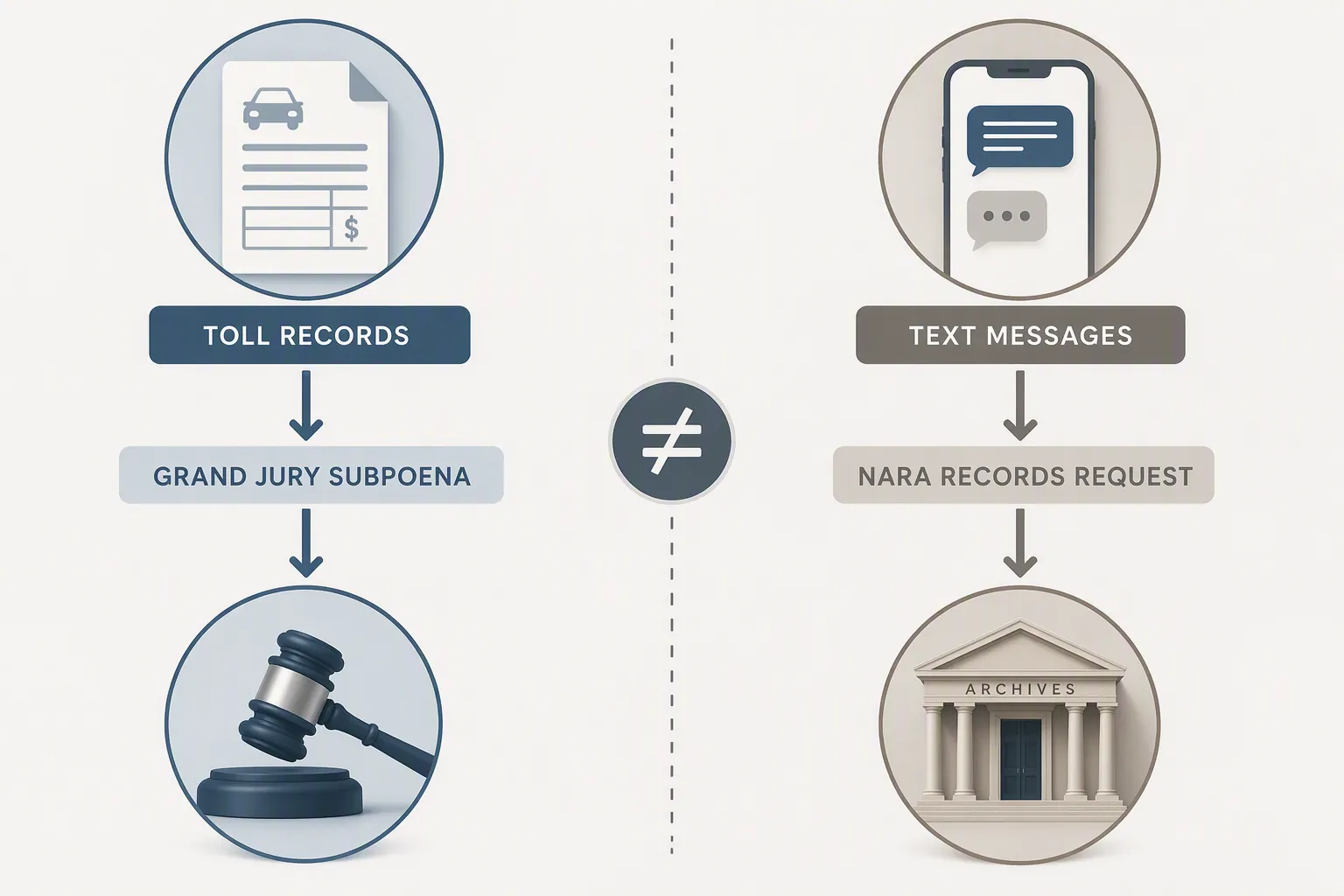
The distinction matters because “toll records” and “text messages” are different evidentiary objects, and the White House counsel’s office and NARA are different institutional routes. A witness who answers the first route does not necessarily make a false statement by failing to narrate the second. That may frustrate an examiner. It may make for an accusatory referral letter. It does not, by itself, make out a federal false-statement offense.
What §1001 would require DOJ to prove
Section 1001 is not an anti-evasion statute in the abstract. It criminalizes, among other things, knowingly and willfully making a materially false, fictitious, or fraudulent statement or representation in a matter within federal jurisdiction.[3] In a referral like this, the materiality and jurisdiction pieces would not do the hardest work. The hard question would be falsity.
If Smith said, in substance, “we did not obtain those text messages through NARA,” and that statement was knowingly false, the case would look very different. If he denied that the office had used any non-grand-jury method to obtain the communications at issue, the government would have a statement to test against documents, subpoena returns, privilege review records, and witness testimony. But the reported question was narrower. It concerned how toll records were obtained from the White House counsel’s office. A truthful answer to that narrower question does not become false merely because a broader answer would have been more useful to the committee.
The prosecution would also need more than annoyance with incompleteness. A witness can give an answer that is clipped, lawyered, self-protective, or ungenerous without satisfying §1001’s falsity requirement. That is not a loophole. It is the difference between punishing false statements and punishing a witness for failing to serve as the examiner’s co-counsel.
Bronston puts the burden where it belongs: on the questioner
Bronston v. United States is the case that keeps this referral from being evaluated by vibes. The Supreme Court held in 1973 that a witness cannot be convicted of perjury for an answer that is literally true, even if the answer is unresponsive or arguably intended to mislead. The operative sentence for this dispute is direct: “the burden is on the questioner to pin the witness down to the specific object of the questioner’s inquiry.”[4]
That rule fits committee testimony particularly well. Congressional questioning often moves quickly, and members or staff may ask a question that carries political assumptions, investigative shorthand, or a hoped-for admission. But criminal liability cannot be built from what the examiner meant to ask. It depends on what the witness was actually asked and what the witness actually said.
There is a doctrinal caveat worth stating before anyone overstates the point. Bronston itself was a perjury case, not a Supreme Court §1001 false-statement case. Its literal-truth principle is well established in lower-court false-statement analysis, but the Supreme Court has not squarely decided the Bronston rule in precisely this §1001 posture. A prosecutor could try to argue around that boundary. Still, the practical problem remains severe: if the words spoken were literally true in response to the question asked, the government starts without the false statement the statute requires.
Bronston also explains why the referral’s broad paraphrase is dangerous. Once a question about one subpoena route is recast as a question about every way prosecutors obtained related communications, the falsity analysis has already drifted from transcript to accusation. Courts do not usually let that drift carry the government through a criminal element.
Applying the rule to the Smith referral
The reported facts produce a simple sequence:
- The committee asked Smith about one mechanism: toll records obtained from the White House counsel’s office through a grand-jury subpoena path.
- Smith answered that mechanism question.
- The referral alleges he should also have disclosed a separate NARA route for text messages.
- The criminal theory therefore depends on turning a non-volunteered fact into a false statement.
That fourth step is where the case thins out. Section 1001 can reach affirmative lies, false denials, fraudulent representations, and concealment in circumstances covered by the statute. But the referral, as reported, is not built around Smith saying the NARA subpoena did not exist. It is built around Smith not adding that information when answering a different question. Bronston is hostile to precisely that move.
A hypothetical shows the line without importing facts not in the record. If a witness is asked, “Did you receive records from Custodian A by subpoena X?” and truthfully answers yes, that answer does not become false because the witness also received related records from Custodian B by subpoena Y. The examiner may have missed the better follow-up. The witness may have avoided volunteering damaging context. But the criminal law does not silently rewrite the first question into the broader one.
The committee’s strongest possible framing would be that Smith’s answer was misleading by omission. But misleading is not the same as false when the literal answer matches the literal question. A §1001 prosecution would have to survive that distinction before reaching intent, materiality, or any dispute over the propriety of the subpoenas themselves.
The former-prosecutor assessments track the same defect
The outside assessments reported by CBS News matter because they do not merely say the referral is politically charged. They identify the same legal failure. Former federal prosecutors Kyle Freeny and Gregory Rosen told CBS News that the referral fails to show Smith committed a crime and described the legal theory as “legally untenable.” Rosen specifically pointed to the literal-truth defense as a barrier to prosecution.[5]
That is the more probative criticism. A former prosecutor’s generic skepticism would not answer the statutory question. Rosen’s literal-truth point does. It maps the reported transcript mismatch onto the doctrine: if Smith’s answer was true as to the acquisition method he was asked about, the government cannot make the answer criminal by arguing he should have understood the question to cover a separate NARA subpoena for text messages.
Freeny’s and Rosen’s comments also help separate prosecutive risk from prosecutive merit. A referral from a House committee chair can create process: review, intake, internal memos, perhaps interviews or document pulls. But process is not proof. For §1001 purposes, DOJ would still need a statement that was false in the way the statute requires.
Discovery undercuts the concealment narrative, but it is secondary
Smith’s attorneys, Lanny Breuer and Peter Koski, added another point in their response: Trump’s defense team allegedly received copies of the same text messages in discovery and did not object to how they were obtained. USA Today reported that argument as part of Smith’s response to Jordan’s referral.[6]
That fact is useful, but it should not be made to carry more weight than it can. If Trump’s lawyers had the messages in discovery, that weakens any insinuation that Smith’s team secretly hid the existence of the messages from the defense. It may also reduce the practical force of any impropriety narrative surrounding the acquisition of the communications.
But the discovery point is not the main reason the referral is weak. A §1001 charge would not rise or fall on whether Trump’s lawyers objected during discovery. It would rise or fall on whether Smith made a materially false statement to Congress. The discovery response is supporting context. The literal-truth problem is the structural defect.
Why a weak referral can still matter
A legally weak referral is not necessarily an irrelevant one. Jordan has made other referrals, and the current Justice Department environment gives those referrals more practical significance than they would have in a colder political climate. The Brennan referral, also reportedly involving false-statement allegations, has been described as the subject of an ongoing DOJ investigation, though the precise scope and stage are not independently verifiable from the available source material.[5]
The Comey matter is another caution. A 2025 false-statement indictment against James Comey was dismissed on appointment-defect grounds, with an appeal described in the sourced material as pending.[5] That history does not make the Smith referral stronger. It shows that referrals and politically salient false-statement theories can become real litigation events even when they later encounter serious legal defects.
There is also an unresolved recusal issue. Axios reported that Jim Jordan referred Smith to DOJ over alleged false statements. Related sourced materials state that Acting Attorney General Todd Blanche had been Trump’s lead defense counsel in the cases Smith prosecuted and said at his July 2026 confirmation hearing that he believed Smith should be investigated.[7][8] No public recusal determination has been located in the available materials. That does not change the §1001 analysis, but it affects the risk environment in which the referral may be reviewed.
For lawyers assessing exposure, that is the uncomfortable split. The merits look weak because the alleged falsehood depends on expanding the question after the fact. The procedural risk is not zero because DOJ may still review the referral, and personnel, referrals, and pending politically charged matters can turn weak theories into expensive ones.
The narrow risk judgment
On the reported facts, the referral’s legal theory depends on treating a literally true answer as criminal because it was not more expansive than the question required. That is a poor fit for §1001 and a direct collision with the Bronston principle that the examiner must pin the witness down to the specific object of inquiry. DOJ may review the referral, and the surrounding environment may make that review consequential. But the prosecution theory described in the public reporting is legally weak.
References
- Rep. Jim Jordan refers Jack Smith for possible prosecution — PBS News
- Jim Jordan issues criminal referral against former special counsel Jack Smith for alleged perjury — ABC News
- 18 U.S.C. §1001 — Cornell Legal Information Institute
- Bronston v. United States, 409 U.S. 352 (1973) — Supreme Court of the United States
- Ex-prosecutors say House GOP's Jack Smith criminal referral fails to show he committed a crime — CBS News
- Jack Smith's team slams Jim Jordan's "dangerous" criminal referral — USA Today
- Jim Jordan refers Jack Smith to DOJ over alleged false statements — Axios
- Fact sheet on Jack Smith referral, Brennan referral, Comey indictment, and Todd Blanche recusal issue — The Justice Connection
Related records
Tool profile
Browse tool evaluations →Governing regulation
Browse the obligations tracker →Preventive workflow
Browse verification workflows →
Report a correction or tip
Spotted an outdated figure, a misstated fact, or a ruling this case record should reflect? Public comments are disabled for this content given the professional cost of a misreported case outcome, penalty amount, or rule text — use the structured correction channel instead.
Report a correction or tip for this record →