
ADA 36: Josh Turek and Disability Rights Law at a Crossroads
As the 36th ADA anniversary arrives, disability rights law faces coordinated legal challenges from Texas v. Kennedy, a DOJ OLC opinion rejecting the integration mandate, and the rescission of Olmstead guidance. This article examines what these developments mean for entities receiving federal funds and where the legal risk currently stands.
- Jurisdiction
- US Federal
- Court
- U.S. District Court for the Northern District of Texas
- AI tool named
- None
- Ruling date
- Jul 20, 2026
- Source document
- View primary court order ↗
- Last verified
- Jul 29, 2026
Lex Machina Review is an independent risk-tracking and reference resource. Nothing on this site is legal advice, and using it does not create an attorney-client relationship. Every record is reviewed against primary sources but may not reflect the most current status of a matter — always verify directly against the cited court order, rule text, or a licensed attorney before relying on it.
Companion explanation — secondary to the source document above
The 36th anniversary of the Americans with Disabilities Act arrived with the familiar public vocabulary of pride, access, and unfinished work. The Census Bureau’s anniversary facts put the population directly affected by that promise at 45.8 million Americans with disabilities, or 13.7% of the population, using 2024 ACS one-year estimates.[1] In Iowa, Josh Turek stood with former Sen. Tom Harkin and called the ADA “our Emancipation Proclamation,” a phrase that captured why the law still carries constitutional-scale meaning for many disabled people even though it is a civil-rights statute, not a constitutional amendment.[2]
But ADA 36 is not only an anniversary story. It lands in the middle of a live dispute over whether federally funded programs must continue to plan, administer, and defend services around the integration mandate: the rule, rooted in Olmstead and embedded across decades of disability-rights practice, that public entities may not needlessly segregate disabled people in institutions when community-based services are appropriate. For school districts, state Medicaid agencies, hospital systems, and other HHS-funded providers, the practical question is not whether the ADA still has symbolic force. It is whether the assumptions they used in June remain safe enough to use before the next filing deadline.

The Anniversary Collision
Three developments now have to be read together. First, Texas v. Kennedy remains a live challenge to the 2024 HHS Section 504 rules and to the integration mandate those rules reinforce. Second, the Justice Department’s Office of Legal Counsel issued a June 18, 2026 slip opinion taking the position that Section 504 and ADA Title II do not include an integration mandate. Third, DOJ rescinded its Olmstead guidance on July 20, 2026.[3]
Each event has a different legal effect. A lawsuit can produce an injunction or a merits ruling. An OLC opinion can reshape how federal agencies litigate, settle, and write rules, but it does not bind courts. A guidance rescission removes an agency’s public compliance roadmap, but it does not erase the Supreme Court’s Olmstead decision or the lower-court authority that has built on it. The risk is created by the combination: the plaintiff states are challenging the 2024 rule, the executive branch has signaled sympathy with their legal theory, and regulated entities are left with less stable federal guidance while the court calendar is still moving.
Texas v. Kennedy Is Smaller Than It Was, Not Harmless
Texas v. Kennedy is the load-bearing docket because it is the place where the 2024 HHS Section 504 rules could be narrowed, delayed, or blocked. Disability Rights Education & Defense Fund describes the case as a challenge to protections for disabled people under Section 504, including protections tied to community integration.[3] The Arc framed the renewed January 2026 attack by Texas and eight other states as an effort directed at Section 504 and “the right of disabled people to live in their communities.”[4]
| Date | Litigation posture | Why it matters |
|---|---|---|
| September 2024 | Seventeen states originally filed the challenge. | The case began as a broad state challenge to the 2024 HHS Section 504 rules. |
| January 2026 | Nine states renewed the attack. | The plaintiff group had already narrowed, but the case still remained a multi-state threat. |
| June 10, 2026 | Kansas dropped out after disability-community advocacy. | The exit showed that participation in the lawsuit carried political and public-pressure costs. |
| July 20, 2026 | Missouri dropped out after advocacy. | The coalition shrank again just as DOJ rescinded Olmstead guidance. |
| July 29, 2026 | Three plaintiff states remained: Alaska, Florida, and Texas. | The case remained live despite the shrinking coalition. |
| August 31, 2026 | Government opposition is currently due. | This is the next major marker unless settlement, rulemaking, or a posture shift overtakes the schedule. |
| September 22, 2026 | The states’ reply is currently due. | The date matters, but its usefulness depends on whether the federal government continues to defend the rule adversarially. |
The shrinking plaintiff coalition should not be treated as a clean victory. It matters that the case moved from 17 original states in September 2024, to nine renewing states in January 2026, to three remaining states as of July 29, 2026: Alaska, Florida, and Texas.[3][4] It also matters that Kansas and Missouri exited after disability-community advocacy. Those exits make the lawsuit politically less cost-free than it first appeared. They do not remove the possibility that the remaining states could obtain relief affecting the 2024 rules.
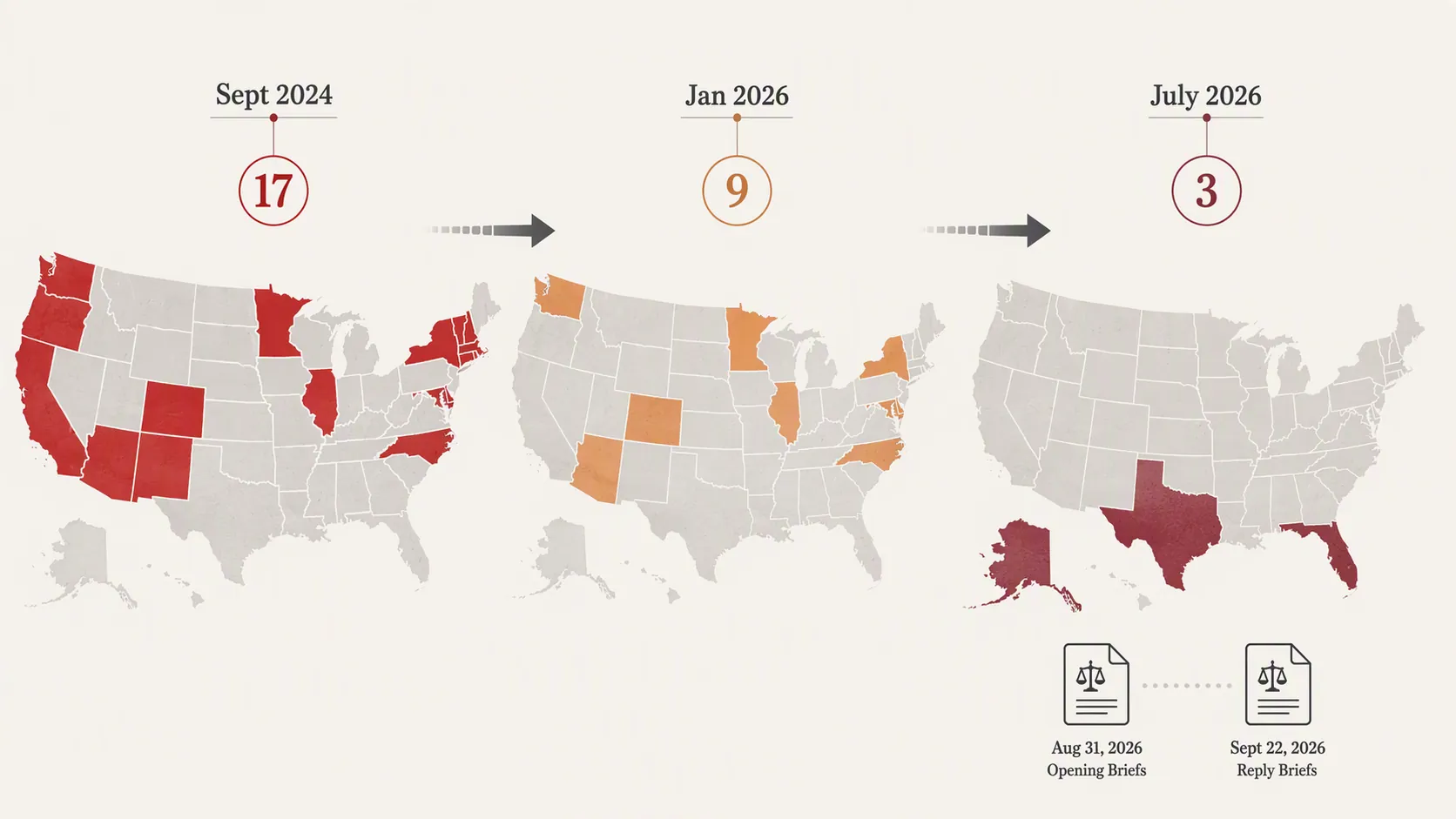
That is the point compliance counsel cannot afford to miss. A smaller plaintiff group may affect the politics and perhaps the optics of the case. It does not automatically reduce the legal stakes for HHS-funded entities if the remaining plaintiffs still seek relief against rules that tell recipients how to comply with Section 504.
What the OLC Opinion Changes, and What It Does Not
The June 18 OLC slip opinion is disruptive because it puts the federal executive branch’s legal machinery in tension with the integration mandate. The opinion’s reported position is that Section 504 and ADA Title II do not include an integration mandate, a view that conflicts with Olmstead and with 27 years of lower-court precedent applying and elaborating that principle.[3]
The careful distinction is essential. OLC opinions are powerful inside the executive branch. They can tell agencies what legal theory to adopt, what arguments to stop making, and what risks to avoid in rulemaking. They can change whether HHS defends the 2024 Section 504 rules with force, seeks a stay, negotiates, rewrites, or settles. They do not overrule the Supreme Court. A district court hearing Texas v. Kennedy is not required to accept OLC’s view simply because DOJ has adopted it.
For regulated entities, that means the OLC opinion should be treated as a litigation-posture and agency-behavior event, not as a repeal. The integration mandate has not vanished from court doctrine. But the federal government’s willingness to defend that mandate, and to maintain the 2024 rule as written, is now a live uncertainty.
Guidance Rescission Creates a Different Kind of Exposure
DOJ’s July 20 rescission of its Olmstead guidance is less dramatic than a court ruling and more operationally important than a press statement. Guidance does not itself create the underlying statutory obligation. But guidance tells state agencies, hospitals, schools, and service providers how the enforcing agency reads that obligation. When DOJ removes that public map, compliance teams lose a reference point just as plaintiff states are attacking the rule framework in court.[3]
That does not make institutional segregation newly lawful. Olmstead remains the controlling Supreme Court decision. Lower-court precedent remains part of the risk analysis. Private plaintiffs and advocacy organizations can still bring claims. Federal funding conditions still matter. What changes is the reliability of federal executive-branch alignment: the agency that once issued guidance supporting integration has now withdrawn that guidance while OLC has supplied a theory hostile to the mandate.
A state Medicaid agency considering whether to slow a community-services transition, a hospital system weighing discharge planning obligations, or a school district reviewing placement and service-delivery policies should not read the rescission as permission to ignore integration. The safer reading is narrower and more uncomfortable: the agency signal has become unstable, and litigation risk now depends more heavily on courts, existing precedent, funding agreements, and the unresolved fate of the 2024 HHS rule.
The Practical Risk for Federally Funded Entities
The current risk is not evenly distributed. Entities receiving HHS funds face the most immediate uncertainty because Texas v. Kennedy targets the 2024 HHS Section 504 rules. If the court blocks those rules, recipients would not necessarily lose all integration obligations, but they would lose the clearest current regulatory statement from HHS on how those obligations apply.
- State Medicaid agencies should assume community-integration decisions remain litigation-sensitive, especially where changes affect people who could live outside institutions with appropriate supports.
- Hospitals and health systems should avoid treating the guidance rescission as a safe harbor for more restrictive discharge or placement practices.
- Schools and federally funded service providers should separate rule-challenge uncertainty from day-to-day nondiscrimination duties that remain enforceable through other sources.
- Compliance teams should preserve the reasoning behind integration-related decisions, because a later court or agency shift may make the contemporaneous record matter.
- Litigation teams should treat the August 31 and September 22 dates as important but fragile; the OLC opinion increases the chance that the case may change posture before those filings resolve the merits.
The most hazardous advice would be the simplest-sounding advice: either that nothing has changed, or that everything has changed. Neither is accurate. The statutory and precedential framework still exists, but the federal government’s defense of that framework is no longer something recipients can assume.
Where Turek Fits in the Legal Story
Turek’s anniversary remarks matter because they put a political answer next to a legal destabilization. He is not merely invoking ADA heritage; he has opposed the lawsuit and pledged, if elected to the Senate, to codify protections. That is a campaign position, not enacted law. Its importance is that it names the institutional path that may become more urgent if courts narrow the 2024 rules or if federal agencies retreat from integration enforcement.
The Harkin setting sharpened that contrast. Harkin is closely associated with the ADA’s legislative history, and the July anniversary coverage placed Turek inside that lineage.[2][5] But lineage does not answer the compliance question. Codification is only meaningful if Congress has the votes, the text is specific enough to matter, and the resulting statute closes the gap that litigation or agency retreat has opened.
Turek’s broader policy orientation also points toward disability employment and Medicaid-related constraints. Iowa Public Radio reported in 2025 on a “Work Without Worry” bill advancing to help Iowans with disabilities and Medicaid work without the same fear of losing support.[6] That issue belongs near, but not inside, the Section 504 fight. Benefits cliffs and integration obligations are connected by lived experience; legally, they travel through different mechanisms.
The Next Agenda Is Being Named Before It Is Written
Other policy actors are also trying to frame what comes after ADA commemoration. The National Council on Disability announced a Disability Middle Class Framework on July 26, 2026, describing it as an in-process effort, with no concrete policy proposals yet published and a next council meeting scheduled for August 19, 2026.[7] That makes it useful evidence of agenda-setting, not a source of operational compliance guidance.
House floor rhetoric has moved in the same anniversary register. Rep. Steny Hoyer’s July 21 remarks warned that the country cannot “turn the clock back” on the ADA.[8] That language captures the political stakes, but the legal question now turns on documents with filing deadlines, agency signatures, and remedial consequences.
Where the Law Stands on July 29, 2026
As of July 29, 2026, the integration mandate remains supported by Olmstead and decades of lower-court precedent. The 2024 HHS Section 504 rules remain the immediate object of a live challenge. The plaintiff-state coalition has narrowed dramatically, but Texas, Alaska, and Florida are still in the case. DOJ’s OLC opinion and Olmstead guidance rescission do not bind courts, but they make the federal executive branch a less reliable defender of the integration framework than it was before June 18.
That is the actual anniversary posture. ADA 36 is not settled heritage, and it is not legal collapse. It is a docketed fight over whether the next phase of disability-rights law will be clarified by courts, narrowed by agency retreat and litigation, or forced back into Congress. For entities receiving federal funds, the August 31 government opposition deadline and the September 22 reply deadline remain important markers. They are also fragile ones, because the federal government’s own legal position may now be moving toward settlement, rulemaking, or nondefense before the court ever supplies the clarity compliance officers want.
References
- Americans With Disabilities Act: July 26, 2026, U.S. Census Bureau, July 26, 2026.
- Turek to push for ‘Work Without Worry’ policy for disabled Iowans, Radio Iowa, July 27, 2026.
- Protect 504, Disability Rights Education & Defense Fund.
- Texas and Eight Other States Renew Attack on Section 504 and the Right of Disabled People to Live in Their Communities, The Arc, January 2026.
- Tom Harkin and Josh Turek reflect on 36 years of the Americans with Disabilities Act, KCCI, July 27, 2026.
- Bill advances to help Iowans with disabilities, Medicaid work without worry, Iowa Public Radio, February 26, 2025.
- NCD announces plan for Disability Middle Class Framework on ADA anniversary, National Council on Disability, July 26, 2026.
- Hoyer: We Cannot Turn the Clock Back to the Time Before the ADA, Office of House Majority Leader Steny Hoyer, July 21, 2026.
Related records
Tool profile
Browse tool evaluations →Governing regulation
Browse the obligations tracker →Preventive workflow
Browse verification workflows →
Report a correction or tip
Spotted an outdated figure, a misstated fact, or a ruling this case record should reflect? Public comments are disabled for this content given the professional cost of a misreported case outcome, penalty amount, or rule text — use the structured correction channel instead.
Report a correction or tip for this record →