
What Jury Duty's deception teaches about AI hallucination risk
The article uses the production secrets of James Marsden's Jury Duty to show how convincingly fabricated legal content can be, and draws a direct parallel to AI hallucination in court filings, giving litigators a memorable framework for verifying citations.
- Jurisdiction
- United States
- Court
- Multiple
- AI tool named
- Gemini 3.5 Pro
- Ruling date
- Jun 9, 2026
- Source document
- View primary court order ↗
- Last verified
- Jul 27, 2026
Lex Machina Review is an independent risk-tracking and reference resource. Nothing on this site is legal advice, and using it does not create an attorney-client relationship. Every record is reviewed against primary sources but may not reflect the most current status of a matter — always verify directly against the cited court order, rule text, or a licensed attorney before relying on it.
Companion explanation — secondary to the source document above
The fake courthouse worked because it behaved like one
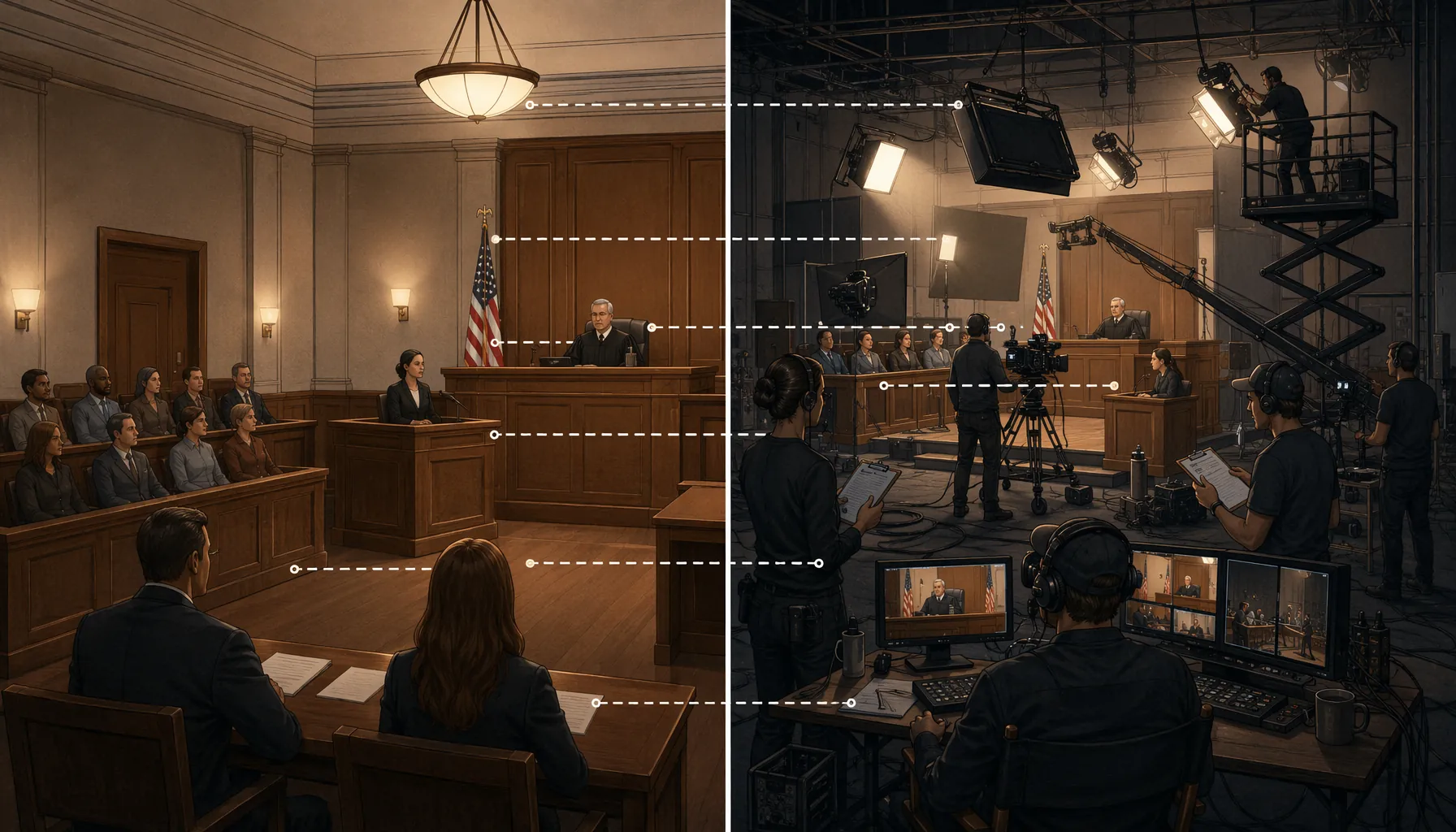
Behind the scenes of James Marsden’s Jury Duty experience, the trick was not one clever prank. It was an environment built to keep feeling ordinary after any single oddity should have raised suspicion. The production ran for 17 days, staged 12 witnesses, used 28 pieces of evidence, and generated more than 30 hours of in-court testimony, only about four hours of which made it to air. Jake Szymanski has described the unused material as full of the kind of “boring legal jargon” that made the proceeding feel real because real proceedings are often boring. [1]
The courthouse was not merely a backdrop. It was a decommissioned building that had reportedly been rehabbed from a haunted house into something that could pass as a functioning civic space. [2] That detail matters more than the novelty of it. A fake legal world does not have to be perfect; it has to have enough furniture, delays, paper, tone, and procedural drag that the person inside it stops asking whether the whole thing is false.
James Marsden’s role worked partly because he was visible. He was the famous person in the room, playing an exaggerated version of himself, and that gave Ronald Gladden a strange but stabilizing explanation for some of the unreality around him. The celebrity presence became one more official-looking fixture in a system that kept producing forms, testimony, admonitions, lunch breaks, whispered side conversations, and waiting.
The hidden scale was the more important fact. The production reportedly kept roughly 100 crew members out of sight while Ronald saw only a few camera people, an arrangement that let the visible world stay small and plausible while the real machinery remained concealed. [3] That is the part lawyers should sit with. The deception did not depend on Ronald being careless. It depended on a surrounding system that kept supplying normal cues faster than he could justify distrusting them.
Normalcy was the production design
Most discussions of AI hallucinated citations still lean too heavily on the idea that the fake authority should look fake. That is comforting, and it is often wrong. A fabricated case name can arrive with a believable reporter citation, a plausible court, a familiar procedural posture, and a quote that sounds like something a judge might have written. It can sit inside a brief that is otherwise competent. By the time someone notices, the document may already have been filed, served, indexed, assigned, reviewed by a clerk, and read by an opponent who now has to spend time proving a negative.
The useful comparison to Jury Duty is structural, not moral or causal. The show was entertainment, designed and monitored by human beings, with a reveal built into the premise. AI hallucination in legal work is not a hidden-camera series, and the producers of Jury Duty did not cause lawyers to cite nonexistent law. The parallel is narrower and more useful: fabricated legal reality becomes dangerous when enough ordinary legal texture surrounds it that competent people stop feeling an immediate need to interrupt.
| What the production built | Why it worked | The filing-risk analogue |
|---|---|---|
| A real-looking courthouse and a long trial schedule | Duration made the premise feel less like a stunt and more like an obligation | A polished brief can normalize a false citation by embedding it in familiar litigation form |
| Witnesses, exhibits, testimony, and procedural delays | Volume supplied texture; boredom supplied credibility | Generated text can surround a fake authority with enough accurate law to lower suspicion |
| Visible authority figures and concealed production machinery | Ronald saw the institutional surface, not the system constructing it | A lawyer may see confident legal prose without seeing how the model produced or invented it |
| Gradual escalation rather than immediate absurdity | Each strange moment had already been cushioned by ordinary moments | A hallucinated premise may survive because nothing around it initially looks broken |
That last point is the one that gets missed in scolding articles about fake cases. Lawyers do not usually trust a citation because they believe fiction is harmless. They trust it because it appears inside a professional container: the right caption, the right motion, the right standard of review, the right tone of authority. The container does some of the persuasion before anyone reaches the database check.
The cake-flipping moment changed the moral temperature
The cleanest point of comparison is not a favorite Marsden scene or an improvisational trick. It is the cake-flipping incident, when Ronald’s hurt became visible enough that the people running the show recognized that the joke had gone too far. Szymanski later said the production had crossed a line in that moment. [4]
That admission is what keeps the analogy from becoming smug. The show’s deception had craft, but it also had a human being on the receiving end. Ronald had been asked to participate sincerely in a fake civic process. When the reveal approached harm rather than amusement, someone could see his face, understand the consequence, and pull back.
Court filings have their own reveal moment. It may come when a judge asks for copies of cases that do not exist. It may come when a clerk cannot locate an authority. It may come when opposing counsel spends billable time chasing a quotation and discovers that the cited passage was never written. The emotional register is different, but the structure is recognizable: a person trusted the institutional surface until an external check broke the spell.
The harm lands after plausibility has already done its work
A hallucinated citation is not just a bad footnote. It reallocates work. The lawyer has to explain it. The client may pay for the cleanup or suffer delay. The judge has to decide whether the mistake was negligent, reckless, sanctionable, or merely embarrassing. Clerks and opposing counsel lose time to a proposition that had no legal existence until a tool generated it and a professional filing gave it procedural life.
That is why the usual “just verify your citations” warning is both correct and incomplete. It states the rule, but not the behavioral trap. Verification fails most often at the point where the work product looks least like it needs verification. The risk is not the bizarre answer that announces itself as machine slop. The risk is the case that looks boring enough to be true.
The Jury Duty production understood this almost too well. It used tedious legal language because tedium is part of the court aesthetic. AI legal hallucination exploits the same weakness accidentally: fluent output borrows credibility from the rituals around it. The model does not need to know the law to imitate the shape of legal confidence.
What the sanctions data adds, and what it cannot prove
The scale is no longer anecdotal. HAQQ’s AI legal hallucination tracker, drawing on the Charlotin database, listed 1,598 documented AI hallucination cases worldwide as of June 9, 2026, and described the database as adding about eight new cases per day with additions accelerating. The tracker’s boundary is important: it counts cases where a court explicitly found reliance on hallucinated material, so it does not measure every unfiled draft, every corrected citation, or every hallucination caught before docketing. [5]
The penalty signal is also getting harder to dismiss. Norton Rose Fulbright reported that U.S. courts imposed more than $145,000 in AI-filing penalties in Q1 2026 alone, including a record $109,700 penalty in a single matter. [6] Those figures do not prove that every AI-assisted filing is dangerous, and they do not measure responsible use. They show that courts are encountering enough filed hallucinations to impose real financial consequences.
The comfort that purpose-built legal tools eliminate the problem is also too broad. HAQQ’s audit cites Stanford RegLab findings that purpose-built legal AI tools hallucinated in a reported range of 17% to 34%. [5] That is not a measure of lawyer misconduct, and it should not be treated as a direct prediction for any one product or task. It is enough to reject the lazier assumption that a legal-branded interface turns generated authority into verified authority.
Plausible legal output is unverified by default
The practical reset is simple to say and hard to maintain: plausible legal output is not provisionally true. It is unverified by default until each authority is checked outside the generative system. That means the citation exists, the cited proposition appears in the source, the case remains good law for the proposition, and the quotation has not been invented, blended, or moved into a context where it no longer means what the draft says it means.
This is a posture before it is a workflow. A lawyer who treats AI text as a confident junior associate may still be tempted to spot-check the authorities that look unusual. A lawyer who treats AI text as unverified by default starts somewhere else: every case, statute, quotation, procedural fact, and record reference has to earn its way into the filed document through an external source.
For teams that need operational detail, the next layer belongs in verification protocols rather than analogy. The site’s Gemini 3.5 Pro verification-gap analysis addresses why even delayed or improved model behavior does not remove the need for independent checks. The workflow comparison between general-purpose and purpose-built legal AI is the more practical place to decide how different tools should be supervised. The task-safety guide on which legal tasks ChatGPT can handle safely helps separate low-risk drafting support from work that should not move forward without source-by-source review.
The lesson from James Marsden’s Jury Duty experience is not that lawyers are like unsuspecting reality-show participants. It is that false systems become persuasive when they are surrounded by enough normal procedure. Jury Duty had people watching for harm and able to stop. AI-generated legal text becomes safest only when lawyers build that stopping function themselves before the document reaches a docket.
References
- About Amazon Jake Szymanski interview on Amazon Freevee’s Jury Duty — About Amazon
- James Marsden Breaks Down the Margaritaville Scene in Jury Duty — Variety
- James Marsden reveals Jury Duty secrets — NPR Fresh Air, May 2, 2023
- Jury Duty director explains the time the show went too far with non-actor Ronald Gladden — CBC Arts
- AI Legal Hallucination Audit — HAQQ
- AI in litigation: update on gen AI sanctions in 2026 — Norton Rose Fulbright
Related records
Tool profile
Browse tool evaluations →Governing regulation
Browse the obligations tracker →Preventive workflow
Browse verification workflows →
Report a correction or tip
Spotted an outdated figure, a misstated fact, or a ruling this case record should reflect? Public comments are disabled for this content given the professional cost of a misreported case outcome, penalty amount, or rule text — use the structured correction channel instead.
Report a correction or tip for this record →