
What Kagan's 2026 Defense Tells Us About the Roberts Court
This analysis examines Justice Elena Kagan's July 2026 defense of the Roberts Court's independence, weighing her three cited cases against shadow-docket data and the 'two courts' framework to help practitioners predict when the Court will check executive overreach.
- Jurisdiction
- US Federal
- Court
- Supreme Court of the United States
- Judge
- Elena Kagan
- AI tool named
- None
- Ruling date
- Jul 23, 2026
- Source document
- View primary court order ↗
- Last verified
- Jul 30, 2026
Lex Machina Review is an independent risk-tracking and reference resource. Nothing on this site is legal advice, and using it does not create an attorney-client relationship. Every record is reviewed against primary sources but may not reflect the most current status of a matter — always verify directly against the cited court order, rule text, or a licensed attorney before relying on it.
Companion explanation — secondary to the source document above
The practical question raised by Justice Elena Kagan’s defense of the Roberts Court’s independence is not whether a liberal justice can say generous things about a conservative institution. It is whether her defense should change the litigation risk memo for a party challenging Trump administration action.
On July 23, 2026, at the 9th Circuit Judicial Conference in Bellevue, Washington, Kagan gave a defense that was careful enough to be useful. She acknowledged that the Court is “very conservative” and that it does things she thinks are “deeply wrong,” but rejected the idea that the justices are a “puppet” for the administration. She also pointed to three cases as evidence that the Court can check Trump: Learning Resources v. Trump, Trump v. Barbara, and Trump v. Cook. At the same time, she warned that the Court is “granting too many” emergency applications, creating a “vicious circle” in which rushed decisionmaking is “almost guaranteed to lead to more errors.” [1]
That combination matters. Kagan did not offer the easy institutional line that nothing is wrong. She offered something narrower: this is a very conservative Court, sometimes badly wrong in her view, but still capable of acting independently. For lawyers, the question is where that independence appears often enough to matter.
Kagan’s three cases are evidence, not a forecast
The three cases Kagan cited should not be waved away. If the Roberts Court were mechanically captured, there would be little reason for a liberal justice to identify recent Trump cases in which the administration failed to get everything it wanted. The better objection is more concrete: selected merits examples do not tell counsel enough about the settings in which executive-power disputes are now won, paused, or effectively lost.
| Case Kagan cited | What it helps prove | What it does not prove |
|---|---|---|
| Learning Resources v. Trump | The conservative bloc can fracture when tariff authority or statutory structure gives textualist judges a nonideological route to reject an aggressive executive reading. [1] | It does not show that the Court will resist the administration when the legal issue is fused to the dominant conservative policy agenda. |
| Trump v. Barbara | Birthright citizenship puts pressure on constitutional text, history, and institutional limits; those constraints can matter even in a Trump case. [1] | It does not establish that emergency relief strategy should assume cross-ideological restraint in every high-salience immigration or citizenship dispute. |
| Trump v. Cook | A removal dispute involving the Federal Reserve presents institutional concerns that can make some conservatives wary of unbounded presidential control. [1] | It does not prove a general judicial appetite to police executive power across agencies, especially where the administration’s position aligns with separation-of-powers theories favored by the conservative majority. |
Read that way, Kagan’s proof set is stronger than a pundit’s anecdote and weaker than a practitioner’s model. It identifies pressure points. Technical statutory questions matter. Jurisdictional limits matter. Textual and originalist constraints matter. Institutional preservation sometimes matters. Those are not ornaments; they are the reasons a conservative justice can vote against a conservative administration without experiencing the vote as ideological defection.
But the cases are still doing limited work. A lawyer deciding whether to seek a stay, preserve a statutory argument, or warn a client about Supreme Court risk needs to know whether the Court’s independence is repeatable under the conditions of the actual dispute. A merits case with full briefing, a developed record, and a legal issue that gives conservative judges room to enforce their own method is not the same animal as an emergency application asking the Court to let the administration act now.
The emergency docket is where the defense narrows
The counterweight to Kagan’s defense is not a generalized complaint about legitimacy. It is the emergency docket. Brennan Center tracking, based on ProPublica analysis, found that the Trump administration won approximately 75% of 28 emergency applications. The same July 13, 2026 account reported that the 2024–25 term was the first in which substantive shadow-docket cases outnumbered merits-docket cases. [2]
The 75% figure should be used carefully. It includes partial wins, and “win” can be counted in different ways. Even with that caveat, the number is hard to ignore for anyone pricing Supreme Court risk. If the administration usually gets meaningful emergency relief, the interim posture becomes part of the merits reality. The client may not care that the legal theory remains formally contestable if the practical consequence has already occurred.

This is why Kagan’s own warning may be the most important part of her remarks for litigators. “We’re granting too many of these applications,” she said, describing non-optimal emergency decisionmaking and a cycle likely to produce more errors. [1] That is not an outside critic accusing the Court of bad faith. It is an institutionalist justice describing a docket environment in which speed, thin records, and repeated government requests distort the Court’s work.
The practical effect is obvious in the stay posture. A district court injunction that would once have structured the litigation for months may now become a short-lived waypoint. The solicitor general’s emergency filing can move the dispute into a forum where the administration asks not merely for review, but for permission to operate while review proceeds. The party resisting executive action then has to litigate the merits, irreparable harm, equities, and institutional stakes under compressed conditions before an audience that has been unusually receptive to the administration’s emergency position.
That does not make the Court a puppet. It makes the docket choice consequential. Kagan’s defense has its greatest force when the case gives the Court time and doctrinal space to separate legal method from partisan result. It has less force when the administration can frame immediate relief as necessary to restore executive authority, prevent lower-court interference, or preserve a policy the conservative majority is already inclined to view sympathetically.
The “two Roberts Courts” model is more useful than the captured-or-independent debate
SCOTUSblog’s June 2026 empirical analysis, “The Two Roberts Courts,” offers a better working model than the binary fight over whether the Court is independent or captured. The analysis describes two modes: an ideological 6–3 pattern in high-salience disputes and more fractured cross-bloc coalitions in technical or statutory cases. [3]
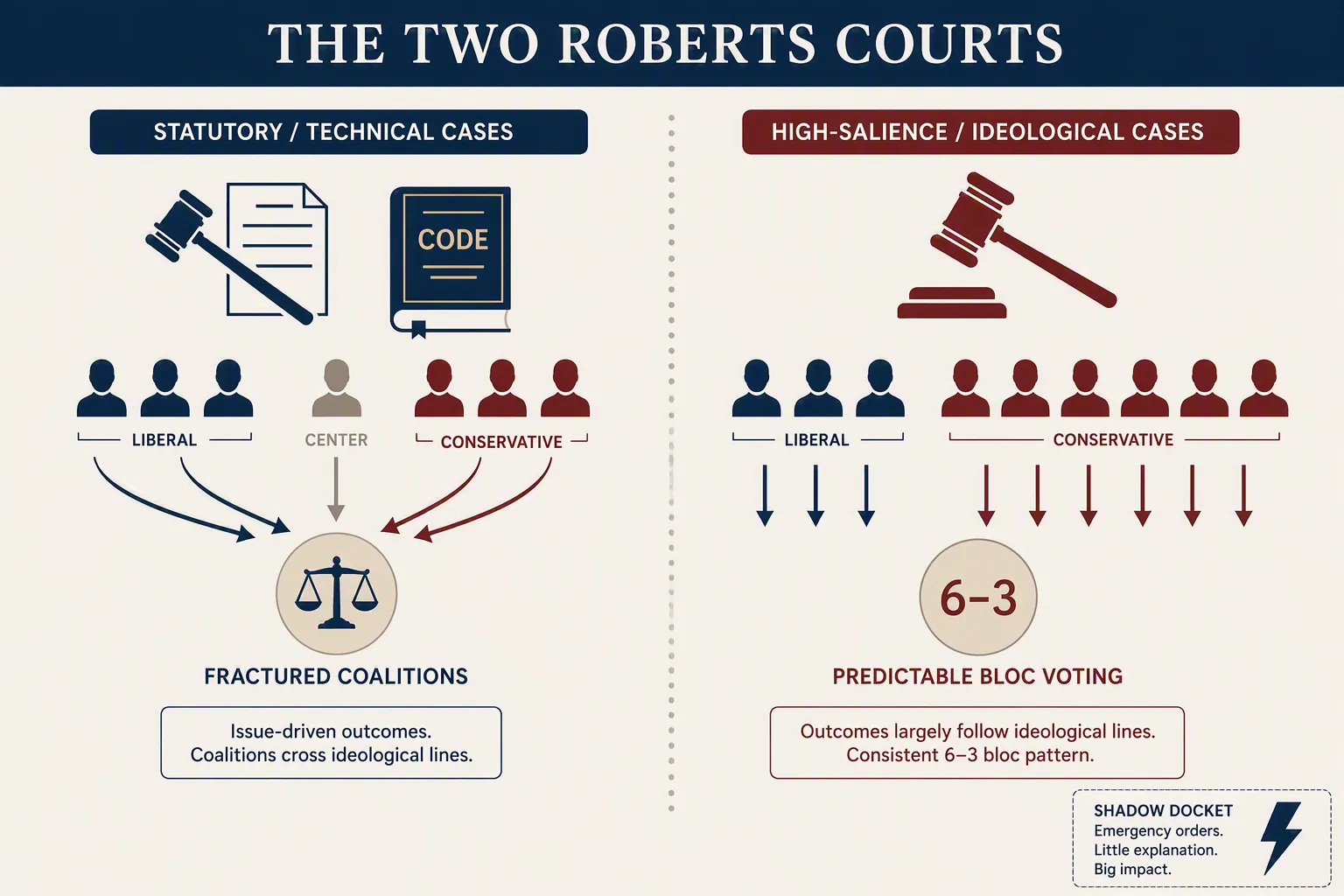
That framework tracks the lawyer’s problem better than the public legitimacy debate. “Independent” is not a personality trait. It is a pattern of behavior under pressure. A Court can be institutionally independent in the sense that it does not take dictation from the White House, while still being predictably receptive to an administration whose positions match the majority’s constitutional priors, regulatory skepticism, or account of executive power.
For case assessment, the first question is not whether the caption includes Trump. It is whether the dispute activates a legal constraint that conservative justices already recognize as their own. A litigant challenging the administration has a better chance when it can make the case about statutory fit, remedial overbreadth, jurisdiction, agency structure, constitutional text, or institutional stability. Those arguments do not guarantee success, but they give the Court a route to check the executive without asking conservative justices to abandon their jurisprudential commitments.
The second question is whether the case will reach the Court as an emergency. If the answer is yes, the risk profile changes. The lawyer defending a lower-court order must assume that the administration’s application will be framed around immediate governmental injury, nationwide remedial excess, and the need to prevent a single judge from controlling federal policy. In that posture, even a legally serious challenge may be treated as something to be resolved later while the administration proceeds now.
This is also where the site’s earlier statistical piece, “The Data Behind SCOTUS Bias Allegations in Trump Rulings,” fits. The raw win-rate backdrop is useful, but the next layer is docket-sensitive classification. A 75% emergency win rate does not mean every Trump administration position wins. It means counsel should not treat three cross-ideological merits examples as a safe proxy for emergency-docket behavior.
What to do with Kagan’s concession that the Court is “very conservative”
Kagan’s concession is more valuable than a full-throated defense would have been. By saying the Court is “very conservative” and sometimes “deeply wrong,” she separated two claims that often get blurred: ideological direction and institutional obedience. [1] The first is obvious in many areas of doctrine. The second requires more proof.
For practitioners, that distinction matters. If the Court were simply obedient, the analysis would be crude: the administration asks, the Court grants. Kagan’s three cases make that account too simple. If the Court were simply neutral, the emergency data would be much less troubling. The current evidence points to something more operationally specific: a conservative Court that can check a conservative administration when legal method supplies a limiting principle, but that often gives the administration what it needs in urgent, high-salience disputes.
The same institutional strain shows up in smaller signals. In Havana Docks, Kagan issued her first solo dissent after nearly 16 years on the Court; SCOTUSblog reported that Justice Clarence Thomas had 52 solo dissents, while Chief Justice John Roberts and Kagan had one each. [3] That fact should not be turned into melodrama. It is useful because it marks rare isolation by a justice who generally does not write as if institutional disagreement is costless.
The point is not that Kagan’s institutional loyalty blinds her. It is that her defense must be read alongside her alarm. She is telling lawyers two things at once: do not assume the Court is a White House instrument, and do not assume its emergency practice is healthy enough to produce reliably careful decisions.
The litigation-risk takeaway
A lawyer challenging executive action should give Kagan’s defense real weight when the case can be built around a conservative legal constraint. A clean statutory argument is worth preserving. A jurisdictional defect should not be treated as window dressing. A remedial objection should be anticipated before the government turns it into the basis for emergency relief. A separation-of-powers claim that protects an institution conservatives value may have more room than a claim that asks the Court to endorse broad judicial supervision of the administration.
The harder advice is for emergency planning. If the client’s practical objective depends on keeping a lower-court injunction in place, Supreme Court risk should be priced from the start, not added after the government files. The record must be built for irreparable harm and equities before the application arrives. The merits theory must be understandable at emergency speed. And the client should be told plainly that a strong district-court win may not control the operational timeline.
Kagan is partly right. The Roberts Court is not well described as a puppet if that means it mechanically obeys the Trump administration. Her three cases matter because they show that conservative legal method can produce real checks on executive overreach. But those examples do not erase the shadow-docket pattern, and they do not justify treating cross-ideological merits outcomes as a general guarantee.
The usable forecast is narrower: independence exists, but it is conditional, docket-sensitive, and least protective when the administration’s position aligns with the Court’s dominant ideological bloc. In those cases, especially on emergency applications, Kagan’s defense may describe the institution’s self-conception better than the risk borne by the party trying to stop executive action.
References
- Coverage of Justice Kagan’s July 23, 2026 remarks at the 9th Circuit Judicial Conference — AP, Politico, and SCOTUSblog — July 23, 2026
- Brennan Center/ProPublica shadow-docket analysis — Brennan Center for Justice — July 13, 2026
- The Two Roberts Courts — SCOTUSblog — June 2026
Related records
Tool profile
Browse tool evaluations →Governing regulation
Browse the obligations tracker →Preventive workflow
Browse verification workflows →
Report a correction or tip
Spotted an outdated figure, a misstated fact, or a ruling this case record should reflect? Public comments are disabled for this content given the professional cost of a misreported case outcome, penalty amount, or rule text — use the structured correction channel instead.
Report a correction or tip for this record →