
Nevada Judge Dismisses Kash Patel's Defamation Lawsuit
Chief Judge Andrew P. Gordon dismissed Kash Patel's defamation lawsuit against California blogger Jim Stewartson for lack of personal jurisdiction and vacated the $250,000 default judgment Patel had previously won. The ruling reached no conclusion on whether the posts were defamatory, so a refiled case in another forum remains possible.
- Jurisdiction
- US-Nevada
- Court
- U.S. District Court for the District of Nevada
- Judge
- Andrew P. Gordon
- AI tool named
- None
- Ruling date
- Jul 28, 2026
- Source document
- View primary court order ↗
- Last verified
- Aug 1, 2026
Lex Machina Review is an independent risk-tracking and reference resource. Nothing on this site is legal advice, and using it does not create an attorney-client relationship. Every record is reviewed against primary sources but may not reflect the most current status of a matter — always verify directly against the cited court order, rule text, or a licensed attorney before relying on it.
Companion explanation — secondary to the source document above
Kash Patel’s defamation lawsuit was dismissed by a Nevada judge on forum power, not on whether Jim Stewartson’s posts were true, false, opinion, hyperbole, or defamatory. Chief Judge Andrew P. Gordon of the District of Nevada granted Stewartson’s motion to dismiss for lack of personal jurisdiction, set aside the earlier $250,000 default judgment as void under Rule 60(b)(4), and dismissed the case without prejudice in an order signed July 25 and entered July 28, 2026. [1]
That distinction controls the status of the case. The court did not say Patel lost a defamation merits fight. It did not say Stewartson’s posts were legally protected. It said Nevada federal court lacked power over this California-based defendant on this record.
| Record field | Entry |
|---|---|
| Case | Kashyap Patel and The Kash Foundation v. James Stewartson, No. 2:23-cv-00873 |
| Court | U.S. District Court for the District of Nevada |
| Judge | Chief Judge Andrew P. Gordon; Magistrate Judge Nancy J. Koppe appeared on the docket |
| Nature of suit | 320 Assault, Libel & Slander; diversity jurisdiction |
| Final ruling addressed here | Motion to set aside default judgment and motion to dismiss granted; dismissal without prejudice |
| Ruling date | Signed July 25, 2026; entered July 28, 2026 |

How the case reached a default judgment before losing its footing
The procedural path matters because the dismissal did not arrive at the start of the case. Patel and The Kash Foundation filed in June 2023. Service problems followed. A clerk’s default was entered in late 2023. The case then sat long enough for the court to issue an order to show cause in 2025 before the plaintiffs obtained a default judgment. Only after that judgment did Stewartson appear and attack the court’s power to bind him.
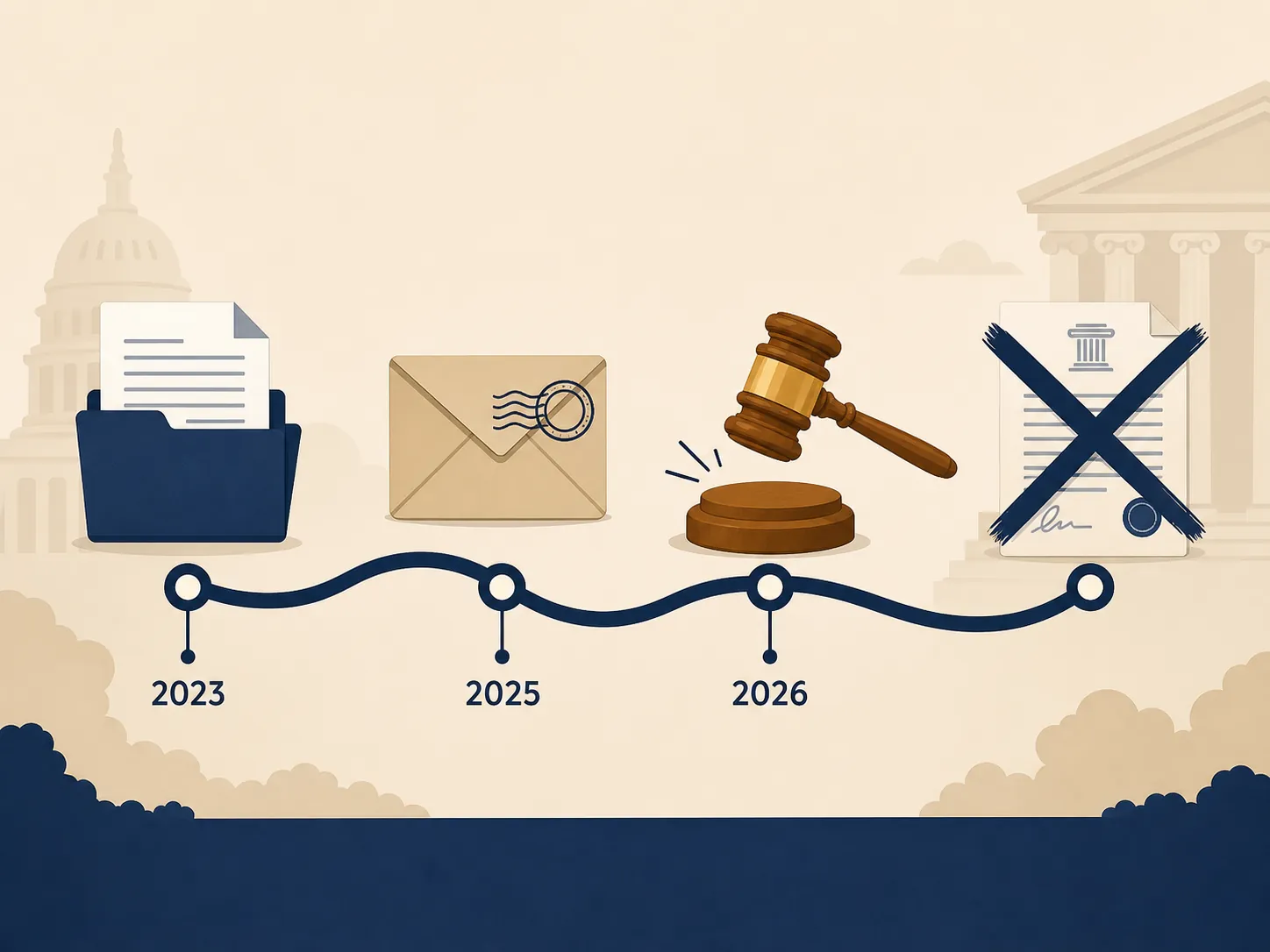
| Date | Docket event |
|---|---|
| June 3, 2023 | Patel and The Kash Foundation filed the complaint in the District of Nevada. [2] |
| June 30 and Aug. 3, 2023 | Summonses were returned unexecuted. [2] |
| 2023, after Rule 4(m) notice | The court extended the service deadline to Dec. 27, 2023. [2] |
| Oct. 7, 2023 | Service was recorded on the docket. [2] |
| Dec. 22, 2023 | The clerk entered default. [2] |
| March 4, 2025 | The court issued an order to show cause for failure to prosecute. [2] |
| Aug. 5, 2025 | Default judgment was entered for $250,000 total: $100,000 compensatory and $100,000 punitive damages to Patel, and $25,000 compensatory and $25,000 punitive damages to The Kash Foundation. [3] |
| Sept. 5, 2025 | Stewartson filed motions to dismiss and to vacate the default judgment. [2] |
| April 19, 2026 | The court ordered supplemental briefing on the burden of proof for a Rule 60(b)(4) challenge, noting an unresolved Ninth Circuit question and a split between other circuits. [2] |
| July 25 / July 28, 2026 | Judge Gordon signed, and the docket entered, the order vacating the default judgment and dismissing the case for lack of personal jurisdiction. [1][2] |
One docket trap is worth flagging. CourtListener lists “Date Terminated: Aug. 5, 2025,” but that corresponds to the earlier closure after default judgment, not the later jurisdictional dismissal entered in July 2026. [2] For anyone reconstructing the case from docket metadata alone, that is exactly the sort of entry that can make the procedural status look cleaner than it was.
The personal-jurisdiction ruling
Judge Gordon’s ruling turned on minimum contacts. Stewartson was a California-based commentator who published on Substack and X. Patel was alleged to be a Nevada resident. But the court held that posts aimed at a national audience did not become Nevada-directed conduct merely because they discussed or tagged a Nevada resident. The order described the relevant audience as “the American body politic writ large,” not a Nevada forum. [1]
The supplemental-briefing issue could have mattered in another case: who bears the burden when a defendant asks to set aside a default judgment as void for lack of personal jurisdiction? Judge Gordon noted the uncertainty, then made it immaterial. “Regardless of who bears the burden of proof,” the court found Stewartson did not have minimum contacts with Nevada. [1]
That is a narrower holding than many public summaries can tolerate. The court did not hold that internet posts can never support personal jurisdiction outside the poster’s home state. It held that these posts, on this record, were not directed at Nevada in a way that satisfied due process. National political speech about a person who happens to reside in Nevada was not enough.
The tagging point is especially important for online-defamation risk. The order treated tagging Patel as part of the publication mechanics, not as a substitute for forum-directed conduct. The plaintiff’s residence supplied an injury location; it did not supply the defendant’s Nevada contacts.
What the alleged posts were, and why they were not the ruling
Patel’s complaint challenged posts from June 2021 through May 2023. The order identifies statements accusing or labeling Patel as a “Kremlin asset,” a “traitor,” and someone who “planned January 6,” along with crude insults including “blatantly incompetent chud” and another profane phrase the court quoted. [1]
Those allegations explain why the suit was filed. They do not explain why it was dismissed. The order did not test falsity, defamatory meaning, actual malice, opinion, rhetorical hyperbole, or damages. It stopped at the court’s power to exercise jurisdiction over Stewartson.
That means “dismissed” is doing less work than it may appear to do. It is a jurisdictional dismissal without prejudice, not a merits adjudication clearing the posts.
Why the $250,000 judgment was vacated
The default judgment was not reduced, reconsidered, or reweighed. It was vacated because a judgment entered without personal jurisdiction is void. Rule 60(b)(4) is the mechanism for that result, and Judge Gordon used it to set aside the August 2025 judgment in full. [1]
Practically, that erased the $250,000 award: $200,000 that had been awarded to Patel personally and $50,000 that had been awarded to The Kash Foundation. [3] The amount did not disappear because the court found the injury overstated. It disappeared because the court concluded the forum never had authority to enter judgment against Stewartson.
Stewartson’s late appearance did not earn praise from the court. Judge Gordon wrote that Stewartson had “wasted the plaintiffs’ and the court’s time” and added, “I do not commend his actions.” [1] That criticism sits alongside the jurisdictional ruling rather than against it. A defendant can behave badly in litigation and still be outside the court’s personal jurisdiction.
The court also did not convert that criticism into fee-shifting. Because the judgment was void, the order left the parties where the jurisdictional defect required them to be: no enforceable Nevada default judgment, and no merits determination to anchor the rest of the dispute. [1]
The present status
As of the July 2026 order, Patel v. Stewartson is dismissed without prejudice in the District of Nevada. The prior $250,000 default judgment is vacated as void. The court made no merits ruling on truth, falsity, defamatory meaning, opinion, actual malice, or damages. [1]
A new filing in a forum with personal jurisdiction remains possible. That is not a prediction that Patel will refile, or that Stewartson would lose if he did. It is simply the consequence of a dismissal without prejudice on a threshold jurisdictional ground.
So the record answer is limited and important: a Nevada federal judge dismissed Kash Patel’s defamation lawsuit against Jim Stewartson because Nevada lacked personal jurisdiction over the defendant, and the court vacated the default judgment for the same reason. Nothing in the order supplies a clean merits vindication for either side.
References
Related records
Tool profile
Browse tool evaluations →Governing regulation
Browse the obligations tracker →Preventive workflow
Browse verification workflows →
Report a correction or tip
Spotted an outdated figure, a misstated fact, or a ruling this case record should reflect? Public comments are disabled for this content given the professional cost of a misreported case outcome, penalty amount, or rule text — use the structured correction channel instead.
Report a correction or tip for this record →