
Verify legal analysis of the Kelly Cochran murder case in three sources
The Kelly Cochran murder case has a compact, fully verifiable legal record across Michigan and Indiana proceedings. This article presents each charge, ruling, sentence, and appeal outcome linked to its primary court order, and flags where AI-generated or true-crime accounts diverge from the record.
- Jurisdiction
- Michigan, Indiana
- Court
- Michigan Court of Appeals
- Judge
- Richard J. Celello
- AI tool named
- None named
- Ruling date
- Jun 11, 2019
- Source document
- View primary court order ↗
- Last verified
- Aug 1, 2026
Lex Machina Review is an independent risk-tracking and reference resource. Nothing on this site is legal advice, and using it does not create an attorney-client relationship. Every record is reviewed against primary sources but may not reflect the most current status of a matter — always verify directly against the cited court order, rule text, or a licensed attorney before relying on it.
Companion explanation — secondary to the source document above
Record status: last verified August 1, 2026
This is a verification record for legal analysis of the Kelly Cochran murder case, not a retelling of the crimes and not legal advice. The useful question is narrow: which charges, rulings, sentences, and appeal outcomes can be tied to a named court record or contemporaneous source, and which familiar claims remain prosecution theory, party statement, or true-crime shorthand.
The anchor document is the Michigan Court of Appeals unpublished opinion in People of Michigan v. Kelly Marie Cochran, No. 338951, issued June 11, 2019. It affirmed the Michigan conviction and remanded only for correction of a typographical error in the sentencing documents; it did not reopen the conviction, order a new trial, or disturb the life sentence. [1][2]
The next Michigan step is the March 2020 Michigan Supreme Court leave denial. Local reporting quoted the order as saying the court was “not persuaded that the question presented should be reviewed,” which leaves the Court of Appeals disposition intact. [3]
The separate Indiana step is the Lake County proceeding involving the death of Jason Cochran. Contemporary reporting states that Cochran pleaded guilty in April 2018 and was sentenced in May 2018 to 65 years, consecutive to the Michigan sentence, under an agreement that removed exposure to the death penalty and life without parole. [4][5]
| Verification step | Source status | What it verifies | What it does not verify |
|---|---|---|---|
| Michigan Court of Appeals, No. 338951 | Unpublished appellate opinion / case listing | Appellate posture; affirmed conviction; remand limited to sentencing typographical correction. [1][2] | It does not convert every prosecution theory or trial narrative into a judicial finding. |
| Michigan Supreme Court leave denial | Reported order language | Leave denied in March 2020; Court of Appeals outcome left in place. [3] | It is not a merits opinion adopting a broader factual narrative. |
| Indiana plea and sentence | Contemporary reporting of Lake County plea/sentence outcome | April 2018 guilty plea; May 2018 65-year consecutive sentence; plea context removing death penalty and life-without-parole exposure. [4][5] | It does not merge Indiana facts, charges, or sentencing posture into the Michigan appeal. |
Michigan proceeding: charges, verdict, sentence, appeal
The Michigan case concerned the killing of Chris Regan in Iron County. The trial-day details most often needed for a legal record—court, judge, verdict date, and count list—come from contemporary local reporting, while the appellate effect of the case comes from the Court of Appeals opinion and later leave denial.
| Field | Verified record |
|---|---|
| Jurisdiction | Michigan |
| Trial court | Iron County Trial Court, as reported contemporaneously. [6] |
| Trial judge | Judge Richard J. Celello, as reported contemporaneously. [6] |
| Appellate case | People of Michigan v. Kelly Marie Cochran, Michigan Court of Appeals unpublished opinion No. 338951, issued June 11, 2019. [1][2] |
| Verdict date | February 28, 2017, as reported by Iron Mountain Daily News. [6] |
| Counts of conviction | First-degree murder under an aiding-and-abetting theory, MCL 750.316; conspiracy to mutilate a dead body; concealing a death; larceny in a building; and lying to a peace officer. [6] |
| Trial outcome | Jury convicted Cochran on all five counts. [6] |
| Sentence | Life without parole plus concurrent terms, as reported after verdict and reflected in the appellate posture. [1][6] |
| Court of Appeals result | Affirmed; remanded only to correct a sentencing typographical error. [1][2] |
| Michigan Supreme Court result | Leave denied in March 2020. [3] |
| Current verified Michigan status | Conviction and sentence remain undisturbed in the cited source chain; no new trial or merits reversal appears in the supplied record. |
That last line matters. A remand for a typographical correction is still a remand, but it is not the kind of remand that changes guilt, orders resentencing on the merits, or creates an unresolved conviction status. A summary that says only “appeal remanded” without the limiting phrase is materially incomplete.
Indiana proceeding: separate plea, separate sentence
The Indiana case should sit beside the Michigan case, not inside it. The Indiana proceeding concerned Jason Cochran’s death in Hobart, Indiana. Reporting described the death as occurring on February 20, 2016, with homicide by asphyxia by strangulation complicated by heroin intoxication. [4]
| Field | Verified record |
|---|---|
| Jurisdiction | Indiana |
| Court / county | Lake County, Indiana, as identified in reporting of the plea and sentence. [4][5] |
| Judge | Not used as a verified field here; the supplied source set does not provide a citable judge identification. |
| Victim | Jason Cochran. [4] |
| Plea | Guilty plea reported in April 2018. [4] |
| Sentence | 65 years, reported in May 2018. [5] |
| Consecutive status | Reported as consecutive to the Michigan sentence. [5] |
| Plea context | Reporting states the agreement removed death-penalty and life-without-parole exposure. [4][5] |
| Current verified Indiana status | The supplied record supports a guilty plea and 65-year consecutive sentence; it does not support treating the Indiana plea as part of the Michigan appellate ruling. |
The Indiana material is important because it confirms a second homicide proceeding and a consecutive sentence. It is also where overbroad summaries often start to drift. A Michigan appellate court did not adjudicate the Indiana plea. The Indiana guilty plea did not supply the Michigan jury verdict. They are related in public narrative; they remain separate legal events.
Claims that should not be upgraded into findings
The Cochran case carries several claims that are easy to repeat and hard to source cleanly. For legal analysis, the question is not whether a claim appeared in a public account. The question is whether a court found it, a party alleged it, or a reporter attributed it.
| Claim or phrase | Record-safe classification | Safer wording |
|---|---|---|
| “Marriage pact” | Prosecution theory / party-account material, not a judicial finding in the cited appellate outcome. | “Prosecutors advanced a pact theory,” unless a specific cited passage is being discussed. |
| “Serial killer” | Public-reporting and suspicion language, not a conviction label established by the cited Michigan or Indiana outcomes. | “Some reports described suspicions or allegations of additional killings; the cited legal record verifies the Michigan conviction and Indiana guilty plea.” |
| “Trophy bag” | Unproven claim; the Court of Appeals record noted that no evidence of such a bag was found. [1] | “A trophy-bag claim appeared in the case narrative, but the cited appellate record did not treat recovered physical evidence of such a bag as established.” |
| “Indiana sentencing date” | Supported here by contemporary reporting, not by a sentencing order reproduced in the supplied source set. [5] | “ABC7 Chicago reported the May 2018 sentencing; obtain the Lake County sentencing entry before relying on the exact docket language.” |
This distinction is not cosmetic. A prosecution theory can explain why evidence was offered or why a case was charged a certain way. It does not become a finding merely because the defendant was convicted. A party statement can be admissible, disputed, limited, or repeated in media coverage. It still needs a source label.
Where AI summaries and true-crime recaps tend to diverge
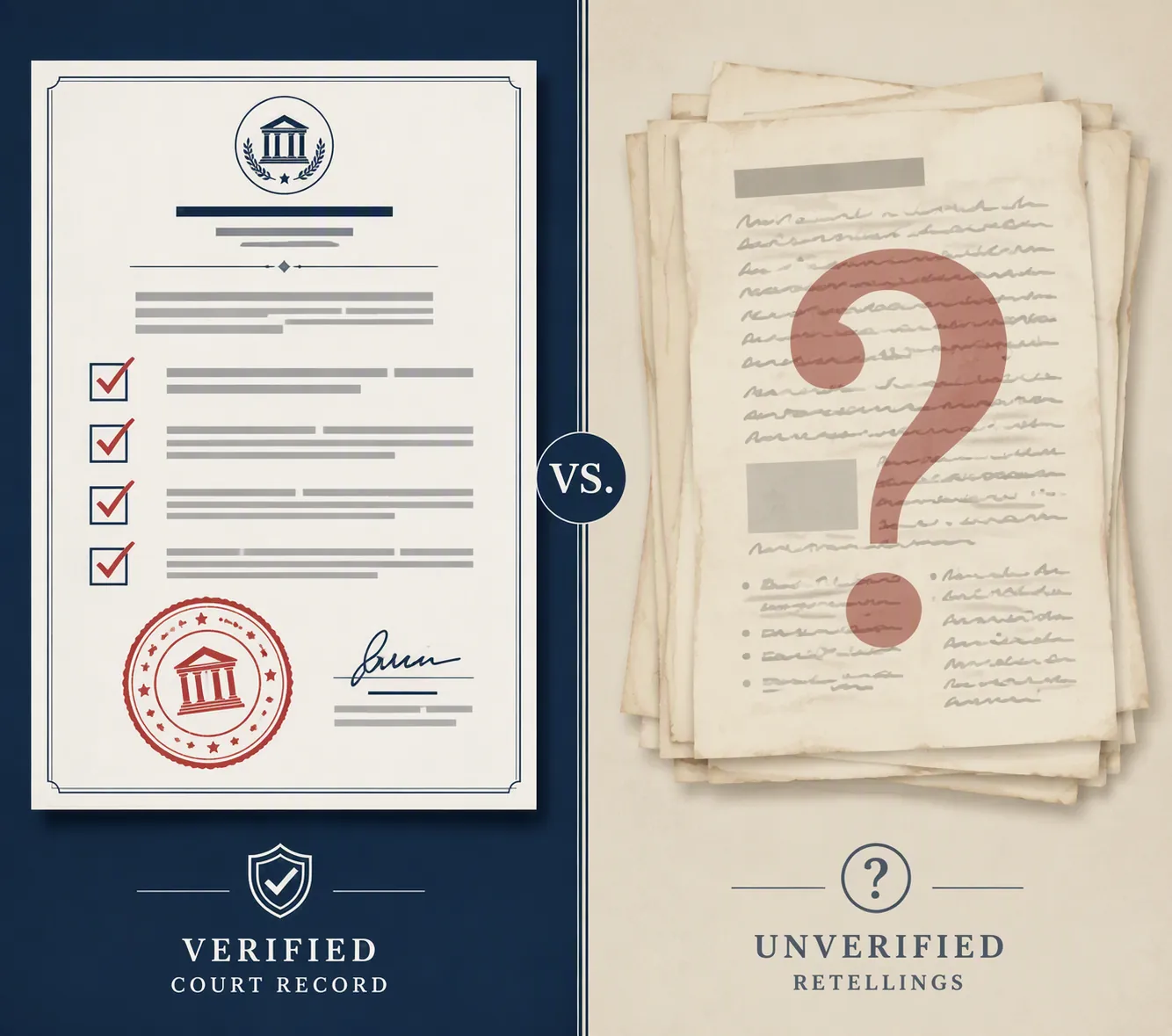
No source in this record establishes that a specific AI system has hallucinated this case. The risk is structural. The main Michigan authority is unpublished, the public story is louder than the appellate record, and the Indiana proceeding is close enough in time and subject matter to be merged by a careless summary. That source class matters because benchmark work on legal-AI hallucination has identified unpublished and lower-court authority as especially vulnerable; here, that is a verification warning, not proof of a case-specific AI failure.
- Merging the proceedings: treating the Michigan jury conviction, the Michigan appeal, and the Indiana guilty plea as if they were one case file.
- Overstating the appeal: saying the appeal was “remanded” without saying the remand was only for a sentencing typographical correction. [1]
- Turning allegations into findings: presenting the marriage-pact theory, serial-killer language, or trophy-bag claim as adjudicated fact.
- Losing the source class: quoting true-crime narration as if it were the Court of Appeals opinion.
- Treating a leave denial as an endorsement: the Michigan Supreme Court denial left the result in place, but it was not a full merits opinion adopting every factual statement below. [3]
The safest way to audit a generated or published case summary is mechanical. Mark every sentence as Michigan trial reporting, Michigan appellate record, Michigan leave denial, Indiana plea/sentence reporting, or unverified narrative. If a sentence cannot survive that marking exercise, it should not appear as legal analysis.
Practical verification rule
A defensible legal analysis of the Kelly Cochran murder case should attach each material claim to one of three steps: the Michigan Court of Appeals unpublished opinion No. 338951, the Michigan Supreme Court leave denial, or the Indiana plea and sentence record. Trial-day reporting may fill record-adjacent details such as judge, verdict date, and count list, but it should be labeled as reporting. Claims about a marriage pact, serial killing, or a trophy bag should not be written as judicial findings unless the cited court record actually says so.
References
- People of Michigan v. Kelly, Midpage.
- People v. Cochran, Justia.
- Appeal denied for woman convicted of murder in Caspian, Iron Mountain Daily News, March 2020.
- Woman serving life in Michigan for boyfriend's death pleads guilty to her husband's murder in Indiana, Chicago Tribune, April 18, 2018.
- Hobart woman suspected of being serial killer gets 65 years for husband's murder, ABC7 Chicago, May 2018.
- Cochran guilty of murder, Iron Mountain Daily News, March 2017.
Related records
Tool profile
Browse tool evaluations →Governing regulation
Browse the obligations tracker →Preventive workflow
Browse verification workflows →
Report a correction or tip
Spotted an outdated figure, a misstated fact, or a ruling this case record should reflect? Public comments are disabled for this content given the professional cost of a misreported case outcome, penalty amount, or rule text — use the structured correction channel instead.
Report a correction or tip for this record →