
Who Faces Liability After the Kenmore Air Plane Crash?
This article maps the multi-defendant liability landscape after the Kenmore Air Flight 140 crash in Puget Sound, identifying potential claims against the operator and manufacturer under Washington tort law and unresolved admiralty jurisdiction issues that control where and under what rules a case can be filed.
- Jurisdiction
- Washington, United States
- Court
- Washington State Superior Court
- AI tool named
- None
- Ruling date
- Jul 23, 2026
- Source document
- View primary court order ↗
- Last verified
- Jul 25, 2026
Lex Machina Review is an independent risk-tracking and reference resource. Nothing on this site is legal advice, and using it does not create an attorney-client relationship. Every record is reviewed against primary sources but may not reflect the most current status of a matter — always verify directly against the cited court order, rule text, or a licensed attorney before relying on it.
Companion explanation — secondary to the source document above
Current as of July 25, 2026: no lawsuit has been reported from the Kenmore Air Flight 140 crash, and no NTSB preliminary report has been published. The legal posture is therefore prospective, not a liability finding and not legal advice. The useful question for a passenger lawyer or risk manager is narrower: with survivors still being treated, records still inside company and maintenance files, and a DHC-3 failure history already sitting in the public record, who belongs on the early defendant chart and which court rules may control the case?
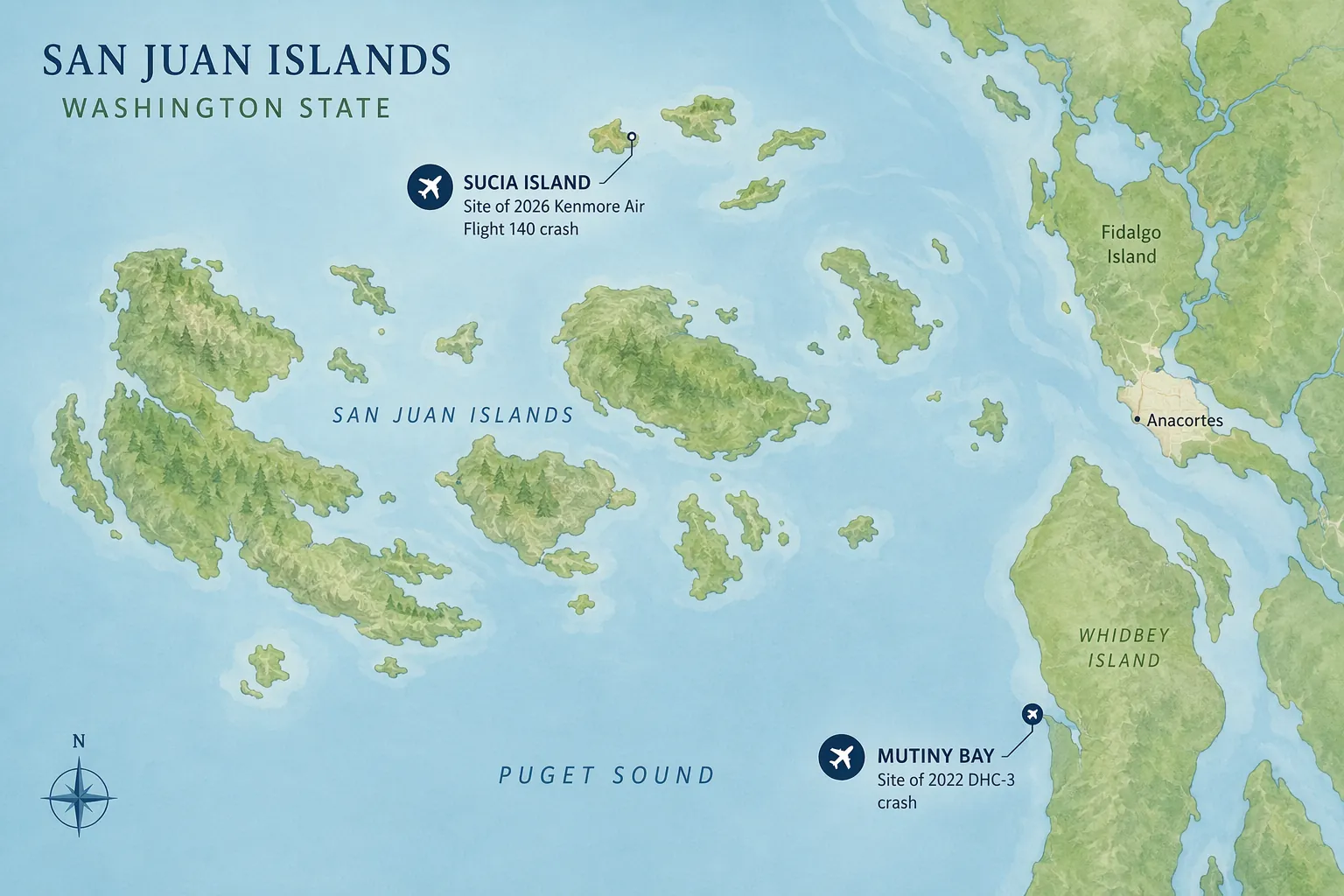
The confirmed public fact pattern is enough to start preservation work, but not enough to assign cause. Kenmore Air Flight 140, a DHC-3T Vazar Turbine Otter registered as N709KA, went down on July 23, 2026, in Shallow Bay near Sucia Island in Washington’s San Juan Islands. Eleven people were rescued; CNN reported one person critically injured, four injured in total, and seven discharged by July 24, citing the San Juan County Sheriff’s Office.[1] FAA registry records identify N709KA as a De Havilland DHC-3 with a standard airworthiness certificate, while the Aviation Safety Network accident entry identifies the aircraft as MSN 410, a 1960 airframe, and flags that its current accident information is based on news, social media, or unofficial sources.[2][3]
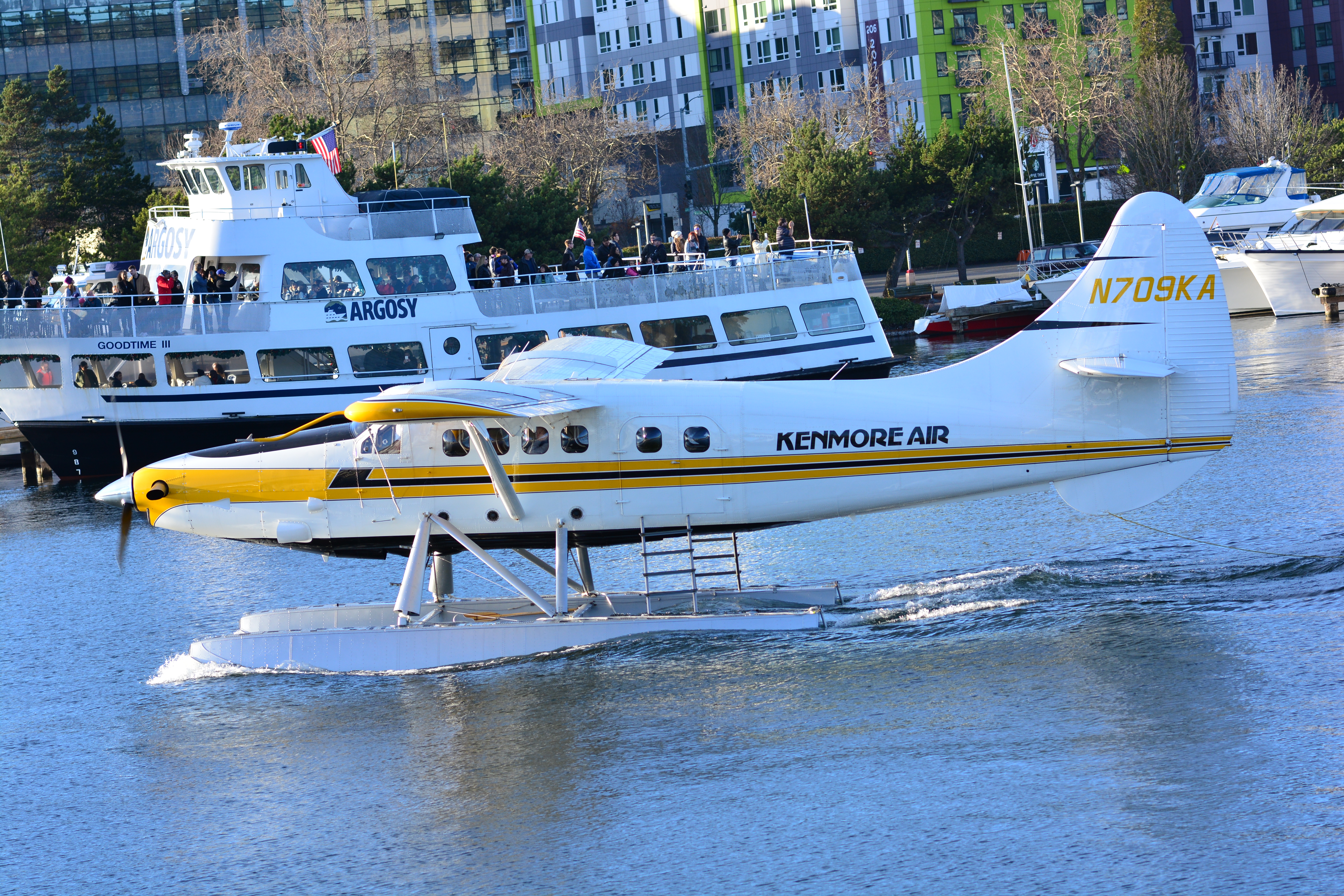
That posture matters. A survivable crash produces a different litigation file than a fatal one. Medical damages may still be changing, passenger interviews may be possible, and the aircraft, components, maintenance records, dispatch materials, weather decisions, and company communications can still be preserved before a narrative hardens. The rescue is not the end of the legal story; it is the reason the legal story has to move quickly.
The first filing question is not just “Kenmore or no Kenmore”
Kenmore Air is the obvious first defendant candidate because it operated the domestic passenger flight. If a passenger files under Washington tort law, the operator track would likely sound in negligence: aircraft condition, inspection practices, pilot decisions, weather evaluation, dispatch, training, and compliance with federal operating rules for commuter and on-demand operations. The standard of care would not be invented from sympathy for the survivors; it would be built from the carrier’s obligations, its own manuals, maintenance records, logbooks, FAA requirements, and what the crew and dispatch operation knew before departure.
But this is not a clean single-operator file. The aircraft type pulls the case toward product and component questions almost immediately because the DHC-3 has a recent, fatal, same-region accident record involving the horizontal stabilizer trim system. That does not prove that N709KA failed in the same way. It does mean that a lawyer who waits for the preliminary report before asking for actuator, inspection, compliance, and maintenance records may already be behind.
The Montreal Convention should not do work here. The reported flight was domestic Washington point-to-point service, not international carriage. That leaves the main liability map in state tort, possible product-liability claims, federal aviation duties, and the harder jurisdictional question created by the crash location in navigable water.
Why the 2022 Mutiny Bay record changes the discovery map
The 2022 Mutiny Bay DHC-3 crash is the reason the Sucia Island file cannot be treated as an ordinary floatplane mishap with an operator-only theory. In that earlier accident, West Isle Air DHC-3 Otter N725TH crashed into Puget Sound near Whidbey Island, killing all 10 people aboard. The NTSB’s AIR2301 report found that the probable cause was the in-flight unthreading of the horizontal stabilizer trim actuator’s clamp nut because a lock ring was missing, producing an abrupt airplane-nose-down pitch and water impact.[4]
That is a specific mechanical failure mode, not a vague family resemblance. It points to tangible items: the actuator assembly, lock ring presence and condition, inspection history, maintenance instructions, service difficulty reports, communications with the type-certificate holder, and compliance with post-Mutiny Bay airworthiness directives. The fact that Sucia and Mutiny Bay are both Puget Sound DHC-3 water crashes, about 35 miles apart, is litigation-significant because it tells counsel what to look for first; it is not yet causation evidence for Flight 140.[5]
The regulatory timeline also matters. Transport Canada issued AD CF-2018-04 in January 2018 addressing corrosion concerns on DHC-3 aircraft.[6] After the Mutiny Bay crash, the FAA issued Emergency AD 2022-21-51 on October 4, 2022, requiring inspections related to possible cracks in the elevator auxiliary spar.[7] The FAA then issued AD 2022-23-08 on November 2, 2022, requiring inspection of the horizontal stabilizer actuator lock ring within 10 flight hours and corrective action if the lock ring was missing.[8]
For N709KA, the legal issue is not whether those directives existed in the abstract. It is whether this aircraft’s records show timely compliance, what was actually inspected, who performed the work, whether any replacement parts were installed, whether discrepancies were deferred or cleared, and whether the operator or maintenance provider had reason to revisit the assembly before Flight 140. FAA registry status confirms certification; it does not answer the maintenance-history question.[2]
Aviation Law Group’s July 23 statement deserves attention for that reason. The firm, which represented families after the Mutiny Bay crash, said it was monitoring the Sucia investigation and identified actuator AD-compliance records as among the first documents that should be secured.[9] That is a plaintiff-side source with an adversarial interest. Still, the document list is the kind of list competent counsel on either side would build: AD compliance, maintenance logs, component history, inspection signoffs, and communications about the trim system.
| Early target | Why it matters |
|---|---|
| Aircraft logbooks and AD compliance records | Show whether FAA AD 2022-23-08 and related inspections were completed, by whom, and when. |
| Horizontal stabilizer trim actuator records | Connect or separate N709KA from the Mutiny Bay failure mode without assuming the same cause. |
| Maintenance-provider files | Identify whether exposure stops with the operator or extends to inspection, repair, or component actors. |
| Dispatch, weather, and pilot records | Support or weaken an operator-negligence theory independent of product defect. |
| Component custody and preservation records | Determine whether the physical evidence remains usable for NTSB, expert, and litigation analysis. |
The product-liability track runs through the type certificate, not through pattern alone
Viking Air, as the DHC-3 type-certificate holder identified in the regulatory history, is the natural product-liability focus if the Flight 140 evidence points toward a design, warning, instruction, or continued-airworthiness problem. That theory would not be limited to asking whether a part broke. It would ask what the certificate holder knew after earlier field experience, what inspection or service information was issued, whether mandated inspections were sufficient, and whether operators received clear instructions about the failure mode.
The stronger version of the product theory would need a bridge from the 2022 NTSB findings to N709KA’s actual hardware. If the actuator and lock ring on Flight 140 were intact and the failure sequence points elsewhere, Mutiny Bay becomes background notice, not a causation theory. If the same assembly shows noncompliance, wear, missing retention hardware, improper installation, or unclear inspection guidance, the case changes. That is why early access to the physical aircraft and component records is more valuable than early public certainty.
Component manufacturers, repair stations, and maintenance contractors may also enter the chart, but only if records justify it. A first-week defendant chart can list those actors as investigation targets. It should not pretend they are defendants with established exposure before the maintenance chain, part serial history, overhaul documents, and inspection signoffs are reviewed.
Washington tort law gives structure, but it does not solve the water problem
If Washington law governs the passenger claims, several rules become practical from the start. Washington generally does not allow punitive damages unless expressly authorized, and its comparative-fault statute allocates responsibility among at-fault entities rather than letting a plaintiff convert every defendant into a full backstop for non-economic damages in the ordinary case.[10] That affects settlement value, contribution strategy, and how aggressively defendants try to identify nonparties at fault.
The limitation periods also point counsel toward prompt but not panic-driven filing. Washington’s personal-injury statute provides a three-year period, and wrongful-death actions are governed through Washington’s wrongful-death statute when a death claim exists.[11][12] On the current public facts, Flight 140 is a survivable crash with reported injuries, not a reported fatality. That distinction changes damages, client counseling, and immediate medical-record development.
Kenmore Air’s prior accident and litigation history may be discoverable in targeted ways, but it should not be overused as character evidence in the opening theory. Public summaries note a 2016 Lopez Island DHC-2 Beaver crash involving Kenmore Air passengers and a 2022 Orcas Island mechanical failure.[13] Those events may matter if they connect to training, maintenance systems, notice, or institutional practices. They do not, standing alone, prove negligence in the Sucia crash.
Admiralty is the trap: locality plus maritime nexus
The crash location should not be reduced to “water equals admiralty.” Puget Sound is navigable water, and Shallow Bay is not a roadside ditch. But modern admiralty jurisdiction analysis does not stop at locality. The case has to satisfy a location inquiry and a connection inquiry: whether the incident occurred on navigable waters or caused injury there, and whether the incident has a potentially disruptive impact on maritime commerce and a substantial relationship to traditional maritime activity.[14]
That “locality plus” problem is especially awkward for a domestic seaplane. Floatplanes use water as a landing surface, interact with vessel traffic, and can trigger marine rescue operations. At the same time, Flight 140 was not a vessel voyage, not cargo carriage by sea, and not international aviation. The maritime nexus analysis will likely turn on facts that are not yet public: the precise crash location within Shallow Bay, proximity to marine traffic or facilities, rescue response, route purpose, and how a court characterizes scheduled or chartered floatplane operations in navigable waters.
The scholarship gives counsel the framework, not the answer. SMU Journal of Air Law scholarship on admiralty jurisdiction in air-crash cases describes the doctrinal movement from simple locality toward a maritime-connection inquiry.[14] Slack Davis Sanger’s aviation-admiralty analysis argues for applying admiralty jurisdiction to aviation accidents over navigable waters in appropriate cases.[15] The research record for this article identifies no controlling Ninth Circuit decision directly answering how that test applies to a domestic Part 135 seaplane crash in Puget Sound.
The choice matters because admiralty can change more than the caption. It can affect jury access, available damages, contribution and indemnity rules, forum strategy, and how state comparative-fault rules interact with federal maritime principles. A plaintiff who files as if this is an ordinary Washington personal-injury action may face a jurisdictional fight after the case is already shaped. A defendant who ignores admiralty may miss an early forum and damages argument.
What the early liability map should look like
A disciplined first-week chart would keep three columns open rather than forcing one theory too early. The operator column asks whether Kenmore Air breached aviation and common-law duties in dispatch, maintenance, inspection, weather evaluation, pilot operation, or passenger safety. The product column asks whether Viking Air or component actors bear responsibility for a known DHC-3 failure mode, inadequate instructions, inspection requirements, or continued-airworthiness failures. The jurisdiction column asks whether the case belongs in ordinary state-law litigation, federal court, admiralty, or some hybrid posture where state claims and maritime principles collide.
Those columns should be investigated in that order only if “order” means preservation priority, not liability ranking. Physical evidence and maintenance records can disappear, be repaired, be overwritten, or become harder to interpret. Medical records will mature. The NTSB preliminary report will eventually narrow the sequence. But the actuator, lock ring, logbooks, AD signoffs, dispatch materials, and exact water-location evidence are early items because they determine which legal map survives contact with the facts.
The careful answer, as of July 25, 2026, is that both operator negligence and product-liability tracks are plausible, the Montreal Convention should fall away because the flight was domestic, and the decisive early move is jurisdictional and technical discovery. The Mutiny Bay parallel is too important to ignore and too incomplete to treat as proof.
References
- Kenmore Air crash: 11 people rescued off Washington's Sucia Island, CNN, July 24, 2026.
- FAA Registry N709KA, Federal Aviation Administration.
- ASN Wikibase Occurrence # N709KA, Aviation Safety Network.
- Loss of Control and Impact With Water, De Havilland DHC-3, N725TH, Mutiny Bay, Washington, September 4, 2022, National Transportation Safety Board, September 29, 2023.
- 2022 Mutiny Bay DHC-3 crash, Wikipedia.
- Airworthiness Directive CF-2018-04, Transport Canada, January 2018.
- Emergency Airworthiness Directive 2022-21-51, Federal Aviation Administration, October 4, 2022.
- Airworthiness Directive 2022-23-08, Federal Aviation Administration, November 2, 2022.
- Kenmore Air Floatplane Crash Near Sucia Island: What We Know and the Questions Investigators Must Answer, Aviation Law Group, July 23, 2026.
- RCW 4.22: Damages and Comparative Fault, Washington State Legislature.
- RCW 4.16.080: Actions limited to three years, Washington State Legislature.
- RCW 4.20.010: Wrongful death—Right of action, Washington State Legislature.
- Kenmore Air, Wikipedia.
- Admiralty Law and Jurisdiction in Air Crash Cases, SMU Journal of Air Law.
- The Case for Applying Admiralty Jurisdiction to Aviation Accidents Over Navigable Waters, Slack Davis Sanger.
Related records
Tool profile
Browse tool evaluations →Governing regulation
Browse the obligations tracker →Preventive workflow
Browse verification workflows →
Report a correction or tip
Spotted an outdated figure, a misstated fact, or a ruling this case record should reflect? Public comments are disabled for this content given the professional cost of a misreported case outcome, penalty amount, or rule text — use the structured correction channel instead.
Report a correction or tip for this record →