
Kohberger's Guilty Plea Withdrawal Under Idaho Rule 33(c)
This article explains the two-tier standard of Idaho Criminal Rule 33(c)—pre-sentence 'just cause' versus post-sentence 'manifest injustice'—using Bryan Kohberger's pro se withdrawal petition as a live case study. Readers will learn why his sworn admissions and the Strickland/Hill test create a steep evidentiary bar despite the one-year statute of limitations not yet having run.
- Jurisdiction
- Idaho, United States
- Court
- Ada County District Court
- Judge
- Steven Hippler
- AI tool named
- None
- Ruling date
- Jul 23, 2025
- Source document
- View primary court order ↗
- Last verified
- Jul 28, 2026
Lex Machina Review is an independent risk-tracking and reference resource. Nothing on this site is legal advice, and using it does not create an attorney-client relationship. Every record is reviewed against primary sources but may not reflect the most current status of a matter — always verify directly against the cited court order, rule text, or a licensed attorney before relying on it.
Companion explanation — secondary to the source document above
Last verified July 28, 2026. This article is a criminal-procedure risk explainer, not legal advice and not an AI-sanctions or AI-hallucination item. The operative sources are Idaho Criminal Rule 33(c), Hill v. Lockhart, and Idaho’s post-conviction statute; the filed Ada County petition was not directly reviewed in the materials available for this article, so the petition’s reported allegations are attributed here to NBC News, Newsweek, and the New York Post unless and until the court filing itself is obtained. [1][2][3][4][5][6]
For a procedural explanation of Bryan Kohberger’s guilty-plea withdrawal effort, the first point is not the notoriety of the case. It is the timing. Idaho Criminal Rule 33(c) draws a clean line between a request made before sentencing and one made after sentencing. Before sentence, the court may allow withdrawal “for any just reason.” After sentence, the court may set aside the judgment and permit withdrawal only “to correct manifest injustice.” [1]
The case is already on the post-sentence side of Rule 33(c)
That distinction decides the legal conversation before the case facts take over. Kohberger pleaded guilty on July 2, 2025, to four counts of first-degree murder in the killings of four University of Idaho students. He was sentenced on July 23, 2025, to four consecutive life sentences without parole. His pro se petition seeking to withdraw the plea was filed on July 27, 2026. [4][5][6]
| When the motion is made | Idaho Rule 33(c) standard | Practical consequence |
|---|---|---|
| Before sentencing | Withdrawal may be allowed “for any just reason.” | The court still evaluates the record, but the standard is less demanding. |
| After sentencing | Withdrawal may be allowed only “to correct manifest injustice.” | The defendant must overcome the judgment, the plea record, and the strong interest in finality. |
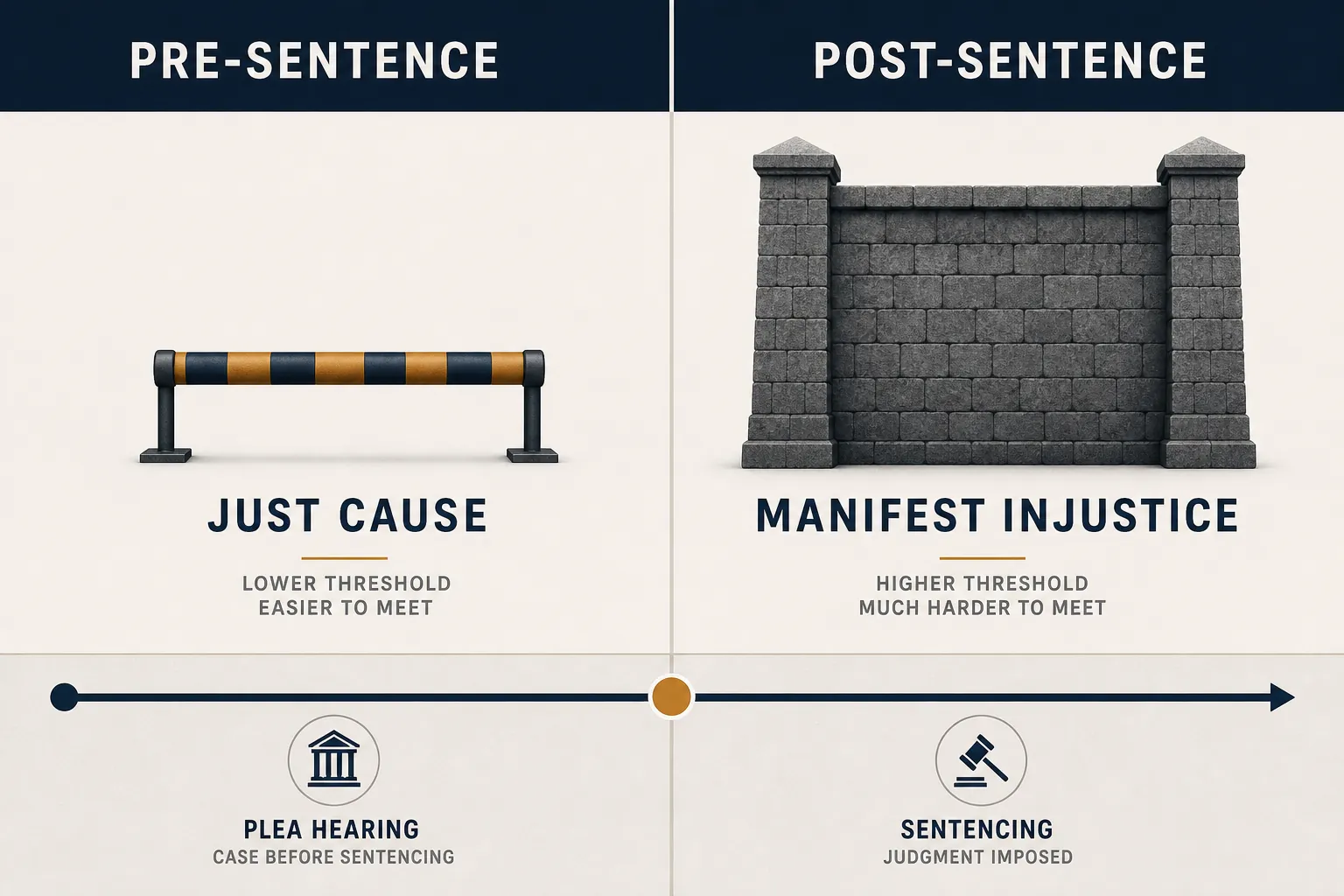
Calling the filing a “plea withdrawal request” is accurate, but incomplete. After sentencing, Rule 33(c) is not a loose reconsideration mechanism. It asks whether leaving the plea and judgment in place would work a manifest injustice. That is why the July 23, 2025 sentencing date matters more than the media cycle around the filing. Once judgment has been entered, the defendant is no longer asking the court to pause before imposing punishment; he is asking it to undo a completed criminal judgment.
The plea colloquy is not background color
The reported plea colloquy is the hard part for Kohberger. Newsweek and NBC News reported that, during the change-of-plea hearing, Judge Steven Hippler asked Kohberger whether he was pleading guilty because he was guilty, and Kohberger answered yes. [4][5]
That single answer is not the whole record, but it is not a throwaway line either. Plea colloquies exist because later litigation often turns on whether a plea was knowing, voluntary, and supported by an adequate factual basis. The questions are repetitive by design. A judge asks about guilt, rights, threats, promises, medications, counsel, and understanding because the courtroom record is supposed to reduce later ambiguity.
A defendant may still challenge a plea after giving sworn affirmative answers. The law does not treat a plea transcript as magically immune from attack. But the burden changes in practice because the defendant must give the court a reason to treat his own prior answers as unreliable. General statements that counsel failed him, that he felt pressured, or that he misunderstood the consequences usually do less work than a specific contradiction tied to the hearing: who said what, when it was said, why it was false, how it affected the plea decision, and why the issue did not surface when the judge asked the questions designed to expose it.
That is the evidentiary center of the petition as reported. If Kohberger said under oath that he was pleading guilty because he was guilty, then a later filing must do more than use forceful adjectives. It must explain why that answer should not be credited.
Ineffective assistance has to pass through Hill
The reported petition appears to frame the plea challenge around ineffective assistance of counsel. In the guilty-plea setting, Hill v. Lockhart applies Strickland’s two-part ineffective-assistance framework. The defendant must show deficient performance by counsel and prejudice; for prejudice, he must show a reasonable probability that, but for counsel’s errors, he would not have pleaded guilty and would have insisted on going to trial. [2]
That second half is often where plea-withdrawal petitions lose altitude. It is not enough to say, after the sentence is known, that trial would have been preferred. The defendant has to connect the alleged lawyer error to the decision made at the plea hearing. The court will ask whether the alleged error plausibly changed the choice between pleading guilty under the negotiated terms and proceeding to trial under the risks then facing the defendant.
The reported allegations are serious if supported. NBC News, Newsweek, and the New York Post reported that Kohberger claimed he was “advised to lie,” was convinced that “actual guilt was not an important factor,” and was subjected to “false promises” or “blatant disinformation.” [4][5][6]
| Reported allegation | What it may address | What the petition would still need to supply |
|---|---|---|
| Counsel allegedly advised him to lie | Deficient performance, if the advice was actually given and related to material plea answers | Specific facts identifying the advice, timing, context, and how it produced false sworn answers |
| Counsel allegedly said actual guilt was not important | Voluntariness and counsel-performance issues, especially if it distorted the meaning of the plea | A concrete explanation of what was said and why Kohberger still answered that he was pleading guilty because he was guilty |
| False promises or disinformation | Potentially both deficient performance and voluntariness | The promise or misinformation must be identified; conclusory labels will not substitute for facts |
| He would have chosen trial | Hill prejudice | A reasonable probability that he would have rejected the plea and insisted on trial, not merely regret after sentencing |
The allegation that counsel advised a client to lie is the sort of claim that deserves careful treatment rather than ridicule. It is also the sort of claim courts are unlikely to accept in the abstract. If a filed petition says only that counsel lied, misled, or pressured the defendant, the plea transcript will usually remain the more concrete record. If the petition supplies dates, statements, witnesses, correspondence, or other evidence that directly undermines the plea colloquy, the analysis becomes more serious.
The “actual guilt was not important” allegation is especially sensitive because the reported colloquy put actual guilt directly on the record. A court does not need to infer what Kohberger thought about guilt if the transcript shows the judge asked him and he answered yes. To overcome that, the petition would need to explain why the courtroom answer was unreliable in a way that satisfies the manifest-injustice standard, not merely why he now disputes the wisdom of the plea.
The bargain matters to Hill prejudice
The plea terms are not incidental. The reported agreement avoided the death penalty and resulted in four consecutive life-without-parole sentences. Reports also describe a waiver of direct-appeal rights as part of the plea agreement. [7][8]
Those terms do not make an ineffective-assistance claim impossible. A defendant can accept an extraordinarily severe sentence and still have a valid argument that counsel’s performance made the plea involuntary or unintelligent. But under Hill, prejudice is measured against the choice actually available at the time. If the plea removed a possible death sentence, the petition must make it plausible that, without counsel’s alleged errors, Kohberger would have rejected that bargain and gone to trial anyway.
That is a more demanding showing than saying the sentence is harsh. Life without parole is severe; four consecutive life-without-parole sentences are severe. But the legal question is comparative. The court will look at the risks the plea avoided, the rights waived, the sworn admissions made, and the specific evidence offered to show that the plea decision was infected by counsel’s deficient performance.
The post-conviction route opens the door; it does not lower the threshold
Because the reported plea agreement included a waiver of direct-appeal rights, the petition is being described as a post-conviction filing under Idaho Code § 19-4901 rather than a conventional direct appeal. Idaho’s Uniform Post-Conviction Procedure Act supplies the vehicle for collateral challenges to a conviction or sentence, including constitutional claims such as ineffective assistance. [3][7][8]
The one-year limitations issue should be kept separate from the merits. On the reported timeline, the filing date does not appear to be the immediate barrier under the post-conviction limitations framework. But timeliness only gets a petition into the proper procedural lane. It does not convert a post-sentence Rule 33(c) request into a pre-sentence “just reason” request, and it does not dilute Hill’s prejudice requirement. [3]
The same is true of pro se status. A self-represented filing should be read with enough care to understand the claim being made. It should not be mocked for lacking the polish of a lawyer-drafted brief. But a court does not grant plea withdrawal because the petition is handwritten, urgent, or framed in lay terms. The substantive burden remains manifest injustice.
What belongs outside the Rule 33(c) analysis
Several surrounding facts are real without being legally central. Idaho Attorney General Raúl Labrador has publicly said his office will oppose the petition. That matters as a litigation-position update, but the State’s opposition does not itself answer whether manifest injustice exists. [4][5]
The reported timing is also easy to overread. The petition was filed two days before the scheduled July 29, 2026 premiere of a Netflix docuseries about the case. [6][9]
That may explain why the filing receives wider attention than an ordinary post-conviction petition. It does not change the text of Rule 33(c), the plea transcript, or the Hill inquiry. Public attention can make a docket entry louder. It cannot make a sworn plea answer less sworn.
The narrow procedural answer
Kohberger’s petition is procedurally possible because Idaho law recognizes post-sentence plea withdrawal and post-conviction review. It is substantively steep because he is on the manifest-injustice side of Rule 33(c), because the reported plea colloquy contains sworn admissions of guilt, and because ineffective assistance in the plea context requires both deficient performance and a reasonable probability that he would have rejected the plea and insisted on trial.
The petition’s fate should turn less on its timing, its pro se form, or the documentary attention around it than on whether the filed record supplies specific evidence strong enough to overcome Kohberger’s own plea answers and satisfy Hill.
References
- Idaho Criminal Rule 33. Pleas, Idaho Supreme Court, https://isc.idaho.gov/icr33
- Hill v. Lockhart, 474 U.S. 52 (1985), Justia U.S. Supreme Court Center, https://supreme.justia.com/cases/federal/us/474/52/
- Idaho Code § 19-4901. Remedy — To whom available — Conditions, Idaho Legislature, https://legislature.idaho.gov/statutesrules/idstat/title19/t19ch49/sect19-4901/
- NBC News coverage of Bryan Kohberger’s post-sentence petition, NBC News, https://www.nbcnews.com/news/us-news
- Newsweek coverage of Bryan Kohberger’s guilty-plea withdrawal petition, Newsweek, https://www.newsweek.com/
- New York Post coverage of Bryan Kohberger’s pro se petition, New York Post, https://nypost.com/
- CNN coverage of Bryan Kohberger’s plea agreement and sentencing, CNN, https://www.cnn.com/
- ABC News coverage of Bryan Kohberger’s plea agreement and appeal waiver, ABC News, https://abcnews.go.com/
- TheWrap coverage of the Bryan Kohberger petition and Netflix docuseries timing, TheWrap, https://www.thewrap.com/
Related records
Tool profile
Browse tool evaluations →Governing regulation
Browse the obligations tracker →Preventive workflow
Browse verification workflows →
Report a correction or tip
Spotted an outdated figure, a misstated fact, or a ruling this case record should reflect? Public comments are disabled for this content given the professional cost of a misreported case outcome, penalty amount, or rule text — use the structured correction channel instead.
Report a correction or tip for this record →