
Why Kohberger's Post-Conviction Relief Motion Likely Fails
Bryan Kohberger's July 2026 pro se post-conviction relief petition seeks to withdraw his guilty plea to four murders, but faces an extraordinarily high 'manifest injustice' bar under Idaho Criminal Rule 33(c) and must overcome his own sworn in-court admissions. This analysis examines the legal standards, the Strickland test for ineffective assistance, and expert assessments that the petition is very unlikely to succeed.
- Jurisdiction
- Idaho
- Court
- Idaho District Court (Latah County)
- Judge
- Steven Hippler
- AI tool named
- none
- Ruling date
- Jul 27, 2026
- Source document
- View primary court order ↗
- Last verified
- Jul 28, 2026
Lex Machina Review is an independent risk-tracking and reference resource. Nothing on this site is legal advice, and using it does not create an attorney-client relationship. Every record is reviewed against primary sources but may not reflect the most current status of a matter — always verify directly against the cited court order, rule text, or a licensed attorney before relying on it.
Companion explanation — secondary to the source document above
Bryan Kohberger’s July 27, 2026 pro se post-conviction filing matters because it is procedurally possible, not because it is procedurally strong. Reports describe the filing as a petition challenging his guilty plea and conviction, filed after he received life without parole under a plea resolution that avoided a capital trial. [1] That makes the first question easy: he can file. The harder question—the one that controls any serious legal analysis of Kohberger’s post-conviction relief motion—is whether Idaho law gives a court any basis to unwind a sworn guilty plea after sentencing.
It does, but only in the narrowest way. Idaho Criminal Rule 33(c) allows withdrawal of a guilty plea after sentencing only “to correct manifest injustice,” and places the burden on the defendant to prove that ground by a preponderance of the evidence. [2] Timeliness gets Kohberger into the building. It does not move the “manifest injustice” burden.
The filing is timely; the standard is the problem
The post-conviction route is not an exotic workaround. Idaho’s Uniform Post-Conviction Procedure Act provides a statutory remedy for convicted defendants seeking collateral relief. [3] Idaho Code § 19-4902 imposes a one-year limitation period that runs from the expiration of the time for appeal or from the final determination of an appeal. [4] On the reported dates, Kohberger’s July 27, 2026 petition appears timely.
| Procedural point | Reported date | Why it matters now |
|---|---|---|
| Indictment | May 2023 | The original case was charged as a capital prosecution. [5] |
| Guilty plea | July 2, 2025 | The plea created the sworn record Kohberger must now overcome. [5] |
| Sentencing | July 23, 2025 | The post-sentencing posture triggered Idaho Criminal Rule 33(c)’s manifest-injustice standard. [1][2] |
| Pro se post-conviction petition | July 27, 2026 | The petition was filed within the apparent post-conviction window, but before any State response or court ruling. [1][4] |
A timely collateral filing is often mistaken for a live second chance. It is not. In this posture, the court is not asking whether Kohberger now regrets the bargain, whether the case remains nationally notorious, or whether a defendant can imagine a better outcome in hindsight. The court’s task is narrower: whether leaving the plea in place would be a manifest injustice.
That distinction is especially important because Kohberger is acting pro se. A pro se filing may be read with practical care, but it does not lower the substantive burden. The petition still has to supply facts, not atmosphere; evidence, not suspicion; a legally cognizable defect, not a generalized objection to the pressure inherent in facing the death penalty.
The plea colloquy is the central obstacle
The most damaging record for Kohberger is not a later news interview, a lawyer’s comment, or the plea agreement’s drafting. It is the plea colloquy before Judge Steven Hippler. Reported accounts state that Judge Hippler conducted an unusually extensive colloquy and twice asked Kohberger directly whether he was “pleading guilty because you are guilty.” Kohberger reportedly answered yes both times. [5][6]
That is not a formality. A plea colloquy exists to create a record that the defendant understands the rights being surrendered, the punishment being accepted, and the factual basis for the plea. Once the defendant has sworn in open court that the plea is knowing, voluntary, and grounded in guilt, a later filing alleging coercion or false promises is evaluated against those admissions.
This is where many public discussions of guilty-plea withdrawal go wrong. The issue is not whether a defendant can ever challenge a plea after saying the right words in court. A plea colloquy is not magic. A defendant may still prove that counsel’s conduct, undisclosed promises, mental incapacity, or some other defect made the plea involuntary. But the sworn answers are not treated as disposable once the defendant changes position. They are the baseline record.
For Kohberger, that means any claim of coercion has to do more than say that he faced terrible choices. A defendant in a capital case will almost always face terrible choices. The legally relevant question is whether his will was overborne by improper conduct, misinformation, or a promise that made his in-court answers unreliable. If the petition relies only on conclusory assertions that counsel pressured him or that he pleaded guilty for reasons other than guilt, it runs directly into his reported sworn admissions.
Manifest injustice requires proof, not a better litigation story
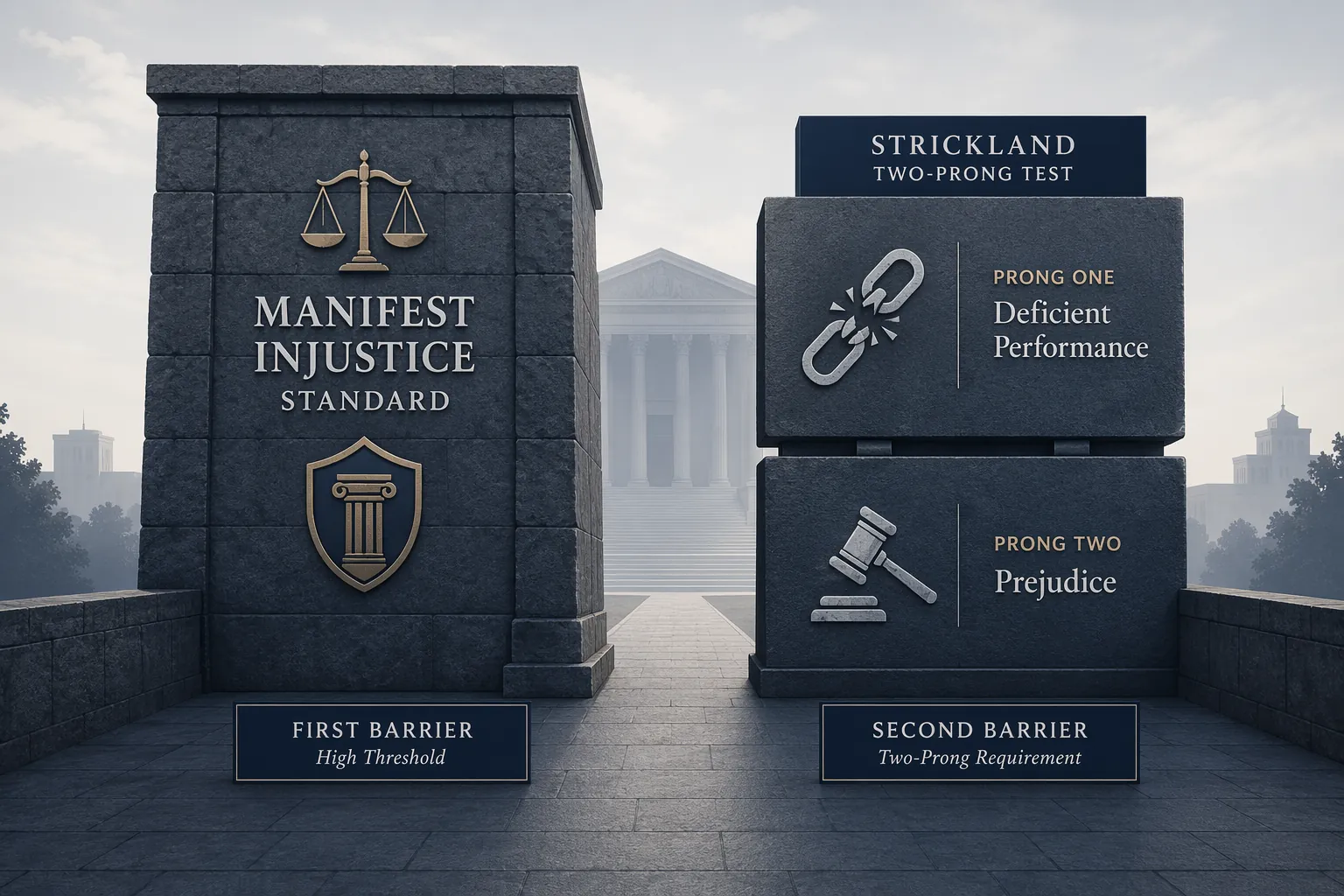
Idaho Rule 33(c)’s “manifest injustice” language does most of the work here. The rule does not ask whether withdrawal would be convenient, whether the defendant would now prefer trial, or whether the public would like to hear the evidence tested. It asks whether the court must allow withdrawal to correct an injustice serious enough to disturb a final judgment after sentencing. [2]
The burden also matters. “Preponderance of the evidence” is a lower burden than proof beyond a reasonable doubt, but it is still a burden of proof. Kohberger would need to show that his version of the defect is more likely than not. In a post-plea setting, that often means producing materials outside mere assertion: communications, testimony, contemporaneous objections, medical evidence, or other facts capable of explaining why the plea colloquy should not be credited.
The reported record leaves him with a narrow lane. If he claims false promises, he must identify who made them, what was promised, when it was promised, why it was material, and why his in-court answers did not disclose it. If he claims coercion, he must separate unlawful coercion from the ordinary pressure of a capital prosecution and a life-or-death plea decision. If he claims he is innocent, that claim must still confront his reported answer that he was pleading guilty because he was guilty.
The Strickland problem is even harder
Kohberger’s most plausible legal vehicle, at least as reported, is ineffective assistance of counsel. That claim has a familiar two-part test. Under Strickland v. Washington, a defendant must show both deficient performance by counsel and prejudice resulting from that deficiency. [7] Losing on either prong loses the claim.
Deficient performance is not measured by whether the defendant later dislikes the advice. It asks whether counsel’s work fell below the applicable professional standard. In this case, that inquiry would occur against a concrete result: a reported defense team of four experienced public defenders obtained a plea resolution that removed the death penalty and produced life without parole instead of a capital trial. [8][6]
That does not automatically prove effective assistance. A lawyer can secure a favorable sentencing outcome and still commit a constitutional error. But the result matters because it makes broad attacks on counsel’s competence difficult to sustain. The court would likely look for a specific professional failure: a material misstatement of law, failure to investigate a known defense, concealment of a consequence, unauthorized action, or some other identifiable defect tied to the plea decision.
The prejudice prong then asks whether the alleged deficiency mattered. A defendant does not obtain relief merely by identifying imperfect lawyering. He must connect the defect to the decision to plead guilty and to the reliability of the proceeding. In practical terms, Kohberger would need to persuade the court that, but for counsel’s deficient conduct, the plea would not stand under the post-sentencing standard.
That showing is hard in any serious felony case. It is harder where the plea eliminated a death-penalty exposure. The bargain itself gives the State a straightforward response: competent capital defense lawyers may reasonably recommend a plea that avoids execution, particularly when the defendant confirms under oath that he understands the agreement and is pleading guilty because he is guilty.
The attorney commentary mostly tracks the procedural record
The outside attorney assessments reported so far are useful because they are consistent with the governing record, not because they decide anything. Eric Faddis, a trial attorney, called the ineffective-assistance theory “incredulous” and said “none of the post-conviction options would be a get out of jail free card.” Boise defense attorney Edwina Elcox described the bar as “high.” [8] Criminal defense attorney David Ritter similarly emphasized the difficulty of overcoming sworn admissions. [6]
Those are professional assessments, not court findings. Still, they identify the right pressure points: Rule 33(c), the plea colloquy, and Strickland. A petition that does not supply admissible facts capable of moving those points will not become stronger because the underlying case is famous.
Charles Crafts, an Idaho defense attorney, raised the one reported point that complicates a clean dismissal narrative: he described the plea agreement as “thin” because it allegedly lacked language tying post-conviction filings to reinstatement of the death penalty. [8] That observation is worth taking seriously. Drafting can matter, especially where a plea agreement tries to define consequences for future litigation.
But a thin agreement is not the same thing as a defective plea. The post-conviction question is still whether Kohberger can prove manifest injustice or constitutionally ineffective assistance. If the agreement did not spell out every consequence of collateral litigation, that may affect arguments about risk and remedy. It does not, by itself, erase the plea colloquy or establish that counsel performed deficiently.
Garza keeps the door from being overstated, but it does not open this one
It would be too broad to say that Kohberger has no remaining rights because he entered a plea agreement or waived appellate rights. Garza v. Idaho held that prejudice is presumed when counsel disregards a defendant’s instruction to file a notice of appeal, even where the defendant signed an appeal waiver. [9] Judge Hippler reportedly cited Garza at sentencing, acknowledging that appeal waivers do not extinguish every post-conviction right. [8]
Garza matters because it prevents sloppy analysis. A waiver is not a locked vault. Some claims survive. But Garza addressed a specific failure-to-file-an-appeal scenario. It does not establish that a defendant can withdraw a guilty plea after sentencing simply by recasting regret as coercion, or by asserting ineffective assistance without satisfying Strickland and Rule 33(c).
Winning would revive the risk the plea avoided
The remedy also matters. If Kohberger somehow succeeded in withdrawing the plea, that would not mean release. Reported attorney commentary has emphasized that the original capital indictment would revive, exposing him again to the death penalty the plea deal removed. [8][6]
That downside risk is not a rhetorical flourish. It is central to why post-plea litigation in capital cases is so unforgiving. A defendant asking to undo a life-without-parole bargain may be asking to restore the very sentencing exposure his lawyers negotiated away. A court considering a plea-withdrawal request will not treat that posture as a cost-free return to pretrial litigation.
The present record points one way, with important caveats
On the reported record, Kohberger’s petition is very unlikely to succeed. The filing appears timely, and collateral rights are not extinguished merely because he pleaded guilty. But the controlling standard is manifest injustice; the burden is his; the plea colloquy reportedly contains direct admissions of guilt; and an ineffective-assistance claim must satisfy both Strickland prongs despite a defense outcome that removed the death penalty.
That is a risk assessment, not a ruling. As of July 28, 2026, the petition is one day old. No court has ruled. The State has not filed its response. The handwritten petition and plea-agreement materials are being discussed largely through reported excerpts and descriptions where direct docket inspection was not available for this analysis. If later filings attach specific evidence contradicting the plea record, the analysis would have to be updated. On what is now public, the sworn record is doing exactly what a careful plea colloquy is designed to do.
References
- Bryan Kohberger files a petition to challenge his guilty plea and conviction — NBC News
- Idaho Criminal Rules — Rule 33(c): Withdrawal of Plea of Guilty; Rule 39
- Idaho Code § 19-4901 — Justia
- Idaho Code § 19-4902 — Justia
- Bryan Kohberger says he's innocent, plans to pursue trial — Idaho Statesman
- Bryan Kohberger plans to seek post-conviction relief, sources say — Fox News
- Strickland v. Washington, 466 U.S. 668 (1984) — Justia
- Bryan Kohberger can still appeal his life sentence despite plea deal; here's how — NewsNation
- Garza v. Idaho, 586 U.S. ___ (2019) — Justia
Related records
Tool profile
Browse tool evaluations →Governing regulation
Browse the obligations tracker →Preventive workflow
Browse verification workflows →
Report a correction or tip
Spotted an outdated figure, a misstated fact, or a ruling this case record should reflect? Public comments are disabled for this content given the professional cost of a misreported case outcome, penalty amount, or rule text — use the structured correction channel instead.
Report a correction or tip for this record →